
Quick Answer
A plant extract MOQ is the smallest order quantity a supplier will produce or sell for a given specification, and it normally ranges from 1 kg for in-stock standard grades to 25 kg or more for customized specifications. MOQ is never a single number: it shifts with marker direction, assay range, stock status, packing format and document requirements. Before sending an RFQ, prepare six items in one request — botanical source, target marker or extract ratio, assay method, sample quantity, packing size and destination market — so the supplier can quote one grade instead of asking four follow-up questions. Use the Plant Extract Supplier hub as the working path, then confirm specification, COA, sample and commercial details with the supplier.
1. Why Plant Extract MOQ Varies So Much Between Suppliers
MOQ looks simple until you compare two quotes for the same botanical and find a ten-fold difference. The variation is not arbitrary; it tracks four production realities:
- Grade and assay range. A stock standard grade (e.g. 10% chlorogenic acid by HPLC) can be packed from existing inventory, so trial quantities start around 1 kg. A custom assay range or a higher purity cut requires a dedicated production run, which pushes the starting quantity to 25 kg or higher.
- Stock status. In-stock specifications ship in 1–3 working days and allow low MOQs. Out-of-stock or seasonal botanicals force a production schedule (often 7–15 working days) and a larger minimum to justify the run.
- Packing format. Drums (10–25 kg), cartons and inner foil bags each have a minimum fill size. Asking for 2 kg in a drum format may be rejected simply because the packing line does not support it.
- Document requirements. Export-ready orders need COA, specification sheet, method notes and destination-market documents. When certificates and fumigation records are required, suppliers typically expect a bulk-sized order to amortize the documentation cost.
Standardized extracts dominate the market — standardized botanical extracts accounted for roughly 60% of the plant extract market in 2025, and over half of dietary supplements rely on standardized actives — which is exactly why grade wording has to match between buyer and supplier before price is even discussed.
What Drives Plant Extract MOQ Differences
| Driver | Typical effect on MOQ | What to confirm with the supplier |
|---|---|---|
| Marker direction | Custom marker = higher MOQ | Target marker name and % range |
| Assay method | HPLC vs UV vs TLC change grade definition | Exact method and reference standard |
| Stock status | In-stock = 1 kg trial possible | Current batch availability |
| Packing format | Drum formats raise minimums | Inner bag, drum or carton size |
| Document scope | Certificate-heavy orders need bulk | Full export document list |
| Destination market | Compliance work is amortized per order | Country, port and delivery term |
2. Sample Review vs Bulk RFQ: Two Different Conversations
The most common RFQ mistake is treating sample approval and bulk quotation as one request. They answer different questions and should be sequenced. Confirm the grade on a sample first, then lock commercial terms on the bulk RFQ.
Sample Review vs Bulk RFQ
| Dimension | Sample review | Bulk RFQ |
|---|---|---|
| Main purpose | Confirm grade fit, documents and physical behavior | Confirm supply, packing, lead time and export needs |
| Buyer input | Application, target marker, sample quantity and document list | Quantity, MOQ expectation, packing size and destination market |
| Typical quantity | 10–100 g, sometimes up to 1 kg | 1 kg trial to 25 kg+ production |
| Limit | Does not prove commercial availability without RFQ details | Should follow sample or document approval when specifications are strict |
3. What Sample Types Actually Cost (and What Gets Credited)
Sample pricing is the fastest way to read a supplier’s commercial posture. Three tiers are common across the industry:
| Sample type | Typical cost | Notes |
|---|---|---|
| Stock standard sample | US$0–50 (often free, buyer pays courier) | 10–25 g, with COA; fastest way to verify grade fit |
| Custom specification sample | US$50–500 | Made to your assay range; fee usually credited against the first bulk order |
| Pre-production / pilot sample | US$100–1,000+ | Required for customized extracts, blends or new production lines |
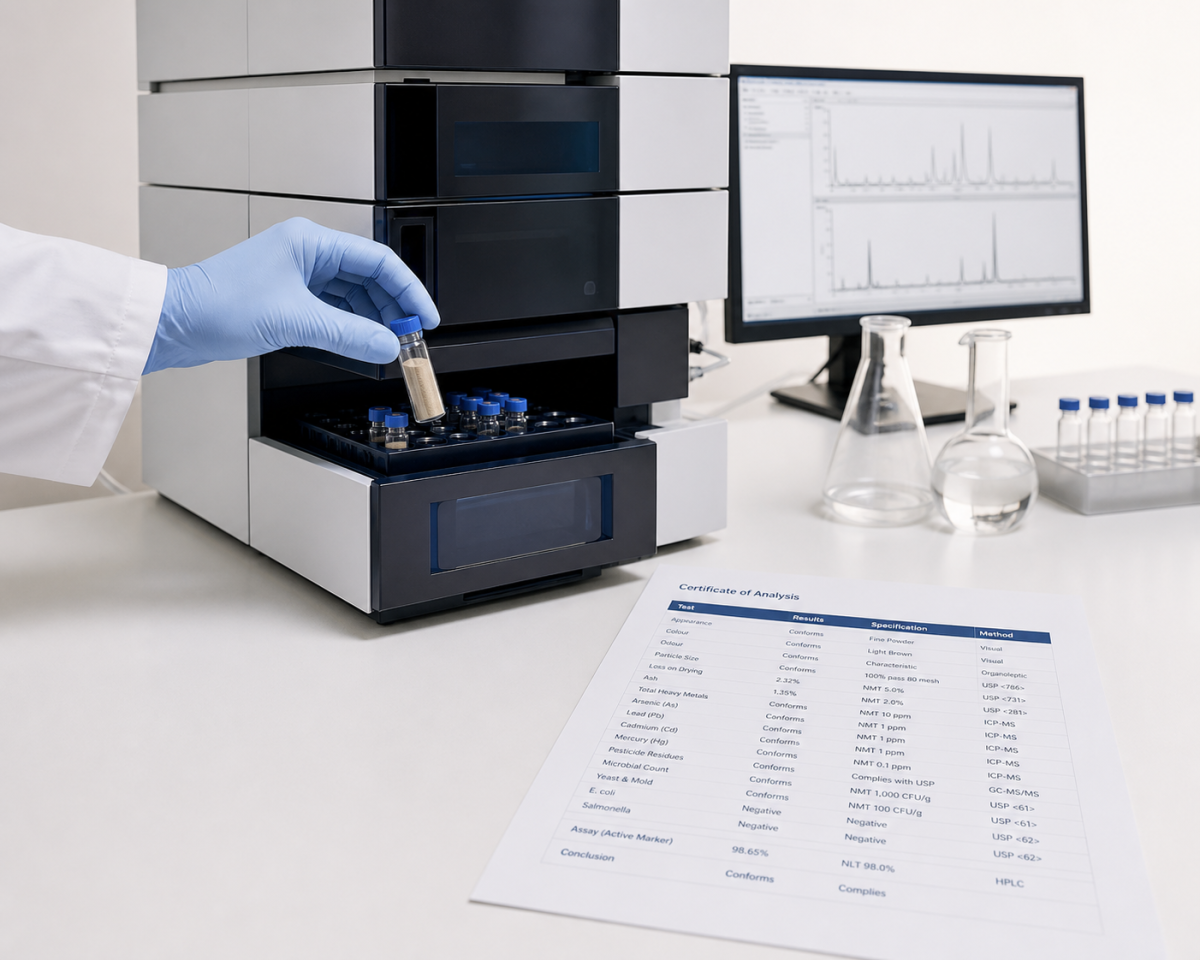
Buyers who move through a paid custom sample into a bulk order typically see the sample fee deducted from the first invoice, so the effective cost of qualifying a supplier is often close to zero. Industry sample-to-order conversion commonly lands in the 20–30% range — regard a paid sample as a strong commercial signal rather than an expense.
4. The Plant Extract Market in Numbers: Why This Checklist Matters
Sourcing decisions now sit inside a large and growing market, which means more suppliers quoting more grades — and more variance to filter.
| Metric | Value | Source |
|---|---|---|
| Global botanical extracts market, 2024 | ~US$30 billion | Global Market Insights (2025) |
| Forecast market size, 2034 | ~US$64.6 billion, ~8% CAGR | Global Market Insights (2025) |
| Standardized extracts share, 2025 | ~60% of the market | Global Growth Insights (2025) |
| China’s share of standardized extracts, 2025 | ~30% (US$3.35B) | Global Growth Insights (2025) |
| Typical trial MOQ, stock standard grade | 1 kg | Supplier benchmark |
| Typical bulk MOQ, customized spec | 25 kg+ | Supplier benchmark |
With Asia Pacific the largest regional market and China the leading producer of standardized extracts, most cross-border buyers will be comparing Chinese suppliers — where grade, assay method and document scope differ meaningfully between factories. That is precisely where a written specification checklist prevents mixed quotes.
5. The 8-Point Specification Checklist to Send With Every RFQ
Put these eight fields in one request so the supplier can quote a single grade on the first pass:
- Botanical source and plant part — Latin name and the exact part used (leaf, root, fruit, flower).
- Target marker or extract ratio — e.g. “10% chlorogenic acid” or “5:1 extract”; include the purity range, not just a single value.
- Assay method — HPLC, UV or TLC; the method changes what the COA actually proves.
- Sample quantity and approval plan — grams needed, and whether you will run independent lab verification.
- COA and document list — specification sheet, COA, method note, MSDS and export files.
- MOQ expectation — trial quantity, first order quantity and repeat order expectation.
- Packing size and label needs — inner bag, drum or carton; neutral or private label.
- Destination market and delivery term — country, port or address, and the requested Incoterm.
A complete checklist usually cuts RFQ response time from days to hours, because the supplier is not guessing which grade you mean.
6. Document Checklist: What a Clean COA and Export File Look Like
Documents are the part buyers verify after delivery, but they should be agreed before quotation. Confirm at minimum:
- Specification sheet — grade definition, marker range, assay method, particle size, loss on drying.
- COA — batch-specific values for assay, heavy metals, microbial limits, solvent residues and pesticide residues.
- Method note — how each parameter was tested, so your QA can replicate it.
- MSDS and export files — safety data sheet, certificate of origin and any phytosanitary or destination-market certificates.
For regulated markets such as the EU, buyers should also check the supplier’s food-safety and quality certifications — FSSC 22000, ISO 22000, HACCP, ISO 9001, plus Kosher/Halal where the end product requires them — and confirm the certificate covers the specific ingredient, not just the facility.
7. Packing and Shipping: Match the Format to the Order Size
Packing affects quotation, logistics and warehouse review, so align it with the destination market before asking for a price.
| Shipping method | Typical weight band | Typical transit time |
|---|---|---|
| International express (DHL / FedEx / UPS) | ≤ 50 kg | 3–5 working days |
| Air freight | 50–1,000 kg | 5–7 days |
| Sea freight | 100 kg+ (container-friendly) | 15–30 days |
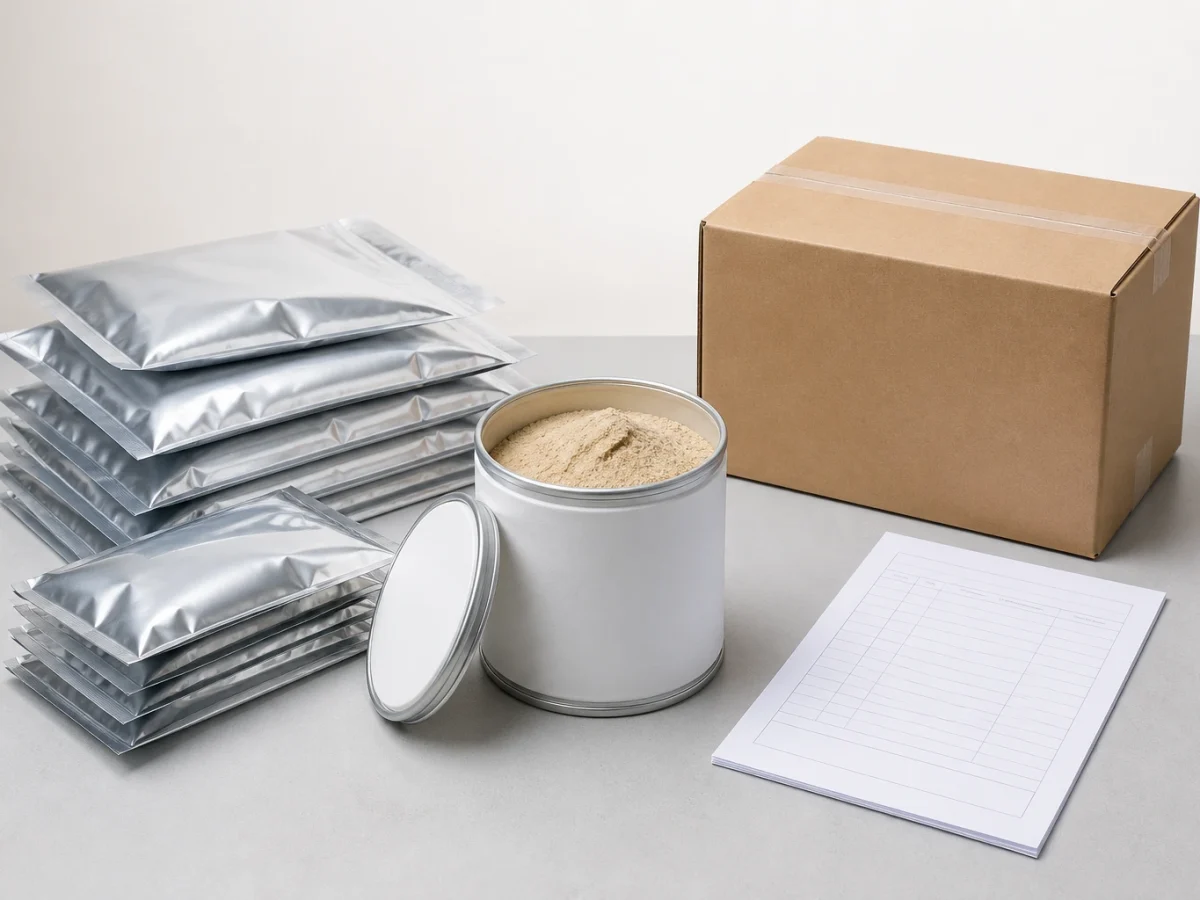
Common packing: 1 kg aluminum foil bags with an inner plastic bag for trial orders, and 10–25 kg fiber drums or cartons for bulk. If your warehouse requires a specific bag weight or pallet configuration, state it in the RFQ — repacking later adds cost and lead time.
8. When to Use a Product Page Instead of This Checklist
If the grade is already clear, skip the comparison process and go straight to a product page for assay range, COA and MOQ details:
- Chlorogenic Acid Supplier – Assay range and MOQ review.
- Ginkgo Biloba Leaf Extract Supplier – HPLC COA and packing review.
- Marigold Flower Extract Supplier – Lutein direction and MOQ review.
- Mulberry Leaf Extract Supplier – DNJ direction and packing review.
- Inulin Powder Supplier – Source, solubility and MOQ review.
Use this guide when you still need to compare assay methods, sample approval steps, documentation scope or commercial terms across multiple botanical extracts.
FAQ
MOQ changes with marker direction, assay range, stock status, packing format and document requirements. A stock standard grade can start at 1 kg, while a custom assay range or drum-based packing format typically requires 25 kg or more.
Send the application, target specification, sample status, COA needs, packing size and destination market in one request. The more complete the specification, the faster the supplier can quote a single grade.
Often yes, but buyers should separate grade, assay method and document needs for each material to keep comparison clear. Mixing grades in one request usually produces blended quotes that are hard to audit.
For a stock standard grade, 10–25 g with a COA is usually enough for preliminary verification and is often free (buyer pays courier). Custom specification samples typically cost US$50–500 and are credited against the first bulk order.
Generally yes. Suppliers who invest in a made-to-spec sample are signaling production capability and commercial intent; industry sample-to-order conversion commonly runs 20–30%.
At minimum a batch-specific COA, specification sheet, method note and MSDS, plus a certificate of origin and any destination-market certificates your customs requires. Confirm the full document list before quotation, not after delivery.
Summary
If you are comparing plant extract suppliers, confirm the source, target specification, assay method, COA fields, sample test plan, MOQ, packing and destination market before quotation. A short document checklist keeps supplier comparison faster and easier to audit. Start with the Plant Extract Supplier hub, use the Plant Extract RFQ Checklist download to structure your request, and contact HERBSEA with your specification, sample, COA and RFQ requirements.
Related Sourcing Resources
- Botanical Extract Assay Method Guide for HPLC, UV, TLC and marker wording.
- Plant Extract Specification Sheet Template for source, marker, COA and packing fields.
- Bulk Botanical Extract RFQ Checklist for quantity, MOQ, sample status and destination market.
- Ingredient Sourcing Guide Index for grouped tea powder, plant extract, fruit powder and documentation resources.
- Bulk Ingredient Sample Request Template for sample quantity, specification, COA and MOQ fields.
- Food Ingredient RFQ Template for supplier comparison, packing and quotation fields.
- Ingredient Export Documentation Checklist for COA, packing and destination-market document review.
- Ingredient Supplier Audit Checklist for supplier scope, sample control and document readiness.
Data Sources
Market sizing: Global Market Insights, *Botanical Extracts Market Report 2025–2034* (2024 market ~US$30B; 2034 forecast ~US$64.6B at ~8% CAGR). Standardized-extract share and China production share: Global Growth Insights, *Plant Extract Market Report* (2025). MOQ, sample-cost and transit-time benchmarks: aggregated supplier data from Chinese botanical extract manufacturers and export listings, 2025–2026. Figures are directional benchmarks for RFQ preparation, not quotations.