
Quick answer: Send a bulk ingredient sample request that states the exact product and target specification, the sample quantity needed for your planned tests, the document package (specification sheet + representative COA + sample lot), and the commercial path (MOQ, packing, destination market, review deadline). A structured request lets the supplier match one ingredient, one specification and one document file to your project instead of replying with a generic quotation. About 78% of B2B buyers ask for a physical sample before placing an order, and suppliers who respond to sample requests with clear documentation convert more RFQs to orders — so the quality of your request directly affects sourcing speed.
Why the Sample Request Sets the Pace of Your Whole Sourcing Project
A sample request is the first point where a supplier has enough information to regard your project as a serious sourcing candidate. Procurement teams that send a vague request (“we need some extract, send a sample”) typically receive back five different grades, five different specifications and no comparable COAs. Teams that send a structured request receive one matched grade, one specification sheet and one representative COA per candidate supplier — which is exactly what you need to compare suppliers on the same basis.
In B2B ingredient sourcing, the industry benchmark is that sample-to-order conversion runs at roughly 20–30% for well-managed sourcing programs, and the documentation you request with the sample (specification, COA, sample lot) is what allows that conversion to happen without a second round of clarification. The request template below is the tool that gets you there in one message.
Sample Request vs Product RFQ: Use the Right Document
Buyers often confuse a sample request with an RFQ. They serve different stages of the sourcing funnel. Send the sample request first when you are still screening suppliers, then graduate to a product RFQ once the ingredient and specification are locked.
| Dimension | Sample request | Product RFQ |
|---|---|---|
| Main purpose | Standardize buyer inputs before supplier comparison | Confirm product-level grade, sample, packing and quotation details |
| Best fit | Early screening, document review and internal alignment | Ready-to-quote projects with a defined ingredient target |
| What the supplier returns | Matched grade + specification + representative COA + sample offer | Firm price, MOQ, packing, lead time and quotation |
| Typical timing | Before specification freeze | After sample approval, before PO |
| Limit | Needs product details before final quotation | Works best when the buyer has a clear checklist |
Rule of thumb: if you cannot yet name the target specification or assay range, start with the sample request. If you can, go straight to the Food Ingredient RFQ Template.
The 7 Fields Every Bulk Ingredient Sample Request Must Contain
The template below maps each field to what the supplier does with it. Missing any of the seven usually costs you one extra email round-trip — or worse, a sample that does not fit your test matrix.
| # | Field | Buyer input | Why it matters |
|---|---|---|---|
| 1 | Ingredient target | Product name, botanical or food ingredient type, target grade and application | Gives the supplier a clear matching direction |
| 2 | Specification | Assay range, particle size, form, purity, carrier, target assay method | Determines which grade the supplier can offer |
| 3 | Sample plan | Sample quantity, test matrix, internal review deadline | Helps the supplier prepare a usable sample shipment |
| 4 | Destination | Shipping address, destination country and market | Sets document and compliance expectations |
| 5 | Document needs | Specification sheet, representative COA, sample lot and packing note | Connects the sample with your QA file |
| 6 | Commercial path | MOQ expectation, packing preference, lead time | Prepares the next quotation step |
| 7 | Review plan | Who evaluates the sample and by when | Lets the supplier prioritize and sequence your request |
Keep the request short, specific and attached to one sourcing file. Confirm application, target specification, sample quantity, COA fields, packing, MOQ expectation and destination market before comparing supplier replies.
How Much Sample to Request: Match Quantity to Your Test Plan
Sample size should follow the tests you actually plan to run — not a default “500 g please”. Requesting too little forces the supplier and your lab to ration material; requesting far more than needed raises freight cost and signals inexperience. Use the quantity tiers below as a benchmark for botanical extracts and food-grade powders.
| Sample quantity | What it covers | Typical use case |
|---|---|---|
| 1–5 g | Botanical identity check, visual and organoleptic review | First-pass screening of a new ingredient |
| 50–200 g | Sensory panel and basic in-house lab work | Early formulation checks |
| 500 g–2 kg | Full third-party COA testing — microbiology, heavy metals, pesticide residues | Qualification before bulk quotation |
| 5–10 kg | Application trials and real production-line tests | Beverage, powder blend or supplement prototyping |
| 25–50 kg | Retail packing trials or shelf-life testing across SKUs | Multi-SKU launch preparation |
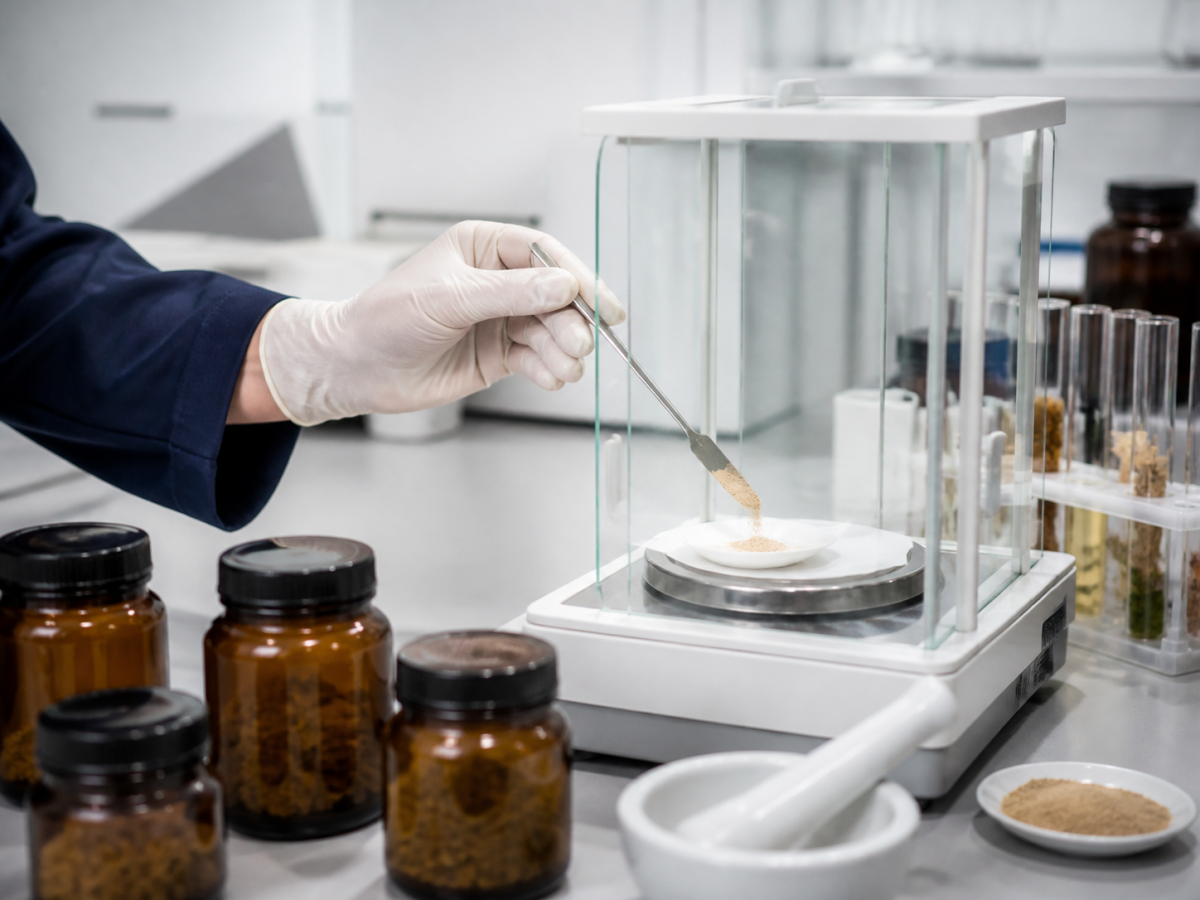
When the destination market is regulated (EU, US, Middle East), plan for 500 g–2 kg so the sample lot can support independent third-party testing. Request the sample lot number in the same message so the test result can be traced back to a specific batch.
What Samples Cost and How Long They Take
Sample cost depends on whether the material is stock, custom-blended or a pre-production run. Budget both the sample fee and the courier charge — express freight for a small parcel typically runs US$25–90 depending on weight and destination.
| Sample type | Typical cost (USD) | Typical lead time | Best used when |
|---|---|---|---|
| Stock sample (existing grade) | US$0–50, buyer usually pays freight | 1–3 days dispatch | Supplier screening, quality check |
| Custom sample (adjusted spec or carrier) | US$50–500 | 2–4 weeks | Branded or application-specific requirements |
| Pre-production sample (real materials and packing) | US$100–1,000+ | 1–3 weeks after tooling or batch scheduling | Final approval before a bulk run |
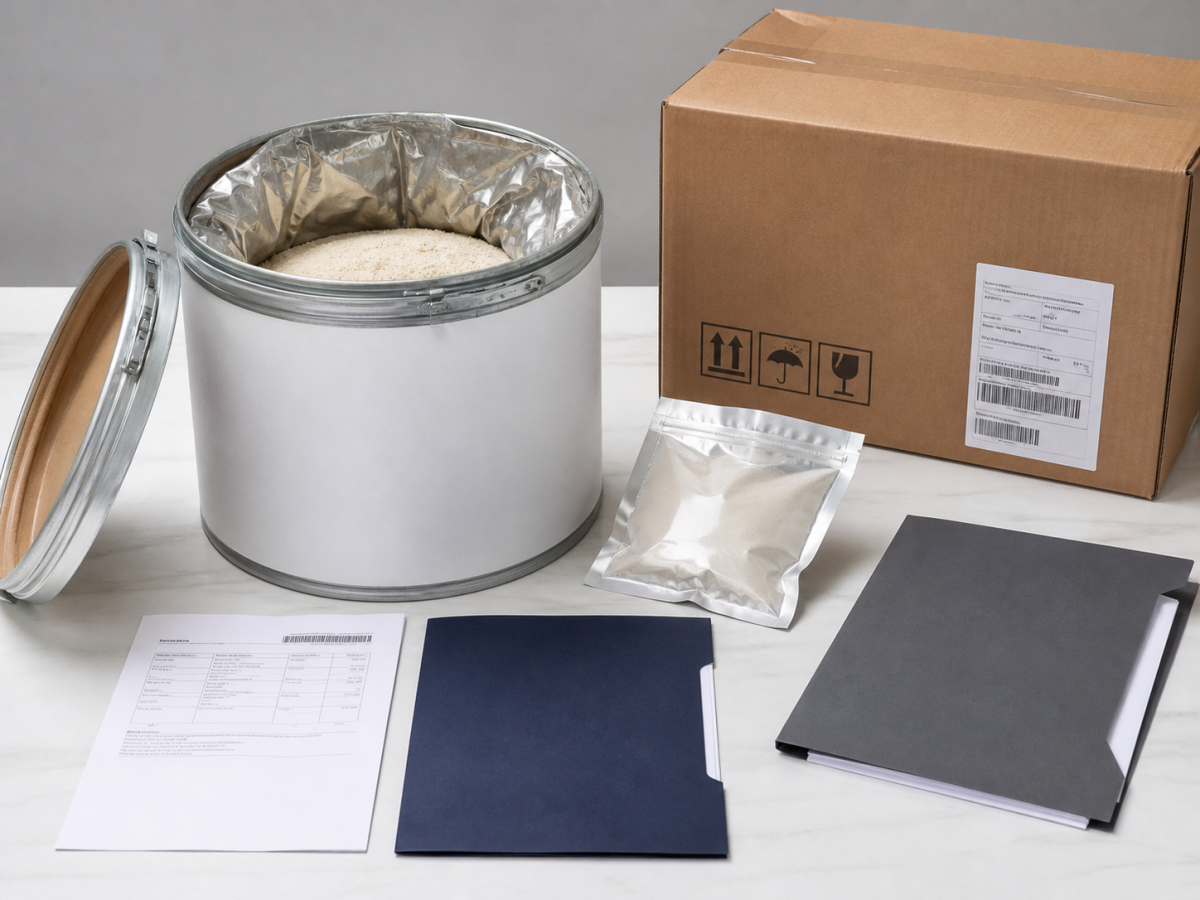
Most ingredient suppliers credit or refund a custom or pre-production sample fee against the first bulk order above the MOQ — confirm this in writing in the same message you send the sample request. Always confirm the total cost (sample fee + freight) up front so there are no surprises at dispatch.
Document Package to Request With the Sample
The sample is only useful if it arrives with the documents that let your QA team and your destination-market compliance file it. Request the following from the supplier with every bulk sample:
- Specification sheet — product name, grade, assay range, particle size, form, and target analytical method.
- Representative COA — the Certificate of Analysis covering purity, moisture, microbiological results, batch number and expiry date.
- Sample lot reference — the specific lot number the sample was drawn from, so third-party test results map back to a traceable batch.
- Packing note — inner pack (food-grade PE or foil barrier liner), outer pack (fibre drum or export carton) and net weight.
- Certification documents — as applicable to the grade: ISO 22000 / FSSC 22000, HACCP, HALAL, KOSHER, Non-GMO and Organic (USDA, EU or China organic).
For more detail on the full export file set, see the Ingredient Export Documentation Checklist.
Certification Expectations by Destination Market
The certificate file you need changes with the destination market and the end application. Align your certification requirements before you compare supplier replies so every quote is measured against the same standard.
| Certification | Typical demand signal | Common destination / segment |
|---|---|---|
| ISO 22000 / FSSC 22000 | Food-safety management baseline for international buyers | Global, retail and export programs |
| HACCP | Hazard control in production and handling | Most food-grade supply chains |
| HALAL | Market access for Muslim-majority markets | Middle East, Southeast Asia |
| KOSHER | Retail and specialty segments | US, Israel, EU kosher markets |
| Non-GMO | Increasingly required in EU and North America | Clean-label and retail brands |
| Organic (USDA / EU / CN) | Premium ingredient positioning | EU, US, China organic programs |
State the certification requirement in the sample request rather than waiting for the quotation round — organic, HALAL or KOSHER certification is often product- and source-specific and can change which grade the supplier can offer.
Market Context: Why B2B Buyers Are Structuring Sample Requests Now
Global plant extract demand continues to grow, and structured sampling is becoming the standard gate before bulk commitment. The global botanical extracts market was valued at about US$17.1 billion in 2024 and is projected to reach roughly US$18.6 billion in 2025, with most analysts forecasting a high-single-digit CAGR through the early 2030s. Standardized extracts account for about 60% of the market, and China is the leading producing origin, representing roughly 30% of the standardized-extract segment.
| Market indicator | Figure | Year |
|---|---|---|
| Global botanical extracts market | ~US$17.1B | 2024 |
| Global botanical extracts market (forecast) | ~US$18.6B | 2025 |
| Standardized extract share of market | ~60% | 2025 |
| China share of standardized-extract segment | ~30% | 2025 |
| B2B buyers who request a sample before ordering | ~78% | 2023 |
For the practical consequence: buyers who send one structured sample request per ingredient get faster, more comparable replies — and the suppliers with the right grade, COA and certification file win the order.
FAQ
Product name, target specification (grade, assay range, form), application, sample quantity, COA needs, packing request, destination address and next RFQ timing.
Yes — when QA needs to connect the sample lot with the supplier document file before bulk quotation. Ask for the specification sheet and representative COA in the same message as the sample request.
Match the quantity to the test plan: 1–5 g for identity screening, 50–200 g for sensory and basic lab work, 500 g–2 kg for full third-party COA testing, 5–10 kg for application trials and 25–50 kg for packing or shelf-life tests.
Stock samples are often free with the buyer paying freight. Custom samples typically cost US$50–500 and pre-production samples US$100–1,000+, and many suppliers credit or refund the fee against the first bulk order above the MOQ.
Use the HERBSEA contact page or the relevant product page with the sample and document checklist. Include the seven fields above so the supplier can reply with one matched grade and document package.
A sample request standardizes buyer inputs for supplier screening and document review. An RFQ confirms grade, packing, MOQ, price and lead time for a defined ingredient target — use it after the sample has been approved.
Summary
If supplier comparison is slow, standardize the buyer request first. A clear template helps HERBSEA connect the ingredient, application, sample quantity, COA, MOQ, packing and destination details into one practical quotation path — and lets you compare candidate suppliers on the same specification and the same document file.
Related HERBSEA resources to complete the sourcing path:
- Plant Extract Sample Request Guide — botanical extract sample and COA preparation
- Fruit Powder Sample Request Checklist — fruit powder color, flavor and sample lot review
- Food Ingredient RFQ Template — supplier comparison, packing and quotation fields
- Ingredient Export Documentation Checklist — COA, packing and destination-market document review
- Ingredient Supplier Audit Checklist — supplier scope, sample control and document readiness
- Contact HERBSEA — send sample quantity, application, COA and RFQ details
Browse the commercial range: Plant Extract, Fruit Powder and Instant Tea Powder product categories.
Data sources: global botanical extracts market figures from Global Growth Insights, 2024–2025; sample quantity tiers based on natural-ingredient sourcing practice guides (Arovella, 2026); sample cost and lead-time ranges from China sourcing practice reports (TopChinaSourcing, ChinaISPP, Epic Sourcing, 2026); B2B sample-before-order rate from the Alibaba Global Buyer Behavior Report, 2023; sample-to-order conversion benchmark 20–30% per B2B export practice references. Figures are indicative planning benchmarks for B2B buyers, not quotations.