
Quick Answer — What should an ingredient export documentation checklist include?
Confirm eight document and data fields in writing before the supplier prepares samples, a quotation or an order: (1) product description and specification sheet; (2) a lot-matched Certificate of Analysis (COA); (3) commercial invoice fields and packing list; (4) shipping mark and packing data (net weight, gross weight, carton or drum size, pallet details); (5) transport documents (Bill of Lading or Air Waybill); (6) destination-market certificates (health certificate, phytosanitary certificate, certificate of origin where required); (7) destination-market regulation and classification checks (HS code, residue limits, labelling); and (8) importer or broker document requests for the specific market. A complete checklist lets the supplier return one usable quotation instead of a three-round clarification loop. Send the checklist, packing and destination details via Contact HERBSEA so the sourcing file matches the ingredient, specification and document package.
1. The Eight-Document Core Export Package
Ingredient export documentation is not one certificate — it is a package that covers identity, quality, transport and destination compliance. Industry guidance lists a core set that applies to nearly every food-ingredient shipment, with food-specific certificates layered on top depending on product form and destination market (Vinaopen, 2026; Florence Firm, 2026).
| Document | Issued by | What it proves | When it matters |
|---|---|---|---|
| Commercial invoice | Exporter | Product identity, quantity, unit price, Incoterms, origin | Customs valuation and payment settlement for every shipment |
| Packing list | Exporter | Package count, net/gross weight per package, dimensions | Customs checks it against the invoice to catch mismatches |
| Bill of Lading / Air Waybill | Shipping line or airline | Receipt of goods and transport contract | Required by the importer to collect cargo at destination |
| Specification sheet | Supplier (master document) | Identity, physical/chemical limits, packing, shelf life | Baseline for every batch; the COA is tested against it |
| Certificate of Analysis (COA) | Supplier lab or third-party lab (ISO 17025 preferred) | The specific lot conforms to the specification | Per-lot evidence buyers and regulators review before release |
| Certificate of origin | Chamber of Commerce or authorized body | Country of origin; enables preferential tariffs | Required where trade agreements (RCEP, Form E, EUR.1, etc.) apply |
| Health certificate | National food-safety authority | Processed food is safe for human consumption | Most processed-food markets (EU, US, Japan, Korea, Middle East) |
| Phytosanitary certificate | National Plant Protection Organization (NPPO) | Plant-based goods are free from regulated pests | Raw and lightly processed plant products entering most markets |
The practical rule: missing or incorrect documents are one of the most common causes of customs holds and shipment delays of two to three weeks for shelf-life-sensitive goods (Food Expo Connect, 2026; Moo Software, 2026). Confirm the document set before the order, not after the container is booked.
2. Phytosanitary vs Health Certificate vs COA: Which Applies to Your Ingredient
Buyers frequently ask for “all certificates” without knowing which ones legally exist for the product form. The certificate type follows the degree of processing:
| Certificate | Product form | Typical issuer | Key timing rule |
|---|---|---|---|
| Phytosanitary certificate | Raw or lightly processed plant products (leaf, powder from whole plant) | National Plant Protection Organization (US: APHIS; EU member NPPOs; China: GAC) | Inspections are usually valid for a limited window, commonly no more than 30 days before shipping |
| Health certificate | Processed and semi-processed food (dried, milled, roasted, packaged) | National food-safety authority | Confirms compliance with the importing country’s food-safety rules |
| COA | Any commercial lot | In-house or third-party accredited lab | Issued per lot; must reference the exact batch number |
| Fumigation certificate (ISPM 15) | Shipments with wooden packing (pallets, crates) | Licensed fumigation provider | Confirms wood was heat-treated or fumigated per ISPM 15 |
Semi-processed products sometimes need both a phytosanitary and a health certificate — confirm with the exporter’s quarantine agency and the importer’s broker rather than assuming one document covers the other (Kiki’s Agroplace, 2026). For quality, buyers should never accept a “representative” COA in place of a lot-matched one; the COA must reference the exact sample or production lot being shipped.
3. COA vs Specification Sheet: Know the Difference Before You Ask
The two documents buyers most often conflate serve different purposes:
| Dimension | Specification sheet | Certificate of Analysis (COA) |
|---|---|---|
| Nature | Master document defining identity and limits | Batch evidence showing the lot met those limits |
| Validity | Stable until the spec changes | Applies only to the referenced lot |
| Fields | Assay/marker, physical properties, limits, packing, shelf life | Actual measured values for that lot, test methods, batch number |
| Who signs | Supplier quality function | Lab analyst (in-house or third-party) |
| Buyer use | RFQ baseline and supplier comparison | Pre-shipment release and import filing |
For a worked example on tea extract, see Green Tea Extract COA vs Specification Sheet. Key COA fields for most ingredient exports: lot-matched batch number; pesticide residue results against the destination market’s framework (the EU framework under Regulation (EC) 396/2005 screens on the order of 562 parameters for tea with a 0.01 mg/kg default for unlisted substances); heavy metals (lead, arsenic, cadmium, mercury); microbiology; moisture and physical properties with stated test methods; and traceability data (production date, best-before date, origin, certification numbers).

4. Destination Market Determines the Certificate Stack
The same ingredient needs different documents in different markets. Regulatory status should be part of the sourcing decision from the first inquiry, not discovered after the purchase order (Bionutricia Extract, 2026):
| Market | Key framework | Typical document asks |
|---|---|---|
| EU | Novel Food Regulation (pre-15 May 1997 use test); Regulation (EC) 396/2005 residue limits; strict labelling (batch code, origin, best-before) | COA against EU MRLs, health certificate, HACCP/ISO 22000/FSSC 22000 certificates, novel-food status statement |
| United States | GRAS / DSHEA pathways; FDA facility registration (FEI number); 21 CFR Part 111 GMP for supplements | Lot-matched COA, facility registration proof, NDI documentation where applicable, allergen/GMO statements |
| China | National food standards; new food ingredient (新食品原料) approval for non-traditional materials | COA per national standard, export enterprise filing, label per GB requirements |
| Japan / Korea | Market-specific residue lists and positive lists; food additive approvals | COA with market-specific residue fields, ingredient registration or notification |
| Gulf / Southeast Asia | Halal certification from recognized bodies (IFANCA, ESMA, JAKIM, HDC) | Halal certificate covering the exact SKU, plus COA and health certificate |
| Israel / US / EU kosher supply chains | Kosher certification (OU Kosher, Kof-K) | Kosher certificate valid for the production period of the shipped lot |
Two practical rules: (a) write the destination market into the request so the supplier quotes the right residue fields and certificates; (b) verify certificate validity for the actual production period — a certificate that lapsed six months ago turns a COA into a liability rather than assurance (Altus Exports, 2026).
5. HS Code and Tariff Classification: Confirm Before You Quote
Tariff classification decides duty, VAT treatment and the regulatory lane (inspection, quarantine, food-additive status). The same material in a different form can sit in a different chapter:
| Ingredient form | HS line (indicative) | Notes |
|---|---|---|
| Tea (green, black, flavored) | 0902 (e.g., 0902.30/0902.40 black tea) | Leaf and powder tea; export tax rebate in China varies by line |
| Instant tea powder (pure extract, no added flavor) | 1302.14 (e.g., 1302.14.00 in many schedules) | Classified as unfermented, unflavored vegetable extract |
| Other plant saps and extracts | 1302.19 (e.g., 1302.19.90) | Broad extract category; China MFN import rate ~9.5%, export rebate ~13% (indicative) |
| Flavored/formulated powders | 2106.90.90 (other food preparations) | Adding flavors, sweeteners or actives can move the classification |
Classification is not a supplier guess — final classification should be confirmed by the buyer, importer or broker for the destination market, ideally with a pre-classification ruling where volume justifies it. See the Black Tea Powder HS Code and Export Documentation Guide for a worked tea-powder example.
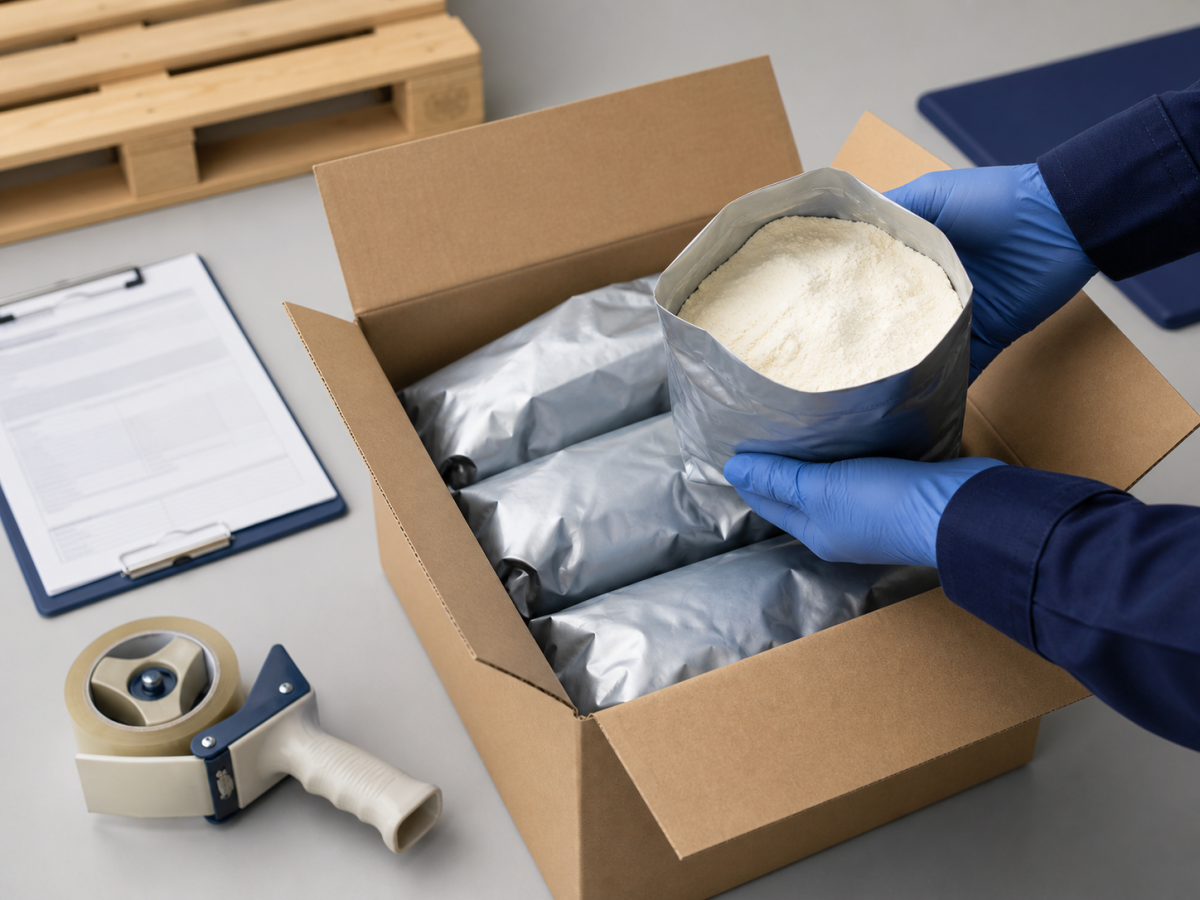
6. Packing List, Shipping Marks and ISPM 15: The Fields That Stop Freight Delays
Packing data is the most under-specified part of export documentation. Confirm these fields in the checklist so freight, import and reorder records stay consistent:
- Net weight and gross weight per package and per shipment — customs and freight quotes are built on these numbers.
- Carton or drum size — dimensions drive container loading and air-freight volumetric weight.
- Pallet information — pallet type, height, and whether wooden pallets carry an ISPM 15 mark (heat-treated or fumigated).
- Shipping marks — buyer reference, port of destination, package number and handling marks printed on each outer carton.
- Label requirements — product name, net weight, origin, batch code and best-before date per destination rules; some markets require label text in a specific language.
- Fumigation certificate — required when wooden packing is used (ISPM 15).
Label-language and best-before-date rules differ by market, so put the destination country on the checklist line-by-line rather than in free text.
7. Template Request vs Product RFQ: Send the Right Document at the Right Stage
| Dimension | Template request (sourcing file) | Product RFQ |
|---|---|---|
| Main purpose | Standardize buyer inputs before supplier comparison | Confirm product-level grade, sample, packing and quotation details |
| Best fit | Early screening, document review and internal alignment | Ready-to-quote projects with a defined ingredient target |
| Document focus | Specification sheet, representative COA, document package | Lot-matched COA, proforma invoice, packing list, export documents |
| Limit | Needs product details before final quotation | Works best when the buyer has a complete checklist |
Practical sequence: run the template request first, align the document package with the destination market, then issue the product RFQ with the approved specification attached. Industry experience puts sample-to-order conversion at roughly 20–30% — most inquiries never become orders, which is why disciplined buyers use the documentation stage to pre-qualify suppliers before any commercial commitment. Sample cost tiers follow the same logic: stock samples typically US$0–50 (often free, freight paid by buyer), custom specification-matched samples US$50–500, and pre-production samples US$100–1,000+ before bulk production.
8. Market Data: Why Documentation Readiness Is a Competitive Edge
Figures below are public industry estimates — use them for direction, not contract math.
| Data point | Value | Source / year |
|---|---|---|
| Global plant extract market | ~US$38–48 billion (2025, estimates vary by scope) | Multiple industry reports, 2025–2026 |
| China plant extract exports | ~US$8.96 billion (2025), ~36% of global trade | Industry World report, 2026 |
| Certification and testing cost share | Rose from ~4.7% (2021) to ~9.3% (2026) of total ingredient cost | Industry World report, 2026 |
| EU tea residue framework | ~562 parameters screened; 0.01 mg/kg default for unlisted substances | Regulation (EC) 396/2005 |
| Missing or incorrect documents | Customs holds / delays of 2–3 weeks on affected shipments | Food Expo Connect / Moo Software, 2026 |
| B2B sample-to-order conversion | ~20–30% of sample inquiries become orders | Industry observation, 2026 |
As regulators tighten residue limits and buyers demand traceability, documentation is moving from an administrative task to a qualification criterion. Suppliers with export-grade certification stacks (HACCP, ISO 22000, FSSC 22000, Halal, Kosher, organic where relevant) and lot-matched documentation are the ones that move from sample to bulk without re-qualification.
9. Related Sourcing Pages
- Black Tea Powder HS Code and Export Documentation Guide – Worked export-document path for tea powder buyers.
- Green Tea Extract COA vs Specification Sheet – Worked COA and specification review path.
- Instant Green Tea Powder Supplier – Example product page for sample and RFQ detail.
- Green Tea Extract Supplier – Extract-grade documentation path.
- Plant Extract Product Category – Category-level ingredient and certificate review.
- Contact HERBSEA – Send the document checklist, packing and destination details.
FAQ
Include product description, specification sheet, COA, commercial invoice fields, packing list, shipping mark, transport documents, packing data, destination-market certificates and importer or broker document requests.
Final classification should be confirmed by the buyer, importer or broker for the destination market, ideally with a pre-classification ruling for repeat shipments.
Raw plant products typically need a phytosanitary certificate from the National Plant Protection Organization; processed foods typically need a health certificate from the food-safety authority; semi-processed products sometimes need both.
EU buyers commonly ask for COA against EU residue limits, health certificates, HACCP/ISO 22000/FSSC 22000 certificates and a novel-food status statement; US buyers commonly ask for lot-matched COA, FDA facility registration proof and NDI or GRAS documentation where applicable.
Residue frameworks, label language, Halal/Kosher status and novel-food rules differ by market; the document package that passes in one market can fail in another.
Use the HERBSEA contact page with product name, destination market, packing request and document checklist.
Summary
Standardize the buyer request first: product description and specification, lot-matched COA, invoice and packing list fields, shipping marks, transport documents, destination-market certificates, classification check and importer or broker requests. A clear template helps HERBSEA connect the ingredient, application, sample, COA, MOQ, packing and destination details into one practical quotation path — and keeps the approved specification and its lot-matched COA as the reference for the first commercial batch. Contact HERBSEA for export documentation checklist, packing and destination details.
Data Sources
Data sources: Vinaopen (2026) export document set by industry; Florence Firm (2026) China export documentation guide; Kiki’s Agroplace (2026) certificate types and timing; Food Expo Connect (2026) functional-food export documentation; Moo Software (2026) food trade document coordination; Bionutricia Extract (2026) EU/US regulatory pathways; Altus Exports (2026) certification by market; Industry World report (2026) plant extract market and certification cost share; EU Regulation (EC) 396/2005 residue framework; China Customs HS reference data (indicative rates). Market figures are public industry estimates for directional use only.
Ingredient Sourcing Resource Center
- Ingredient Sourcing Guide Index for grouped tea powder, plant extract, fruit powder and documentation resources.
- Bulk Ingredient Sample Request Template for sample quantity, specification, COA and MOQ fields.
- Food Ingredient RFQ Template for supplier comparison, packing and quotation fields.
- Ingredient Export Documentation Checklist for COA, packing and destination-market document review.
- Ingredient Supplier Audit Checklist for supplier scope, sample control and document readiness.