
Quick Answer — What is the difference between a green tea extract COA and a specification sheet?
A specification sheet is the agreed contract for a grade: it lists the parameters (total polyphenols, EGCG, caffeine, moisture, ash, heavy metals, microbiology) with the limits and test methods that every batch must meet. A COA (Certificate of Analysis) is the per-batch report card: it proves that one specific lot actually met those limits, with measured values, method references, a lot number and a signature. The specification defines what to buy; the COA proves what was delivered. Review both together before samples or quotation — the specification sets expectations and the COA confirms the sample or shipment matches them. Use the Green Tea Extract product page as the commercial reference for specification, COA and sample requests.
1. Two Documents, Two Different Jobs: Know What Each One Proves
Buyers who regard the COA and specification sheet as interchangeable documents tend to make two mistakes: they approve a batch against a vague specification, or they expect a single COA to carry the full supply agreement. Each document answers a different question.
| Dimension | Specification sheet | COA (Certificate of Analysis) |
|---|---|---|
| Role | The agreed quality contract for a grade | The per-batch evidence that the grade was met |
| Issued when | Before ordering, as part of RFQ and approval | After production or testing of each lot |
| Covers | All potential batches of the defined grade | Exactly one batch (lot) of material |
| Content | Parameter limits + test methods + grade definition | Measured results + methods + lot number + signature |
| Changes | Only when the grade or agreement changes | Every batch — values vary within the spec limits |
| Validity | Long-term reference for the supply relationship | Tied to the specific lot and its shelf life |
| Who signs | Supplier QA as the committing party | Analyst/QC manager of the testing facility |
| What buyers verify | Whether the limits fit the application | Whether the numbers are inside those limits |
Practical rule: fix the specification first, then check every COA against it. A COA is meaningless without the specification it references, and a specification is unverifiable without COAs per batch (FSSC 22000 v6 and ISO 22000:2018 require documented verification that supplied products conform to specification before use, per clauses 7.1.6 and 8.5.3).
2. Read the Green Tea Extract COA Field by Field
A complete green tea extract COA covers four blocks: identification, physical and assay values, contaminant limits and document integrity. The typical ranges below are drawn from published supplier COAs and common trade practice for food-grade and supplement-grade extract (SV Botanica, 2026; ChemicalBook supplier data, 2026):
| COA block | Parameter | Typical limit on a 50% polyphenol grade | Method |
|---|---|---|---|
| Identity | Botanical name, CAS (84650-60-2 for green tea extract), part used | Camellia sinensis, leaves | TLC/HPLC identification |
| Assay | Total polyphenols | NLT 50% (up to 98% on high grades) | UV-Vis, Folin-Ciocalteu (ISO 14502-1) |
| Assay | Total catechins (EGCG+EGC+ECG+EC) | NLT 30–40% | HPLC (ISO 14502-2:2005) |
| Assay | EGCG | 20–40% typical; up to 98% on purified grades | HPLC, UV 278 nm |
| Assay | Caffeine | NMT 10% standard grade; NMT 0.5–2% decaffeinated | HPLC |
| Physical | Appearance / color | Light yellow to brownish-yellow fine powder | Visual |
| Physical | Loss on drying | NMT 5.0% | Karl Fischer / drying oven |
| Physical | Ash content | NMT 5.0% | Gravimetric |
| Physical | Particle size | NLT 95% through agreed mesh | Sieve |
| Contaminants | Lead (Pb) | NMT 3.0 ppm (tighter limits apply in the EU) | ICP-MS |
| Contaminants | Arsenic (As) / Cadmium (Cd) / Mercury (Hg) | NMT 2.0 / 1.0 / 0.2 ppm typical | ICP-MS |
| Contaminants | Pesticide residues | Compliant with EU MRL (EC) 396/2005 — roughly 562 parameters for tea, default limit 0.01 mg/kg | Multi-residue GC/LC-MS |
| Microbiology | Total plate count | NMT 1,000 CFU/g | Plate count |
| Microbiology | Yeast & mould | NMT 100 CFU/g | Plate count |
| Microbiology | E. coli, Salmonella, S. aureus | Absent / 25 g | Detection methods |
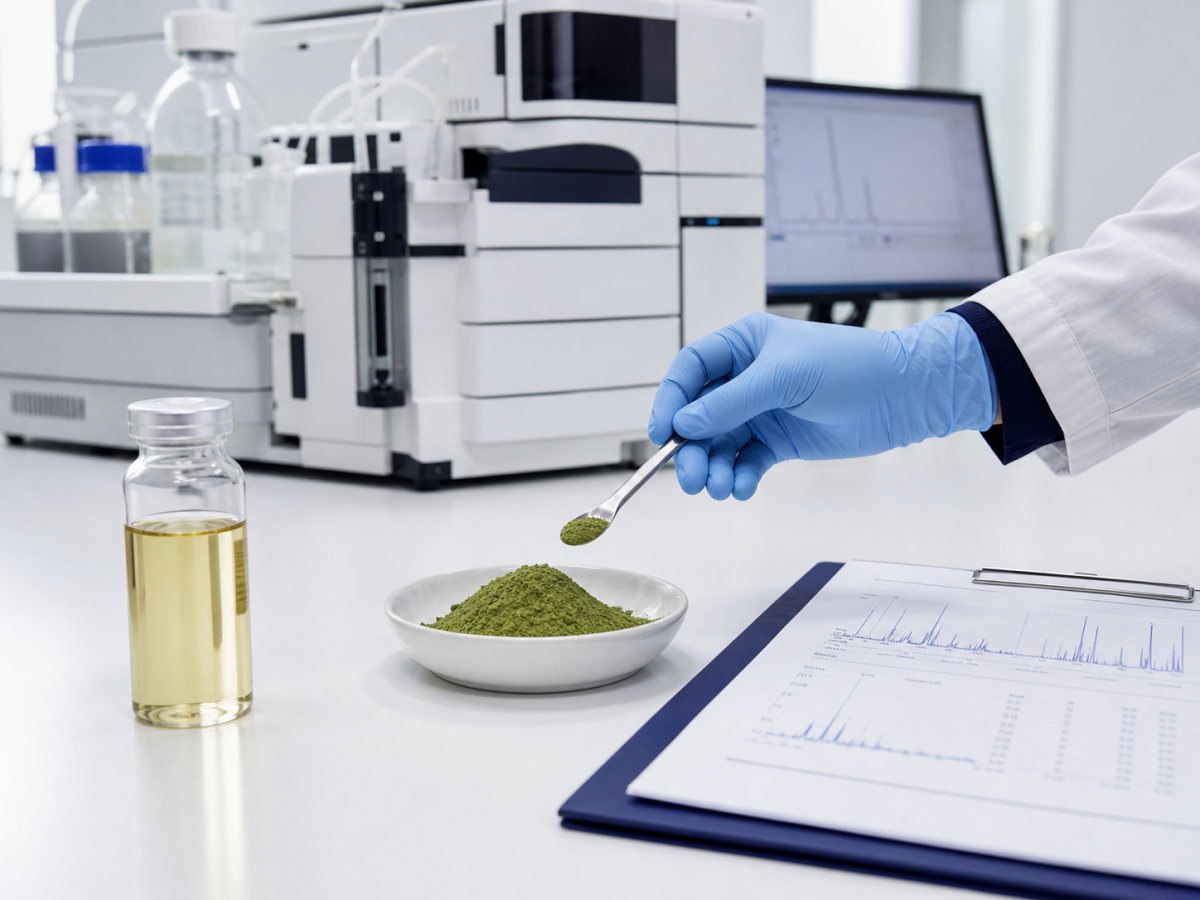
Do not accept “conforms” or “pass” in place of measured numbers on the assay, micro or heavy metal lines. A COA that shows no values, no methods and no lot number carries little evidentiary weight in a supplier audit (Bionutricia, 2026).
3. The Specification Sheet Is the Grade Contract — Match It to the Application
The specification sheet should name the marker target and the assay method, because “green tea extract” is not one specification. Total polyphenols (UV) and EGCG (HPLC) are different claims: a grade labeled 50% polyphenols typically delivers only 12–22% EGCG. Decide which marker the finished product declares, then lock the spec to it.
| Grade tier | Total polyphenols | EGCG | Caffeine | Typical fit |
|---|---|---|---|---|
| Standard food/beverage grade | ≥50% | 20–40% | NMT 10% | Functional beverage, food, cosmetic, entry-level supplement |
| High-potency supplement grade | ≥80–90% | 45–70% | NMT 10% | Capsule and tablet supplement formulation |
| Purified catechin grade | ≥95% | 90–98% | NMT 5% | High-purity EGCG ingredient projects |
| Decaffeinated grade | ≥50% | 25–50% | NMT 0.5–2% | Caffeine-sensitive formulations |
| L-Theanine grade | N/A (amino-acid marker) | N/A | Variable | Products formulated around an L-Theanine marker — separate HPLC document path |
The commercial relevance of standardized grades is backed by market data: the global green tea extract market was estimated at about US$1.8 billion in 2023 and is projected to reach roughly US$4 billion by 2030, a CAGR of about 12% (Citius Research, 2023). The narrower green tea catechins segment was valued at US$737.5 million in 2025 — EGCG holding the largest type share at 53% and dietary supplements the largest application share at 42.1% — projected to reach US$1.27 billion by 2032 at a CAGR of about 8.1% (PW Consulting, 2026). The Camellia sinensis leaf extract market reached US$562.4 million in 2024 and is forecast to grow to US$1.12 billion by 2032 at a CAGR of about 9.3% (24ChemicalResearch, 2025).
4. Certificates and Regulatory Checks to Pair with the Documents
Document review is not complete at the COA and specification sheet. For most destinations the batch documents must align with market-level requirements, and the certification tier the facility holds is a separate question from what the SKU carries.
| Destination / application | Certificate and check to request | Why it matters |
|---|---|---|
| EU food & supplements | EGCG content below 800 mg per daily portion in line with Regulation (EU) 2022/2340; EU MRL compliance against (EC) 396/2005 | Directly applicable law; label statements are mandatory |
| US dietary supplements | FDA facility registration, cGMP documentation, Prior Notice readiness | Entry compliance starts at the ingredient |
| Middle East / Southeast Asia | Halal certificate covering the exact SKU | Market access for food and beverage applications |
| Global food brands | HACCP, ISO 22000 or FSSC 22000 (GFSI-recognized) at facility level; ISO/IEC 17025 lab accreditation for testing | Retailer audit and supplier qualification standard |
| Organic claims | Organic certificate for the specific grade, not only the facility | “Organic” on a COA must match a certificate |
5. Sample Lot Linkage: Why the COA Must Match the Batch You Tested
The most common gap in green tea extract sourcing is testing one batch and approving another. The COA is only meaningful when its lot number matches the sample label, the bag tags and the shipping documents. A representative COA from a previous batch is a starting point, never an approval basis.
| Dimension | Stock sample | Custom sample | Pre-production sample |
|---|---|---|---|
| Definition | Ready-made grade, existing batch | Adjust grade/parameter to buyer input | Run from the actual production line before bulk |
| Typical cost | US$0–50 (often free, freight by buyer) | US$50–500 | US$100–1,000+ |
| Lead time | Short — available stock | Weeks, dependent on batch schedule | Tied to production slot |
| Document fit | COA of the sampled lot | COA of the custom lot | COA + full batch record |
| When used | Grade screening and physical behavior check | Specification negotiation | Scale-up and first bulk order |
Across the ingredient trade, sample-to-order conversion is typically 20–30% — most sample programs fail at the document handoff rather than at product quality (industry benchmark). Send the approved sample lot number with the bulk RFQ so the supplier quotes against the tested batch.
6. COA Red Flags That Should Stop a Purchase Review
- Lot number on the COA does not match the sample label, bag tag or packing list.
- Assay, micro or heavy metal lines show “conforms”/”pass” instead of measured values.
- Pathogen tests are missing, or reported as a count instead of “absent / 25 g”.
- No test methods referenced, so results cannot be reproduced or audited.
- Manufacture date after the test date, or an expiry that does not fit the stated shelf life.
- No signature, issue date or issuing lab — the document is unattributable.
7. The RFQ Document Checklist: What to Send with the Request
- Target marker (polyphenols, EGCG, catechins or L-Theanine) and assay method (HPLC or UV).
- Specification sheet of the grade, including limits for caffeine, moisture, ash and particle size.
- COA fields required, with the sample lot number to be matched.
- Application and process route: capsule, tablet, powder blend, beverage or food project.
- Sample quantity and test plan (50–200 g for in-house checks; 500 g–2 kg for third-party testing).
- MOQ expectation, packing size and construction (25 kg drum with inner liner, FIBC on request).
- Lead time, Incoterms and destination market, including export documents required.
- Facility and product certificates relevant to the destination (see Section 4).
8. FAQ
Check that the COA reports measured values for every parameter named on the specification sheet — assay, appearance, moisture, ash, microbiology, heavy metals and packing — and that the methods and limits match the agreed spec. The specification defines the limits; the COA proves this batch is inside them.
A clear sample-lot-to-COA connection keeps QA and procurement approval records consistent before bulk quotation. If the COA lot number differs from the tested sample, the commercial approval is not valid for the delivered batch.
Total polyphenols (UV, Folin-Ciocalteu) include catechins, tannins, flavonoids and gallic acid, so a 50% polyphenol grade typically delivers only 12–22% EGCG. A 50% EGCG grade is specifically 50% epigallocatechin-3-gallate verified by HPLC. State the EGCG figure whenever the finished product label declares EGCG.
Request EGCG content below 800 mg per daily portion in line with Regulation (EU) 2022/2340, EU MRL compliance against (EC) 396/2005, and facility food-safety certificates (HACCP, ISO 22000 or FSSC 22000) covering the exact SKU where applicable.
Use the Green Tea Extract product page and include application, target assay, method, document needs and destination market. Add the sample quantity and test plan so the supplier ships a lot you can actually evaluate.
Send the specification sheet of the target grade, the required COA fields, the destination market and the quantity together in one request. Suppliers respond faster to a complete document brief than to a product-name-only enquiry.
Summary
The specification sheet is the grade contract; the COA is the per-batch proof. Review the specification against the application first, then check every COA — sample and bulk — against the specification, with the lot number matched from sample label to shipping documents. Add the destination-market certificate set and the RFQ checklist, and green tea extract sourcing becomes a document-driven process instead of a price comparison. Contact HERBSEA for green tea extract specification, COA, samples and RFQ support.
Data Sources
Market and technical figures cited in this guide: green tea extract market US$1.8B (2023) to US$4B (2030), CAGR ~12% (Citius Research, 2023); green tea catechins US$737.5M (2025) to US$1.27B (2032), CAGR ~8.1%, EGCG 53% type share, dietary supplements 42.1% application share (PW Consulting, 2026); Camellia sinensis leaf extract US$562.4M (2024) to US$1.12B (2032), CAGR ~9.3% (24ChemicalResearch, 2025); typical COA parameter ranges and common commercial grades (SV Botanica, 2026; ChemicalBook supplier data, 2026); COA review practice and red flags (Bionutricia, 2026; Allera Technologies, 2026); FSSC 22000 v6 / ISO 22000:2018 supplier verification clauses 7.1.6 and 8.5.3; EU EGCG restriction under Regulation (EU) 2022/2340 amending (EC) 1925/2006; EU pesticide MRL framework (EC) 396/2005; HPLC catechin method ISO 14502-2:2005 and total polyphenol method ISO 14502-1. Figures are indicative for buyer reference and should be verified against current supplier COAs before specification sign-off.
Related Sourcing Pages
- Green Tea Extract product page — main page for specification, COA, samples and quotation.
- EGCG 98 Powder Supplier — adjacent high-purity catechin specification path.
- L-Theanine Green Tea Extract Supplier — adjacent HPLC documentation path.
- Instant Tea Powder Supplier hub — category-level comparison.
- Ingredient Sourcing Guide Index — grouped tea powder, plant extract and documentation resources.
- Bulk Ingredient Sample Request Template — sample quantity, specification, COA and MOQ fields.
- Food Ingredient RFQ Template — supplier comparison, packing and quotation fields.
- Ingredient Export Documentation Checklist — COA, packing and destination-market document review.
- Ingredient Supplier Audit Checklist — supplier scope, sample control and document readiness.
Contact HERBSEA with application, sample, COA and RFQ details.