
Quick Answer — What to check in green tea extract heavy metals documentation
Before you compare suppliers, ask for a batch-specific Certificate of Analysis (COA) that reports lead, arsenic, cadmium and mercury as separate numeric values in mg/kg, tested by ICP-MS (or ICP-OES with documented detection limits) — not a colorimetric “passes limit test” line. Confirm the test method, reporting unit, sample lot number and COA version, then map the values against your destination-market limit: EU food supplements (Regulation (EU) 2023/915) allow lead up to 3.0 mg/kg, cadmium 1.0 mg/kg and mercury 0.10 mg/kg; China GB 2762-2022 reference limits for tea sit at lead 5.0 mg/kg, cadmium 1.0 mg/kg, total arsenic 0.5 mg/kg and total mercury 0.3 mg/kg; USP <232> expresses limits as permitted daily exposure. A generic specification sheet is a marketing document — a lot-matched COA is release data. Use the Green Tea Extract product page as the commercial reference and send application, target assay, sample quantity, COA fields and destination market to get a usable response.
1. Why Heavy Metals Documentation Matters for Green Tea Extract
Green tea extract is a concentrated botanical: polyphenol content typically runs 50-98% and the raw leaf can be concentrated 5:1 to 10:1 before it reaches your formulation. Concentration matters for heavy metals because contaminant levels scale with the concentration factor — Camellia sinensis accumulates lead and cadmium in leaf tissue more readily than many other botanicals, and when leaves are concentrated into extract, the metal burden concentrates with them. A practical illustration from the EU supplement trade: raw leaf material at 1.8 mg/kg lead, concentrated fivefold, yields extract at roughly 9.0 mg/kg — above the 3.0 mg/kg food-supplement ceiling before it even reaches your finished product.
This is why the documentation conversation happens before the quotation conversation. Buyers who request specification, representative COA, test method and sample lot details early screen out suppliers whose quality system cannot support the destination market’s compliance evidence. QA teams, product developers and export managers should regard heavy metals documentation as part of supplier qualification, not as a post-order formality.
2. The Four-Metal Panel: What a Compliant COA Must Report
The regulatory baseline for botanical extracts is the four-metal panel:
| Element | What it is | Typical risk in tea-derived ingredients |
|---|---|---|
| Lead (Pb) | Environmental contaminant; soil and processing uptake | Highest observed element; concentration amplifies it |
| Cadmium (Cd) | Soil/fertilizer contaminant; root and leaf uptake | Leaf tissue of Camellia sinensis accumulates it |
| Arsenic (As) | Geogenic element; total vs inorganic arsenic differ | EU-bound products need inorganic arsenic speciation |
| Mercury (Hg) | Trace contaminant; lowest ceilings of the four | Lower risk, but must still be tested per batch |
A COA that reports only “total heavy metals: pass” without breaking out each element is not sufficient — mercury and arsenic can each fail independently, and a bundled figure can mask one element sitting close to its limit. Ask for individual numeric values per element with the unit (mg/kg or ppm are equivalent) and the method used.
3. Regulatory Limits by Destination Market
There is no single global limit for green tea extract heavy metals — the applicable limit depends on the finished product category and the destination market. The table below shows the limits you will most often be checked against:
| Market / framework | Lead (Pb) | Cadmium (Cd) | Arsenic (As) | Mercury (Hg) | Basis |
|---|---|---|---|---|---|
| EU food supplements — Regulation (EU) 2023/915 | 3.0 mg/kg | 1.0 mg/kg (3.0 for seaweed-based) | Inorganic As regulated by product category; speciation expected | 0.10 mg/kg | Binding maximum levels for food supplements |
| China GB 2762-2022 (tea reference limits) | 5.0 mg/kg | 1.0 mg/kg | Total As 0.5 mg/kg | 0.30 mg/kg | National food contaminant standard; confirm category |
| USP <232> dietary supplements | 10 µg/day PDE | 5 µg/day PDE | 15 µg/day PDE (inorganic) | 5 µg/day PDE | Expressed as permitted daily exposure, converted per maximum daily intake |
| California Prop 65 (lead) | 0.5 µg/day MADL | — | — | — | At a 1 g daily serving, extract should test below 0.5 mg/kg lead |
Verify the applicable category before you set a target: green tea extract destined for a dietary supplement in the EU is checked against 3.0 mg/kg lead; the same material used as a tea-based food ingredient in China is typically referenced against GB 2762-2022 tea limits; and a US brand shipping to California must model the Prop 65 lead MADL against its actual serving weight. State the buyer target limit explicitly in the RFQ so the supplier can confirm their COA covers it.
4. Test Methods: How to Tell a Defensible COA from a Weak One
The analytical method determines whether the COA number is meaningful. The table below is the comparison QA teams should run before accepting a document:
| Method | Typical detection limit | Strength | Weakness |
|---|---|---|---|
| ICP-MS (reference method) | 0.001 mg/kg (1 ppb) | Gold standard; USP <233>, EPA 200.8, EN 15763:2009; required for regulated markets | Higher instrument cost per sample |
| ICP-OES | ~0.05 mg/kg | Faster and cheaper per sample | Can report “not detected” for borderline mercury that ICP-MS would quantify |
| GFAAS (graphite furnace AAS) | ~0.02 mg/kg | Standard for lead per GB 5009.12 | Single-element; slower |
| AFS (atomic fluorescence) | As 0.010 / Hg 0.003 mg/kg | Standard for arsenic and mercury per GB 5009.11 / GB 5009.17 | Element-limited |
| CVAAS (cold vapor) | trace Hg | Mercury-specific | Single element |
| Colorimetric limit test (USP <231>-style) | 1-5 ppm | Cheap, historical | Not acceptable for regulated-market compliance — no numeric values |
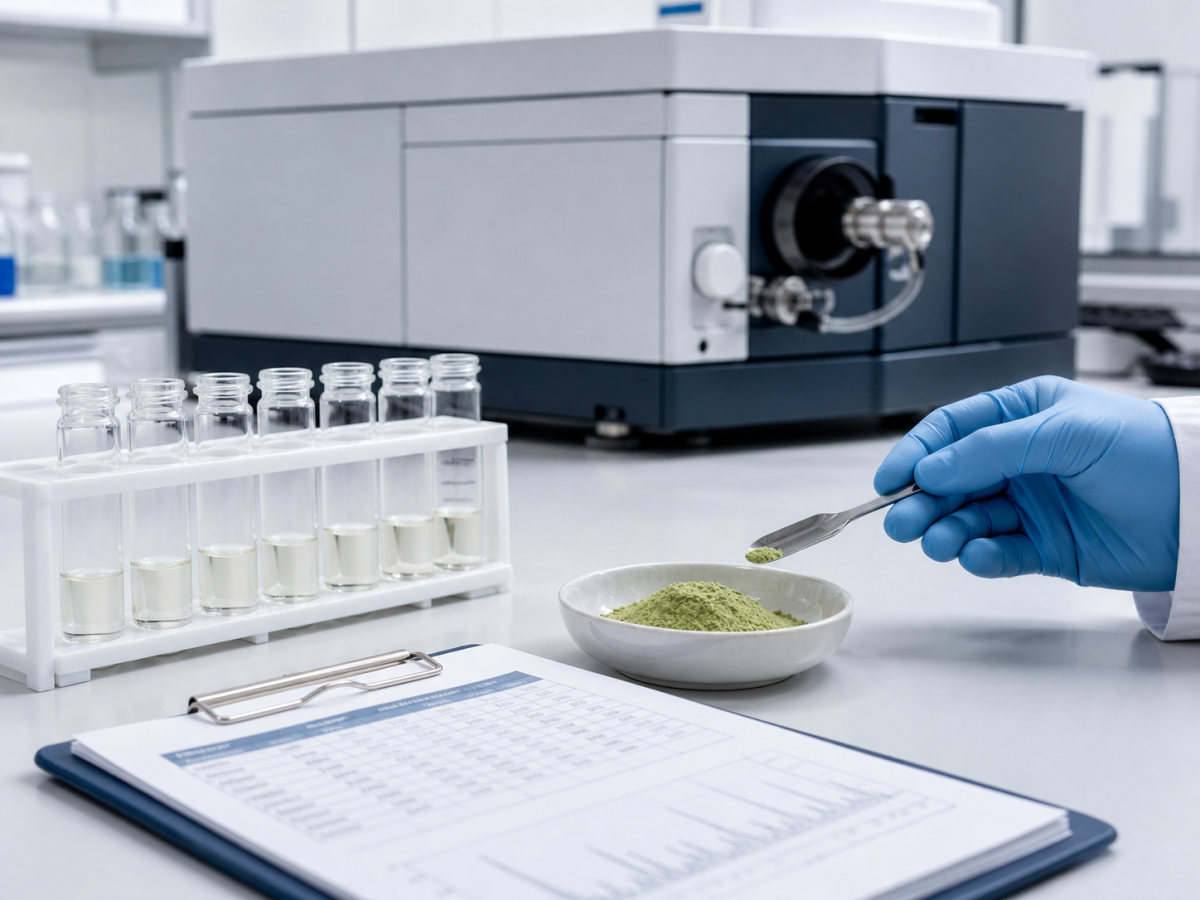
Two practical rules: (1) reject any COA that reports heavy metals as a colorimetric pass/fail with no numbers — the detection limit is too coarse for the limits above; (2) for EU-bound botanicals, request inorganic arsenic speciation (As³⁺ + As⁵⁺) by HPLC-ICP-MS per EN 16802:2016 — total arsenic alone does not satisfy the EU documentation expectation. Confirm the digestion method is documented too: for polyphenol-rich green tea extract, closed-vessel microwave digestion with nitric acid/hydrogen peroxide at above 180 °C avoids recovery suppression from gallated catechin complexes.
5. COA Review Checklist: Field by Field
Work through these fields on every green tea extract heavy metals COA before you approve a supplier:
| COA field | What to verify | Red flag |
|---|---|---|
| Batch / lot number | Matches the sample label and your RFQ reference | No lot number, or a “typical values” sheet |
| Test date & COA version | Current; within supplier’s retest interval | Undated or expired document |
| Method reference | ICP-MS per USP <233> / EN 15763:2009, or GB 5009 series | No method cited at all |
| Reporting unit | mg/kg or ppm stated for every element | Unit missing or mixed |
| Element values | Pb, As, Cd, Hg each numeric and below your target | Single bundled “total heavy metals” figure |
| LOQ / LOD | Stated; below the applicable limit | Only “less than limit” without LOQ |
| Limit basis | Cites the regulation or buyer spec used | No reference to any standard |
| Signature / lab | Accredited lab (ISO 17025 or national equivalent) | In-house test with no accreditation |
Keep the COA with the sample record: batch number, sample label, COA version and an internal review note. Traceability is what makes the approval record usable in an audit.
6. Sample Review vs Bulk RFQ: Documentation by Stage
Documentation requirements differ depending on whether you are at sample review or bulk quotation:
| Dimension | Sample review | Bulk RFQ |
|---|---|---|
| Main purpose | Check powder behavior, specification fit and document readiness | Confirm supply plan, MOQ, packing, lead time and export details |
| Heavy metals documents | Batch-specific COA for the sample lot; test method and unit confirmed | COA policy, retest interval, destination-market limits, inspection readiness |
| Buyer input | Application, sample quantity, test matrix and COA fields | Quantity, packing size, destination market and reorder expectation |
| Limit | Commercial terms confirmed later | Should follow sample and document approval when requirements are strict |
If the grade is fixed, send sample quantity, COA fields, packing request, MOQ expectation and destination market. If the grade is still open, ask for available specification options with a representative COA and sample lot details — then review the COA against Section 5 before committing.
7. Green Tea Extract Market Context for Sourcing Decisions
The sourcing context helps justify why documentation rigor matters commercially:
| Metric | Value | Source |
|---|---|---|
| Global green tea extract market, 2024 | USD 3.55 billion, ~7.1% CAGR | Data Insights Reports (2024) |
| Camellia sinensis leaf extract market, 2024 | USD 562.4 million, projected USD 1.12 billion by 2032 (9.3% CAGR) | 24ChemicalResearch (2024) |
| Regional share, Asia Pacific | ~46% of tea extract demand (2025) | PMarket Research (2025) |
| Top application | Functional food and beverage ~55% of demand (2025) | PMarket Research (2025) |
| Typical high-assay benchmark | Polyphenols ≥90%, EGCG ≥40% for premium grades | Industry testing guidance (2025) |
APAC sourcing dominates supply, which means Chinese green tea extract suppliers with export documentation experience — lot-level COAs, ICP-MS data and destination-market limit mapping — are the ones that move smoothly through EU, US and domestic qualification.
8. FAQ
Check lead, arsenic, cadmium and mercury as separate numeric values in mg/kg, tested by ICP-MS (or ICP-OES with documented detection limits). For EU-bound products, ask for inorganic arsenic speciation as well. Cross-check the values against your destination-market limit before approving the sample.
Request the specification sheet, a batch-specific representative COA, the test method with reporting unit, the sample lot number and COA version, and any buyer-specific target limit. Keep the documents with the sample approval record for traceability.
Yes, when QA approval or destination-market review depends on document readiness. A generic specification sheet is not release data — confirm the lot-matched COA and method before the quotation commits to a supply plan.
Colorimetric limit tests detect in the 1-5 ppm range, too coarse to demonstrate compliance with EU 2023/915 (lead 3.0 mg/kg) or China GB 2762-2022 (lead 5.0 mg/kg) reference levels. ICP-MS quantifies each element down to 0.001 mg/kg and is the method regulators expect.
Yes. A specification sheet describes typical values and is a marketing document; a batch-specific COA reports actual test results for the lot you are buying, with lot number, method, unit and test date. Insist on the actual result for the lot under review.
Use the Green Tea Extract product page on iherbsea.com or the HERBSEA contact form with assay target, document fields, sample request and destination market, so the supplier can respond with a usable sample and COA.
9. Summary
Align application, target specification, COA fields, sample plan, MOQ, packing, export documents and destination market before comparing suppliers. For green tea extract heavy metals, the minimum viable document set is a batch-specific COA with numeric Pb/As/Cd/Hg values by ICP-MS, a stated method and unit, a sample lot match, and a limit basis you can map to your market. Clear inputs help suppliers respond with usable samples and quotation details.
Related Resources
- Green Tea Extract Supplier — main page for heavy metals documentation and samples.
- EGCG 98 Powder Supplier — adjacent high-assay green tea extract path.
- L-Theanine Green Tea Extract Supplier — adjacent HPLC documentation path.
- Instant Tea Powder Supplier hub — category-level comparison.
- Bulk Ingredient Sample Request Template — sample quantity, specification, COA and MOQ fields.
- Food Ingredient RFQ Template — supplier comparison, packing and quotation fields.
- Ingredient Export Documentation Checklist — COA, packing and destination-market document review.
- Ingredient Supplier Audit Checklist — supplier scope, sample control and document readiness.
- Contact HERBSEA — send application, sample, COA and RFQ details.
Data sources: Regulation (EU) 2023/915 maximum levels for food supplements (FSAI, 2023; Inslab, 2024); China GB 2762-2022 contaminant limits and GB 5009 series test methods (2022-2024 testing guidance); USP <232>/<233> elemental impurity standards; California Prop 65 lead MADL guidance (Qalitex Labs, 2024); market estimates from Data Insights Reports (2024), 24ChemicalResearch (2024) and PMarket Research (2025). Limits vary by product category and destination market — confirm the applicable standard with your QA team before setting a target.