
Quick answer: Bulk black tea powder (fermented black tea in packings over 3 kg) is classified under HS 0902.40 (“other black tea”), which enters the United States duty-free (MFN: Free, per USITC 2026 HTS). Black tea in retail packings of 3 kg or less falls under 0902.30; instant tea, extracts and concentrates fall under 2101.20 (2101.20.20.10 instant tea, MFN Free). In 2024 the top three black tea exporters — Kenya, Sri Lanka and India — shipped roughly US$2.7 billion of HS 0902.40 combined, about 78% of world exports (UN Comtrade 2024). Your final code must be confirmed by your importer, broker or customs advisor for the destination market.
Preparing black tea powder export documents? Confirm product description, specification, COA, packing, shipment terms and destination requirements before you ask for samples or a quotation. This B2B sourcing guide helps purchasing, QA, product development and export teams prepare supplier questions. Use the Instant Black Tea Powder product page as the main commercial page, then confirm specification, document, sample, packing and destination details with the supplier.
The Opinion This Guide Argues
Most HS-code guides tell you “which code to use.” This one takes a different position, backed by 2024–2026 trade and customs data:
The single biggest export risk in the black tea powder trade is not the HS code itself — it is the gap between what the buyer calls the product and what the material actually is. Classification errors, customs holds and rejected shipments almost always trace back to that gap, not to a wrong tariff line.
Three facts support this view. First, “black tea powder” is a trade name that covers at least four materially different products, only one of which belongs in HS 0902. Second, China — the birthplace of tea — became a net importer of black tea in 2019, and by 2025 its black tea export value fell 20.89% year-on-year even as volume rose (China Association for the Promotion of International Agricultural Cooperation, China Black Tea Import & Export Analysis Report 2026). The low-value bulk lane that most “black tea powder” shipments travel in is the lane being squeezed. Third, the European Union’s pesticide MRL framework — 562 parameters for tea, with a default 0.01 mg/kg limit for unauthorized actives — is the largest hidden barrier in this trade, and it is decided by documentation and lab data, not by the HS code (Ningbo Customs, China Customs Gazette, December 2025).
So this guide is organized the way a buyer actually works: first classify the material correctly, then check the trade data to know what price and supply reality to expect, then assemble the documents that clear customs and the destination market. Read it once, keep it as a checklist.
1. Why “Black Tea Powder” Classification Is Confusing
“Black tea powder” can describe at least four different materials in supplier and buyer communication:
| What the buyer says | What the material actually is | Likely HS path |
|---|---|---|
| Ground black tea leaves | Fermented tea leaves milled to a powder, not water-soluble | HS 0902.30 / 0902.40 |
| Instant black tea powder | Water-soluble extract made by extraction + spray/freeze drying | HS 2101.20 |
| Black tea extract powder | Concentrated extract with carriers or higher polyphenol content | HS 2101.20 |
| Milk tea / dessert premix | Tea + sugar, creamer, flavor and other ingredients | HS 2101.20 (often higher duty if sugar-heavy) |
Customs authorities do not classify by marketing name. They look at the actual material — processing method, ingredient statement, water solubility, net weight per immediate packing — and apply the applicable tariff rules. This is where most real-world classification disputes begin. A buyer who writes “black tea powder” on an RFQ can receive a quotation for any of the four products above; a supplier who labels instant tea as “powdered black tea” on an invoice can trigger a customs re-classification, a duty assessment, or a hold at destination.
The practical rule for sourcing teams: name the material by its production process and physical behavior, not by its commercial label. Before requesting a quote, confirm with your supplier:
- Is the material made from black tea leaves, tea extract, or a blended preparation?
- Is it instant and water soluble? Does it contain sugar, carriers, creamer or flavors?
- What is the net weight per immediate packing (3 kg threshold matters)?
- Is it packed for bulk manufacturing or retail sale?
- What is the destination market, and does the buyer need food import documentation in addition to customs documents?
2. HS Code Comparison Table (Reference Only)
Below are the commonly referenced codes for black tea and tea-derived powder products, with US MFN duty rates as published in the USITC Harmonized Tariff Schedule. This table is a starting point, not a legal classification.
| HS code | Article description | Typical product | US MFN duty (2026 HTS) | Notes |
|---|---|---|---|---|
| 0902.30 | Black tea in immediate packings ≤ 3 kg | Retail-boxed black tea powder, tea bags | Free | Retail packing threshold |
| 0902.40 | Other black tea (fermented), packings > 3 kg | Bulk black tea powder, loose leaf, 25 kg cartons / drums | Free | Covers Camellia sinensis leaf and leaf powder; the code buyers most often confirm for bulk powder |
| 2101.20.20 | Extracts, essences and concentrates of tea or maté | Instant tea, tea extract powder, concentrated tea | Free | Subheading 2101.20.20.10 = instant tea |
| 2101.20.32–2101.20.58 | Preparations with a basis of tea extracts, sugar-heavy variants | Sweetened instant tea, milk tea base with sugar | 10% or 30.5¢/kg + 8.5% | Duty rises when sugar content exceeds 10% / 65% by dry weight |
| 2101.20.90 | Other preparations with a basis of tea | Other tea-based preparations | 8.5% | — |
Market-level differences to expect:
| Market | Tariff tool / system | Key reference for black tea powder |
|---|---|---|
| United States | USITC HTS | 0902.30 / 0902.40 (MFN Free); Schedule B export code 2101.20.0020 for instant tea |
| European Union | EU TARIC | 0902 40 00 (packings > 3 kg); same 0902 structure as HS |
| United Kingdom | UK Trade Tariff | Commodity 0902400000, which explicitly includes Camellia sinensis leaf powder as “other black tea” |
| China (export side) | China Customs tariff schedule | Black tea 0902.30 / 0902.40; dark tea (黑茶) has had its own tariff line since 2021, which has made dark tea exports smoother |
Note on China-origin shipments: China exported 37,410 tonnes of tea worth US$1.42 billion in 2024 (General Administration of Customs of China). Black tea exports were 24,800 tonnes (~US$172 million), and dark tea exports rose 19.8% year-on-year to 512 tonnes — the only major tea category that grew in volume, price and value simultaneously.
3. Global Black Tea Trade: 2024 Data (Why This Product Category Matters)
Data below is compiled from UN Comtrade 2024 (as reported for HS 0902.40).
| Rank | Exporting country | 2024 export value | Share of world exports | 2024 volume |
|---|---|---|---|---|
| 1 | Kenya | ~US$1.36 billion | 39.2% | ~606,300 t |
| 2 | Sri Lanka | ~US$674 million | 19.5% | ~137,400 t |
| 3 | India | ~US$667 million | 19.3% | ~221,300 t |
| 4 | China | ~US$199 million | 5.8% | — |
| 5 | Malawi | ~US$69 million | 2.0% | — |
Takeaways for buyers:
- Supply is concentrated: the top three origins control ~78% of world black tea exports, so bulk buyers should plan for origin-dependent specification and lead-time differences.
- Unit value varies by origin: Kenya’s export unit value was about US$2.24/kg in 2024, while China’s overall tea export average price fell to US$3.79/kg (down 19.8% YoY) — price alone is not a quality signal; ask for the specification and COA.
- Instant tea is a different trade lane: soluble/instant tea has its own export classification (e.g., US Schedule B 2101.20.0020), so it does not appear in HS 0902.40 volumes.
4. The 2025–2026 Market Reality: What the Latest China Data Tells Buyers
This section is based on the China Black Tea Import & Export Analysis Report (2026), released in April 2026 by the China Association for the Promotion of International Agricultural Cooperation (CAPICA, 中农促茶产业分会), and on 2025 customs statistics published by the China Tea Marketing Association (中国茶叶流通协会). Both are primary industry sources widely republished in Chinese trade media and WeChat official accounts — the kind of data a serious buyer should read before negotiating.
The headline numbers are striking, and they run against the common assumption that “China is the world’s tea leader, so Chinese black tea powder must be competitive”:
| Metric | 2025 figure | Change vs 2024 | Signal for buyers |
|---|---|---|---|
| China black tea export volume | 25,900 t | +4.48% | Volume grew, but modestly |
| China black tea export value | ~US$136 million | −20.89% | Value fell sharply — price pressure is real |
| China black tea export average price | ~US$5.26/kg | −24.29% | Price collapsed; commodity lane is crowded |
| China black tea import volume | 49,100 t | +17.28% | Imports now ~1.9× exports |
| China black tea import value | ~US$149 million | +20.74% | Import value now exceeds export value |
| Bulk packing (>3 kg) share of Chinese exports | >80% | — | Matches HS 0902.40 logic: bulk is the norm |
| Top Chinese export province | Hunan (4,817.8 t) | — | Zhejiang, Yunnan, Anhui, Shaanxi follow; top 5 >54% |
| Top destination for Chinese black tea | United States | — | Poland, Russia, Kazakhstan, Germany follow |
Three buyer-relevant conclusions follow from this table:
Conclusion 1 — China has been a net black tea importer since 2019, and the gap is widening. The report confirms that China imported 49,100 tonnes of black tea in 2025 while exporting only 25,900 tonnes. India became the largest source at 15,200 t (+142.99% YoY), followed by Sri Lanka, Kenya, Vietnam and Uganda — together >86% of imports. For a buyer this means: Chinese-origin bulk black tea powder is not a price-lower-than-everyone commodity anymore; Kenyan, Indian and Sri Lankan origins are competitive on price and scale.
Conclusion 2 — The commodity lane is being squeezed, which is an opportunity for buyers who buy on specification. The report’s own recommendation is blunt: China “cannot win a low-price war” in bulk commodities and should shift toward organic certification, flavor standardization, functional tea and specialty sub-categories. What that means on the ground: suppliers who still quote rock-bottom prices for generic bulk powder are cutting margin somewhere — quality, consistency, or documentation. The buyers who will get reliable product are those who demand the specification sheet, COA and residue report before comparing price.
Conclusion 3 — Instant and extract products are the value lane, and they are classified separately. Because >80% of Chinese black tea export volume moves in bulk leaf/powder form (HS 0902.40), the higher-value instant tea and extract products (HS 2101.20) are a distinct, less price-driven trade. If your application needs solubility, concentrate ratios or consistent flavor, you are buying 2101.20 — and the supplier qualification criteria are different (extraction process, carriers, water activity, solubility test data, batch consistency).
Global market context
For perspective, the global black tea market is large and growing. Industry market reports vary by scope, but the direction is consistent:
| Source | 2025 market size (black tea) | Growth assumption |
|---|---|---|
| Deep Market Insights | ~US$54.2 billion | 5.0% CAGR to 2031 |
| Grand View Research (black segment) | ~US$37.0 billion | 5.9% CAGR to 2033 |
| China-based investment report (inwinwn) | ~US$11.9 billion (trade-focused scope) | ~6.4% CAGR |
Whatever the exact scope, two structural trends matter for ingredient buyers: ready-to-drink (RTD) tea and functional beverages are the fastest-growing demand pools, and premiumization is splitting the market — organic and certified teas are growing faster than commodity tea. For a powder supplier, that means demand is shifting toward consistent, testable, documented ingredients rather than anonymous bulk.
The channel shift buyers should watch: new-tea and cross-border e-commerce
A separate but related development is changing who buys black tea powder and through what channel. Chinese new-tea chains have become the most effective route for establishing overseas tea demand: by the end of 2025, Mixue Bingcheng operated more than 4,400 stores outside mainland China, Chagee expanded into North America, and more than 20 Chinese new-tea brands had entered overseas markets (36Kr Global, April 2026). When Taobao’s cross-border channel opened a tea category in December 2025, sales of re-processed teas (milk tea bags, cold-brew mixes) grew more than 40% within the first months, and Keemun black tea grew about 30% year-on-year on Tmall’s first quarter. These consumer brands are industrializing tea demand: they buy standardized, large-lot, documented ingredient inputs — exactly the profile that HS 0902.40 and 2101.20 shipments serve. For an ingredient buyer, the practical consequence is that bulk black tea powder demand is no longer driven only by legacy tea-bag brands in the UK and Middle East; it is increasingly driven by beverage formulators and RTD producers who expect spec sheets, residue reports and batch consistency as standard.
5. The Hidden Barrier: EU Pesticide MRL Rules and What They Cost
If the HS code decides what your product is, the destination market’s residue rules decide whether your shipment clears at all. For black tea powder, the European Union is the strictest major market, and it is the one buyers most often underestimate.
What the EU actually requires
Under Regulation (EC) No. 396/2005, the EU maintains around 562 pesticide parameters for tea, most set at the limit of quantification (LOQ) of 0.02–0.05 mg/kg. For active substances not authorized or not listed for tea, the default MRL is 0.01 mg/kg — effectively a zero-tolerance level. Ningbo Customs (writing in the China Customs Gazette, December 2025) gives a concrete comparison: for imidacloprid, China’s MRL is 0.5 mg/kg while the EU’s is 0.05 mg/kg — a tenfold difference.
Two non-pesticide contaminants have become recurring rejection triggers:
- Anthraquinone (蒽醌): the EU set a limit of 0.02 mg/kg based on an EFSA risk assessment. Research from the team of academician Chen Zongmao (published via the Tea Research Institute, Chinese Academy of Agricultural Sciences) found that coal-fired processing can raise anthraquinone levels in tea 4.3–23.9× compared with electric heating, with exceedance rates of 50–85% for coal-processed tea versus 5–35% for electric-processed. Smoke from coal and wood combustion during drying is the dominant source — a processing-contamination issue, not a pesticide application issue.
- Pyrrolizidine alkaloids (PA) and perchlorate: monitored under EU Regulation 2023/915 (contaminants); perchlorate for tea has been cited around 0.75 mg/kg and PA at 150 µg/kg. These are contaminant limits, separate from the pesticide MRL framework.
The enforcement reality
- Since 2023, tea has been under the EU’s official enhanced control program with a ~20% sampling rate — one in five shipments can expect official sampling.
- EFSA monitoring data cited in industry analyses associate roughly 78% of EU tea shipment rejections with MRL exceedance.
- The EU has no “small shipment” exemption: even sample-sized imports are legally subject to the same limits.
What this means for buyers of black tea powder
The compliance cost is real and it changes supplier selection:
- Require a multi-residue lab report with every quotation. A COA alone is not enough for EU-bound product; ask for the actual pesticide residue test report (multi-residue method, e.g., 500+ parameters) with batch-matched sample IDs.
- Ask how the product is dried. Coal or wood-fired drying is a red flag for EU-bound tea; electric or steam drying is the safer processing route. This single question can save an entire shipment.
- Verify the default-limit logic. If a substance is not authorized in the EU, it defaults to 0.01 mg/kg. Ask the supplier to confirm their raw material is grown without EU-banned actives.
- Budget for the document layer. EU importers commonly ask for the residue report, batch traceability, and a declaration of conformity with EC 396/2005. A supplier that cannot produce these is not EU-ready regardless of price.
The same logic applies to other markets, but with different reference points: the United States relies on FDA Prior Notice and facility registration, with non-compliance of prior notice requirements accounting for roughly 23% of FDA import holds in 2023 enforcement data; Middle East markets require Halal certification; Canada requires a CFIA import licence and often a phytosanitary certificate.

6. Export Documentation Checklist (What to Request)
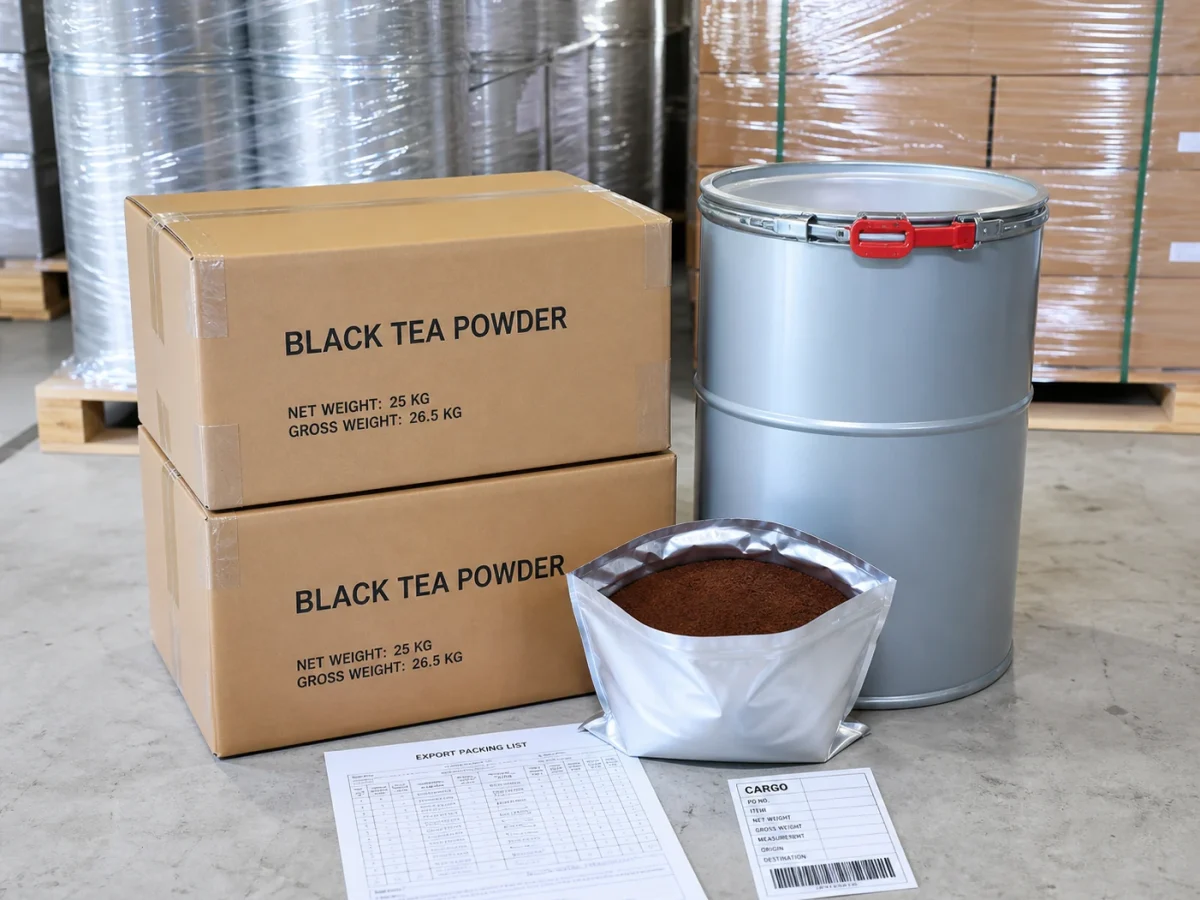
The four documents above (commercial invoice, packing list, COA and bill of lading) are the minimum standard set most B2B buyers request with every shipment.
| Document | Purpose | Issued by | Key content to verify |
|---|---|---|---|
| Commercial Invoice | Customs declaration, payment, value assessment | Exporter | Unit price, total value, HS code, Incoterms, payment terms |
| Packing List | Cargo verification, freight calculation | Exporter | Number of cartons, gross/net weight, carton dimensions |
| Certificate of Analysis (COA) | Product quality and specification evidence | Factory or third-party lab | Assay values, test methods, batch/lot number, expiry |
| Bill of Lading / Air Waybill | Title to goods, shipment record | Carrier / forwarder | Vessel/flight, ports, consignee, marks |
| Certificate of Origin | Origin claim, possible tariff preference under FTAs | Chamber of Commerce / Customs | Origin criteria, FTA article used |
| Phytosanitary Certificate | Plant quarantine compliance (market-dependent) | Export inspection authority | No quarantine pests; fumigation and disinfestation records |
| FDA Prior Notice (US) | Advance shipment notification | Importer / broker, filed via FDA PNSI | Filed before arrival; FDA Facility Registration must be current |
| Pesticide residue test report | Regulatory compliance evidence | Accredited third-party lab | Multi-residue method; see market table below |
| Halal certificate | Religious compliance (GCC / Muslim-majority markets) | Recognized Halal body | Certification scope covers the plant and the product |
| Health / Sanitary certificate | Food import clearance (some markets) | Export inspection authority | Compliance with destination food law |
A practical note on documents: in the current trade environment, the documents that decide whether a shipment clears are increasingly the data-heavy ones — the pesticide residue report, the batch traceability record and the origin certificate — not the invoice and packing list. Regard the commercial invoice as a legal record (it is), but verify the laboratory evidence with the same care you give to price.
7. Destination Market Regulatory Comparison
| Market | Key import requirements | Main rejection risk | Reference |
|---|---|---|---|
| United States | FDA facility registration (renewed every 2 years), Prior Notice via PNSI, HACCP/GMP alignment | Missing/incomplete Prior Notice; non-compliance accounted for ~23% of FDA import holds in 2023 enforcement data | FDA; third-party review of 2023 FDA data |
| European Union | Regulation (EC) 396/2005 pesticide MRLs; ~562 pesticide parameters for tea, most at 0.02–0.05 mg/kg; default MRL 0.01 mg/kg (LOD) for unauthorized actives; EC 852/2004 hygiene and traceability | MRL exceedance — reportedly ~78% of EU shipment rejections per EFSA 2023 monitoring; anthraquinone at 0.02 mg/kg is a frequent trigger; tea is under enhanced official control with ~20% sampling since 2023 | Regulation (EC) 396/2005; EFSA monitoring; Ningbo Customs trade bulletin |
| Middle East (UAE, Saudi Arabia) | Halal certification, ESMA / SFDA registration, SABER (Saudi) | No Halal certificate = no clearance | Market import rules (2024–2026) |
| Southeast Asia (Singapore, Thailand) | SFA import permit / Thai FDA food registration | Missing local label language or import license | SFA / Thai FDA |
| Canada | CFIA import licence, phytosanitary certificate | Missing plant health documents | CFIA |
Reading the table: for the EU row, note that the “78%” rejection figure and the “20% sampling” figure both come from EFSA and customs monitoring data published in 2023–2025 — they are the most frequently cited enforcement statistics in Chinese tea export guidance issued by customs authorities. For any market in this table, the buyer’s job is to ask the supplier, before the RFQ, which documents the supplier can actually produce in time for shipment.
8. Sample Review vs Bulk RFQ (When to Move Forward)
| Dimension | Sample review | Bulk RFQ |
|---|---|---|
| Main purpose | Check powder behavior, specification fit, document readiness | Confirm supply plan, MOQ, packing, lead time, export details |
| Buyer input | Application, sample quantity, test matrix, COA needs | Quantity, packing size, destination market, reorder expectation |
| Documents | Representative COA, spec sheet, allergen statement if applicable | Proforma invoice, packing options, origin certificate, test reports |
| Limit | Needs later commercial confirmation | Should follow sample and document approval when requirements are strict |
The sample stage is the buyer’s only low-cost opportunity to verify the material claims — solubility, particle size, flavor profile, residue background — before committing to a container. Use it to validate the classification question too: if the sample dissolves fully in cold water, it is likely an instant/extract product (2101.20), and the bulk RFQ should be framed around that code, not 0902.40.
9. RFQ Checklist (Copy This Into Your RFQ)
- Product description and ingredient statement (tea leaves vs extract vs premix)
- Intended application and target specification (solubility, particle size, assay)
- Destination market and broker/importer document request
- Specification sheet and representative COA
- Pesticide residue test report (multi-residue) and drying/processing method
- Packing list, invoice, shipping mark and label needs
- MOQ, lead time, shipment terms (Incoterms) and destination market
- Regulatory documents: FDA Prior Notice support (US), pesticide MRL report (EU), Halal (GCC), phytosanitary (as required)
- Sample quantity and test matrix for sample review
HERBSEA can share product and export document details, but final tariff classification should be confirmed by the buyer, broker or importer for the destination market. Bulk black tea powder most often maps to HS 0902.40; instant tea and extracts map to HS 2101.20.
Common review items include commercial invoice, packing list, specification sheet, COA, bill of lading, certificate of origin, and destination-specific documents such as FDA Prior Notice (US), pesticide residue test reports (EU) or Halal certificates (GCC and Muslim-majority markets).
0902 covers tea leaf products (even powdered); 2101.20 covers extracts, essences and concentrates of tea and preparations based on them. If the powder is water-soluble because it was extracted and dried, it is a 2101 product; if it is simply milled fermented leaf, it stays in 0902.
US HTS 0902.30 covers black tea in immediate packings of a content not exceeding 3 kg (retail-style packing); 0902.40 covers other packings, which is where bulk cartons and drums of tea powder normally fall.
According to the CAPICA China Black Tea Import & Export Analysis Report (2026), 2025 export value fell 20.89% to about US$136 million while volume rose 4.48% to 25,900 t, dragging average price down 24.29% to about US$5.26/kg. The report attributes this to low-price competition in the bulk commodity lane and recommends a shift toward organic, standardized and functional products.
The EU maintains roughly 562 pesticide parameters for tea, most at 0.02–0.05 mg/kg, with a 0.01 mg/kg default for unauthorized actives — significantly stricter than China’s tea MRLs (about 110 parameters). Anthraquinone at 0.02 mg/kg and enhanced official control (about 20% sampling since 2023) make the EU the most demanding major market for black tea powder.
Use the Instant Black Tea Powder product page or the contact form with product description, destination market, packing request and document checklist.
Summary
Before comparing suppliers, align application, target specification, COA fields, sample plan, MOQ, packing, export documents and destination market. Confirm whether your material is milled leaf (0902.40), instant tea or extract (2101.20), and which market-specific certificates your destination requires. The current trade data argues for one additional step: verify the residue test report and processing method before you compare prices, because in the EU lane especially, documentation decides whether the shipment clears. Clear inputs help suppliers respond with usable samples and quotation details.
Download or request the Tea Ingredient RFQ Checklist from HERBSEA.
Ingredient Sourcing Resource Center
Use these HERBSEA resources to keep supplier, COA, sample, MOQ, RFQ and export documentation review in one practical sourcing path.
- Ingredient Sourcing Guide Index for grouped tea powder, plant extract, fruit powder and documentation resources.
- Bulk Ingredient Sample Request Template for sample quantity, specification, COA and MOQ fields.
- Food Ingredient RFQ Template for supplier comparison, packing and quotation fields.
- Ingredient Export Documentation Checklist for COA, packing and destination-market document review.
- Ingredient Supplier Audit Checklist for supplier scope, sample control and document readiness.
Data sources: USITC 2026 Harmonized Tariff Schedule (HTS) 0902/2101; UN Comtrade 2024 (as reported via public trade-data aggregators); General Administration of Customs of China 2024–2025 tea trade statistics; China Tea Marketing Association (中国茶叶流通协会) 2025 tea export statistics; China Association for the Promotion of International Agricultural Cooperation (中农促茶产业分会) China Black Tea Import & Export Analysis Report (2026); Ningbo Customs / China Customs Gazette (December 2025) on EU technical barriers; EFSA monitoring reporting; EU Regulation (EC) 396/2005 and Regulation (EU) 2023/915; UK Trade Tariff commodity 0902400000; FDA import enforcement data as reported in 2023; destination-market import rules as summarized from public 2024–2026 sources. All tariff classifications must be confirmed with a licensed broker or importer of record.