
Quick Answer: For black tea powder used in vending drink formulation, buyers should evaluate five inputs before requesting samples or quotation: (1) vending process parameters (water temperature, mixing time, powder addition level), (2) formula matrix (sweetener, dairy, plant-base or dry-mix components), (3) target physical behavior (dispersion, sediment, color stability), (4) document set (specification sheet, representative COA, sample lot), and (5) commercial details (MOQ, packing, lead time, destination market). The global instant black tea powder market was estimated at USD 395.5 million in 2025 and is projected to reach USD 599.4 million by 2032 (CAGR 6.1%), with spray-dried grades accounting for about 61% of production. Start with the Instant Black Tea Powder product page and send vending-specific inputs so suppliers can respond with usable samples and quotation details.
1. Why Vending Drinks Need a Different Black Tea Powder Grade
Vending dispensing differs from manual brewing in three ways that change the powder specification:
- Short mixing window. A vending machine typically mixes powder and water in seconds to a few minutes. Poorly soluble powders leave clumps or undissolved particles at the nozzle.
- Fixed water temperature. Many machines run hot water at 70–90°C or offer only a single temperature setting. Cold-water-soluble (CWS) grades behave differently from hot-water grades.
- No visual QC before serving. Unlike a barista who can re-stir or discard a bad cup, a vending machine dispenses the first attempt. Sediment, color drift or foam collapse directly reaches the consumer.
The instant black tea powder segment is also growing with this channel: global hot-drink vending machine revenue was estimated at USD 75 billion in 2025 and is projected to grow at about 3.6% CAGR to roughly USD 99 billion by 2033, with tea machines holding about 28% of the hot-drink vending segment. Asia-Pacific vending installation growth, particularly for tea and herbal drinks, is projected above 10% CAGR. For buyers, this means supplier grades optimized for vending (low moisture, controlled particle size, stable dispersion) are increasingly standard rather than niche.
2. The Five Inputs That Determine Your Powder Specification
| Review point | Buyer input needed | Why it matters for vending | Example question to send |
|---|---|---|---|
| Vending process | Machine water temperature, mixing time, powder addition level, serving format | Determines whether a hot-water or cold-water-soluble grade fits; affects dispersion and sediment review | “Our machine mixes for 8 seconds at 85°C. Which grade avoids clumping and sediment at 12 g/L?” |
| Formula matrix | Sweetener, dairy, plant-base or other dry-mix components | Sugar, milk powder and acidity change color, sensory direction and physical behavior | “We blend with milk powder and sucralose. Does the powder keep color stability in a milky matrix?” |
| Sample testing | Color, odor, flow, wetting, sediment, blend behavior | Sample testing in the real matrix is the only reliable way to compare suppliers before bulk RFQ | “Can you supply 2 kg for a 3-variable test in our full formula?” |
| Document set | Specification sheet, representative COA, sample lot, packing note | Supports purchasing records and QA release before production | “Please share COA fields for polyphenols, caffeine, moisture, heavy metals and microbiology.” |
| Commercial details | MOQ expectation, packing size, lead time, destination market | Speeds supplier response and avoids rework at contract stage | “Our MOQ target is 500 kg, packed in 25 kg drums, shipped to Rotterdam.” |
3. Vending-Grade Specifications to Check Before You Compare
Not all “instant black tea powder” is the same. Typical commercial ranges for vending-oriented grades (verify against the supplier’s actual COA):
| Parameter | Typical range for vending-grade | What it means for the drink |
|---|---|---|
| Moisture | ≤ 5–6% | Low moisture avoids clumping in the powder hopper and extends shelf life |
| Particle size | 80 mesh pass ≥ 95% (or 120–200 mesh) | Finer, uniform particles dissolve faster and reduce nozzle residue |
| Caffeine | 7.0–12.0% (varies by grade) | Defines strength consistency cup-to-cup |
| Tea polyphenols | 18–35% (standard), custom higher | Drives color, astringency and sensory direction |
| pH | 4.5–6.0 | Predicts stability when blended with acidic or dairy ingredients |
| Heavy metals (as Pb) | ≤ 2.0 mg/kg | Common import-market limit; confirm against destination regulation |
| Microbiology | TPC ≤ 1,000 cfu/g; yeast & mould ≤ 50–100 cfu/g; Salmonella absent/25g | Required for food-grade import clearance in most markets |
Regulatory framing: EU Regulation (EC) 396/2005 sets roughly 562 pesticide MRL parameters for tea with a default limit of 0.01 mg/kg where no specific MRL exists — the strictest reference point for EU-bound vending programs. ISO 3720:2011 defines the minimum quality standard for black tea used as raw material. Confirm which standard the supplier’s COA references before sampling.
4. Spray-Dried vs Freeze-Dried: Which Fits Vending Economics?
| Dimension | Spray-dried | Freeze-dried |
|---|---|---|
| Solubility | Instant in hot water; CWS grades available | Instant in hot and cold water |
| Flavor / aroma retention | Good, standard processing | Superior — closer to fresh brew |
| Color | Stable, slightly deeper | Lighter, brighter infusion color |
| Cost per kg | Lower — scalable, standard in vending | Higher — premium positioning |
| Typical use | Vending, RTD, 3-in-1 mixes, foodservice bases | Premium sachets, specialty tea programs |
| Share of production | ~61% of instant tea powder output | Smaller, premium niche |
For high-volume vending programs, spray-dried standard grade is usually the value choice; reserve freeze-dried for premium or cold-brew vending lines where flavor fidelity justifies the cost.
5. Sample Review vs Bulk RFQ: When to Switch
| Dimension | Sample review | Bulk RFQ |
|---|---|---|
| Main purpose | Check powder behavior, specification fit and document readiness | Confirm supply plan, MOQ, packing, lead time and export details |
| Buyer input | Application, sample quantity, test matrix, COA needs | Quantity, packing size, destination market, reorder expectation |
| Typical cost to buyer | Stock sample: US$0–50; custom sample: US$50–500 | Pre-production / pilot lot: US$100–1,000+ |
| Decision gate | Sample approval in the vending matrix | Bulk order only after sample and document approval |
| Limit | Commercial terms still unconfirmed | Should follow sample and document approval for strict requirements |
Industry experience puts sample-to-order conversion for food ingredients around 20–30% — meaning roughly one in four or five sample requests converts to a bulk order. That makes the sample stage the highest-leverage point: test the real matrix, not just a glass of hot water.
6. Market Context: How Big Is This Sourcing Category?
| Data point | Figure | Source / year |
|---|---|---|
| Global instant black tea powder market | USD 395.5M (2025) → USD 599.4M (2032), CAGR 6.1% | pmarketresearch.com, 2025 |
| Spray drying share of production | ~61.2% | pmarketresearch.com, 2025 |
| RTD beverages share of application | ~47.1% | pmarketresearch.com, 2025 |
| Global hot-drink vending machine market | USD 75.0B (2025) → USD 99.1B (2033), CAGR 3.6% | archivemarketresearch.com, 2025 |
| Tea machines share of hot-drink vending | ~28.3% | dataintelo.com, 2025 |
| Global black tea exports (top exporters) | Kenya US$1.36B, Sri Lanka US$674M, India US$667M (top 3 ≈ 78% of total) | UN Comtrade 2024 |
| China tea exports | 374.1 thousand tonnes / US$1.42B (black tea 24.8 thousand tonnes) | China Customs 2024 |
Buyers can use this table to justify vending-line investment and to benchmark supplier origin and export readiness.
7. RFQ Checklist for Vending Drink Black Tea Powder
Before you send the RFQ, confirm each line is answered:
- Vending machine process route (temperature, mixing time, addition level).
- Formula matrix and powder addition level (sweetener, dairy, plant-base components).
- Solubility, sediment, color and sensory target (with pass/fail criteria).
- COA and specification sheet needs (polyphenols, caffeine, moisture, heavy metals, microbiology).
- Regulatory reference (EU MRL 396/2005, ISO 3720, destination-market import rules).
- MOQ, packing size and destination market.
8. FAQ
The five highest-impact inputs are vending process parameters, formula matrix, target physical behavior (dispersion, sediment, color), the document set (spec, COA, sample lot), and commercial details (MOQ, packing, destination). Dispersion and sediment in the actual machine matter more than any single lab value.
Yes. Sweetener, dairy, plant-base ingredients and machine process all change visible powder behavior. A glass-of-water test can approve a powder that fails in the full formula. Budget 2 kg or more per candidate for a multi-variable test.
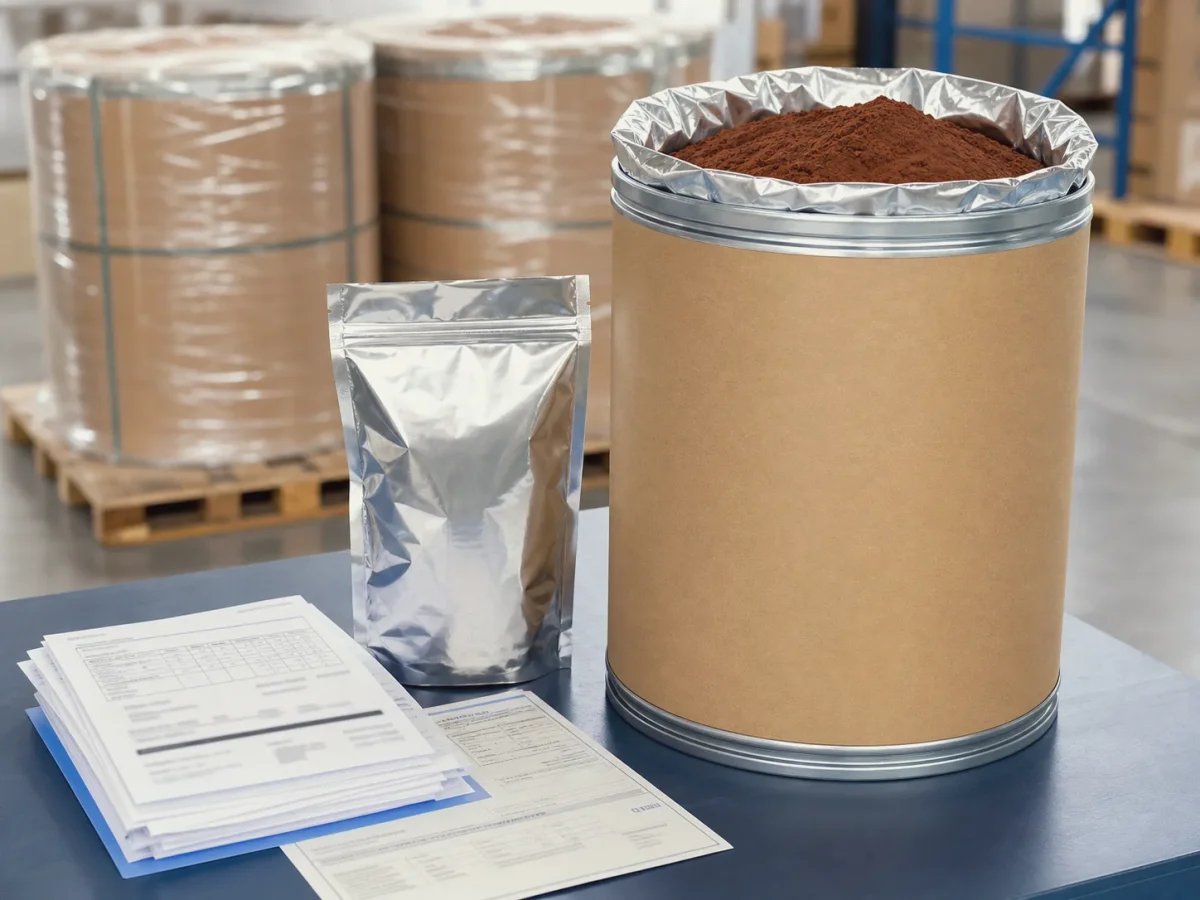
Commercial MOQs commonly start around 250–500 kg for standard vending grades, with mixed-container options available for smaller programs. Confirm packing (commonly 20–25 kg drums or foil-lined bags) and lead time (typically 7–15 days after confirmation for stock grades).
A representative COA with polyphenols, caffeine, moisture, heavy metals and microbiology; a specification sheet; packing list and origin documents; plus certifications such as ISO 9001, ISO 22000, HACCP, Halal, Kosher or USDA Organic depending on destination market.
Not always — but destinations with organic labeling programs or retailers with sustainability requirements often ask for USDA Organic or EU Organic certification. Confirm the certification set against the destination market before sampling, because organic grades carry a price premium.
Typical flow: sample request (1–3 days for stock), lab test in matrix (1–2 weeks), sample approval, bulk RFQ and quotation (1 week), production and shipment (2–4 weeks depending on grade and destination). Start 8–12 weeks before the planned launch for a new vending program.
Summary
Before comparing suppliers, align five inputs: application (vending process), target specification (dispersion, sediment, color, sensory), document set (spec, COA, sample lot), sample plan (real matrix testing), and commercial terms (MOQ, packing, lead time, destination market). Clear inputs help suppliers respond with usable samples and quotation details — and they convert to bulk orders at meaningfully higher rates.
Related HERBSEA Sourcing Resources
- Instant Black Tea Powder Supplier – Main commercial page for vending drink black tea powder samples and quotation.
- Instant Green Tea Powder Supplier – Adjacent vending drink tea powder path.
- Bulk Matcha Powder Supplier – Adjacent green tea dry-mix path.
- Instant Tea Powder Supplier hub – Category-level comparison across tea powders.
- Ingredient Sourcing Guide Index – Grouped tea powder, plant extract, fruit powder and documentation resources.
- Bulk Ingredient Sample Request Template – Sample quantity, specification, COA and MOQ fields.
- Food Ingredient RFQ Template – Supplier comparison, packing and quotation fields.
- Ingredient Export Documentation Checklist – COA, packing and destination-market document review.
- Ingredient Supplier Audit Checklist – Supplier scope, sample control and document readiness.
- Contact HERBSEA – Send application, sample, COA and RFQ details.
Data Sources
Market and specification figures cited from pmarketresearch.com (2025), archivemarketresearch.com (2025), dataintelo.com (2025), UN Comtrade (2024), China Customs (2024) and published supplier COA ranges. Figures are directional benchmarks, not quotations; confirm all values against the supplier’s current COA and the destination market’s regulations.