
Fruit Powder Sample Request Checklist: Fields, Quantity, COA and MOQ to Confirm Before RFQ
Quick Answer — What should a fruit powder sample request include?
Confirm six fields in writing before the supplier prepares a lot: (1) finished application and process route (beverage, bakery, dairy, dry mix or food-service); (2) physical targets — color, flavor, solubility, flow and blend behavior; (3) specification and COA needs (assay, moisture, mesh, microbiology, residues); (4) sample quantity sized to your test plan (50–200 g for sensory, 500 g–2 kg for full third-party testing); (5) destination address and review timeline; and (6) commercial expectations — MOQ, packing size, lead time and destination market. A precise request returns a usable sample and an accurate quotation in one round; a vague one starts a three-round clarification loop. Use the Fruit Powder Supplier hub as the commercial page, then send application, sample, COA and RFQ details via Contact HERBSEA.
1. Six Fields Every Fruit Powder Sample Request Must Cover
Fruit powder is not one commodity — it is a family of grades defined by fruit type, drying technology (spray-dried vs freeze-dried), carrier content and particle size. The same strawberry powder can be quoted at very different prices depending on whether it is 100% fruit or carries maltodextrin. Cover these six fields so the supplier prepares the right lot the first time:
| Review point | Buyer input | Why it matters |
|---|---|---|
| Application | Beverage, bakery, snack, dairy, powder blend or food-service project | Controls color, flavor and powder-behavior priorities |
| Powder behavior | Solubility, dispersion, color, flavor impact, flow and blend behavior | These points decide sample approval |
| Document set | Specification sheet, representative COA, packing note and export files | Helps QA connect the sample with supplier records |
| Sample plan | Sample quantity, test matrix, destination address and review timeline | Clear inputs help the supplier prepare a useful lot |
| Commercial path | MOQ expectation, packing size, lead time and destination market | Prepares quotation after sample approval |
| Compliance | Certificates covering the exact SKU (HACCP, ISO 22000, FSSC 22000, Halal, Kosher, organic) | Prevents a sample that cannot legally enter your market |
Use this guide as a pre-RFQ worksheet. If the specification is fixed, send the target assay, powder behavior and document list first. If the grade is still open, ask for available specification options with a representative COA and sample lot details.
2. Sample Review vs Bulk RFQ: Send the Right Request at the Right Time
Many buyers collapse the sample stage into the quotation stage and get neither. Samples verify physical behavior and document fit; RFQs verify commercial supply. Keep them separate:
| Dimension | Sample review | Bulk RFQ |
|---|---|---|
| Main purpose | Check physical behavior, document fit and application match | Confirm commercial supply, packing, lead time and export needs |
| Buyer input | Application, sample quantity, target specification and COA needs | Quantity, MOQ expectation, packing size and destination market |
| Document focus | Lot-matched COA, specification sheet, certificates covering the SKU | Proforma invoice, packing list, export documents, certificate validity |
| Limit | Needs later commercial confirmation | Should follow document or sample approval when the specification is strict |
Practical rule: request the sample first, evaluate it in your own matrix, then send the RFQ with the approved sample lot number attached. Industry experience puts sample-to-order conversion at roughly 20–30% — most inquiries never become orders, which is exactly why disciplined buyers use the sample stage to pre-qualify suppliers before any commercial commitment.
3. How Much Fruit Powder Sample to Request
Sample quantity should follow your test plan, not a round number. Under-ordering forces a second sample round; over-ordering is freight waste. A common industry rule of thumb: 1–5 g for identity and basic visual checks, 50–200 g for sensory panels and basic in-house lab work, and 500 g–2 kg when the sample must support full third-party testing including microbiology, heavy metals and pesticide residues (Arovela, 2026). Many fruit powder suppliers quote 1–5 kg per variant for qualified buyers so the same lot covers both bench work and a small pilot run.
| Test purpose | Suggested quantity | What it verifies |
|---|---|---|
| Identity, color and aroma check | 1–5 g | Fruit type, drying technology, visual and olfactory screening |
| Sensory panel and in-house lab | 50–200 g | Color, flavor, solubility, flow, blend behavior in your recipe |
| Full third-party COA testing | 500 g–2 kg | Microbiology, heavy metals, pesticide residues, label claim support |
| Pilot / production trial | 1–5 kg per variant | Performance in the actual line, storage and scale-up behavior |
State the quantity and the test matrix in the request. A supplier that asks “what will you test with this?” is a better qualification signal than one that ships the smallest free pouch.
4. Documents That Must Travel With the Sample
A sample without documents is a rumor. Require the document set below so your QA can connect the physical lot to supplier records:
- Specification sheet — fruit type, process (spray- or freeze-dried), carrier percentage, assay/ratio, moisture, particle size, solubility.
- Lot-matched COA — batch number, production and best-before dates, physical, chemical and microbiological fields. A representative COA from another lot is a starting point only; the COA must match the sample lot number.
- Certificate copies — facility food-safety certificates (HACCP, ISO 22000, FSSC 22000 — the GFSI-recognized tier many retailers require) and market certificates (Halal, Kosher, organic) that cover the exact SKU, not just the facility.
- Packing note — inner/outer packing, net weight, desiccant policy and moisture-barrier construction.
- Export files — FDA facility registration and Prior Notice readiness for US entry, health or phytosanitary certificate for other destinations, country of origin.
Red flags in the sample stage: a supplier that refuses samples, charges an unusual courier fee for a 1 kg parcel, sends a generic COA with no batch number, or ships an unlabeled bag (Nutrisikakao, 2026). Any of these is a qualification signal to weigh before scaling up.
5. Sample Types and What They Cost
| Sample type | Typical cost | Best use |
|---|---|---|
| Stock sample | US$0–50 (often free, freight paid by buyer) | Screen color, flavor, solubility and physical behavior; first-fit check |
| Custom sample | US$50–500 | Specification-matched lot — target assay, mesh, moisture, carrier percentage |
| Pre-production sample | US$100–1,000+ | Approval before bulk production; ties the lot to your quoted specification |
Expect the sample itself to be free or at a nominal handling fee for qualified buyers, with courier shipping typically paid by the buyer; many suppliers refund the sample cost against the first order. Delivery is commonly 3–7 working days by express courier. Keep the sample COA and lot number on file so the first bulk shipment can be compared against the approved lot.
6. How to Evaluate the Sample Before Approval
Testing the powder in your final matrix is the step most sample programs skip — and the one that prevents the most bulk-order surprises. Sweetener, acid, dairy, heat and dry-mix conditions can all change visible performance:
- Visual and olfactory check — color uniformity, no light/dark patches, no off-odors (musty, moldy, chemical).
- Dry-powder check — particle size and flow, no lumps or foreign matter, dust level.
- Application test — mix the powder exactly as production will: hot or cold liquid, dairy or plant base, heat step, dry blend. Evaluate dispersibility, clumping, settling, color shift and flavor impact.
- Benchmark — compare against your current supplier or retained standard, and document results for a go/no-go record.
- Storage check — because fruit powders are hygroscopic, note how the sample behaves after open exposure: moisture uptake and caking behavior tell you what packing and handling the bulk lot will need.
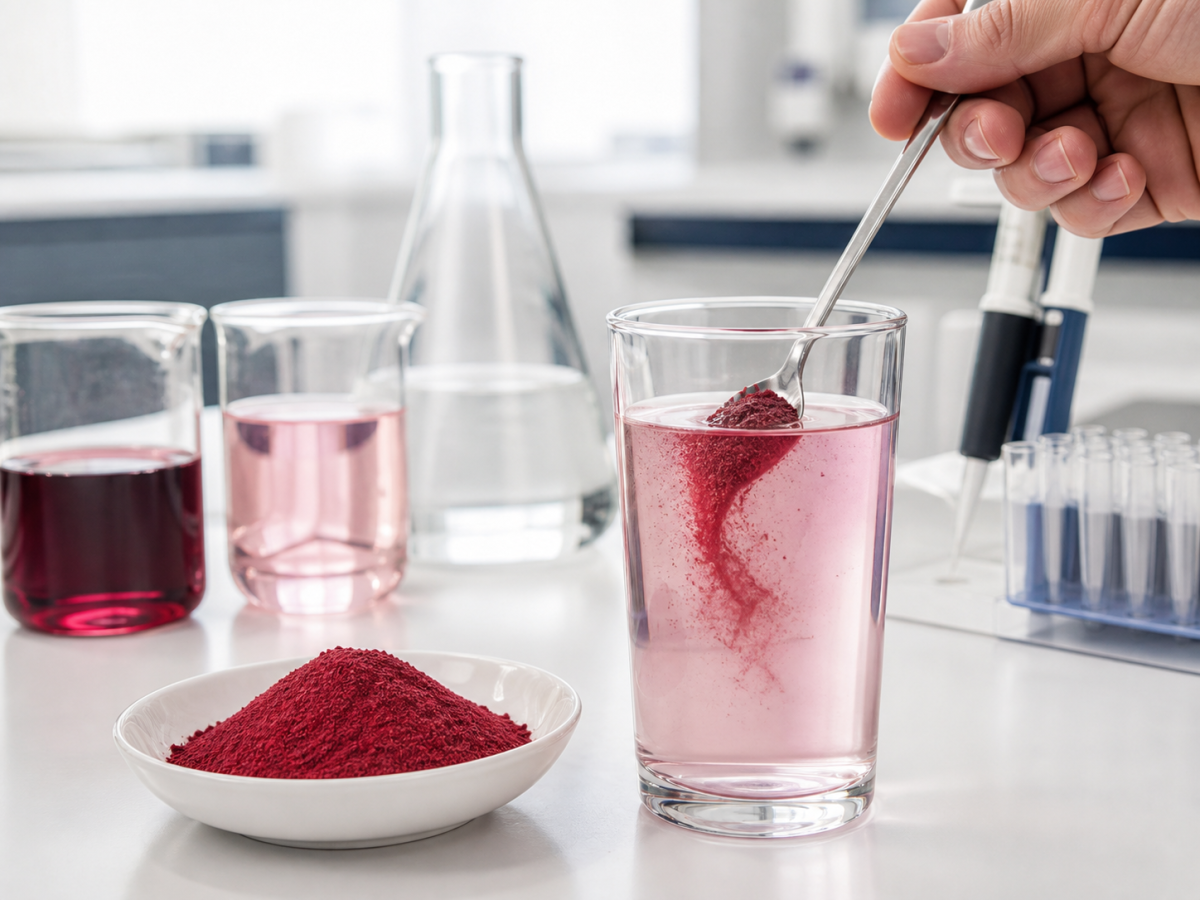
Write the approval standard down: product name, format, target particle size, acceptable color range, dust limit, packing type and document requirements. Keep the approved sample and its COA as the reference for the first commercial batch — “everyone liked the sample” is not a specification.
7. From Sample Approval to Bulk RFQ: MOQ, Packing and Lead Time
| Commercial field | What to confirm | Typical range / guidance |
|---|---|---|
| MOQ | Per SKU, per production run | Often 25 kg to 500 kg for stock grades; higher for custom or pre-production runs |
| Packing size | Inner and outer packing | 1–25 kg moisture-barrier foil bags inside cartons or drums; 25 kg is the common export unit |
| Lead time | Stock vs production lead | Stock 3–7 working days; production 2–4 weeks depending on volume and season |
| Destination market | Port, Incoterm, import requirements | Confirm HS line (1106.30), label language, Halal/Kosher/organic documents per market |
| Payment terms | Deposit, balance, LC for larger programs | Align before the proforma invoice, not after |
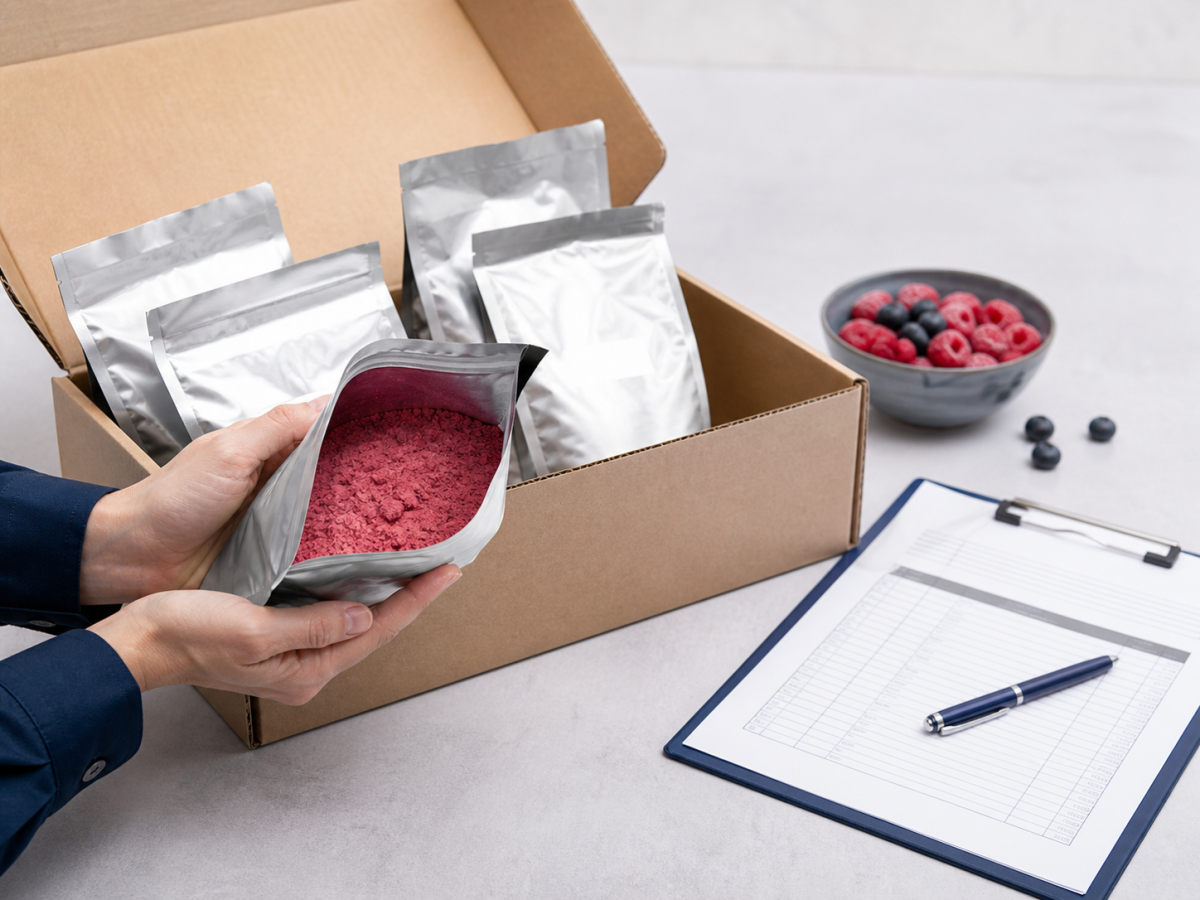
Because fruit powders absorb moisture and clump, packing is not a footnote: multi-layer moisture-barrier packing with a desiccant policy protects both shelf life and flowability during sea freight. Complete details (quantity, MOQ expectation, packing size and destination market) let the supplier quote accurately in one round.
8. Market Data: Why Fruit Powder Sourcing Is Growing
A short market context helps buyers set expectations on supply and pricing. Figures below are public industry estimates — use them for direction, not contract math.
| Data point | Value | Source / year |
|---|---|---|
| Global fruit powder market | USD 17.43B (2025) → USD 25.81B (2031), CAGR 6.76% | Research and Markets, 2026 |
| Freeze-dried fruit powder market | USD 10.9B (2025) → USD 21.1B (2035), CAGR 6.8% | Future Market Insights, 2025 |
| Freeze-dried share of fruit & vegetable powder | 45.2% of the category (2025) | PW Consulting, 2026 |
| Strawberry share of freeze-dried powder | 22.3% of segment (2025), top fruit type | Future Market Insights, 2025 |
| Food & beverage application share | 41.6% of freeze-dried fruit powder demand (2025) | Future Market Insights, 2025 |
| China fruit & fruit-product exports | USD 8.56B in 2024, +20.9% YoY; 6.59M MT, +31.1% YoY | China Customs via CCCFNA, 2024 |
The category-wide growth in beverages, bakery, dairy and supplements means more SKUs, more origins and more price spread — which makes the sample stage more valuable, not less. Suppliers with export-grade certification stacks (FSSC 22000/HACCP among China export mills) and lot-matched documentation are the ones that can move from sample to bulk without re-qualification.
9. Related Product Pages for Sample Review
- Strawberry Powder Supplier — flavor and color sample review.
- Mango Powder Supplier — color and flavor sample review.
- Pitaya Powder Supplier — color application sample review.
- Acerola Cherry Powder Supplier — target specification and COA review.
For category-level comparison, use the Fruit Powder Supplier hub; for quotation, contact HERBSEA with application, sample, COA and RFQ details.
FAQ
Include application, color and flavor target, sample quantity, COA needs, destination address, MOQ expectation and packing preference.
Size the quantity to the test plan: 50–200 g covers sensory and basic lab work, while 500 g–2 kg is needed when the sample must support full third-party testing for microbiology, heavy metals and pesticide residues.
Yes. Sweetener, acid, dairy, heat and dry-mix conditions can change visible performance, so test the powder exactly as production will use it and document the results.
Use the relevant product page or the Fruit Powder Supplier hub with application, sample, COA and RFQ details.
The lot-matched COA with the sample batch number, specification sheet, certificate copies covering the exact SKU, packing note and export files relevant to the destination market.
The approved sample lot number is attached to the bulk RFQ, and the buyer confirms MOQ, packing size, lead time and destination market for an accurate quotation.
Summary
Before supplier comparison, align material identity, application, target specification, COA fields, sample plan, MOQ, packing and destination market. Clear inputs help suppliers respond with usable samples and quotation details — then keep the approved sample and its lot-matched COA as the reference for the first commercial batch.
Download or request the ingredient RFQ checklist from HERBSEA.
Ingredient Sourcing Resource Center
Use these HERBSEA resources to keep supplier, COA, sample, MOQ, RFQ and export documentation review in one practical sourcing path.
- Ingredient Sourcing Guide Index for grouped tea powder, plant extract, fruit powder and documentation resources.
- Bulk Ingredient Sample Request Template for sample quantity, specification, COA and MOQ fields.
- Food Ingredient RFQ Template for supplier comparison, packing and quotation fields.
- Ingredient Export Documentation Checklist for COA, packing and destination-market document review.
- Ingredient Supplier Audit Checklist for supplier scope, sample control and document readiness.
Data Sources
Market and industry figures cited in this article are drawn from publicly available research: Research and Markets (2026), Future Market Insights (2025), PW Consulting (2026), China Customs export statistics via CCCFNA (2024), Arovela (2026) sample-order guidance, and Nutrisikakao (2026) sample-stage red flags. Figures are industry estimates and should be re-verified against current reports before contract use.