
Quick Answer: Before you request an EGCG sample or quotation, send the supplier six inputs: material identity (EGCG target assay + batch/sample code), the HPLC method wording behind the assay, physical acceptance fields (appearance, particle size, flow), the document package you need (spec sheet, COA, method note, packing, export files), commercial terms (quantity, MOQ, packing size, destination market), and the application you are sourcing for. Aligning these six fields first is what separates a usable sample lot from a round of wasted courier fees — and it is exactly what lets suppliers like HERBSEA respond with a representative COA and a quotation that survives QA review. Use the EGCG 98% product page as the commercial reference point while you build the worksheet below.
1. Why the COA Is the First Gate in EGCG Supplier Approval
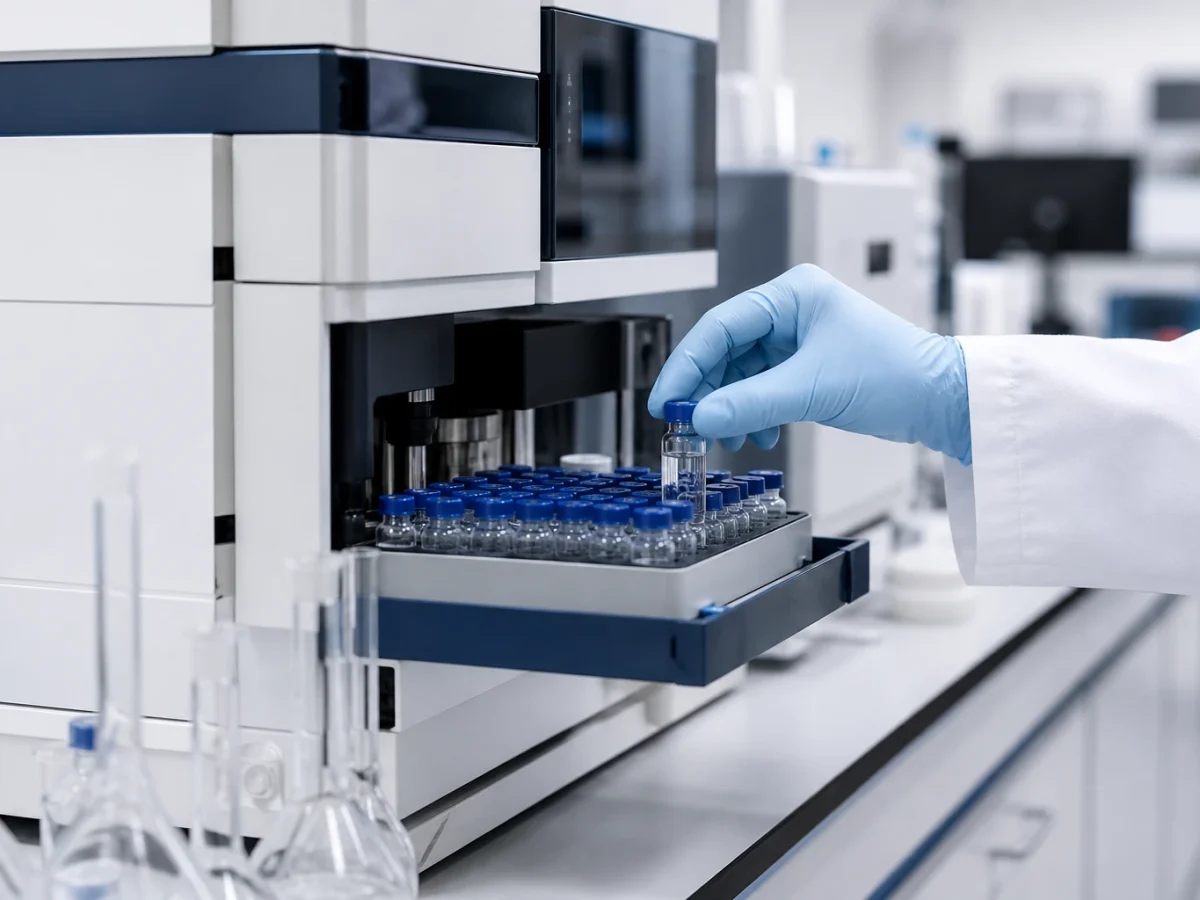
EGCG (epigallocatechin gallate, CAS 989-51-5) is the dominant catechin in green tea and the marker compound that most EGCG purchase specifications are written around. The commercial stakes are real: the global EGCG market was valued at roughly USD 142.8 million in 2024 and is projected to grow to about USD 245.4 million by 2032 (CAGR ≈ 6.2%), with dietary supplements and functional beverages consuming the largest share of high-purity grades (24ChemicalResearch, 2025). High-purity EGCG (98%+) carries a price premium of roughly 40–50% over conventional green tea extracts because the purification chain is complex — and that premium is precisely why the COA, not the price list, must be the first document you approve.
A COA is only useful if it can be tied to a physical lot. That is why the batch number and sample code fields matter more than the assay number itself: they link the analytical results to the powder in your lab. Buyers who skip this step end up approving a document, then re-testing the sample against it and discovering a mismatch that should have been caught before shipping.
Market context to include in your supplier conversation
| Data point | Value | Source |
|---|---|---|
| Global EGCG market, 2024 | ≈ USD 142.8 M | 24ChemicalResearch, 2025 |
| Projected market, 2032 | ≈ USD 245.4 M (CAGR ≈ 6.2%) | 24ChemicalResearch, 2025 |
| Green tea catechins market, 2024 → 2032 | USD 682 M → USD 1,274 M | PW Consulting, 2026 |
| EGCG share of total catechins | ≈ 53% | PW Consulting, 2026 |
| Largest application segments | Dietary supplements ≈ 42%, functional beverages ≈ 33% | PW Consulting, 2026 |
| China share of global EGCG production (2025) | ≈ 48% | ZVZO market research, 2026 |
These figures give your internal stakeholders a defensible reason to run a structured sampling round instead of buying on price alone — and they give the supplier a signal that you are a professional buyer.
2. EGCG 98% vs. Green Tea Extract: Match the Grade to the Application
Not every formulation needs a 98% monomer. Buying the wrong grade either overpays for purity you cannot use or under-specifies a marker your finished product label depends on. Decide the grade before you request samples:
| Dimension | EGCG 98% (high-purity monomer) | Green tea extract / standardized polyphenols |
|---|---|---|
| Primary marker | EGCG by HPLC (≥98% w/w) | Total polyphenols (50–98%) with EGCG at 30–95% |
| Appearance | White to off-white crystalline powder | Tan to brown fine powder |
| Typical use | Capsule/tablet formulas, R&D, high-marker finished goods | Beverage bases, food applications, cost-sensitive blends |
| Price level | Premium (≈40–50% above conventional extract) | Standard |
| COA complexity | Requires catechin fingerprint + GCG resolution check | Polyphenol + caffeine + microbial panel |
| Risk of over-specifying | Higher unit cost, harder supplier pool | Lower cost but may fail label claims if under-specified |
If your application calls for a specific EGCG marker on the finished label (a common pattern in supplements), the high-purity grade is usually the right lane. If you need a functional tea-polyphenol base for a beverage, a standardized extract may be the better commercial fit. HERBSEA supplies both lanes — see the green tea extract page for the standardized range and the EGCG 98% page for the monomer grade.
3. The Seven COA Fields Every Buyer Must Review Before Sampling
A complete EGCG COA is not just “assay 98%”. Run this checklist against the document the supplier sends — if a field is missing, ask for it before approving the sample:
- Material identity — botanical source (Camellia sinensis), product name, target assay, batch number, sample code. This links the document to the physical powder.
- Assay + method wording — EGCG content (% w/w) and the exact method (e.g., “HPLC-UV, 280 nm, USP-aligned”). Method wording is what makes assay values comparable across suppliers.
- Catechin fingerprint — EGCG, EGC, ECG, EC and GCG individually reported. A 98% COA that lists all other catechins as “Not Detected” is a red flag; natural extracts always carry trace co-extractives (GCG 0.3–2.0%, ECG 0.2–1.5%, EGC 0.1–0.8%).
- Physical fields — appearance, color, odor, particle size, bulk density, flow. These decide whether the powder runs through your filling line.
- Purity/contaminant panel — moisture (≤5%), ash, heavy metals (Pb, As, Cd, Hg by ICP-MS), residual solvents (ICH Q3C), pesticide residues (EU MRL Reg (EC) 396/2005 where relevant).
- Microbial panel — total aerobic count (≤1,000 CFU/g typical, tighter on pharma-grade), yeast & mold, E. coli, Salmonella, S. aureus.
- Packing & stability — packing spec, storage conditions, shelf life and manufacturing date. EGCG is light-, heat- and alkali-sensitive; the document should state storage that protects it (sealed, cool, dry; refrigeration for long-term holds).
COA review scorecard
| Field | What to check | Common failure |
|---|---|---|
| Batch/sample code | Matches the sample label 1:1 | Document describes a different lot |
| Method wording | Named method + detection wavelength | “HPLC” with no conditions given |
| GCG resolution | Rs (EGCG/GCG) ≥ 2.0 documented | Co-eluting peaks inflate purity 2–8% |
| Catechin fingerprint | All 5 major catechins reported | Minor catechins listed as ND |
| Heavy metals | Limits + method (ICP-MS) | Only “heavy metals ≤10 ppm” total |
| Microbial | Pathogen absence stated | Only TAC reported |
4. HPLC Method Wording: Why “HPLC” Alone Is Not Enough
The single most common sourcing mistake is comparing assay numbers without comparing methods. EGCG and its epimer GCG are structurally near-identical; a fast-gradient HPLC method that fails to resolve them will quantify part of the GCG peak as EGCG and overstate purity by 2–8%. A supplier claiming 98% with a method that cannot separate the pair may actually be shipping 92–96%.
Ask the supplier for three method details and record them in your worksheet:
- Reference standard — e.g., USP EGCG reference standard (USP-1236700) rather than an in-house standard.
- Chromatographic resolution — the COA should state or reference Rs (EGCG/GCG) ≥ 2.0, per pharmacopeial practice aligned with USP and EP conditions (C18 250 × 4.6 mm, 5 µm; UV at 280 nm).
- Full catechin profile — GCG reported separately so you can verify the EGCG peak is not inflated.
AOAC 2020.03 is an alternative multi-laboratory-validated method for catechins in tea products if you want a second analytical opinion during incoming inspection. Whatever method is used, require the wording before you compare two suppliers’ assay values — otherwise the comparison is meaningless.
5. Sample Review vs. Bulk RFQ: Two Different Conversations
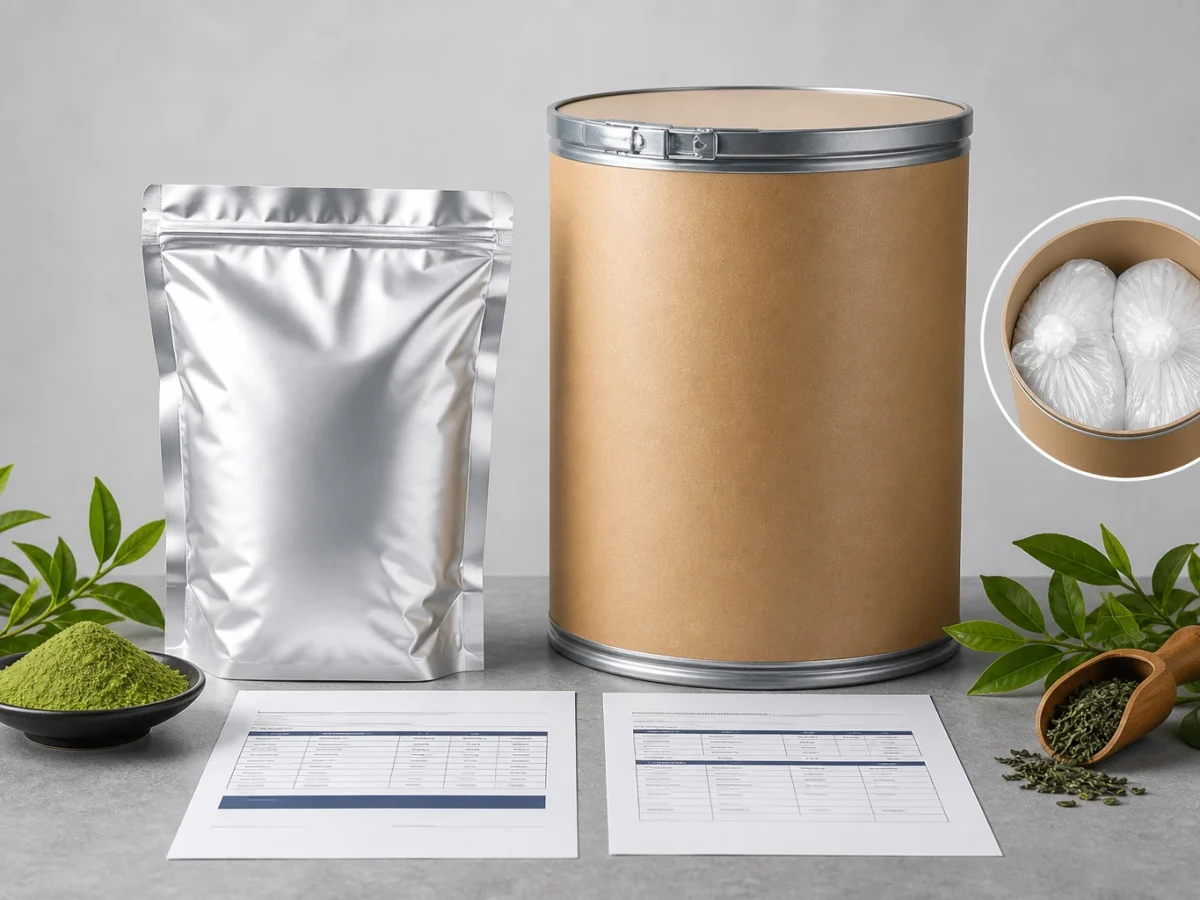
A sample request answers a laboratory question; an RFQ answers a commercial one. Mixing them produces slow, fuzzy supplier responses. Split them deliberately:
| Dimension | Sample review round | Bulk RFQ round |
|---|---|---|
| Main purpose | Verify physical behavior, document fit, application match | Confirm commercial supply, packing, lead time, export needs |
| Buyer inputs | Application, sample quantity, target spec, COA needs | Quantity, MOQ expectation, packing size, destination market |
| Typical outcome | Sample approved / rejected for specification | Quotation, proforma invoice, lead-time commitment |
| Limit | Does not lock commercial terms | Should follow document or sample approval on strict specs |
| Suggested order | Round 1: sample + COA + method note | Round 2: RFQ with approved spec attached |
Practical sequence: if the specification is already fixed, send target assay, powder behavior and document list in round one. If the grade is still open, ask for available specification options with a representative COA and sample-lot details before committing to a target.
6. Certification & Document Package: What a Reliable Supplier Can Provide
Buyers sourcing for regulated markets should confirm the supplier’s facility-level certifications and the document set available per batch. Ask for copies during the sample round, not after the order:
| Certification / document | Relevance to EGCG sourcing |
|---|---|
| ISO 9001 | Quality management system foundation |
| ISO 22000 / FSSC 22000 | Food-safety management; common in supplement ingredients |
| HACCP | Hazard control in the extraction/purification line |
| HALAL / KOSHER | Required for specific destination markets |
| USDA / EU Organic | Needed for organic-grade EGCG SKUs |
| cGMP facility | Expected for pharma-grade / supplement-grade supply |
| Third-party lab reports | SGS, Eurofins or Intertek testing to EU Reg (EC) 396/2005, USP, EP |
| Per-batch COA + MSDS + HPLC chromatogram | The actual document package your QA will review |
Document package checklist
- Specification sheet (grade, markers, physical fields, limits)
- COA for the batch matching the sample code
- HPLC method note (conditions, reference standard, resolution)
- Packing and storage statement
- Export documentation (certificates of origin, phytosanitary where applicable)
- Third-party test reports where your market requires them
7. Samples, MOQs and Lead Times: What to Expect From a Serious Supplier
Benchmarks give you a sanity check before you negotiate:
- Samples: stock samples typically ship within 1–2 business days; qualified B2B buyers often receive 20–50 g samples with freight covered or shared. Custom/off-spec samples take longer and may carry a fee.
- MOQ ladder: sample order 1–5 kg → trial order ~25 kg (one drum) → bulk 100 kg+ is a common structure for green tea extracts.
- Lead times: bulk lead times depend on stock vs. production; expect the supplier to commit to a written lead time in the RFQ round.
If a supplier cannot state sample lead time, MOQ and packing spec in the first reply, take that as a signal to keep the sample round small.
8. Regulatory Context: EGCG in Finished Goods
This section is for formulators, not consumers. If your finished product contains EGCG, the regulatory frame is set by the EFSA 2018 scientific opinion on green tea catechins, which the EU Commission implemented as a maximum of 800 mg EGCG per daily portion in food supplements (aqueous extracts comparable to brewed infusions are treated separately). Below 800 mg/day, EU labelling rules require a per-portion EGCG statement, a maximum-portions warning, and notices on empty-stomach consumption and specific population groups. The UK Committee on Toxicity re-reviewed the data in 2024 and found no new evidence that would change the EFSA conclusion.
For B2B buyers this means one practical thing: the EGCG assay on the COA must be reliable enough to support your finished-goods label calculation. A 2–8% method-driven overstatement of purity is the difference between a compliant label and a reformulation. Document the assay method at sourcing stage and it protects you downstream.
9. FAQ
Material identity (name, target assay, batch number, sample code), the HPLC method wording behind the assay, the catechin fingerprint including GCG, physical fields, contaminant and microbial panels, and packing/stability data. The batch/sample code is the link between the document and the physical lot.
Not reliably. Assay values are only comparable when the methods match — especially the chromatographic resolution between EGCG and GCG. Require the method note before comparing numbers.
Application, target specification (grade + assay), sample quantity, COA needs, physical acceptance fields, packing, MOQ expectation and destination market. A sample request answers the lab question; a separate RFQ answers the commercial question.
GCG is the epimer of EGCG. If the method does not resolve the two peaks (Rs ≥ 2.0), GCG is partly counted as EGCG and purity can be overstated by 2–8%. Reporting GCG separately is evidence the method is resolving the pair.
Facility-level ISO 9001, ISO 22000 or FSSC 22000, HACCP, and market-specific HALAL/KOSHER or USDA/EU Organic as needed. Third-party lab reports (SGS, Eurofins, Intertek) to EU MRL, USP or EP standards add confidence.
Stock samples of 20–50 g shipping within 1–2 business days are common for qualified B2B buyers, with a typical MOQ ladder of 1–5 kg sample → ~25 kg trial → 100 kg+ bulk.
10. Summary
Align six inputs before you request EGCG samples or a quotation: material identity, HPLC method wording, physical acceptance fields, the document package, commercial terms, and the application. Match the grade to the application (98% monomer vs. standardized extract), make the COA the first approval gate, and keep the sample review and bulk RFQ as two separate rounds. Buyers who do this get usable samples and quotations that survive QA — buyers who skip it re-test, re-ship and re-negotiate.
Related HERBSEA resources
- EGCG 98% product page — product-level samples and quotation
- Green tea extract supplier — standardized polyphenol range
- Plant extract HPLC COA review guide — category-level COA comparison
- Bulk ingredient sample request template — sample quantity, spec, COA and MOQ fields
- Food ingredient RFQ template — supplier comparison, packing and quotation fields
- Ingredient export documentation checklist — COA, packing and destination-market documents
- Contact HERBSEA — send application, sample, COA and RFQ details
Data sources: 24ChemicalResearch EGCG market outlook 2025–2032; PW Consulting green tea catechins market 2026; ZVZO global EGCG market research 2026; EFSA scientific opinion on green tea catechins (2018); UK Committee on Toxicity review (2024); EU Regulation (EC) 396/2005 (pesticide MRLs); USP/EP analytical guidance for EGCG assay (HPLC, UV 280 nm, Rs EGCG/GCG ≥ 2.0); AOAC 2020.03. Market figures are third-party estimates and should be re-verified before use in formal documents.