
Fruit Powder Bulk Supplier Guide: Source, Process, COA, Samples and RFQ Checklist
Quick Answer — How do you compare fruit powder bulk suppliers before sending an RFQ?
Compare five things in order: (1) fruit source and powder format — whole fruit vs juice-based, with or without carrier (maltodextrin), spray-dried vs freeze-dried; (2) physical behavior — color, flavor, odor, particle size, flow, solubility and blend behavior in your target application; (3) documents — specification sheet, lot-matched COA, facility certifications (HACCP, ISO 22000, FSSC 22000) and market certificates (Halal, Kosher, organic) that cover the exact powder SKU; (4) sample plan — stock, custom or pre-production sample with the quoted grade; (5) commercial terms — quantity, MOQ, packing size, lead time and destination market. Aligning these five inputs before the RFQ is what separates a usable sample and quotation from a three-round clarification loop. The Fruit Powder Supplier hub is the commercial page for category-level comparison; this guide is the pre-RFQ worksheet.
1. Why Fruit Powder Specification Comes First
Fruit powder is not one commodity — it is a family of grades defined by raw material and drying technology. Buyers who jump to price before nailing down the format end up comparing apples to orange powder. The global fruit powder market was valued at about USD 28.0 billion in 2025 and is forecast to reach USD 52.47 billion by 2034 (Fortune Business Insights, 2025), which means suppliers carry a wide spread of grades priced very differently. Define these fields before any comparison:
- Fruit type and part: mango, strawberry, pineapple, acerola, banana — whole fruit, pulp, juice or peel-based.
- Powder format: pure (carrier-free) or with a carrier such as maltodextrin, and the carrier percentage.
- Drying technology: spray-dried, freeze-dried, drum-dried or vacuum-dried.
- Application target: beverage, bakery, confectionery, dairy, dry mix, supplement — this drives solubility, particle size and moisture expectations.
- Specification fields: assay/ratio, moisture, color value, particle size (mesh), solubility, heavy metals and microbiology.
Spray-Dried vs Freeze-Dried Fruit Powder: What Changes for Buyers
| Dimension | Spray-dried | Freeze-dried |
|---|---|---|
| Process | Atomized juice/puree dried in hot air, continuous, seconds per batch | Frozen material sublimated under vacuum, batch, 24–48 h cycles |
| Cost position | Lower — continuous and energy-efficient | Higher — industry comparisons put freeze drying at roughly 4–5x the cost of spray drying |
| Carrier | Almost always needed (maltodextrin is common), diluting pure fruit content | Not required; can be labeled 100% fruit |
| Nutrient and color retention | Moderate — heat-sensitive nutrients (e.g., vitamin C) can lose 20–40% | High — sources cite 90%+ retention of heat-sensitive nutrients and true-to-fruit color |
| Moisture | 3–5%, good shelf life, more prone to caking over time | 1–4%, very stable, hygroscopic, needs moisture-barrier packing |
| Solubility | Engineered for instant solubility in hot and cold liquids | Rehydrates well but may contain fiber; needs stirring |
| Typical uses | Beverage mixes, bakery, confectionery, dairy, cost-driven mass-market lines | Premium supplements, clean-label and organic lines, garnishes, rehydration products |
Practical rule: for beverage and bakery lines where cost and solubility dominate, spray-dried is the standard workhorse; for premium clean-label or organic programs where the label must read “100% strawberry,” freeze-dried is the defensible choice. Ask the supplier which technology the quoted grade uses — it is the single biggest price and quality lever in fruit powder sourcing.
2. How to Compare Fruit Powder Origins
Origin matters because it sets the raw-material cost base, harvest seasonality, residue profile and document stack. China, India, Vietnam, Thailand and EU/US processors all supply fruit powders, but they specialize differently. Compare origin through the supplier’s traceability statement — from farm or fruit belt to dryer — not just the country of the invoice.
| Origin cluster | Typical strengths | Typical considerations |
|---|---|---|
| China (Shandong, Fujian, Xinjiang belts) | Broad SKU range (apple, peach, strawberry, goji), competitive spray-dried pricing, fast lead times, strong FSSC 22000/HACCP adoption among export mills | Buyers should verify residue panels and organic certificates cover the specific SKU, not the facility only |
| India | Mango, amla, pomegranate, tropical volume; APEDA RCMC + FSSAI document layer; competitive bulk pricing | Certificate scope discipline — an organic certificate for pulp does not auto-cover spray-dried powder |
| Vietnam / Thailand | Tropical fruit cost base (mango, banana, passion fruit, coconut), growing freeze-dried capacity | Smaller-scale plants vary in FSSC 22000 adoption; confirm before retail programs |
| EU / US processors | Premium freeze-dried and organic lines, clean-label programs, low residue risk | Highest price point; longer lead times; suited to premium end-use only |
China’s export momentum is measurable: customs data show China exported 5.27 million tonnes of fresh and dried fruit and nuts in 2024, up 30.3% in volume and 21.4% in value year on year (GACC via Huaon, 2024). For fruit powder specifically, ask for the plant’s export documentation record — HS 1106.30 covers fruit flours and powders — and match it to your destination’s import requirements.
3. Certifications and Document Sets to Require Before RFQ
A supplier’s certification stack tells you which channels they can credibly serve. Require the list below in the first RFQ round, then verify certificate scope covers the exact product and facility — a HACCP certificate for a puree plant does not cover a separately located powder dryer, and an organic certificate for mango pulp does not cover spray-dried mango powder if the drying step sits outside the certified scope.
| Tier | Certificate / document | What it signals | Typical trigger |
|---|---|---|---|
| Facility food safety | HACCP, ISO 22000, FSSC 22000 (GFSI-recognized), BRC, GMP | Systematic hazard control and audit discipline | Baseline for most export buyers; FSSC 22000 required by many retailers and QSR chains |
| Product / market | Halal, Kosher, organic (USDA NOP, EU Organic, JAS, NPOP), Non-GMO, gluten-free | Destination channel access | Halal for GCC/ASEAN; Kosher and organic for US/EU brand programs |
| Export / regulatory | FDA facility registration + Prior Notice readiness (US), phytosanitary or health certificate, COO, lot COA | Market entry compliance | Mandatory per destination; verify certificate validity covers expected arrival, not only sailing date |
| Quality per lot | Specification sheet + lot-matched COA | Parameter traceability for the exact batch quoted | Every commercial lot; request before sample |
Rule of thumb for the RFQ: send the certification checklist with your first inquiry, not after samples. Suppliers that share facility and certificate documentation without hesitation are usually export-ready; hesitation is a qualification signal in itself.
4. COA Review: Parameters That Matter for Fruit Powders
The COA is where the grade becomes auditable. A useful fruit powder COA covers physical, chemical and microbiological fields, plus the lot identity that ties the document to the specific batch. Demand a lot-matched COA — a representative COA from another lot is only a starting point.
| Parameter group | Fields to check | Why it matters |
|---|---|---|
| Physical | Appearance, color, odor, flavor, particle size / mesh, bulk density | Sensory and formulation consistency between lots |
| Chemical | Moisture, total ash, assay or fruit-ratio where applicable, carrier %, heavy metals (Pb, As, Cd, Hg) | Drying quality, purity and destination compliance |
| Microbiological | Total plate count, yeast & mold, E. coli, Salmonella, Staphylococcus | Food-safety gate for food and beverage use |
| Residues | Pesticide residue panel (multi-residue screening), mycotoxins where relevant | EU MRL and clean-label market access |
| Identity | Lot number, production date, expiry, COA date, method references | Traceability and audit trail |
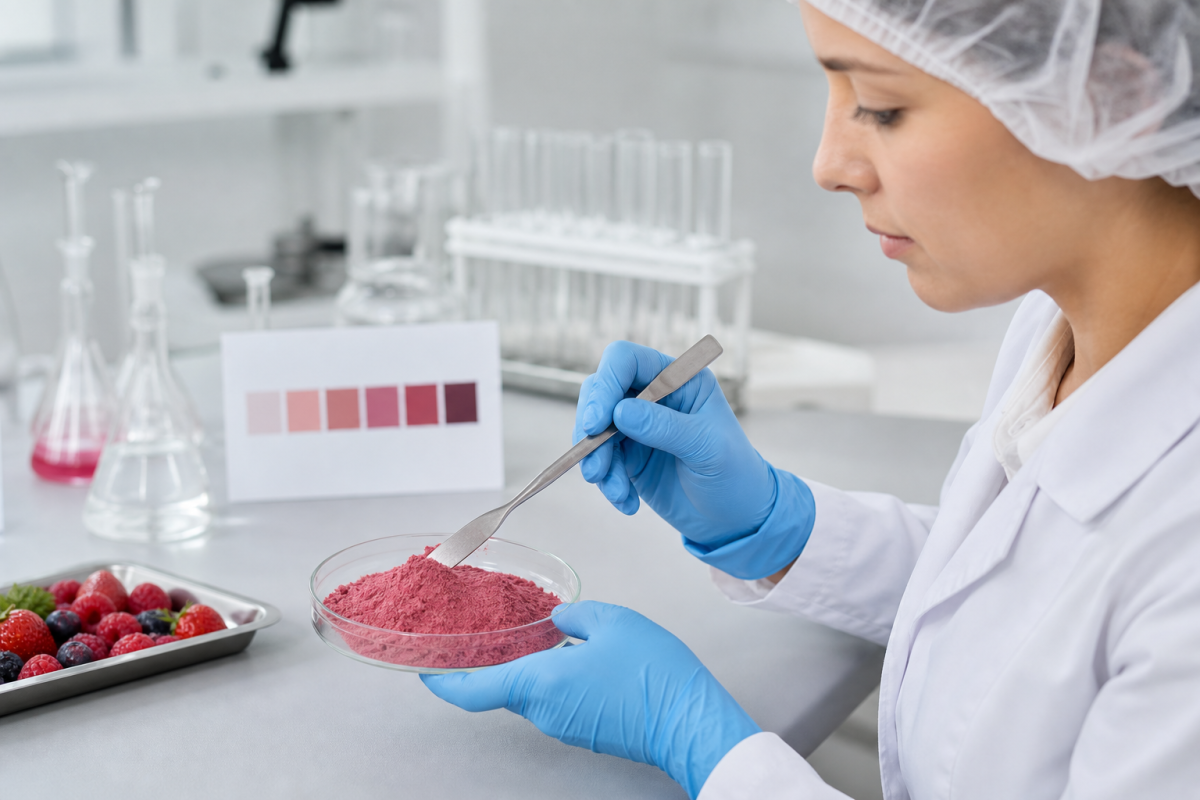
Buyers who specify the COA parameter panel in writing (fruit, process, carrier max %, moisture max, mesh, microbiology, residues) get cleaner quotes. If the destination is the EU, confirm the residue panel is aligned with EU MRL requirements; for the US, confirm FDA registration and Prior Notice handling for the entry.
5. Samples: What to Request and How to Evaluate
Samples are the cheapest failure you can buy — or the most expensive thing you can skip. Request samples against the quoted grade, keep the sample lot linked to the specification, and run an internal review against your application before scaling to a bulk RFQ.
| Sample type | Typical cost | Best use |
|---|---|---|
| Stock sample | US$0–50 (often free with freight paid by buyer) | Screen color, flavor, solubility, physical behavior; first-fit check |
| Custom sample | US$50–500 | Specification-matched lot (target assay, mesh, moisture, carrier %) |
| Pre-production sample | US$100–1,000+ | Approval before bulk production; ties the lot to your quoted spec |
Industry experience puts sample-to-order conversion at roughly 20–30%: most inquiries do not become orders, which is precisely why disciplined buyers use the sample stage to pre-qualify. Evaluate the sample against the five physical fields (color, flavor, odor, particle size, flow, solubility and blend behavior), keep the COA and sample lot ID on file, and connect the sample approval to the quoted grade — never approve a sample from one grade and order another.
6. MOQ, Packing and Shipping Terms
Commercial details complete the comparison. Because fruit powders are hygroscopic, packing is not a footnote: moisture-barrier packing (e.g., aluminum foil laminate or kraft + PE with a desiccant policy) and low-humidity handling protect both shelf life and flowability during sea freight.
| Commercial field | What to confirm | Typical range / guidance |
|---|---|---|
| MOQ | Per SKU, per production run | Often 25 kg to 500 kg for stock grades; higher for custom or pre-production runs |
| Packing size | Inner and outer packing | 1–25 kg foil bags inside cartons or drums; 25 kg is the common export unit |
| Lead time | Stock vs production lead | Stock 3–7 working days; production 2–4 weeks depending on volume and season |
| Destination market | Port, Incoterm, import requirements | Confirm HS line (1106.30), label language, Halal/Kosher/organic documents per market |
| Shipping | Sea, air or courier | Sea for FCL/LCL volume; air or courier for samples and urgent lots |
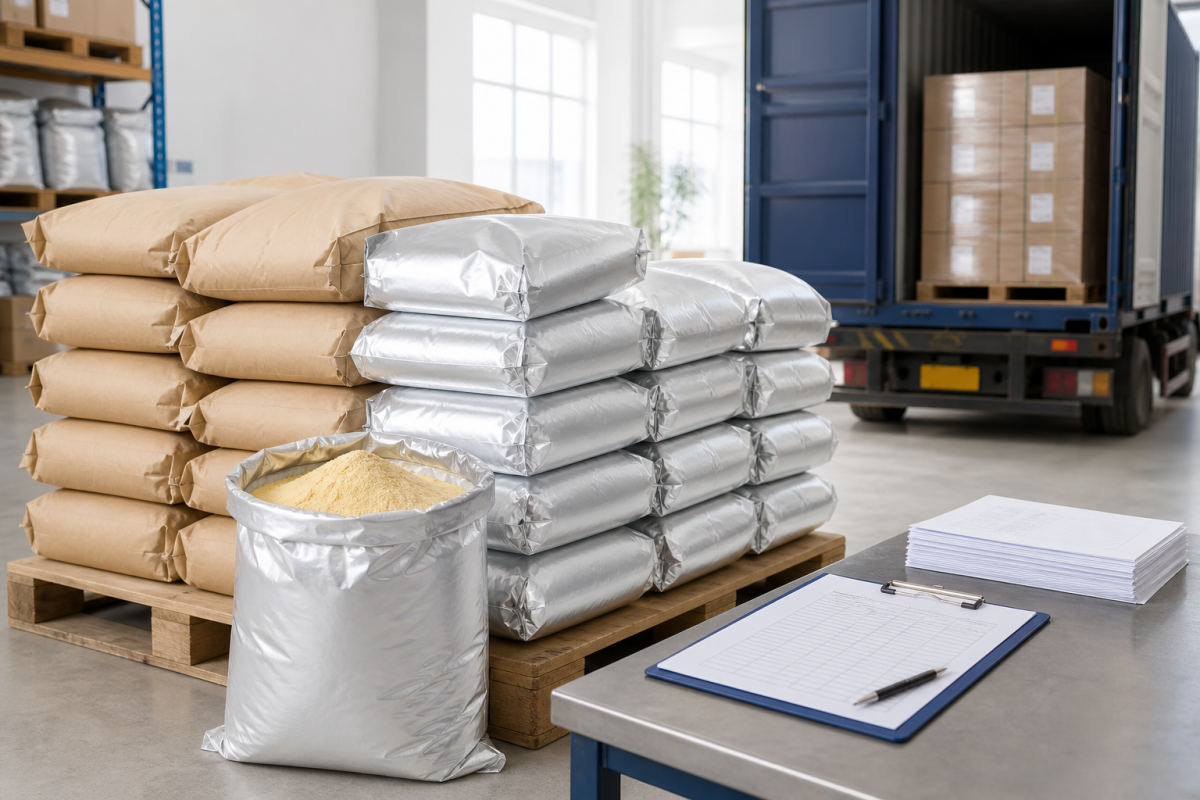
Complete details (quantity, MOQ expectation, packing size and destination market) let the supplier quote accurately in one round. If the specification is fixed, send the target assay, powder behavior and document list first; if the grade is still open, ask for available specification options with a representative COA and sample lot details.
7. Market Data: Where Fruit Powder Demand Is Growing
A short market context helps buyers set expectations on price and supply stability. Figures below are industry estimates from public market research — use them for direction, not contract math.
| Data point | Value | Source / year |
|---|---|---|
| Global fruit powder market | USD 28.0B (2025) → USD 52.47B (2034), CAGR 7.26% | Fortune Business Insights, 2025 |
| Global fruit powder market (alt. estimate) | USD 17.43B (2025) → USD 25.81B (2031), CAGR 6.76% | TechSci Research, 2025 |
| Europe share of global market | 36.89% (2025); North America 25.09%; APAC 21.92% | Fortune Business Insights, 2025 |
| Global dried fruit production | 3.36M MT (2023/24); 3.24M MT projected (2024/25) | International Nut and Dried Fruit Council |
| China fresh & dried fruit + nut exports | 5.27M MT, USD 6.94B, +30.3% volume / +21.4% value (2024) | GACC via Huaon, 2024 |
| Beverage application | Largest application segment, driven by functional and ready-to-drink mixes | Fortune Business Insights, 2025 |
The direction is consistent across sources: demand grows in beverages and clean-label bakery lines, freeze-dried and organic grades outgrow conventional commodity grades, and Asia-Pacific supply keeps expanding. For buyers, that means locking specification and certification needs early protects you from grade substitution when the market tightens.
8. RFQ Checklist
Use this list as the pre-RFQ worksheet:
- Fruit type and powder format (pure vs carrier, carrier max %).
- Application, color, flavor and solubility target.
- COA and specification sheet needs (parameter panel for the destination).
- Certification list (facility food safety, Halal/Kosher/organic per market, export documents).
- Sample status and internal approval plan (stock / custom / pre-production).
- Quantity, MOQ, packing and destination market (Incoterm, HS 1106.30).
9. FAQ
Compare source and powder format (spray-dried vs freeze-dried, carrier or pure), physical behavior (color, flavor, odor, particle size, flow, solubility), the document set (specification sheet, lot-matched COA, facility and market certifications), the sample plan, and commercial terms (MOQ, packing, lead time, destination market). Source and format define the grade before price comparison is meaningful.
Application drives the physical spec: beverages need instant solubility, bakery and dry mixes need even particle distribution, and clean-label or organic lines need carrier-free grades. Sharing the application before samples lets the supplier quote the right format instead of a generic grade.
It depends on the end-use and label. Spray-dried is cost-efficient, highly soluble and suited to beverage, bakery and confectionery volume; freeze-dried retains more heat-sensitive nutrients and true color, needs no carrier, and fits premium, clean-label and organic programs at a higher price point. Confirm the technology behind the quoted grade in writing.
Require facility food-safety certifications (HACCP, ISO 22000, FSSC 22000, BRC) as the baseline, add market certificates (Halal for GCC/ASEAN, Kosher, organic per your label) and destination export documents (FDA registration and Prior Notice for the US, phytosanitary or health certificates, COO). Verify certificate scope covers the exact powder SKU and the drying facility.
A lot-matched COA should cover physical fields (appearance, color, odor, flavor, particle size, bulk density), chemical fields (moisture, total ash, heavy metals, carrier % and assay where applicable), microbiology (total plate count, yeast & mold, E. coli, Salmonella), and the residue panel required by the destination, all tied to a specific lot number with production and expiry dates.
Use the Fruit Powder Supplier hub or the relevant product page — such as Strawberry Powder, Mango Powder, Pineapple Fruit Powder or Acerola Cherry Powder — for sample and quotation requests. For specification, COA, sample and RFQ details, contact HERBSEA directly.
Summary
Before comparing fruit powder bulk suppliers, align material identity (source, format, drying technology), application target, specification fields, COA panel, certification scope, sample plan, MOQ, packing and destination market. Clear inputs produce usable samples and one-round quotations; fuzzy inputs produce grade confusion. Use the Fruit Powder Supplier hub for category-level comparison and contact HERBSEA with application, sample, COA and RFQ details.
Data Sources
Market and industry figures cited in this guide are drawn from publicly available research: Fortune Business Insights (Global Fruit Powder Market, 2025), TechSci Research (2025), the International Nut and Dried Fruit Council, China General Administration of Customs data via Huaon Industry Research (2024), and published food-science comparisons of spray and freeze drying. Figures are industry estimates and should be re-verified against current reports before contract use.
Related Product Pages
- Strawberry Powder Supplier — fruit powder color and flavor review.
- Mango Powder Supplier — fruit powder color and flavor review.
- Pineapple Fruit Powder Supplier — fruit powder sample and packing review.
- Acerola Cherry Powder Supplier — target specification and COA review.
Related Sourcing Pages
- Fruit Powder Supplier hub — for category-level comparison and sample/quotation requests.
- Ingredient Sourcing Guide Index — grouped tea powder, plant extract, fruit powder and documentation resources.
- Bulk Ingredient Sample Request Template — sample quantity, specification, COA and MOQ fields.
- Food Ingredient RFQ Template — supplier comparison, packing and quotation fields.
- Ingredient Export Documentation Checklist — COA, packing and destination-market document review.
- Ingredient Supplier Audit Checklist — supplier scope, sample control and document readiness.
Download or request the ingredient RFQ checklist from HERBSEA.