
Quick Answer — What should a plant extract sample request include?
A complete plant extract sample request specifies seven fields in one email or RFQ: finished-product application, botanical source with Latin binomial and plant part, target specification (marker percentage, extract ratio, and assay method such as HPLC or UV), sample quantity and destination address, required document set (specification sheet, representative lot COA, SDS), MOQ expectation, and packing plus destination market. Suppliers who receive all seven fields can dispatch an evaluation sample in 2–3 business days; incomplete requests typically get a generic sample and a generic reply that QA cannot use for supplier qualification. Use the Plant Extract Supplier hub as the main working path for grade comparison.
1. Why a Complete Sample Request Changes the Supplier Response
The plant extract market rewards buyers who specify precisely. The global plant extracts market was valued at USD 43.48 billion in 2024 and is projected to reach USD 83.73 billion by 2032 at an 8.5% CAGR (360iResearch, 2025). China alone exported 134,000 tonnes of plant extracts worth USD 3.01 billion in 2024 — volume up 21.3% year over year while average export price fell 23.9% to a five-year low (China Chamber of Commerce for Import and Export of Medicines and Health Products, 2025).
That price-volume split has a practical consequence for sample requests. When average prices compress, supply chains absorb more borderline material, and the gap between a top-grade lot and an average lot widens. A sample request that names the marker, the assay method, and the destination market forces the supplier to pick a lot deliberately — and to state in writing which lot you are getting. A request that only says “please send goji berry extract sample” lets the supplier send whichever lot is most convenient.
| Market indicator | 2024 figure | Source |
|---|---|---|
| Global plant extracts market size | USD 43.48 billion, 8.5% CAGR to 2032 | 360iResearch, 2025 |
| China plant extract export value | USD 3.01 billion (-7.7% YoY) | CCCMHP / China customs, 2025 |
| China plant extract export volume | 134,000 tonnes (+21.3% YoY) | CCCMHP / China customs, 2025 |
| Average export price change | -23.9%, five-year low | CCCMHP, 2025 |
| Largest export destination | United States, 22.3% of value | CCCMHP, 2025 |
2. The Seven Fields Every Plant Extract Sample Request Needs
Review each field below before sending an RFQ. Every field maps to a decision the supplier must make, so omitting one shifts that decision back to the supplier — and away from your specification.
| Review point | What to confirm | Why it matters |
|---|---|---|
| Application | Capsule, tablet, powder blend, beverage, food, or cosmetic ingredient project | Application affects particle size, color, odor, carrier choice, and document needs |
| Botanical source | Latin binomial, plant part, and origin direction | Identity is the first thing QA checks; “goji berry extract” without Lycium barbarum and fruit is not a botanical specification |
| Specification target | Marker percentage, extract ratio, assay method (HPLC, UV, TLC), physical fields | Specific targets reduce generic sample replies and make COA comparison possible |
| Sample quantity | Testing amount, number of grades, destination address | Suppliers need this to plan available sample lots and courier documentation |
| Document set | Specification sheet, representative lot COA, SDS, method note | Documents let QA screen the sample before internal testing |
| MOQ expectation | Trial MOQ and annual volume forecast | Suppliers allocate sample lots and pricing tiers based on commercial reality |
| Packing and destination market | Packing size, market (US, EU, other) | Destination market determines export documents and contaminant limits |
Two of these fields deserve extra attention in practice. First, always pair the marker with the assay method: 10% polysaccharides by UV is not comparable to 10% by HPLC, and suppliers of different grades exploit that ambiguity. Second, always name the destination market at sample stage — the COA contaminant panel that satisfies one market may fail another (EU MRLs are stricter than US limits), and discovering this after sample approval wastes a full qualification cycle.
3. Sample Types and Typical Quantities
Not all samples serve the same purpose. Industry practice distinguishes three sample tiers, each with a different quantity, cost expectation, and decision gate.
| Sample type | Typical quantity | Typical cost | Purpose | Typical lead time |
|---|---|---|---|---|
| Evaluation sample | 10–100 g | Often free; courier usually paid by buyer | Confirm grade fit, organoleptic properties, document completeness | 2–3 business days from stock |
| Pilot / trial sample | 100 g – 1 kg, or 25 kg drum for pilot production | USD 50–500 depending on grade | Formulation testing, stability, small-scale production trial | 5–7 business days |
| Pre-production sample | 1–25 kg from the actual production batch | USD 100–1,000+ | Final release before a bulk order | 7–15 working days, batch dependent |
Benchmarks are consistent across suppliers: free evaluation samples of 50–100 g processed in 2–3 business days, trial MOQs starting at 1 kg, standard bulk MOQs of 10–25 kg, and bulk lead times of 14–21 business days after confirmation. Consider any material deviation from these norms a signal — a supplier who cannot ship any sample within two weeks may not hold stock, and documentation that is not ready at sample stage will not be ready for a bulk order.
Sample-to-order conversion across the botanical ingredient industry typically runs 20–30%, which is why most suppliers gate free samples behind a complete request: the seven fields above are also their filter for serious buyers.
4. What to Check When the Sample and COA Arrive
The COA that travels with the sample is the anchor document for supplier qualification. Check it against this list before running any internal test:
- Latin binomial and plant part — a COA that reads only “Goji Berry Extract” without Lycium barbarum and fruit does not document botanical identity.
- Lot number and test date — the lot number must match the sample container; a test date more than 12 months old or missing entirely indicates a recycled document.
- Assay method stated per marker — HPLC, UV, and TLC results for the same marker are not interchangeable.
- Contaminant panel — heavy metals (lead, arsenic, cadmium, mercury), pesticide residues against the destination market’s limits, microbiological counts, and residual solvents.
- Physical fields — loss on drying, mesh size or particle distribution, color, and odor as applicable.
Three red flags justify rejecting a supplier at sample stage: an undisclosed extraction solvent (this is a safety and formulation-critical specification, not a trade secret), a price 40–60% below market (which usually indicates adulteration, misidentification, or an undisclosed lower grade), and certifications listed on a website but not producible as actual certificates with expiry dates on request.
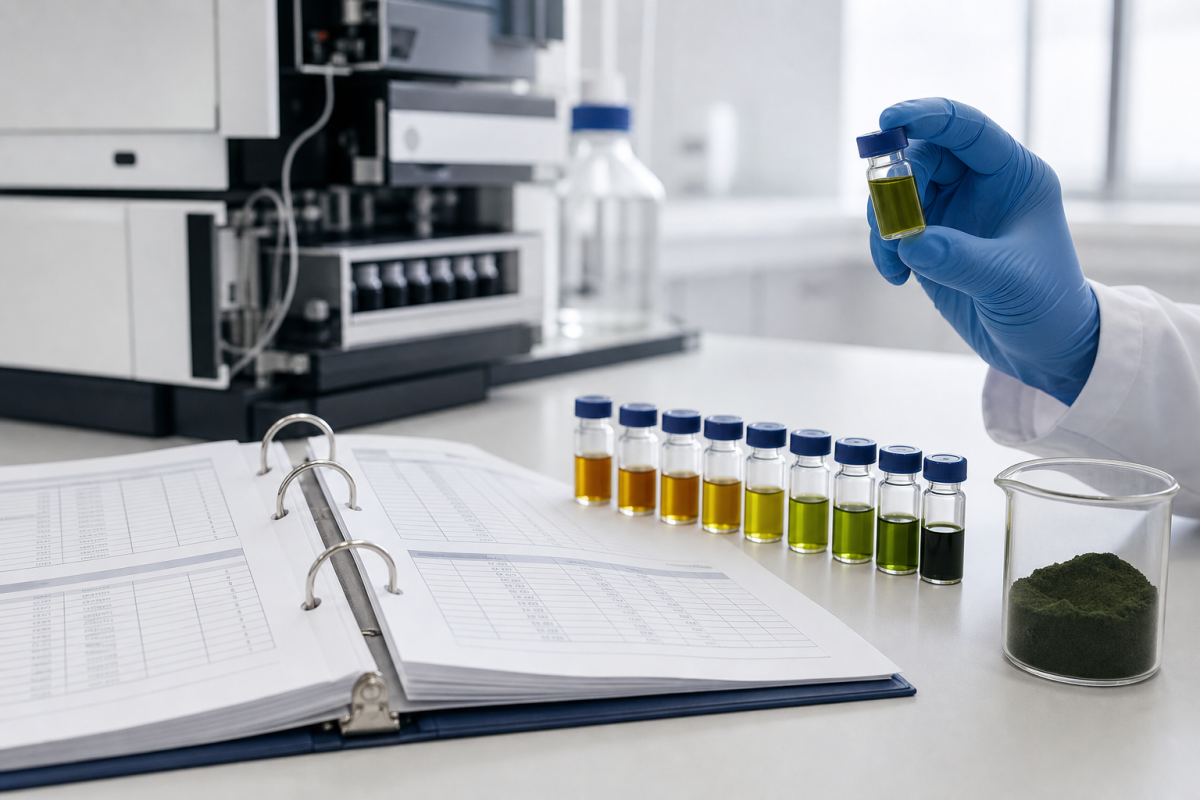
For a deeper method-by-method review of what to look for in HPLC-based COA data, see the HERBSEA plant extract HPLC COA review guide.
5. Destination-Market Regulatory Snapshot for Sample Planning
Regulatory status belongs in the sample conversation, not after the purchase order. The same extract can be a freely-sold supplement ingredient in one market and a claim-restricted or novel ingredient in another, and the document set differs accordingly.
| Destination market | Framework to check | Documents to request at sample stage |
|---|---|---|
| United States | DSHEA dietary supplement pathway; GRAS for food uses; NDI notification where applicable; cGMP (21 CFR 111) | Lot COA, SDS, allergen and GMO statements, FDA facility registration number, Prior Notice support for shipments |
| European Union | Novel Food Regulation (EU) 2015/2283 for preparations without pre-1997 EU consumption history; authorized claims register; contaminant limits (EC) 1881/2006 | Lot COA against EU MRLs, novel food status statement, third-party test reports where arranged |
| Other markets | National food or supplement frameworks vary | Confirm per destination: Halal, Kosher, organic (NOP / EU), FSSC 22000, HACCP certificates as applicable |
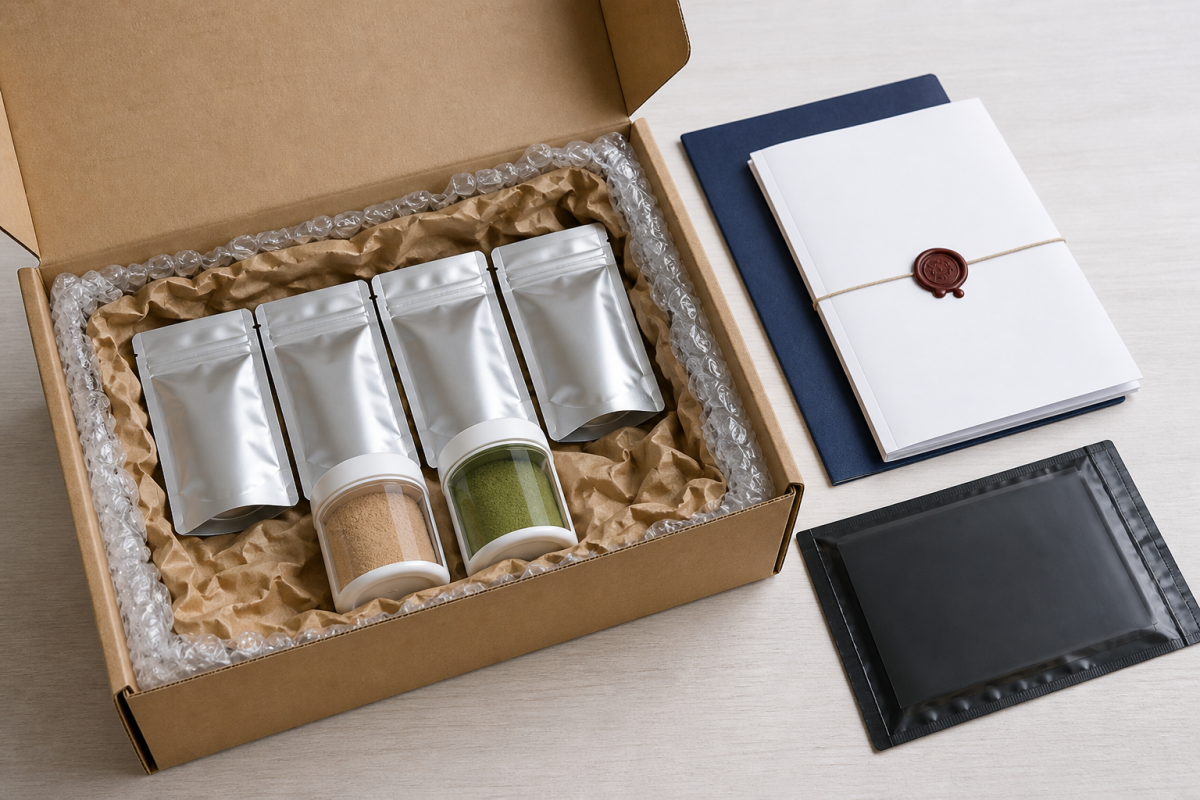
A useful habit from experienced buyers: write the destination market into the RFQ itself, and ask for the supplier’s standard export document set — commercial invoice, packing list, lot-specific COA, GHS-compliant SDS, certificate of origin, and any phytosanitary or Prior Notice documents the market requires. A supplier with regular export experience to your market will produce this set without being asked twice. For the full document-by-document review path, use the HERBSEA ingredient export documentation checklist.
6. Sample Review vs Bulk RFQ
Keep the two decision tracks separate. Sample review answers whether the grade fits; the bulk RFQ answers whether the supply works.
| Dimension | Sample review | Bulk RFQ |
|---|---|---|
| Main purpose | Confirm grade fit, documents, and physical behavior | Confirm supply, packing, lead time, and export needs |
| Buyer input | Application, target marker, sample quantity, document list | Quantity, MOQ expectation, packing size, destination market |
| Limit | Does not prove commercial availability without RFQ details | Should follow sample or document approval when specifications are strict |
7. Practical Recommendation
Use a product page when the grade is already clear — for example, the goji berry extract, sea buckthorn fruit extract, broccoli seed extract, mulberry leaf extract, and inulin powder pages each carry the marker direction for that ingredient. Use this guide when the buyer still needs to compare assay methods, sample approval steps, documentation scope, or commercial terms across multiple botanical extracts.
8. RFQ Checklist
- Finished product application.
- Botanical source with Latin binomial and plant part.
- Target marker or extract ratio, with assay method.
- Physical fields: particle size, color, moisture.
- Sample quantity and destination address.
- Document set: COA, specification sheet, SDS, method note.
- MOQ expectation and annual volume forecast.
- Packing size and destination market.
9. Related Product Pages
- Goji Berry Extract Supplier – Polysaccharide direction and sample review.
- Sea Buckthorn Fruit Extract Supplier – Flavonoid direction and sample review.
- Broccoli Seed Extract Supplier – Glucoraphanin direction and sample review.
- Mulberry Leaf Extract Supplier – DNJ direction and sample review.
- Inulin Powder Supplier – Source, solubility, and sample review.
10. FAQ
Include application, botanical source with Latin binomial, target specification with assay method, sample quantity, destination address, document list (COA, specification sheet, SDS), MOQ expectation, packing size, destination market, and follow-up RFQ timing.
Request 50–100 g for laboratory evaluation, 100 g – 1 kg for formulation and stability work, and a drum or several kilograms from the actual production batch for pre-production release. Trial MOQs typically start at 1 kg and standard bulk MOQs at 10–25 kg.
Yes. A representative lot COA and specification sheet let QA connect the sample lot with supplier claims and buyer requirements before internal testing. A sample that arrives without a lot-matched COA fails basic supplier qualification.
Use the same test conditions across all samples and compare specification, COA completeness, physical behavior in your formulation matrix, document readiness, and commercial terms. Samples assayed by different methods (HPLC vs UV) are not directly comparable.
Stock evaluation samples of 10–100 g are frequently free with the buyer paying courier costs; customized or pilot samples run roughly USD 50–500 depending on grade and quantity; pre-production samples from a production batch run USD 100–1,000 or more. Confirm whether sample costs are credited against the first bulk order.
In-stock evaluation samples typically ship in 2–3 business days and arrive within a week by international courier. Pilot quantities take 5–7 business days, pre-production samples 7–15 working days, and bulk orders 14–21 business days after confirmation. A supplier who cannot ship any sample within two weeks may not hold stock.
11. Summary
If you are comparing plant extract suppliers, confirm the botanical source with Latin binomial, target specification with assay method, COA fields, sample type and quantity, MOQ, packing, and destination market before quotation. A sample request with all seven fields typically turns into a lot-matched sample with complete documents in 2–3 business days; a vague request turns into a generic sample that cannot support supplier qualification. A short document checklist keeps supplier comparison faster and easier to audit. Download or request the Plant Extract RFQ Checklist from HERBSEA.
12. Plant Extract RFQ Templates
- Botanical Extract Assay Method Guide for HPLC, UV, TLC and marker wording.
- Plant Extract Specification Sheet Template for source, marker, COA and packing fields.
- Bulk Botanical Extract RFQ Checklist for quantity, MOQ, sample status and destination market.
- Plant Extract MOQ Specification Checklist for MOQ tiers and specification alignment.
13. Ingredient Sourcing Resource Center
Use these HERBSEA resources to keep supplier, COA, sample, MOQ, RFQ and export documentation review in one practical sourcing path.
- Ingredient Sourcing Guide Index for grouped tea powder, plant extract, fruit powder and documentation resources.
- Bulk Ingredient Sample Request Template for sample quantity, specification, COA and MOQ fields.
- Food Ingredient RFQ Template for supplier comparison, packing and quotation fields.
- Ingredient Export Documentation Checklist for COA, packing and destination-market document review.
- Ingredient Supplier Audit Checklist for supplier scope, sample control and document readiness.
Data sources: global plant extracts market size and CAGR from 360iResearch (2025); China plant extract export value, volume, price and destination data from the China Chamber of Commerce for Import and Export of Medicines and Health Products / China customs statistics (2025). Sample quantity, cost, lead-time and MOQ benchmarks reflect published supplier policies across the botanical ingredients industry and are indicative, not binding — confirm all figures with the supplier in writing for your specific grade and market.