
A plant extract specification sheet aligns botanical identity, target marker, assay method, physical properties, contaminant limits, document package and commercial terms before a supplier issues a quotation. This template turns a loose RFQ into a structured, lot-traceable specification that both QA and purchasing can review against a Certificate of Analysis (COA). Use it as a pre-RFQ worksheet: complete the identity and marker fields first, attach the document list, then send the finished sheet to the supplier contact or relevant HERBSEA product page.
1. What a Plant Extract Specification Sheet Must Contain
A complete specification sheet covers six field groups. Each group answers one procurement question, and skipping any group forces the supplier to guess — which produces vague COAs and mismatched quotations.
Field group overview
| Field group | What the buyer fills in | What the supplier reviews |
|---|---|---|
| Identity | Botanical source (Latin name), plant part, extract ratio, material name, INCI or trade name | Confirms grade before supplier comparison |
| Marker section | Marker compound name, assay range, test method (HPLC, UV, TLC) | Keeps COA review tied to the declared specification |
| Physical section | Appearance, color, odor, particle size, bulk density, flowability, storage direction | Supports sample screening and formulation review |
| Contaminant section | Heavy metal limits, pesticide residues, microbial limits, residual solvents, aflatoxins | Defines the legally relevant ceiling for the destination market |
| Document section | COA, method validation note, MSDS/SDS, packing list, export file needs | Helps QA and purchasing review the supplier package |
| Commercial section | MOQ, packing size, lead time, Incoterm, destination market, quotation currency | Turns a technical file into a priceable request |
The first four groups are technical; the last two convert the technical file into a commercial request. A specification sheet that stops at the marker section leaves the supplier unable to quote packing, lead time or destination-specific documents — which is the most common reason RFQs stall.
2. Botanical Identity and Extract Ratio Fields
Identity is the foundation of the sheet because the same plant part processed at different extract ratios produces different grades. A 4:1 water extract and a 10:1 ethanol extract of the same botanical are not interchangeable in formulation, even if the marker name is identical.
Identity field checklist
| Field | Buyer input | Why it matters |
|---|---|---|
| Botanical name (Latin) | e.g., Curcuma longa, Withania somnifera | Distinguishes species with overlapping common names |
| Plant part | Root, leaf, seed, fruit, bark, whole plant | Marker concentration differs by organ |
| Extract ratio | 4:1, 10:1, 100:1, or “standardized to X%” | Defines concentration and extraction intensity |
| Solvent used | Water, ethanol, supercritical CO2 | Affects residual solvent reporting and formulation compatibility |
| Carrier / excipient | Maltodextrin, silicon dioxide, none | Relevant for label claims and allergen review |
| Material name / grade | e.g., “Curcuminoids 95% HPLC” | Locks the commercial grade before comparison |
Extract ratio is frequently misread. A “10:1” ratio means 10 kg of raw botanical yielded 1 kg of extract — it is a concentration statement, not a potency statement. Potency is defined separately by the marker assay. A 10:1 extract can still be low in the target marker if the raw material was low-grade, so the ratio and the assay must both appear on the sheet and on every COA.
3. Marker Compound and Assay Method Fields
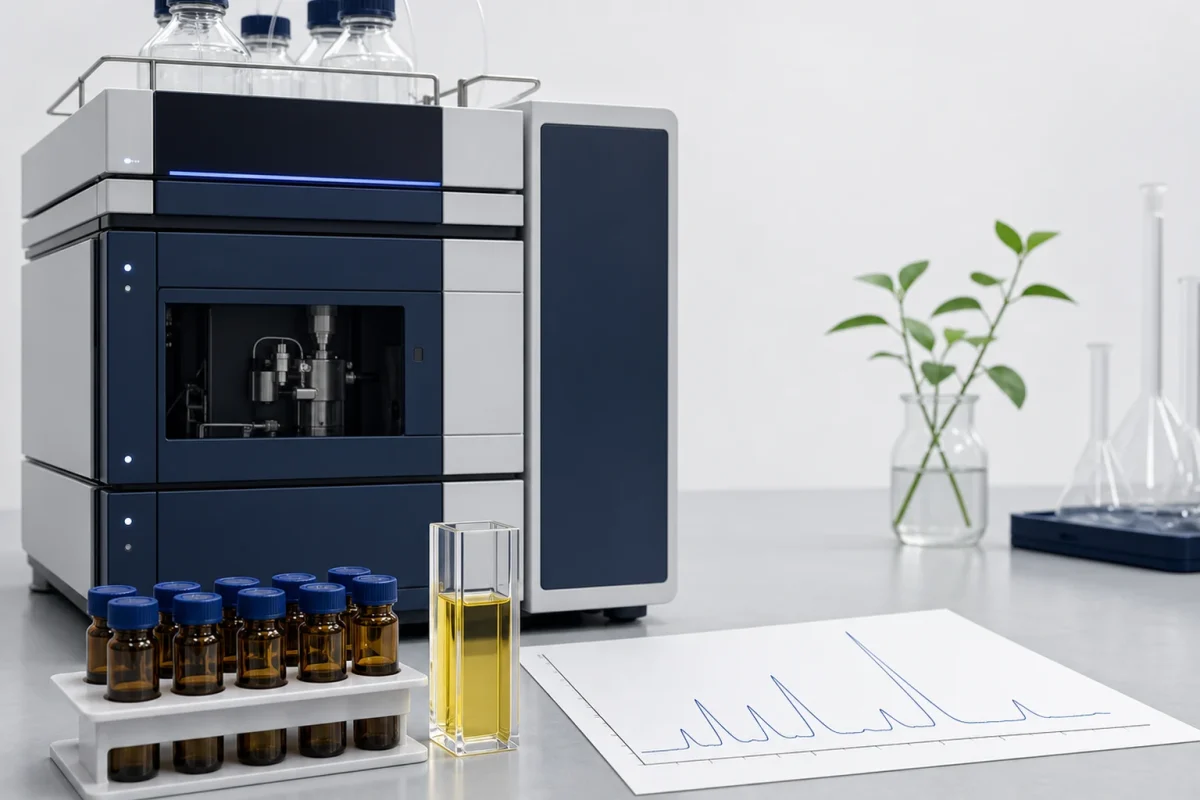
The marker section is where the specification becomes measurable. A marker compound is the chemical constituent used to standardize and verify the extract, and the assay method is the analytical technique that quantifies it. Without both, a COA percentage is unverifiable.
Common marker compounds and assay methods
| Botanical extract | Marker compound | Marker type | Typical assay method |
|---|---|---|---|
| Turmeric (Curcuma longa) | Curcuminoids | Active | HPLC-UV |
| Ashwagandha (Withania somnifera) | Withanolides | Active | HPLC-UV |
| Ginkgo (Ginkgo biloba) | Flavonol glycosides, terpene lactones | Active | HPLC |
| Ginseng (Panax ginseng) | Ginsenosides | Active | HPLC |
| Green tea (Camellia sinensis) | EGCG | Active | HPLC |
| Milk thistle (Silybum marianum) | Silymarin | Active | HPLC |
| Rhodiola (Rhodiola rosea) | Rosavins, salidroside | Active | HPLC |
| Echinacea (Echinacea purpurea) | Cichoric acid, alkylamides | Analytical | HPLC |
HPLC (High-Performance Liquid Chromatography) is the reference method for active-marker quantification because it separates the target constituent from the extract matrix and reports a validated percentage. UV-Vis spectrophotometry is acceptable for some analytical markers but has lower specificity — two different compounds can absorb at the same wavelength and inflate the result. TLC (Thin-Layer Chromatography) is used for rapid identity confirmation, not quantification.
How to fill the marker fields
| Field | Buyer input | Notes |
|---|---|---|
| Marker name | Use the common or pharmacopeial name | Must match the COA line exactly |
| Assay range | e.g., “NLT 95.0% curcuminoids” or “4.0%–6.0% withanolides” | State both floor and ceiling when applicable |
| Test method | HPLC, UV, TLC, GC, ICP-MS | Name the method, not just the result |
| Reference standard | Pharmacopeial (USP, EP, ChP) or in-house | In-house standards require validation data |
| Specification basis | Pharmacopeial monograph, supplier spec, or buyer spec | Determines who owns the limit |
For constituents with known activity, the European Medicines Agency convention sets the acceptable release range at the declared value ±5%. Where only analytical markers apply, the range should reflect validated analytical performance across multiple production batches. State the range on the sheet so the supplier’s COA has a limit to compare against — a COA result without a specification limit cannot be judged pass or fail.
4. Physical Property and Storage Fields
Physical fields govern how the extract behaves in your formulation and warehouse. They are the fields most often omitted from RFQs, and the most common source of sample rejection.
Physical field checklist
| Field | Typical specification | Test method |
|---|---|---|
| Appearance | Fine powder | Visual |
| Color | Characteristic (e.g., orange-yellow for curcumin) | Visual |
| Odor | Characteristic, no off-odor | Organoleptic |
| Particle size | 95% through 80 mesh (180 µm) | Sieve analysis |
| Bulk density | 0.40–0.65 g/mL | USP tap density |
| Loss on drying | NMT 5.0% (powders) | USP (105°C, 3h) |
| Residue on ignition (ash) | NMT 5.0% | USP (800°C) |
| Solubility | Water-soluble / ethanol-soluble / oil-soluble | Qualitative |
| Storage direction | Cool, dry, away from direct light | — |
Loss on drying and particle size are the two fields that most often cause downstream problems. A powder above 5% moisture is prone to caking and microbial growth in storage; a particle size outside the declared mesh range can block encapsulation equipment or produce uneven dispersion in beverages. Include both on the sheet and require both on the COA.
5. Contaminant Limits — Heavy Metals, Pesticides and Microbial
Contaminant limits are the legally binding part of a specification because the acceptable ceiling depends on the destination market, the finished-product form and the daily intake level. A specification that “passes USP” without naming individual elements and numeric limits is not enforceable.
Heavy metal limits (oral exposure, common B2B ceilings)
| Element | Common extract limit | Test method | Regulatory basis |
|---|---|---|---|
| Lead (Pb) | NMT 2.0 ppm | ICP-MS | USP / EP 2.4.27 |
| Arsenic (As) | NMT 1.5 ppm | ICP-MS | USP / EP 2.4.27 |
| Cadmium (Cd) | NMT 0.3–1.0 ppm | ICP-MS | USP / EP 2.4.27 |
| Mercury (Hg) | NMT 0.1–0.15 ppm | ICP-MS | USP / EP 2.4.27 |
The modern reference framework is USP General Chapters on elemental contaminants, harmonized with ICH Q3D. The old colorimetric “heavy metals” test was retired because it could not distinguish individual elements; accepted techniques are now ICP-MS or ICP-OES. The concentration a buyer requires depends on the maximum daily dose: a supplement with a 1 g/day intake can tolerate a higher ppm ceiling than a 30 g/day powder serving under the same Permitted Daily Exposure (PDE). California Proposition 65 layers an additional warning regime with a lead limit roughly ten times tighter than the USP PDE, which matters for any product sold into California.
Pesticide residue limits
For EU-bound products, pesticide residue data should follow EU Regulation (EC) 396/2005, which sets Maximum Residue Levels (MRLs) across hundreds of parameters with a default limit of 0.01 mg/kg. For US-bound products, the reference is USP <561>/<565> and EP 2.8.13, with multi-residue screens run by GC-MS/MS and LC-MS/MS covering 400+ compounds. If a COA cites an “internal method” where a pharmacopeial method exists, request full method validation data — linearity, precision, accuracy, detection limits.
Microbial limits
| Parameter | Common limit | Test method |
|---|---|---|
| Total aerobic microbial count | NMT 10,000 CFU/g | USP / EP 5.1.4 |
| Yeast and mold | NMT 1,000 CFU/g | USP |
| Escherichia coli | Negative / g | USP / EP 2.6.13 |
| Salmonella spp. | Negative / 25 g | USP / EP 2.6.13 |
| Staphylococcus aureus | Negative / g | USP / EP 2.6.13 |
Aflatoxins should also appear on the sheet for botanical extracts: USP 561 sets B1 at NMT 5 µg/kg and total aflatoxins (B1+B2+G1+G2) at NMT 20 µg/kg. Residual solvents must be reported when the extraction process uses ethanol, acetone or hexane, with limits per ICH Q3C.
6. Document Package and Certification Fields
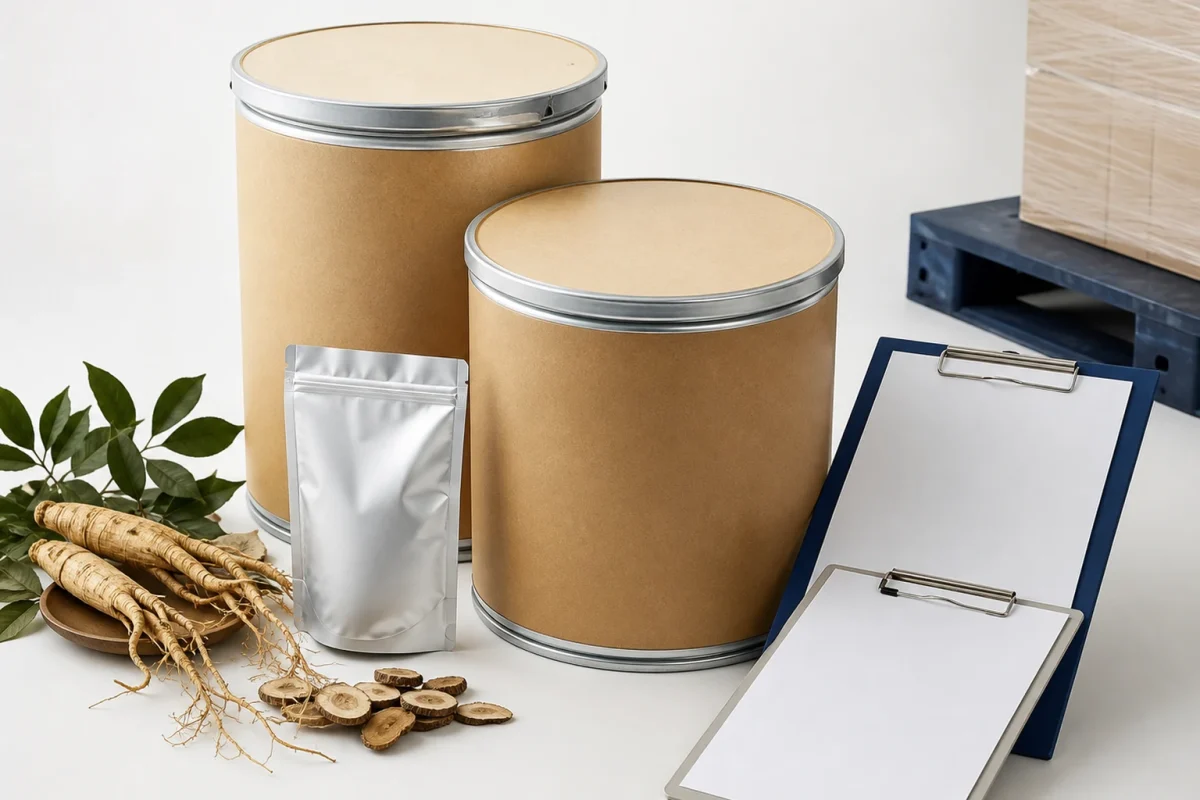
The document section defines what the supplier must deliver alongside the material. A lot-traceable COA is the minimum; the rest depends on the destination market and the buyer’s QA system.
Document and certification checklist
| Document / certification | What it confirms | When required |
|---|---|---|
| Lot-traceable COA | Batch-specific test results tied to the shipping lot | Every shipment |
| Method validation note | Linearity, precision, accuracy, LOD/LOQ for in-house methods | When pharmacopeial method is not used |
| SDS / MSDS | Safety data for handling and transport | All shipments |
| GMP (cGMP) certificate | Current good manufacturing practice (FDA 21 CFR Part 111) | US supplement market |
| FSSC 22000 | Food safety system certification | EU and premium supplement chains |
| ISO 22000 / ISO 9001 | Food safety / quality management | Global supply chains |
| HACCP | Hazard analysis and critical control points | All food-grade supply |
| ISO/IEC 17025 (lab) | Laboratory competence for the test matrix and method | When third-party testing is required |
| Organic (NOP / EU) | Third-party verified organic raw material | Organic-labeled products |
| US FDA Facility Registration | Facility registered with FDA | All US-imported supplements |
Two verification rules apply. First, the lot number on the COA must match the lot number on the shipping documentation and product labels — a generic or “reference” COA reused across batches is a documentation red flag. Second, certifications expire: FSSC 22000 and ISO certificates are typically renewed annually or every three years, so request the actual certificate document with a valid expiry date rather than relying on a website logo.
7. Commercial Fields — From Specification to Quotation
The commercial section converts a technical file into a priceable request. Without it, the supplier can confirm the grade but cannot quote.
Commercial field checklist
| Field | Buyer input | Purpose |
|---|---|---|
| MOQ | Minimum order quantity (kg) | Filters suppliers below your volume |
| Packing size | 25 kg drum, 1 kg bag, custom | Affects logistics cost and storage |
| Lead time | Production + shipping weeks | Production planning |
| Incoterm | FOB, CIF, EXW, DDP | Defines cost and risk transfer |
| Destination market | EU, US, SEA, etc. | Triggers document and limit set |
| Quotation currency | USD, EUR, CNY | Price comparison basis |
| Payment terms | T/T, L/C, net 30 | Cash-flow planning |
8. Open Grade vs Fixed Specification — How to Use the Sheet
Buyers approach the sheet in two modes. In open-grade mode the buyer knows the application but not the exact grade, and asks the supplier to propose available specification options with representative COAs and sample lot details. In fixed-specification mode the buyer has locked the marker, method and limit set, and sends the completed sheet as a firm RFQ.
| Dimension | Open grade | Fixed specification |
|---|---|---|
| Best use | Early supplier screening and sample comparison | Strict QA review and quotation |
| Buyer input | Application, source direction, acceptable marker range | Exact marker, method, physical fields, document list |
| Limitation | Needs later specification confirmation | May reduce available supplier options |
| COA expectation | Representative lot COA for each proposed grade | Lot-traceable COA matching the shipping batch |
If the grade is still open, send the target assay range and method first and ask for two or three specification options. If the grade is fixed, send the completed sheet directly — the supplier’s response should be a quotation plus a lot-traceable COA, not a counter-proposal.
9. Market Context — Why Specification Discipline Matters
The global plant extract market was valued at approximately USD 12.4 billion in 2024 and is projected to reach USD 18.5 billion by 2030, growing at a CAGR of 6.6% (Strategic Market Research, 2024). Botanical-extract-specific estimates range from USD 6.3 billion to USD 7.1 billion in 2024, with CAGR forecasts of 6.3%–9.7% through 2030–2034 (Credence Research; DataString Consulting; Frost & Sullivan, 2024). Powdered extracts dominate the form segment because of stability, dosing precision and transport efficiency — which is exactly why particle size, loss on drying and bulk density belong on every specification sheet.
Asia-Pacific holds the largest regional share at approximately 34%, followed by North America (~29%) and Europe (~26%). Food and beverage is the largest application segment (~37%), with pharmaceuticals (~28%) and dietary supplements (~14%) following. As regulatory scrutiny intensifies — EU MRL frameworks, USP elemental contaminant chapters, Amazon’s 2024 requirement for ISO/IEC 17025-accredited COAs on supplement listings — a disciplined specification sheet is no longer optional; it is the document that determines whether a batch clears customs and listing review.
10. Related HERBSEA Resources
- Plant Extract COA Review Checklist — document screening and COA red-flag review.
- Plant Extract Sample Request Guide — sample quantity, specification and lot details.
- Bulk Ingredient Sample Request Template — sample-level fields across ingredient categories.
- Food Ingredient RFQ Template — supplier comparison, packing and quotation fields.
- Ingredient Export Documentation Checklist — COA, packing and destination-market documents.
- Ingredient Supplier Audit Checklist — supplier scope, sample control and document readiness.
- Bamboo Leaf Extract Supplier — flavonoid specification review.
- Soybean Seed Extract Supplier — isoflavone specification review.
- Zizyphus Jujuba Extract Supplier — botanical source and extract ratio review.
- Contact HERBSEA — send the completed specification, sample, COA and RFQ fields.
Include botanical identity (Latin name, plant part, extract ratio, solvent), marker compound name with assay range and test method, physical properties (appearance, particle size, bulk density, loss on drying), contaminant limits (heavy metals, pesticides, microbial, aflatoxins, residual solvents), document package (lot-traceable COA, SDS, certifications) and commercial terms (MOQ, packing, lead time, Incoterm, destination market).
The assay method (HPLC, UV, TLC) determines how much trust you can place in the percentage. HPLC separates the target constituent from the matrix and reports a validated value; UV-Vis has lower specificity and can overstate the result. A COA percentage without a named method is not verifiable.
For oral-exposure botanical extracts, common B2B ceilings are lead NMT 2.0 ppm, arsenic NMT 1.5 ppm, cadmium NMT 0.3-1.0 ppm and mercury NMT 0.1-0.15 ppm, tested by ICP-MS. The exact ceiling depends on the maximum daily dose and destination market — California Proposition 65 sets a lead limit roughly ten times tighter than the USP PDE.
Yes. MOQ, packing size, lead time, Incoterm and destination market let the supplier move from technical review to quotation. A specification sheet without commercial fields produces a grade confirmation, not a price.
In open-grade mode, send the target assay range and method and ask for two or three specification options with representative COAs. In fixed-specification mode, send the completed sheet as a firm RFQ and expect a quotation plus a lot-traceable COA matching the shipping batch.
Extract ratio (e.g., 10:1) states how much raw botanical yielded the extract — a concentration statement. Marker assay (e.g., 95% curcuminoids by HPLC) states the potency of the target constituent. Both must appear on the sheet and COA because a high ratio does not guarantee a high marker level.
Summary
Before supplier comparison, align material identity, target marker, assay method, physical properties, contaminant limits, document package, MOQ, packing and destination market. Clear inputs help both sides move from document review to quotation. Use this page as a pre-RFQ worksheet, then send the completed fields to the relevant HERBSEA product page or contact form.
Data sources: Strategic Market Research (2024); Credence Research (2024); DataString Consulting (2024); Frost & Sullivan (2024); USP General Chapters; EP 2.4.27 / 2.8.13; EU Regulation (EC) 396/2005; ICH Q3D / Q3C; FDA 21 CFR Part 111. Market figures are third-party estimates and are provided for procurement context only.