
Quick Answer: A complete bulk botanical extract RFQ should carry nine fields: material identity (botanical name, plant part, extract ratio), target specification (marker, assay method, physical fields), sample status, document request (COA, spec sheet, method note), quantity and MOQ expectation, packing size, lead time, payment and delivery terms, and destination market. Sending these in one structured RFQ lets suppliers respond with comparable quotations — and cuts the typical back-and-forth from weeks to days. For reference: routine botanical extract specifications commonly carry a commercial MOQ of 25 kg, trial-order MOQ from 1 kg, sample packs from 100 g to 1 kg, and lead times of 5-15 working days after order confirmation (Essencefield, 2026). Use the Plant Extract COA Review Checklist as the document-screening companion to this RFQ worksheet.
1. The 9 Fields a Bulk RFQ Must Carry
A structured RFQ is the single biggest lever for getting comparable quotations. Suppliers quote what they are asked — incomplete inputs produce mixed quotes.
| # | Field | What to specify | Why it matters |
|---|---|---|---|
| 1 | Material identity | Botanical name, plant part, extract ratio (e.g., 10:1) or marker target | Defines the item before any price comparison |
| 2 | Target specification | Marker, assay range, assay method (HPLC/UV/TLC), physical fields | Avoids “same name, different grade” quotes |
| 3 | Sample status | Needed / received / approved / pending review | Shows where the project sits in the buying process |
| 4 | Document request | Specification sheet, COA, method note, packing and export files | Lets the supplier prepare one complete response |
| 5 | Quantity | Estimated annual or first-order volume | Drives price tier and production planning |
| 6 | MOQ expectation | Trial vs commercial MOQ you can accept | Filters out suppliers that cannot fit your order size |
| 7 | Packing size | Inner bag, drum/carton size, label requirements | Affects quotation, logistics and warehouse review |
| 8 | Lead time + delivery terms | Expected delivery window, FOB / CIF / EXW basis | Aligns your planning with supplier production slots |
| 9 | Destination market | Country, port, address or requested delivery basis | Supports freight and export-document planning |
2. Open Grade vs Fixed Specification
| Dimension | Open grade | Fixed specification |
|---|---|---|
| Best use | Early supplier screening and sample comparison | Strict QA review and quotation |
| Buyer input | Application, source direction, acceptable marker range | Exact marker, method, physical fields, document list |
| RFQ approach | Ask suppliers to propose specification options with representative COA and sample lot | Send target assay and method first; request quote on the fixed spec |
| Limit | Needs later specification confirmation | May reduce available supplier options |
Buyer takeaway: if the grade is fixed, send the target assay and method first. If the grade is still open, run an open-grade RFQ to collect options — then lock the spec before the bulk quote.
3. MOQ, Sample and Lead-Time Benchmarks
These are directional industry figures to calibrate expectations — always reconfirm in the current quotation.
| Parameter | Typical range | Source |
|---|---|---|
| Sample pack | 100 g – 1 kg | Essencefield, 2026 |
| Trial-order MOQ | from 1 kg | Essencefield, 2026 |
| Commercial MOQ (routine spec) | 25 kg | Essencefield, 2026 |
| Lead time (standard spec, after order) | 5-15 working days | Essencefield, 2026 |
| Supplier long-list size (before shortlisting) | 8-15 suppliers | Altus Exports buyer playbook, 2026 |
| RFQ response deadline to set | 10-14 business days | Altus Exports buyer playbook, 2026 |
Custom specifications (different extract ratio, marker testing, particle size, carrier or documentation scope) typically extend both MOQ and lead time.
4. The RFQ-to-Quotation Flow (6 Steps)
A professional sourcing sequence produces verifiable quotations instead of price lists:
- Define the specification document — one page covering botanical name, extraction method, purity parameters, packaging, volume, certifications and Incoterms (Altus Exports, 2026).
- Build a long list — 8-15 potential suppliers from exporter registries, trade shows, import shipment data and B2B platforms.
- Issue a structured RFQ — request unit price (FOB and/or CIF), MOQ, lead time, sample availability, certifications and export history; set a 10-14 business-day response deadline.
- Verify before payment — confirm registration/licence status directly (not supplier-provided scans), request shipping bills or bills of lading, and check reference buyers.
- Test a representative sample — evaluate against your application (dry formats: appearance, particle behavior, bulk density, flow; beverage: dispersibility, sedimentation, flavor, color); retain the approved sample as the reference standard.
- Place a trial order, then scale — start with a trial lot, compare the first commercial batch against the approved sample, then commit to repeat volume.
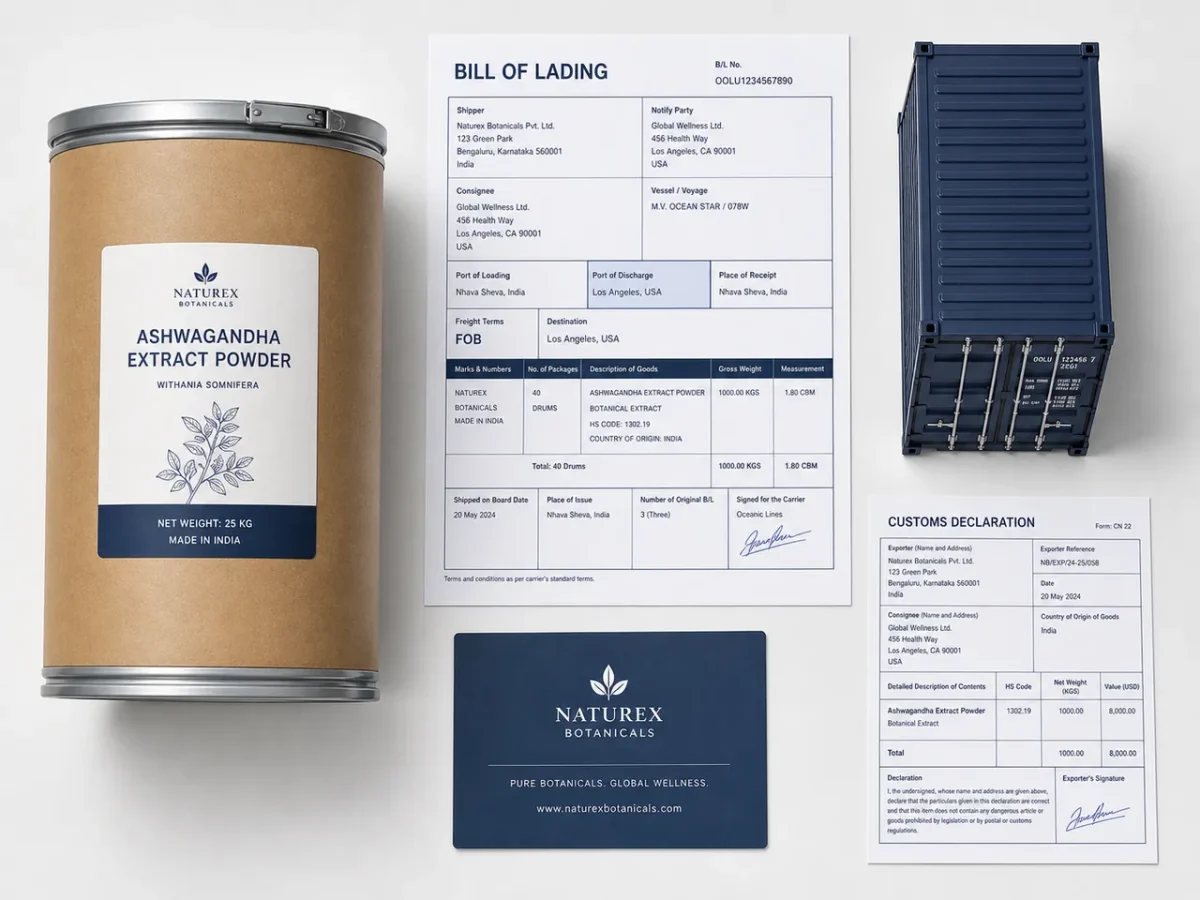
The export package above covers step 3-4 of the flow — stating FOB/CIF basis and verifying shipping documents before any payment commitment.
5. Quotation Comparison: What the Price Includes
Two suppliers can quote the same per-kg price with very different delivered costs. Compare these five elements, not the headline number.
| Comparison point | What to check | Red flag |
|---|---|---|
| Price basis | FOB vs CIF vs EXW; freight who pays | Price without a stated basis |
| MOQ scope | Trial vs commercial MOQ; grade-dependent MOQ | MOQ only “on request” |
| Lead time | Standard vs custom spec; production slot | Lead time not committed in writing |
| Payment terms | T/T deposit %, L/C, net days | 100% prepayment demanded on first order |
| Document scope | COA, method note, export files included | Documents quoted as “extra” |
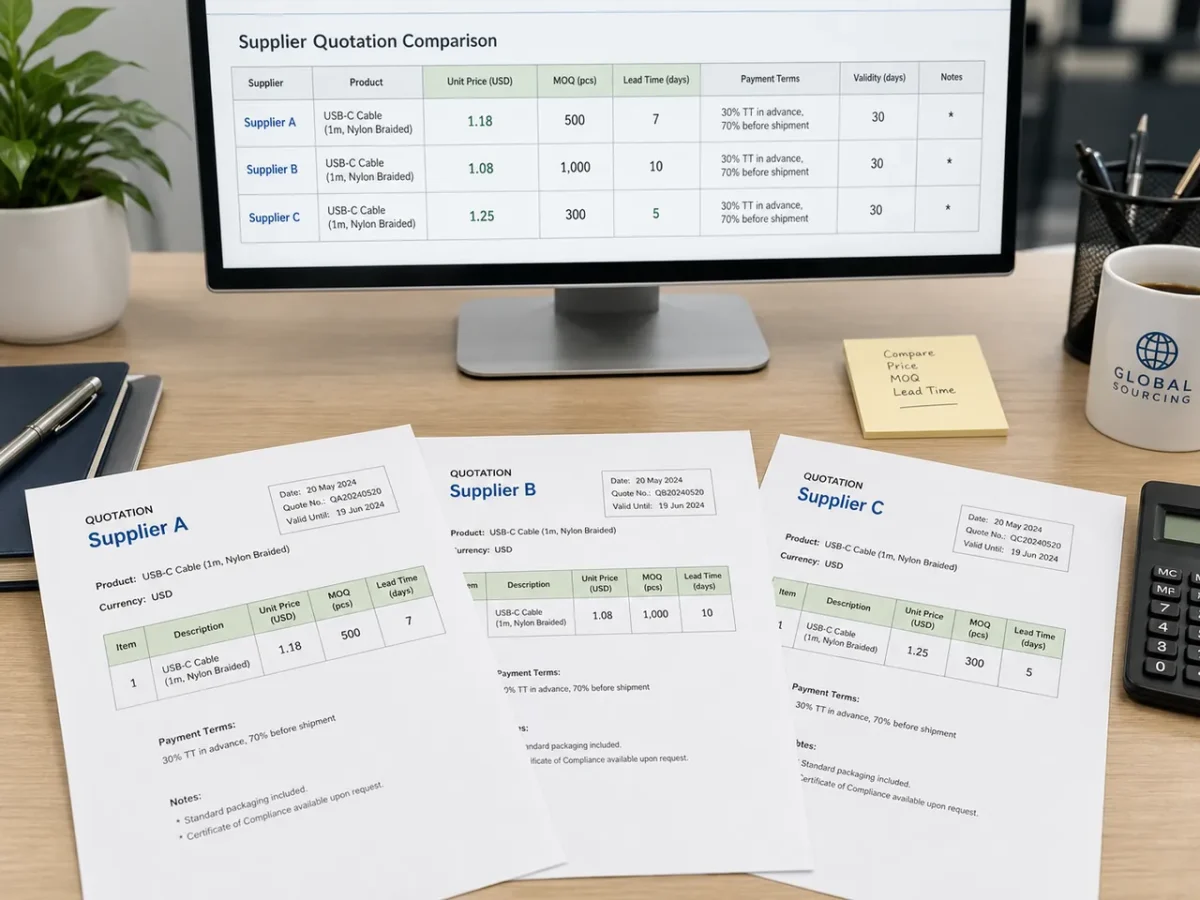
The comparison desk above mirrors section 5 — price basis, MOQ scope, lead time, payment terms and document scope decide which quote is actually cheapest.
6. RFQ-Ready Checklist (Copy Into Your Worksheet)
- Botanical name, plant part, extract ratio and marker target
- Assay method and physical fields (appearance, particle size, bulk density)
- Sample status: needed / received / approved / pending
- COA, spec sheet, method note and export document needs
- Quantity, MOQ expectation and packing size
- Lead time, payment terms and delivery basis (FOB/CIF/EXW)
- Destination market, port and requested delivery basis
7. FAQ
Include material identity, target specification (marker, method, physical fields), sample status, COA needs, quantity, MOQ expectation, packing, lead time, payment/delivery terms and destination market — nine fields that let a supplier quote once instead of asking back.
If the grade is new or the application is still being tested, yes — sample review should come before bulk quotation. Retain the approved sample as your reference standard for every future batch comparison.
Routine specifications commonly carry a commercial MOQ of 25 kg, with trial orders from 1 kg and sample packs from 100 g to 1 kg (Essencefield, 2026). Custom specifications typically raise both MOQ and lead time.
Ask for FOB price in USD per kg at the stated packing specification; request CIF only if you want the supplier to arrange freight — then compare that against your own forwarder rates (Altus Exports, 2026).
Set a response deadline of 10-14 business days — long enough for serious suppliers to quote properly, short enough to keep the process moving. Typical lead time after order confirmation is 5-15 working days for standard specs.
Use the relevant HERBSEA product page or the contact page with the completed RFQ details — a full RFQ record gets a faster, more complete response.
8. Summary
Before supplier comparison, align material identity, target marker, assay method, specification fields, sample plan, MOQ, packing, lead time, payment terms and destination market. A nine-field structured RFQ plus a fixed response deadline moves both sides from document review to comparable quotation — and keeps price comparison honest.
Related resources: Plant Extract COA Review Checklist · Plant Extract MOQ Specification Checklist · Botanical Extract Assay Method Guide · Bulk Ingredient Sample Request Template · Ingredient Export Documentation Checklist · Plant Extract Supplier hub for Honeysuckle Flower, Rutin 95% and Inulin product documentation.
Data sources: Essencefield product sourcing guides (2026); Altus Exports buyer’s playbook for direct ingredient sourcing (2026). Benchmarks are directional and should be reconfirmed in each supplier’s current quotation.