
Quick answer: A professional black tea powder sample request should cover six things: application (RTD tea, milk tea, vending, bakery or dry mix), powder behavior targets (solubility, color, sensory profile), specification + COA needs, sample quantity and test matrix, destination address and shipping terms, and commercial expectations (MOQ, packing, lead time). In practice, stock samples of standard grades are usually free or low-cost with the buyer paying shipping (~US$0-50), while custom or pre-production samples run US$50-1000+ and are often credited against a bulk order. The full request-to-receipt process typically takes 2-6 weeks. Sourcing benchmarks suggest sample-to-order conversion of 20-30% for qualified buyers — so the quality of your sample request directly affects both speed and which suppliers respond to you as a serious buyer.
This B2B sourcing guide helps beverage, food-service and dry mix buyers prepare supplier questions before samples or quotation. Use the Instant Black Tea Powder product page as the main commercial page, then confirm specification, sensory target, solubility, COA, sample and packing details with the supplier.
1. Sample Types & Typical Costs (What You Are Really Asking For)
Not all “samples” are the same. Matching the sample type to your stage saves time and money.
| Sample type | Typical cost | Lead time | Refundable vs bulk order? | Best use |
|---|---|---|---|---|
| Stock sample (standard grade) | US$0-50, usually free + buyer pays shipping | 1-3 days to dispatch | Usually not; some suppliers credit it | Initial quality check, supplier evaluation |
| Custom sample (target specification) | US$50-500 | 2-4 weeks | Often credited against first bulk order | Grade/assay customization |
| Pre-production sample | US$100-1,000+ | 1-3 weeks after process setup | Typically refundable with purchase order | Final approval before bulk production |
| Production-matching sample (from commercial batch) | Included in bulk quote | With batch production | N/A | Batch-to-batch consistency check |
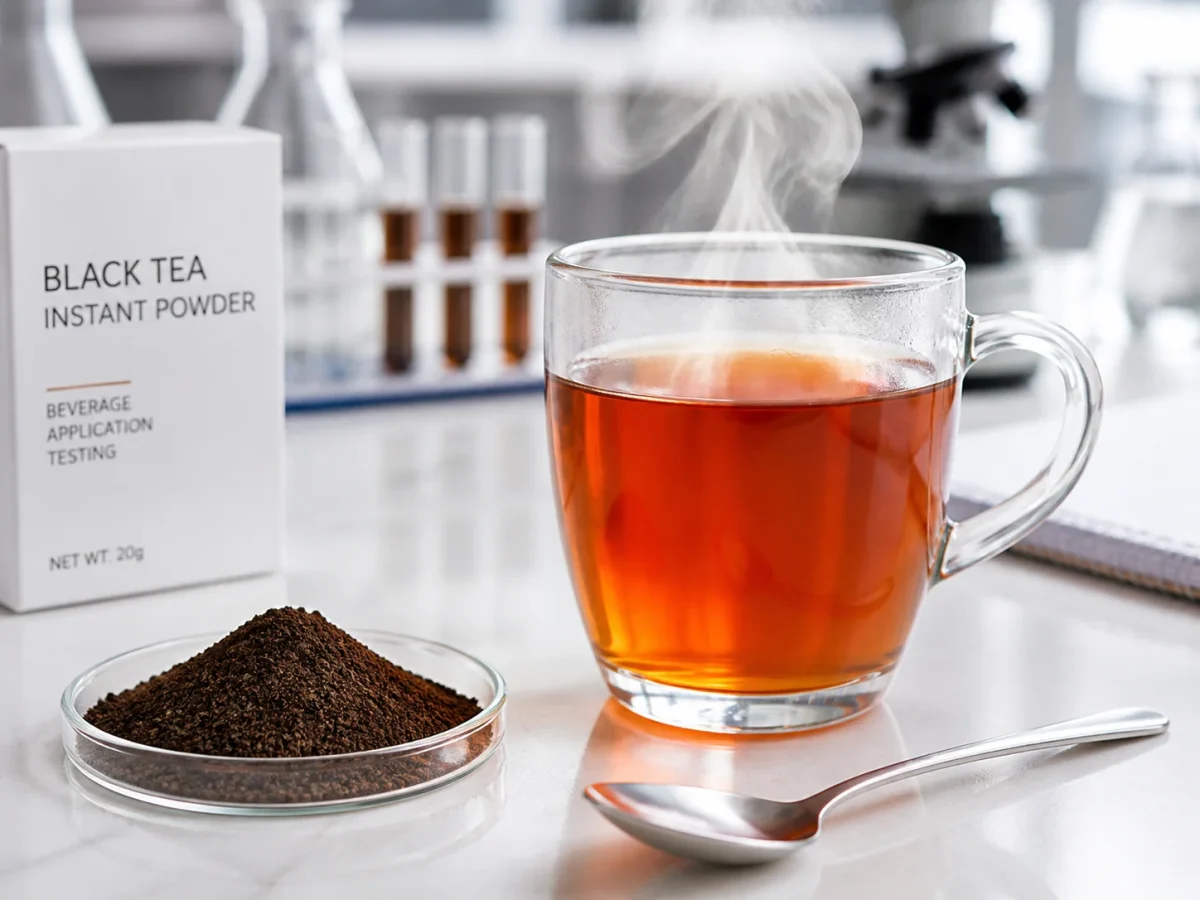
The setup above is a typical beverage application test — instant powder dissolved in water, evaluated against target solubility, color and sensory profile.
Rule of thumb: most reputable suppliers give free stock samples for standard products — you pay shipping. Custom samples carry a fee because of material and labor. Always ask in writing: is the sample free, what does the fee cover, and is it refundable/creditable against the first order?
2. The 2-6 Week Sampling Timeline (Plan Backwards)
| Stage | Typical duration | What happens |
|---|---|---|
| Request + spec alignment | 1-5 days | Supplier confirms availability, spec fit and sample policy |
| Production (stock: none; custom: yes) | 1-4 weeks | Custom grades are produced and QC-tested |
| QC + documentation | 2-5 days | COA, spec sheet and packing prepared |
| International shipping | 3-10 days (express) to 3-6 weeks (sea) | DHL/FedEx/UPS for samples is standard |
| Total request → receipt | 2-6 weeks | Factor this into your development schedule |
Plan backwards from your internal review deadline — especially if the sample must reach QA, a co-packer or a regulatory submission.
3. Sample Cost Breakdown (What You Actually Pay For)
| Cost item | Who normally pays | Typical range | Notes |
|---|---|---|---|
| Sample fee (stock) | Supplier covers; buyer pays if custom | $0 / $50-500 | Confirm refund/credit policy in writing |
| International shipping | Buyer (or DDP if agreed) | $30-120 express for 0.5-2 kg | DHL/FedEx/UPS standard for samples |
| Duties/taxes | Buyer (unless DDP) | Varies by market | Sample under low value often cleared quickly |
| Customs brokerage | Buyer (unless DDP) | Varies | Confirm Incoterm before dispatch |
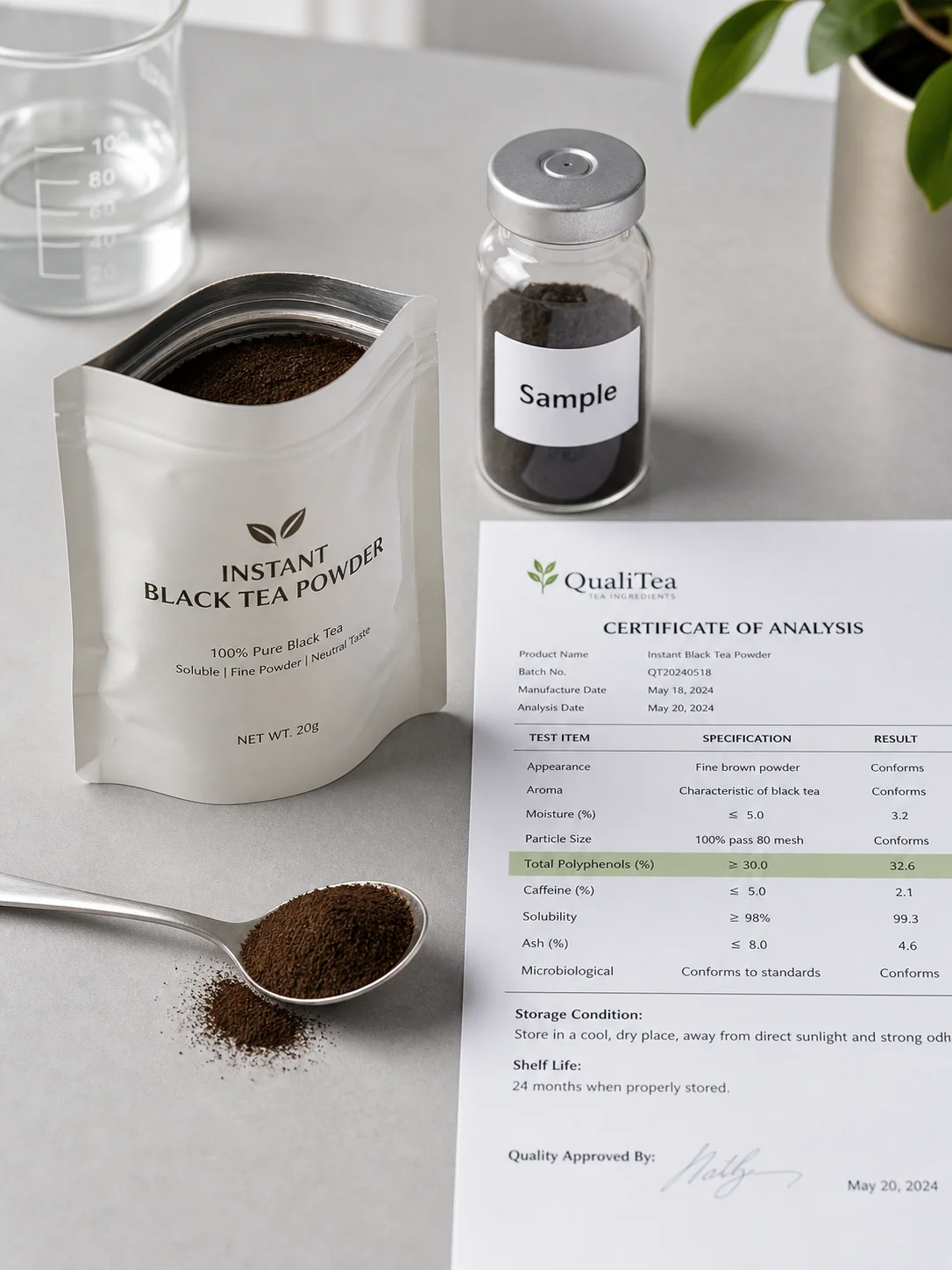
The package above shows the four cost items above in action — sample pouch, express shipping box, invoice with MOQ/packing, and an HS code tag for customs.
Practical tip: a sample fee is a small signal filter for both sides. Serious buyers accept a reasonable sample fee or at least pay shipping; serious suppliers credit the fee against the first bulk order. This is a standard B2B practice — not a red flag.
4. Sample Request Checklist (Copy-Paste Fields)
Send these fields in your first message to avoid back-and-forth:
- Product identity: instant black tea powder, grade (e.g., 20-40% or full-solubility instant), target assay if any
- Application & process route: RTD tea, milk tea, vending drink, food-service, bakery or dry mix; hot-fill/cold-fill
- Powder behavior targets: wetting, dispersion, sediment, color, taste impact — the approval criteria
- Specification & COA needs: spec sheet, representative COA, allergen statement if applicable
- Sample quantity & test matrix: e.g., 500 g for sensory + 200 g for lab; what tests you will run
- Destination & shipping terms: full address, preferred courier, Incoterm (DDU/DDP), and who pays
- Commercial path: MOQ expectation, packing size (10/20/25 kg), lead time target, estimated annual volume
- Internal deadline: when the sample must arrive for your review cycle
5. Shipping Method Comparison (Samples)
| Method | Transit time | Cost (0.5-2 kg) | Best for |
|---|---|---|---|
| Express courier (DHL/FedEx/UPS) | 3-10 days | $30-120 | Standard for samples; tracked, door-to-door |
| Air freight (consolidated) | 1-2 weeks | Moderate | Larger sample volumes (5-25 kg) |
| Sea freight (LCL) | 3-6 weeks | Lowest | Trial orders near MOQ, not single samples |
6. From Sample to Bulk Order (5 Steps)
Confirm batch traceability — sample label, representative COA and quotation record must match — before you move to bulk.
- Evaluate the sample against your test matrix: solubility, color, taste, process fit
- Verify batch traceability: sample label, representative COA and quotation record must match
- Confirm scale-up: ask whether the bulk batch is produced on the same line and process as the sample
- Lock the commercial terms: MOQ, packing, lead time, price breaks — before the trial order
- Keep a reference sample: retain the approved sample and compare it with the first commercial batch (batch-to-batch consistency)
Sourcing benchmarks suggest sample-to-order conversion of 20-30% within 90 days for qualified buyers — the more complete your request, the faster serious suppliers respond with a usable sample.
7. Why Black Tea Powder Samples Matter: Market Context (2024-2026 Data)
| Data point | Value | Source |
|---|---|---|
| Global instant tea market | US$2.58B in 2024 → US$3.45B by 2030 (CAGR ~4.98%) | TechSci Research |
| Global RTD tea market | ~US$39.5B in 2024, ~5.8% CAGR (black tea is the dominant segment) | Archive Market Research / Citius Research |
| US instant tea share of tea consumption | ~18% in 2024 | USDA |
| Global tea production | 6.604 million tonnes in 2023 | International Tea Committee |
| Top black tea exporters (HS 0902.40, 2024) | Kenya ~US$1.36B (39.2%), Sri Lanka ~US$674M, India ~US$667M — top three ~78% of world exports | UN Comtrade 2024 |
Takeaway for buyers: instant black tea powder feeds two fast-growing lanes (instant drinks and RTD tea), and supply is concentrated in a few origins. Sample evaluation is the cheapest way to verify that a supplier’s spec, COA and powder behavior actually fit your finished product before you commit to MOQ.
8. Sample Request vs Bulk RFQ (When to Move Forward)
| Dimension | Sample request | Bulk RFQ |
|---|---|---|
| Main purpose | Check solubility, color, sensory profile and document fit | Confirm commercial supply, packing, lead time and export details |
| Buyer input | Application, sample quantity, test matrix and COA needs | Quantity, MOQ expectation, packing size and destination market |
| Documents | Representative COA, spec sheet, shipping terms | Proforma invoice, packing options, origin certificate, test reports |
| Limit | Needs later commercial confirmation | Should follow sample approval when formula fit is strict |
9. FAQ
What should a black tea powder sample request include?
Include application, powder behavior target, sample quantity, COA needs, destination address, shipping terms, MOQ expectation and packing preference. A complete request gets a faster, more useful response.
Are black tea powder samples free?
Most suppliers provide free stock samples of standard grades — the buyer usually pays international shipping. Custom or pre-production samples typically cost US$50-1,000+ and are often credited against the first bulk order. Confirm the policy in writing.
How much sample should I request?
A common starting point is 300-500 g for sensory and application testing plus a smaller portion for lab analysis (e.g., 100-200 g). Match the quantity to your test matrix; 1-2 kg is enough for pilot-scale work.
How long does it take to receive a sample?
Request-to-receipt usually takes 2-6 weeks: 1-5 days to align, 1-4 weeks for custom production, then 3-10 days express shipping. Factor this into your development and approval deadlines.
Does the sample represent the bulk production?
Ask explicitly whether the bulk batch is produced on the same line and process as the sample, and request a production-matching sample from the commercial batch for batch-to-batch consistency.
Which page should handle quotation?
Use the Instant Black Tea Powder product page for product-level samples and quotation, and this checklist for the sample request itself.
10. Summary
A complete sample request — application, powder behavior targets, spec/COA needs, sample quantity, shipping terms, MOQ and a clear internal deadline — separates serious buyers from noise and shortens the 2-6 week sampling cycle. Confirm sample policy and costs in writing, verify batch traceability, and only move to bulk RFQ after the sample fits your formula.
Download or request the Tea Powder RFQ Checklist from HERBSEA.
Ingredient Sourcing Resource Center
Use these HERBSEA resources to keep supplier, COA, sample, MOQ, RFQ and export documentation review in one practical sourcing path.
- Ingredient Sourcing Guide Index for grouped tea powder, plant extract, fruit powder and documentation resources.
- Bulk Ingredient Sample Request Template for sample quantity, specification, COA and MOQ fields.
- Food Ingredient RFQ Template for supplier comparison, packing and quotation fields.
- Ingredient Export Documentation Checklist for COA, packing and destination-market document review.
- Ingredient Supplier Audit Checklist for supplier scope, sample control and document readiness.
Data sources: B2B sample-cost and lead-time benchmarks compiled from public China-sourcing and ingredient-supplier guides (2024-2026); sample-to-order conversion benchmark (20-30% / 90 days) from B2B platform seller guidance; TechSci Research instant tea market (2024 base, 2030 forecast); Archive Market Research and Citius Research RTD tea market reports (2024/2023 base); USDA instant tea consumption share (2024); International Tea Committee global production (2023); UN Comtrade 2024 black tea export data (HS 0902.40). All costs and policies vary by supplier and market — always confirm sample terms in writing before dispatch.