
Quick Answer: Cold soluble black tea powder is a spray- or freeze-dried instant tea grade formulated to dissolve fully in cold water (0°C and above), with no sediment, clear bright color and stable dispersion in acidic or dairy-based formulas — the base ingredient for RTD iced tea, food-service drinks and cold-mix dry products. Before quoting, buyers should verify four things on the sample: cold-water dispersion (no clumping), sediment level, sensory fit (body, color, bitterness, sweetener/dairy matrix) and COA fields (assay, microbiology, heavy metals). Cold-water soluble powder demand is the fastest-growing segment — cold-water soluble black tea powder usage rose ~9% YoY in North America and Europe as RTD producers switch from leaf extract to powder formats (Intel Market Research, 2026). Use the Instant Black Tea Powder product page as the commercial reference.
1. Cold Soluble vs Hot Soluble: What the Difference Means for You
Not all instant tea powder dissolves the same way. The “soluble” label on a grade determines which drinks it can be used in.
| Dimension | Cold soluble (cold melt) | Hot soluble (hot melt) |
|---|---|---|
| Dissolution | Fully dissolves from ~0°C, no hot-water pre-step | Needs ~60°C+ water to dissolve properly |
| Dispersion | Disperses in cold liquid without clumping | May clump or leave residue in cold formulas |
| Stability | Stable in acidic environments, minimal sediment, clear bright solution | Designed for hot brews; acid/cold stability varies |
| Typical use | RTD iced tea, bottled drinks, cold-mix sachets, smoothies, dairy | Hot instant tea, tea bars, hot vending drinks |
| Segment trend | Fast-growing; RTD demand is the main driver | Mature; stable demand |
Cold melt grades dissolve from ~0°C, stay stable in acidic environments with no sediment and produce a clear bright solution — suited to soft drinks like iced black tea (winmarketresearch China instant tea powder report, 2024-2030).
2. Spray Dried vs Freeze Dried: Which Process Buys You What
The production method drives solubility, flavor retention, color and price. Spray drying dominates volume; freeze drying is the premium route.
| Process | How it works | Solubility | Flavor/aroma retention | Price signal | Best fit |
|---|---|---|---|---|---|
| Spray dried | Tea extract atomized in hot air, water evaporates fast | Good | Moderate — some volatiles lost to heat | Standard | High-volume RTD, cost-sensitive formulations |
| Freeze dried | Extract frozen, water sublimated under vacuum | Superior | High — volatiles and aroma preserved | Premium | Specialty/iced tea brands, premium RTD, color-sensitive products |
| Air dried | Slow drying of extract | Basic | Variable | Lowest | Commodity tea powder, non-critical applications |
Market reality: spray drying accounted for 61.2% of instant black tea powder production in 2025 for its cost efficiency and scalability, while freeze drying is expanding in premium lines that need superior flavor and aroma preservation (pmarketresearch instant black tea powder market, 2025).
3. The 5 Things to Verify on a Cold Soluble Sample
Sample review for cold soluble grades is a liquid-behavior test, not a powder-inspection exercise. Confirm these five before approving:
- Cold-water dispersion — mix at your target process temperature (0-10°C); check for clumping or floating particles within your mixing time.
- Sediment — after standing, measure visible sediment; RTD bottles need near-zero sediment for shelf appearance.
- Color & clarity — solution should be clear and bright, matching your brand color target (avoid grey/brown haze from over-processing).
- Sensory profile — body, bitterness and astringency against your sweetener and dairy system; a grade that works in water may taste different in a milk-tea matrix.
- COA fields — assay/marker, particle size, solubility claim, microbiology and heavy-metal limits per your destination market.

The dispersion test above covers checklist items 1-3 — cold-water mixing, sediment and color clarity are the first three gates of sample approval.
Buyer takeaway: request the sample with your actual formula matrix (sweetener, acid, dairy, flavor system), not just plain water — cold behavior changes in real formulas.
4. Applications: Where Cold Soluble Grades Go
Cold soluble black tea powder serves every cold-preparation channel:
| Application | What to verify | Why it matters |
|---|---|---|
| RTD iced tea (bottled/canned) | Sediment, color stability, acid stability | RTD is the largest application — 47.1% of instant tea powder demand in 2025 (pmarketresearch) |
| Food-service drinks | Dispersion in batch mixing, dosing accuracy | High-volume cold dispensing needs consistent solubility |
| Vending / cold drink machines | Nozzle-free flow, no caking | Powder must dissolve instantly without residue build-up |
| Dry mixes / sachets | Cold-mix solubility, flow, shelf stability | End consumer mixes at home with cold water |
| Dairy & smoothie blends | Behavior in milk-based matrices | Cold soluble grades are preferred in dairy-based tea formulations (Intel Market Research) |
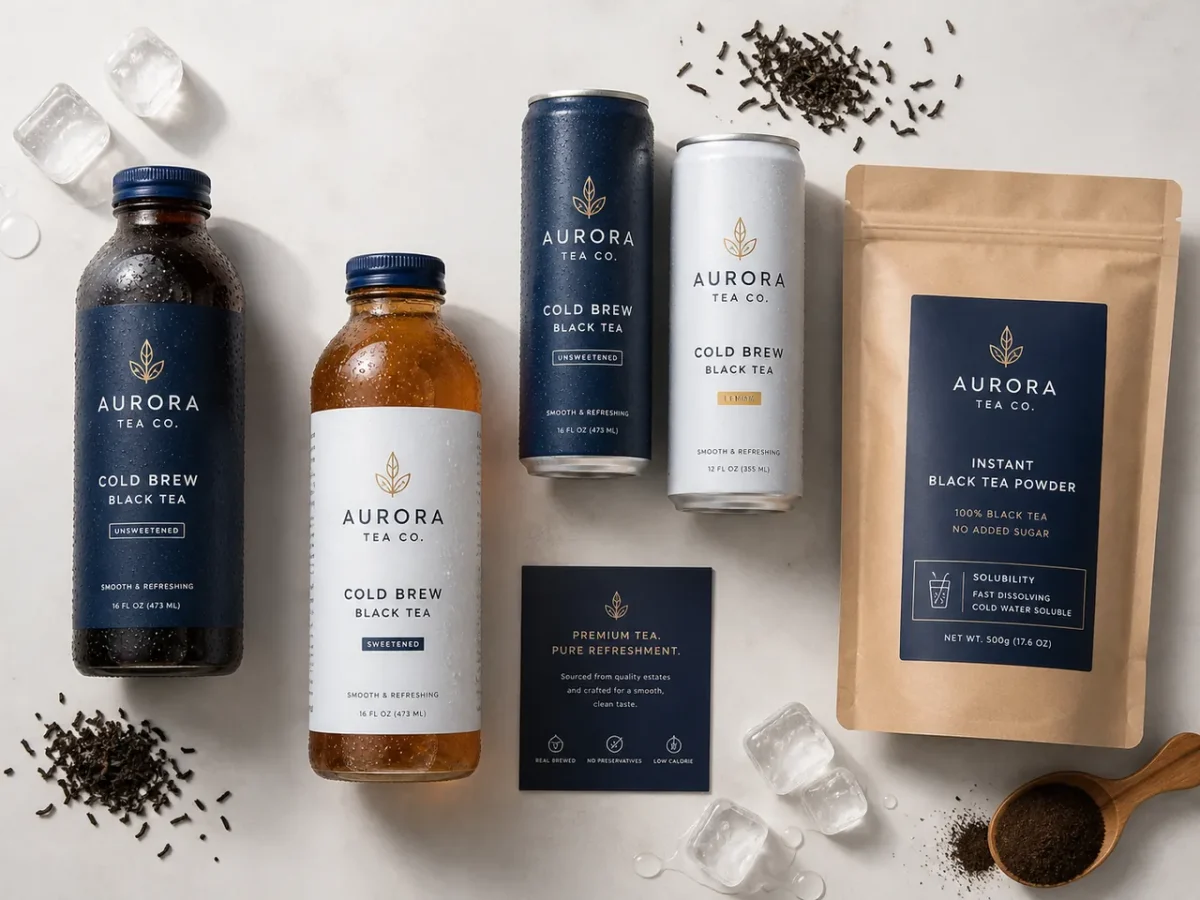
The RTD lineup above is the largest application — 47.1% of instant tea powder demand in 2025 (pmarketresearch), which is why sediment and color stability matter most in sample review.
Market context: global black tea powder market was US$192M in 2024 → US$244M by 2034 (CAGR 3.6%) (Intel Market Research, 2026), while the faster-growing instant black tea powder segment is projected US$395.5M (2025) → US$599.4M (2032), CAGR 6.1% (pmarketresearch, 2025). Cold-water soluble powder specifically rose ~9% YoY in North America and Europe as RTD producers adopted powder over leaf extract (Intel Market Research, 2026).
5. Supplier Evaluation: What to Ask Before Quotation
| Review point | Buyer input | Why it matters |
|---|---|---|
| Cold process | Water temperature, mixing equipment, standing time, formula matrix | Cold process details affect visible dispersion and sediment |
| Sensory direction | Tea body, color, bitterness direction, sweetener or dairy system | The finished drink matrix changes review priority |
| Physical review | Particle size, solubility, sediment, flow direction | Physical fields support sample-to-sample comparison |
| Document set | Specification sheet, representative COA, packing note | Lets QA screen the supplier file before sample approval |
| RFQ details | Quantity, MOQ expectation, packing size, destination market | Commercial inputs let the supplier quote the right grade |
6. Sample Request vs Bulk RFQ
| Dimension | Sample request | Bulk RFQ |
|---|---|---|
| Main purpose | Check solubility, color, sensory profile and document fit | Confirm commercial supply, packing, lead time and export details |
| Buyer input | Application, sample quantity, test matrix, COA needs | Quantity, MOQ expectation, packing size, destination market |
| Limit | Needs later commercial confirmation | Should follow sample approval when formula fit is strict |
7. RFQ-Ready Checklist
- Cold water or process temperature and mixing equipment
- Formula matrix (sweetener, acid, dairy, flavor system)
- Solubility and sediment test target
- COA and specification sheet needs (assay, microbiology, heavy metals)
- Sample quantity and approval path
- MOQ, packing and destination market
8. FAQ
Check dispersion in cold water (no clumping), sediment level, color clarity and the sensory profile against your actual formula — the sample must behave well in the intended cold process, not just in plain water.
No. It is also used in food-service cold drinks, vending machines and cold-mix dry products (sachets, smoothies, dairy blends) that prepare with cold water.
Spray drying (61.2% of 2025 production) is cost-efficient and scalable with good solubility; freeze drying preserves more flavor and aroma with superior solubility, at a premium price — best for specialty and color-sensitive brands.
A powder that dissolves well in 25°C water can clump or sediment at 4°C or in an acidic or dairy matrix. Buyers should specify water temperature, mixing equipment and formula to get comparable samples.
Send the process route (temperature, equipment, matrix), sample quantity, specification target, COA needs, MOQ expectation, packing and destination market — a complete input lets the supplier quote the right cold soluble grade.
Use the Instant Black Tea Powder product page or the HERBSEA contact page with the application, sample, COA and RFQ details.
9. Summary
If you are comparing cold soluble tea powder suppliers, confirm the cold process (temperature, equipment, matrix), solubility and sediment targets, sensory direction, COA fields, sample plan, MOQ, packing and destination market first. Sample testing must use your real formula — cold behavior in plain water is not the same as cold behavior in your finished drink. Then request samples or quotation from the relevant product page.
Related resources: Instant Black Tea Powder product page · Instant Tea Powder Supplier hub · Instant Green Tea Powder Supplier · Ingredient Export Documentation Checklist · Ingredient Supplier Audit Checklist.
Data sources: pmarketresearch instant black tea powder market (2025: spray drying 61.2%, RTD 47.1%, US$395.5M→US$599.4M by 2032, CAGR 6.1%); Intel Market Research black tea powder market (2026: US$192M 2024→US$244M 2034 CAGR 3.6%, cold-water soluble +9% YoY); winmarketresearch China instant tea powder report (2024-2030: cold melt dissolves from ~0°C, acid-stable, no sediment). Market figures vary by report scope and should be read as directional.