
Quick Answer: Before approving any botanical extract supplier, collect and review eight document types: specification sheet, batch COA, assay method note, GMP/food-safety certificates, organic or Kosher/Halal certificates, stability or retest statement, MSDS/SDS, and export documents. The two documents that decide most grades are the specification sheet (defines the approval baseline) and the batch COA (links sample review to the actual production lot). In 2025, 41% of U.S. FDA detentions of botanical extracts were linked to heavy metals or pesticide residues — up 14 percentage points from 2023 — so document review is not paperwork, it is the primary defense against adulterated or non-compliant material. Use the Plant Extract COA Review Checklist as the working path while reading this guide.
1. The 8 Documents a Botanical Extract Supplier Should Provide
A complete supplier documentation package covers quality, safety, and logistics. Ask for all eight before quotation — missing documents are a red flag, not a minor delay.
| # | Document | What to confirm | Why it matters |
|---|---|---|---|
| 1 | Specification sheet (TDS) | Botanical source, part used, extract ratio, target marker, assay range, physical fields (appearance, particle size, bulk density), storage | Defines the buyer approval baseline |
| 2 | Batch COA | Batch number, assay result vs spec, physical fields, microbiology, heavy metals, solvent residues | Links the sample to the production lot |
| 3 | Assay method note | HPLC, UV, TLC or buyer-specified method wording, standard references | Avoids two suppliers “measuring different things” |
| 4 | Food-safety / GMP certificates | FSSC 22000, BRCGS, ISO 22000, HACCP, cGMP (21 CFR 111) | Confirms an audited quality system behind the paper |
| 5 | Religious / organic certificates | USDA Organic, EU Organic, Kosher, Halal (if required by destination) | Non-negotiable for specific end markets |
| 6 | Stability or retest statement | Shelf life, retest date, storage conditions | Defines how long the grade stays valid |
| 7 | MSDS / SDS | Hazard statements, GHS pictograms, handling, transport | Required for shipping and workplace safety |
| 8 | Export documents | Packing list, commercial invoice, COO, phytosanitary (if applicable) | Confirms the supplier can actually ship to your market |
2. Certification Tiers: What Each Level Actually Buys You
Certifications are not all equal. This tier table maps the certification level to the price signal and the supply assurance you can expect.
| Tier | Typical certificates | Price signal | Supply assurance | Best fit |
|---|---|---|---|---|
| Trader / no cert | None, or copy of reseller documents | Lowest | Unverified origin, batch-to-batch drift | Only for one-off, non-regulated trials |
| Basic factory | ISO 9001 + HACCP | Low–mid | Documented QMS, but limited third-party audit depth | Commodity grades, stable specs |
| Export-grade | FSSC 22000 or BRCGS + ISO 17025 lab | Mid–premium | Full food-safety system + accredited in-house testing | Food, beverage and nutraceutical bulk buyers |
| Certified organic / specialty | USDA/EU Organic, Kosher, Halal, Non-GMO, NSF GMP | Premium | Verified sourcing + restricted inputs + premium claims | Clean-label, organic or religious-certified end markets |
Buyer takeaway: for bulk food or nutraceutical projects, use FSSC 22000 or BRCGS as the practical baseline and ISO/IEC 17025-accredited laboratory results as the evidence behind the COA. Lower tiers can still work for tightly-specified commodity grades — but verify each batch.
3. How to Read a COA Like a Buyer: Assay Method vs Market Claims
The COA is only as trustworthy as the method behind it. The same botanical can be “95%” by one method and “60%” by another — method wording must match before you compare grades.
| Method | What it measures | Typical use | What to check |
|---|---|---|---|
| HPLC | Specific marker compounds | Standardized extracts, pharmacopoeia grades | Marker identity, retention time, reference standard |
| UV / UV-Vis | Total content of a class (polyphenols, saponins) | Raw-material screening | Wavelength, calculation formula, interference |
| TLC | Botanical fingerprint | Identity confirmation | Plate image, comparison with reference herb |
| GC | Volatile oils, solvent residues | Aroma oils, residual solvents | Peak list, limit thresholds |
| DNA barcoding | Species identity of raw material | Adulteration screening | Reference database, sample traceability |
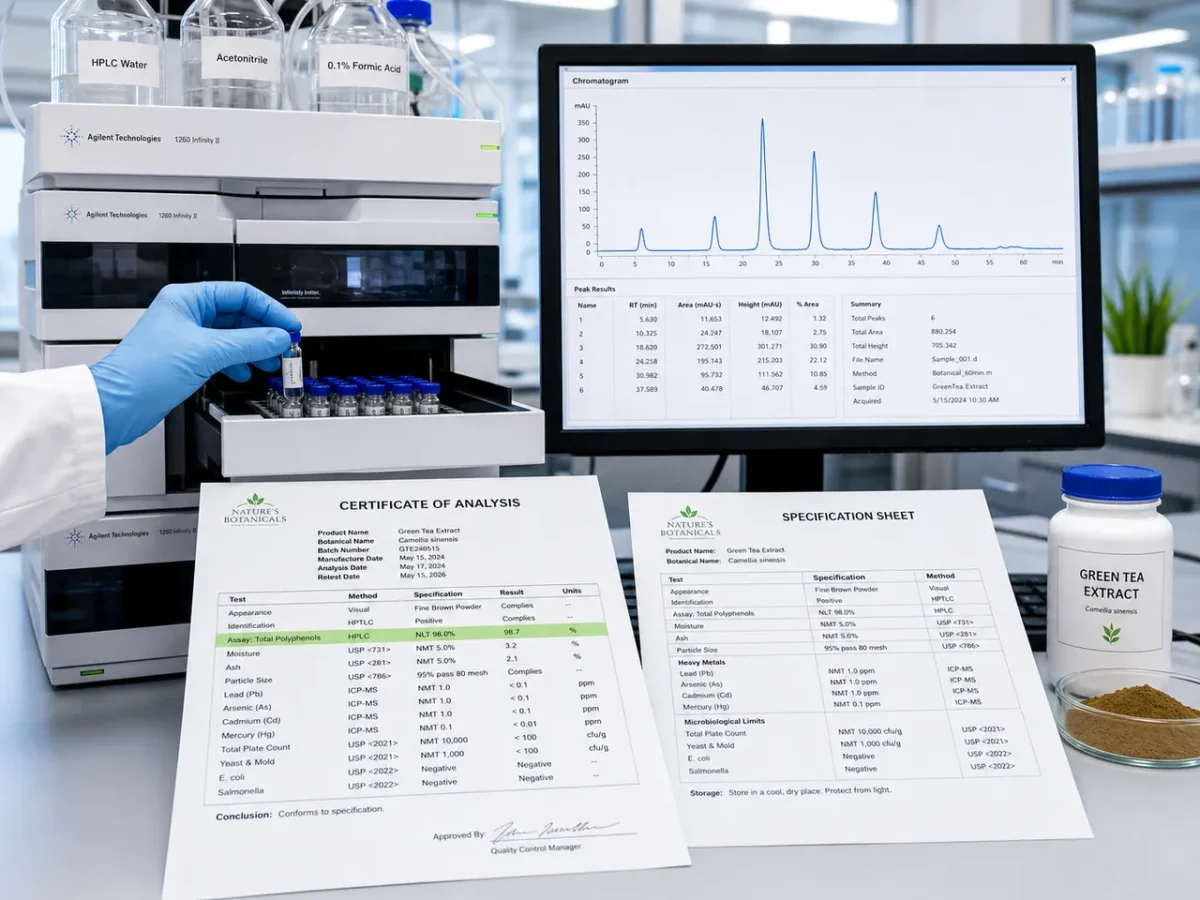
The lab scene above illustrates the COA behind the claim — HPLC retention time, marker identity and reference standards turn a “95%” number into something you can audit.
On every COA, confirm four fields before approving: batch number (must match the sample), assay result vs specification range (within tolerance), heavy metals + pesticide residue limits (per your destination market), and microbiology (for food-grade use). If the supplier cannot name the method, the number has no meaning.
4. Why Documentation Review Matters: Adulteration Is a Measured Risk
Documentation review is the cheapest insurance against adulterated material. Recent industry data shows the risk is real and rising:
- In 2025, 41% of U.S. FDA detentions of botanical extracts were linked to heavy metals or pesticide residues — up 14 percentage points from 2023 (Analysts Insights, 2026).
- Between Q4 2024 and Q2 2025, the FDA placed 17 Indian botanical-extract facilities on Import Alert 20-21 for adulteration and filth.
- A March 2025 peer-reviewed study found 68% of 124 commercial ashwagandha extract samples failed DNA barcoding authentication — a direct measure of substitution and adulteration.
- FDA warning letters to major Chinese and Indian manufacturers in 2025-2026 cited lead contamination at 8.7 ppm and methylene chloride solvent residues at 620 ppm.
These four data points are why COA authenticity checks (batch traceability, method transparency, accredited labs) should be part of every supplier review — not just a “nice to have” after price negotiation.
5. RFQ-Ready Document Request Checklist
Send this eight-point list with your first RFQ so suppliers respond with the right files the first time:
- Specification sheet (source, part, extract ratio, marker, assay range, physical fields)
- Representative batch COA (assay method, batch number, microbiology, heavy metals)
- Assay method note and marker wording
- Food-safety certificates (FSSC 22000 / BRCGS / HACCP / cGMP, whichever applies)
- Organic, Kosher or Halal certificates (if required by destination market)
- Stability or retest statement with storage conditions
- MSDS/SDS and packing details (packing size, label requirement)
- MOQ, lead time, and destination-market export support
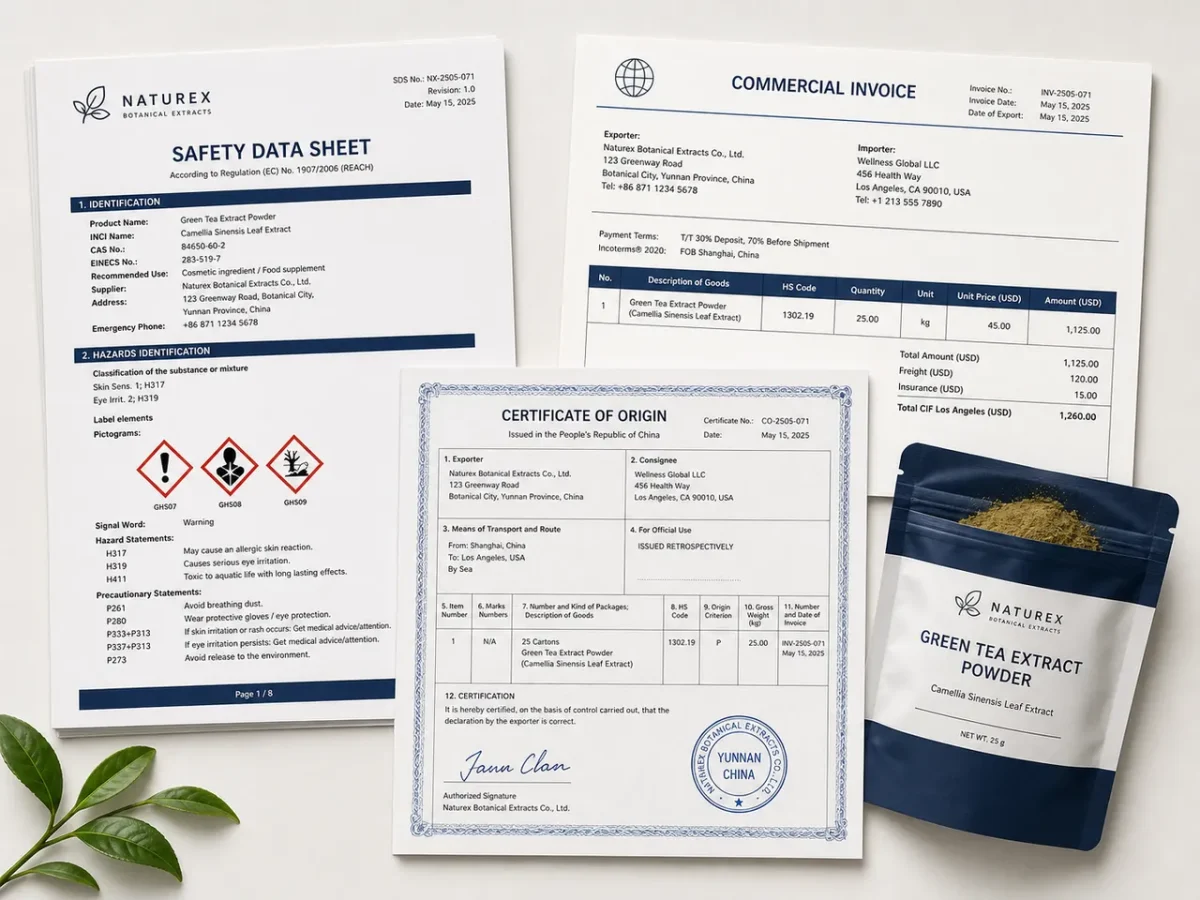
The export package above covers checklist items 7-8 — SDS, packing details and the documents that confirm the supplier can actually ship to your market.
6. Market Context: Botanical Extracts Is a Growing, Concentrated Category
| Metric | Value | Source / Year |
|---|---|---|
| Global herbal extract market | US$31.3B (2024) → US$45.1B (2030), CAGR 6.3% | Global Industry Analysts / Market Glass, 2025 |
| Botanical extracts (food & beverage scope) | US$8.5B (2023) → US$18B (2030), CAGR 11.5% | Citius Research, 2024 |
| Botanical extracts market | US$7.49B (2024) → US$12.97B (2032), CAGR 7.10% | Data Bridge Market Research, 2025 |
| North America share | 36.36% of global demand | Data Bridge Market Research, 2025 |
| China herbal extract growth | CAGR 9.7% (2024-2030) | Global Industry Analysts / Market Glass, 2025 |
| Powder form factor | ~US$3.05B sales in 2024, leads the category | DataString Consulting, 2024 |
Growing demand for clean-label and standardized botanicals means more suppliers, more grades, and more document variability — which is exactly why a structured document review beats comparing prices alone.
7. Sample Review vs Bulk RFQ
| Dimension | Sample review | Bulk RFQ |
|---|---|---|
| Main purpose | Confirm grade fit, documents and physical behavior | Confirm supply, packing, lead time and export needs |
| Buyer input | Application, target marker, sample quantity, document list | Quantity, MOQ expectation, packing size, destination market |
| Documents to request | Spec + COA + method note + certificates | Full 8-document package + export files |
| Limit | Does not prove commercial availability without RFQ details | Should follow sample or document approval when specifications are strict |
8. FAQ
Buyers normally review eight items: specification sheet, batch COA, assay method note, food-safety/GMP certificates, organic or Kosher/Halal certificates, stability statement, MSDS/SDS, and export documents. The specification and batch COA decide the grade; the certificates decide whether the plant behind the paper is audited.
Different methods measure different things — an extract can assay 95% by one method and 60% by another. Align method wording (HPLC vs UV vs TLC) before comparing supplier documents, or you are comparing incompatible numbers.
The specification (TDS) defines the grade baseline: source, extract ratio, marker, assay range and physical fields. The COA reports the actual results for a specific batch. One is the target; the other is the evidence.
For food and nutraceutical projects, use FSSC 22000 or BRCGS as the practical baseline, with HACCP as the minimum floor and ISO/IEC 17025-accredited lab results behind the COA. Add USDA/EU Organic, Kosher or Halal only when your destination market or product claims require them.
Check that the batch number matches the sample, the assay method and reference standards are named, heavy-metal and pesticide limits match your destination-market rules, and the laboratory is accredited (ISO/IEC 17025). Request the retest statement and, for high-risk botanicals, a DNA barcoding report.
Use the relevant product page or the HERBSEA contact page with the specification target, sample needs, MOQ expectation and destination market in one request — a complete RFQ record gets a faster and more complete document response.
9. Summary
Confirm the botanical source, target specification, assay method, COA fields, certificate tier, stability, sample test plan, MOQ, packing and destination market before quotation. An eight-point document checklist keeps supplier comparison faster, more objective and easier to audit — and in an industry where 41% of FDA detentions involve heavy metals or pesticides, document review is a compliance tool, not a formality.
Related resources: Plant Extract COA Review Checklist · Botanical Extract Assay Method Guide · Plant Extract Specification Sheet Template · Ingredient Export Documentation Checklist · Bulk Botanical Extract RFQ Checklist · Plant Extract Supplier hub for Ginkgo Biloba, Chlorogenic Acid, Goji Berry, Broccoli Seed and Rutin 95% product documentation.
Data sources: Global Industry Analysts / Market Glass (2025); Citius Research (2024); Data Bridge Market Research (2025); DataString Consulting (2024); Analysts Insights (2026); U.S. FDA Import Alert 20-21 (2024-2025); peer-reviewed DNA barcoding study (March 2025). Market-size figures vary by report scope and should be read as directional.