
Pea protein powder can work in more than shakes and beverage systems. For supplement brands and contract manufacturers, it is also used in dry powder blends, sachets, stick packs, capsules, tablets, nutrition mixes and plant protein combination formulas. The challenge is that each format asks different questions from the same ingredient.
A buyer may see “pea protein powder” on a supplier list and assume the material is ready for any dosage form. Production teams usually learn that the real answer depends on protein content, particle size, density, flowability, taste profile, moisture, packaging and documentation. A pea protein powder formulation should be reviewed as a technical raw material, not only as a plant-based protein name.
For B2B sourcing, start with the commercial page for HERBSEA Pea Protein powder and then build the formulation brief around the finished format. Capsule projects need filling behavior and bulk density. Tablet projects need compression support from excipients. Powder blends need dispersion, taste balance and batch consistency. Each route can use pea protein, but the purchasing checklist should not be identical.
Why Format Matters Before Sourcing
The same ingredient can behave differently when it enters different production lines. A powder that looks acceptable in a sample bag may bridge in a hopper, dust during transfer, separate in a blend or create texture problems in a finished drink mix. Early formulation review helps prevent a cheap sample from becoming an expensive production issue.
Capsules, tablets and powder blends place different pressure on the ingredient. Capsule filling depends heavily on bulk density, flow and particle behavior. Tablet manufacturing adds compression, binding and disintegration concerns. Powder blends focus on mix uniformity, taste, color, dispersibility and moisture control.
The first question is not “Can this pea protein be used?” The better question is “Which pea protein specification fits this finished-product format?”
Before requesting a quotation, prepare a short technical brief. Include the target application, estimated inclusion level, desired protein content, particle size preference, packaging format, sample quantity, document needs and destination market. This gives the supplier a real basis for recommending a grade instead of simply sending a generic COA.
For broader sourcing points such as MOQ, packaging and lead time, use the bulk pea protein powder supplier guide together with this formulation article.
Long-Tail Section: Pea Protein Powder for Capsules
Capsules are often used when brands want a clean, convenient delivery format for dry ingredients. Pea protein can appear in capsule projects, but buyers should understand the practical limitation: protein ingredients are bulky. A standard capsule holds only a limited amount of powder, and pea protein usually has lower density than many concentrated botanical extracts or crystalline ingredients.
That means capsule projects must be checked carefully at the concept stage. A formulation that looks attractive on paper may require too many capsules per serving, or the capsule size may become too large for the intended product format. For pea protein capsules, bulk density and serving-size math matter as much as the ingredient name.
Key capsule checks include:
- Bulk density and tapped density
- Flowability during encapsulation
- Particle size distribution
- Moisture level
- Dusting during filling
- Compatibility with other powdered ingredients
- Capsule shell choice
- Finished serving-size target
- COA and specification alignment
A buyer should ask the supplier whether the sample has been used in capsule filling tests or whether the material is mainly supplied for powder blends. Not every supplier will have finished-product experience, but a useful reply should still address density, flow, mesh size and moisture.
Capsule blends may require flow agents or carriers depending on the full formula. Pea protein alone may not flow consistently enough for every filling machine, especially if the formula includes hygroscopic ingredients or fine powders. Contract manufacturers should run a pilot test before commercial purchase.
When comparing samples, do not judge only by color and odor. Weigh a measured volume, check how the powder moves after light tapping, observe whether it clumps, and test the blend in the actual capsule size. A small filling trial is more useful than a perfect-looking sample photo.
Long-Tail Section: Pea Protein Tablets and Compression Notes
Tablet projects are more demanding than simple blending. Pea protein is a functional food ingredient, not a complete tablet system by itself. Compression performance depends on the full formula, binder selection, lubricant level, granulation method, moisture, particle size and tablet target.
Some plant proteins may contribute body to a tablet blend, but they do not automatically create good hardness, low friability and stable disintegration. A tablet formula often needs excipients to support manufacturability. The ingredient buyer should not ask only for protein percentage; the R&D team also needs physical handling data.
Important tablet questions include:
- Does the powder compact under the chosen process?
- Will the formula require wet granulation or dry granulation?
- Does pea protein affect tablet hardness?
- How does the ingredient behave with binders and lubricants?
- Is moisture controlled tightly enough for storage?
- Can the finished tablet meet appearance and friability targets?
- Does the COA include the test items required by QA?
A direct-compression project should be treated cautiously. Pea protein may need support from excipients designed for tableting. Wet granulation can improve flow and compression in some formulas, but it adds process steps and may affect cost, lead time and stability review.
For pea protein tablets, the raw material specification is only the starting point; process testing decides whether the formula is commercially practical.
A useful supplier can provide a current specification sheet, batch COA, packaging details and sample support. The manufacturer should then test the ingredient under the actual compression process. Tablet hardness, friability, weight variation and disintegration should be evaluated by the finished-product team rather than assumed from the supplier’s ingredient data.
For quality document review, connect this article with the pea protein specification and COA guide.
Long-Tail Section: Pea Protein Powder Blends
Powder blends are usually the most natural format for pea protein. They include nutrition powders, plant protein mixes, meal replacement blends, stick packs, sachets and private label dry mixes. In these applications, the buyer usually cares about protein content, taste, solubility, color, mouthfeel, flow and batch consistency.
A powder blend can hide some physical limitations better than a capsule or tablet, but it also creates new concerns. Separation may happen if ingredients have very different particle sizes or densities. Taste can become difficult if the formula includes high protein levels. Color variation may affect finished product appearance, especially in light flavors.
For powder blends, the main formulation target is not only protein content; the blend must remain uniform, acceptable in taste and practical for packing.
Pea protein can be combined with other plant proteins, fibers, flavors, sweeteners, minerals, botanical powders and functional ingredients. Each added material changes the handling profile. A formula with pea protein and fine botanical extracts may dust heavily. Another formula with minerals may feel gritty. A blend with flavor powders may need better particle matching to avoid segregation.
During sample testing, check these points:
- Dry blending uniformity
- Flow into sachet or tub filling equipment
- Dust level during transfer
- Taste and aftertaste in the intended flavor system
- Color fit with the target finished product
- Dispersion in water or other liquid
- Sedimentation after mixing
- Moisture pickup after opening
- Compatibility with packaging format
A small bench blend is useful, but it does not replace a pilot batch. Commercial mixing equipment can reveal separation, dusting and fill-weight variation that are not obvious in a laboratory cup.
For beverage-heavy formulas, also review the pea protein beverage formulation notes because dispersion and mouthfeel become more important when the powder is designed to be mixed by the end user.
Specification Points to Confirm Before Sampling
A clear specification helps the buyer compare suppliers and avoid vague quotations. HERBSEA’s pea protein product page lists typical B2B information such as botanical source, protein content, appearance, MOQ, packaging and certification direction. Still, every project should confirm the exact batch data before approval.
Core specification points include:
- Product name
- Botanical source: Pisum sativum
- Protein content
- Assay method
- Appearance
- Odor and taste
- Particle size or mesh
- Moisture
- Ash
- Heavy metals
- Microbiology
- Packaging
- Shelf life
- Storage condition
- Allergen and GMO-related documents where required
- Batch COA availability
A quotation without a matching specification and COA is not enough for serious B2B purchasing.
Protein content is often the headline value, but physical performance can decide whether the material fits production. A higher protein grade is not automatically better if the particle size, taste or flow profile creates problems in the final format. Buyers should keep the finished application in the center of the discussion.
The supplier should also clarify whether the sample grade and commercial batch will follow the same specification. If the sample is from an old batch, pilot testing may not represent the future order. Ask for the sample batch number, COA and expected commercial production route before final approval.
Flowability, Density and Particle Size
Flowability is a practical issue that affects filling, packing and production speed. Poor flow can cause inconsistent capsule weights, slow tablet feeding, uneven sachet filling or messy transfer. Pea protein powders can vary in flow behavior depending on milling, particle size, moisture and surface characteristics.
Bulk density affects both packaging and formula math. Low-density powder takes more space, which can increase tub size, sachet volume or capsule count. Tapped density can also show how the powder behaves under vibration during shipping and filling.
Particle size influences mouthfeel, dispersion, blending and equipment behavior. Fine powder may disperse differently but can create dust. Coarser material may flow better in some systems yet feel less smooth in beverage applications. A balanced specification is usually more useful than chasing one value.
For commercial production, particle size should be reviewed together with density, flow and the final packaging process.
Ask the supplier to provide mesh information and sample enough material for real testing. A 50 g sample may be acceptable for visual review, but pilot work needs more. For capsule or tablet trials, confirm the required sample quantity with the manufacturer before the RFQ.
Taste, Color and Sensory Fit
Pea protein has a characteristic sensory profile. The intensity depends on source, processing, purity, flavor system and inclusion level. In capsules, taste may be less visible unless the product has odor concerns. In tablets, taste can matter if the tablet is chewable or has a coating issue. In powder blends, taste is often one of the most important acceptance factors.
Color also matters. Pea protein may range from light cream to light yellow. That can fit vanilla, cereal, nut, bakery or neutral concepts, but it may affect bright fruit flavors or white powder positioning. A buyer should not approve the ingredient without checking the intended flavor and color direction.
Sensory review should be done in the real formula, not only by smelling the raw powder.
A sample can taste acceptable alone but behave differently with sweeteners, flavors, minerals or botanical extracts. Bitterness, beany notes, chalkiness and sediment can become more obvious at higher inclusion levels. The formulation team should test the ingredient at the expected use level and compare it with alternate samples under the same conditions.
Moisture, Storage and Packaging
Moisture control is important for plant protein powders. High moisture can affect flow, clumping, microbial risk and storage stability. Even when the COA meets the specification, poor warehouse handling after receipt can damage performance.
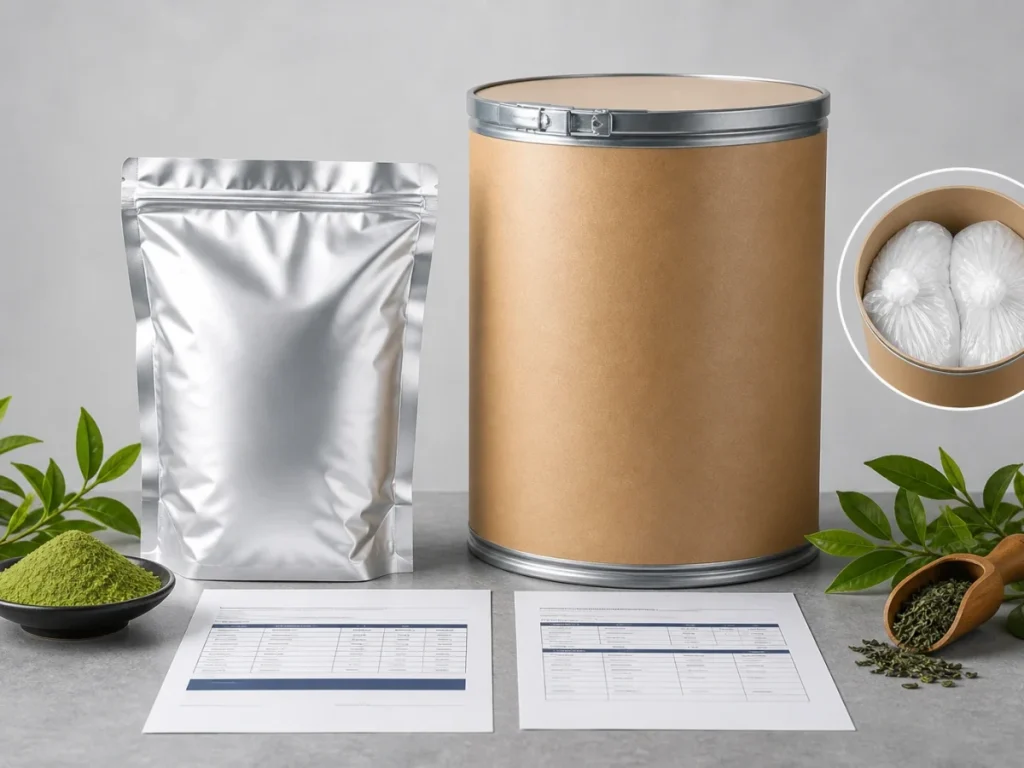
Packaging should match order volume, production rhythm and storage conditions. Common B2B formats include 25 kg bags, drums or customized packing depending on the project. Buyers should confirm inner liner material, outer packaging, pallet condition and whether the packaging suits export shipment.
Storage conditions should be clear: sealed, cool, dry and protected from contamination. Opened bags should be managed carefully in production. Resealing, humidity exposure and repeated handling can affect powder behavior.
For repeat orders, packaging consistency should be part of the purchasing record, not an afterthought.
Ask for packing photos when needed. This helps warehouse and QA teams prepare for receiving inspection. If the project involves private label production, share packing constraints early so the supplier can confirm what is practical before quotation.
COA and Document Checklist for B2B Buyers
The COA connects the supplier’s promise to the actual batch. For pea protein powder formulation, the COA should not be treated as a formality. It should match the product name, batch number, specification and quotation.
Recommended documents include:
- Specification sheet
- Batch COA
- Flow chart where available
- Allergen statement
- GMO-related statement where required
- Heavy metals test data
- Microbiology data
- Storage and shelf-life statement
- Packaging details
- Certificate support such as ISO, Halal or other available documents
- SDS or technical data sheet if requested by the buyer
For U.S.-market dietary supplement projects, buyers can review the FDA’s general page on dietary supplements and FDA information on CGMPs for food and dietary supplements. These links are not a substitute for legal review, but they help procurement and QA teams understand why documentation and batch control matter.
The best RFQ is not only a price request; it is a document request, sample request and production-fit request in one message.
Supplier Questions Before Placing an Order
A practical RFQ should help the supplier answer quickly and accurately. Vague inquiries often create generic replies. Strong inquiries give the supplier the information needed to recommend a grade, quote correctly and prepare documents.
Send these details:
- Product name: pea protein powder
- Target protein content
- Finished-product format: capsule, tablet, powder blend, sachet, stick pack or drink mix
- Estimated inclusion level if available
- Required sample quantity
- Expected order volume
- Destination country
- Packaging preference
- Required documents
- Target lead time
- Any restrictions on allergen, GMO status, certification or labeling support
- Special particle size, taste or solubility requirements
A buyer can send the RFQ through the HERBSEA plant extract supplier contact page. Include the finished application in the message so the supplier can connect the quotation to formulation needs.
For cost planning, pair this checklist with the pea protein powder price factors article.
Sample Testing Workflow
Sample testing should follow the intended product route. Do not run only a visual check if the material will enter a commercial filling line. A better workflow includes document review, raw material inspection, bench formulation, pilot testing and final purchasing approval.
Step 1: Review the specification and COA.
Confirm protein content, appearance, particle size, moisture, contaminants, microbiology and packaging.
Step 2: Inspect the sample.
Check color, odor, clumping, dust, flow and label information.
Step 3: Test in the real formula.
Use the intended capsule size, tablet process or powder blend system.
Step 4: Record performance.
Track flow, density, fill weight, compression behavior, taste, dispersion, color and packing behavior.
Step 5: Compare batches where possible.
Ask whether commercial supply will match the approved sample specification.
Step 6: Confirm final documents.
Make sure the bulk batch COA and documents are available before shipment.
A sample should prove production fit, not only confirm that the supplier can ship powder.
Common Mistakes in Pea Protein Powder Formulation
One common mistake is choosing only by price. Low unit cost can become expensive if the material causes poor flow, taste correction, production delays or rejected batches. Buyers should compare cost together with specification, sample behavior, documentation and supplier communication.
Another issue is using the same sample test for every finished format. Capsule filling, tablet compression and powder blending do not measure the same risks. Each format needs its own pass-or-fail criteria.
Some teams also forget packaging during early sourcing. A powder that works in the formula may still create warehouse or production problems if the packaging is inconvenient, weak or poorly matched to the buyer’s process.
Documentation gaps create another avoidable risk. A supplier reply that includes only a product name and price leaves QA with too many unanswered questions. Ask for the COA, specification and document list before treating a quote as complete.
The strongest supplier choice is the one that fits the formula, the documents, the production line and the purchasing plan together.
Internal Link Placement for This Article
For the main commercial conversion path, link the phrase Pea Protein powder supplier to the core product page near the introduction and again near the CTA.
For category navigation, use Plant Protein supplier category when discussing related plant protein materials.
For supporting content, use these links naturally:
Bulk pea protein powder supplier guide
Pea protein specification and COA guide
Pea protein powder price factors
Pea protein beverage formulation notes
FAQ
Can pea protein powder be used in capsules?
Yes, but capsule projects should check bulk density, flowability, serving-size target and capsule size before approval. Pea protein is a bulky ingredient, so the final serving may require more capsules than expected.
Is pea protein suitable for tablets?
Pea protein may be used in tablet formulas, but it should not be treated as a complete direct-compression system. Tablet projects need excipient review, compression testing, hardness checks, friability checks and disintegration review.
What should buyers check for pea protein powder blends?
Powder blend projects should review protein content, particle size, taste, color, dispersion, flowability, moisture and packaging. Blend uniformity and fill behavior should be tested before commercial purchase.
Which documents should be requested from a pea protein supplier?
Ask for a specification sheet, batch COA, packaging details, storage statement, shelf-life information, contaminant data, microbiology data and available certification support. The exact document set depends on the destination market and finished-product format.
How much sample is needed for formulation testing?
The required sample quantity depends on the test. Visual review may need only a small amount, while capsule filling, tablet compression or pilot powder blending needs more material. Confirm sample volume with the manufacturer before requesting it.
Summary
Pea protein powder formulation depends on the finished product format. Capsules need density and filling checks. Tablets require compression and excipient review. Powder blends depend on taste, particle size, flow, dispersion and packing behavior. For B2B buyers, the right decision comes from matching the specification, COA, sample testing and production route before placing a bulk order.
To start sourcing, review the HERBSEA Pea Protein powder product page, compare related materials in the Plant Protein supplier category, or send an RFQ through the HERBSEA contact page. Include the finished format, target specification, sample needs, order volume and document checklist so the supplier can respond with a practical quotation.
HERBSEA provides raw materials for B2B manufacturing and formulation use. This article is for ingredient sourcing and formulation review only. It is not medical advice and is not a substitute for professional regulatory review of finished products in each destination market.