
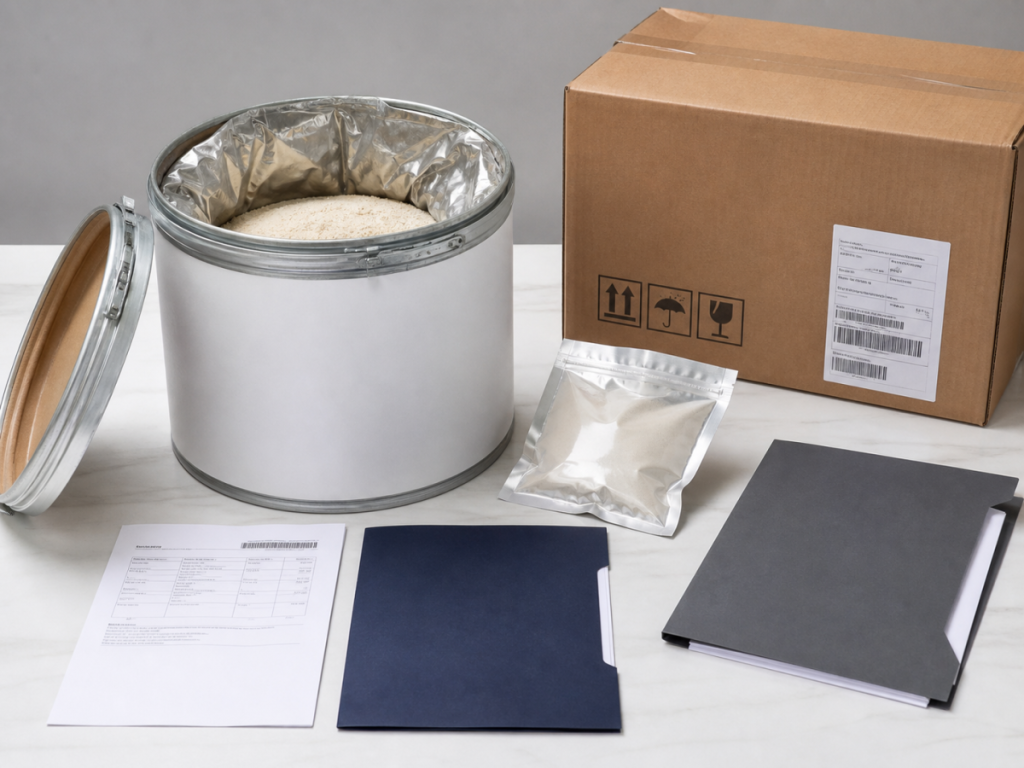
Bulk Pea Protein Powder Supplier Guide
Bulk Pea Protein sourcing should start with a clear buying brief, not only a quick request for unit price. For supplement brands, beverage formulators, private label teams, ingredient importers and contract manufacturers, the real question is whether a supplier can support the full workflow: specification review, sample dispatch, batch COA, MOQ discussion, packaging planning, lead time coordination and export document support.
A lower price is not useful if the material, documents and supply conditions do not match the project. Procurement teams should compare the full sourcing package, not only the number on the quote.
This guide is written for B2B buyers comparing a Pea Protein supplier before moving from inquiry to sample approval or commercial order planning. The goal is to help buyers build a more complete RFQ and avoid choosing a raw material only because one email looks cheaper.
What Buyers Should Confirm First
A useful supplier reply should connect the product name with the buyer’s actual project requirement. “Pea Protein” can be too broad if the buyer does not define specification, application and document scope. Before comparing supplier quotes, buyers should define the target protein content, intended application, document checklist, estimated order quantity and destination country.
A supplier should be able to answer these points:
Product identity
Protein content or assay target
Appearance and color
Particle size or mesh information
Solubility or dispersibility notes
Moisture and ash
Heavy metals
Microbiology
Allergen or cross-contact notes, if relevant
COA scope
Packaging format
Lead time
MOQ
If the buyer does not define these items early, the supplier may reply with a quote that is not really comparable.
Long-Tail Section: Bulk Pea Protein Powder Supplier
When buyers search for a bulk pea protein powder supplier, they are usually looking for a partner that can support repeat purchasing, not only a one-time sample shipment. A suitable supplier should be able to discuss batch consistency, documentation, packaging format, sample-to-bulk alignment and reorder planning.
For private label projects and distributor programs, the approved sample should be traceable to the later commercial lot. Buyers can ask whether the same specification direction can be supported after the first sample is approved, whether COA data will be available for each lot and whether packaging can remain consistent across repeat orders.
A supplier that can explain the sample, COA and future commercial batch in the same language is usually easier to work with.
Specification Review for Pea Protein
Specification is the first real filter in the buying process. Pea Protein can be used in beverage, RTD, powder blend, nutrition bar and general plant protein formulations, but the correct product depends on the target technical brief. Buyers should not assume that all pea protein materials are equivalent.
Useful specification questions include:
What is the protein content target?
Is the material described as isolate, concentrate or another grade?
Does the supplier provide a current specification sheet?
What is the product appearance and color?
Is particle size or mesh information available?
How does the powder behave in water or in a blend?
Are moisture and ash included?
Are heavy metals and microbiology listed?
Is a batch-specific COA available?
Is the packing format suited to the buyer’s warehouse or contract manufacturer?
Specification is not a paperwork step. It is the standard that tells the buyer what is actually being purchased.
Protein Content and Product Grade
Protein content is one of the first fields buyers check. But protein content alone does not answer the sourcing question. A buyer also needs to know whether the grade is suitable for the formula, the document set and the production route.
A lower or higher protein target may affect handling, taste, texture, blending and the final commercial quote. If the project needs a certain protein level for internal formula design, that requirement should be written into the RFQ before sampling starts.
The buyer should ask the supplier to confirm the protein content basis before comparing price.
If the project involves a contract manufacturer or a beverage R&D team, the buyer should also ask how the product behaves in water and whether the available grade is suitable for the intended finished format. That is often more important than a simple product-name match.
Particle Size, Dispersibility and Mix Behavior
Particle size and dispersibility can affect the practical use of pea protein in formulations. The same ingredient may behave differently in beverage systems, dry blends or other finished formats. If the buyer is preparing a powder blend or RTD concept, physical behavior matters as much as assay.
A sample should be tested in the real formula, not only inspected in the bag.
Buyers may ask:
Does the powder disperse easily?
Is particle-size information available?
Does the material create clumping or settling concerns?
Is the sample suitable for the planned mixer or process?
Will the finished product require a different grade?
If a supplier cannot explain these points, the buyer may need more sampling or a more detailed technical discussion before moving forward.
Long-Tail Section: Pea Protein MOQ
Pea Protein MOQ should be reviewed together with sample stage, packaging and reorder planning. A small test quantity may help early evaluation, while a larger order may require more detailed packing, batch reservation and logistics coordination.
MOQ should never be reviewed as a standalone number. The buyer should know what the MOQ includes, whether it applies to sample or commercial purchase, and whether the supplier can support repeat orders under the same specification direction.
A better MOQ question is:
What is the MOQ for the requested grade?
Does MOQ change with packaging?
Is a sample order separate from bulk MOQ?
Can the same spec be held for reorder?
Is there a minimum packing requirement for export?
This gives procurement a real basis for comparison instead of a single number with no context.
Packaging Options for Bulk Pea Protein
Packaging should protect the powder and fit the buyer’s receiving process. Buyers can ask about small bags, carton packing, drums, inner bag requirements, pallet details and label information. For export orders, packaging discussion should happen before order release so commercial documents and shipping arrangements match the shipment.
Packaging is part of the supply decision, not an afterthought.
The supplier should be able to explain:
Available pack sizes
Inner bag requirement
Carton or drum format
Net weight per unit
Label or shipping mark request
Pallet preference
Warehouse handling needs
Destination-country document support
If the buyer has a contract manufacturer, it is worth asking whether that facility has preferred pack sizes or receiving rules. A packaging format that works for one warehouse may not work for another.
Long-Tail Section: Pea Protein Packaging and Lead Time
Pea protein packaging and lead time should be discussed together. Packaging choices can affect production scheduling, stock allocation and export paperwork. A buyer with a tight launch date should state that timeline clearly and ask what part of the lead time is related to production, testing or shipment.
A practical inquiry should include:
Preferred pack format
Estimated order quantity
Sample quantity
Required documents
Destination market
Target delivery timing
Warehouse or contract manufacturer constraints
A supplier can only give a useful lead time when the buyer gives enough logistics context.
Lead Time and Export Document Planning
Lead time depends on stock status, production schedule, testing time, packing arrangement and destination country. Buyers can shorten back-and-forth by sending the document list early. Typical files may include COA, specification sheet, SDS, invoice, packing list and buyer-side quality questionnaire responses where available.
For U.S. dietary supplement projects, buyers may review the FDA’s general page on dietary supplements for regulatory background. For manufacturing quality-system context, buyers can also review 21 CFR Part 111, which covers current good manufacturing practice requirements for dietary supplements.
These references help buyers understand quality-system expectations, while supplier selection should still rely on the actual specification, COA, sample review and documentation provided for the selected material.
COA and Sample Review
A batch-specific COA should match the offered material. Buyers can compare product name, batch number, protein content, appearance, moisture, ash, heavy metals, microbiology and storage condition with the specification sheet.
A COA is useful only when it belongs to the exact batch being quoted.
If the buyer receives a generic document, a document with a different grade name or a COA that does not match the sample, the supplier should clarify the difference before commercial approval. This is especially important when the buyer is moving from sample stage to pilot order stage.
For broader document review, buyers can use HERBSEA’s [plant protein / ingredient document guide] if that is published later, or keep this article linked to the core Pea Protein supplier page for product-specific inquiry.
Long-Tail Section: Pea Protein Sample Testing
Pea protein sample testing should be practical and connected to the intended finished format. A sample may pass document review but still need formulation testing. For beverage applications, the buyer may evaluate dispersibility and mouthfeel. For powder blends, the buyer may check blend uniformity and appearance. For bars or other formats, the buyer may need additional handling or process review.
The sample test should answer the buyer’s manufacturing question, not only the purchasing question.
If the buyer has a contract manufacturer, the sample should be sent with the relevant specification and COA. The contract manufacturer may ask for additional information such as particle size, bulk density, moisture, allergen-related documentation or packing format. These questions should be collected before final quotation.
Application Fit for Buyers
Pea Protein can be used in a range of formulation projects, but each application has a different technical question.
For beverage projects, the team may care about dispersibility and taste.
For RTD projects, the team may care about stability and process fit.
For powder blends, the team may care about flow and visual consistency.
For bars or dry mixes, the team may care about handling and mix behavior.
The right grade is the one that fits the actual product process.
Buyers should not assume that a protein grade suitable for one format will automatically suit another. If the project moves from concept to scale-up, it is worth confirming whether the same spec can be held for commercial supply.
Long-Tail Section: Pea Protein for Beverage Formulation
Pea protein for beverage formulation should be reviewed with an eye toward dispersibility, taste, mouthfeel and process fit. Beverage formulators usually need more than a protein percentage. They need to know whether the powder behaves predictably in the formula, whether it fits the target mouthfeel and whether it can be sourced consistently for scale-up.
A buyer may ask the supplier:
Can this grade be used in beverage formulation?
What sample quantity is appropriate for bench testing?
Is the powder easy to disperse?
What document scope is available?
Can the same grade be held for repeat orders?
This turns a simple product inquiry into a usable formulation discussion.
Supplier Comparison Scorecard
Procurement teams can compare supplier replies using a simple scorecard. Useful fields include product name clarity, specification match, COA completeness, sample availability, MOQ, packaging options, lead time, export document support and communication quality.
If a supplier replies with only a price and no specification detail, the quote may not be ready for serious comparison.
A more useful comparison sheet includes:
Product identity
Protein content target
Particle size or physical notes
COA scope
Sample timing
MOQ
Packaging
Lead time
Destination-country support
Communication quality
Unit price should be reviewed only after the technical basis is clear. A lower price is not helpful if the supplier cannot support the buyer’s documentation or supply needs.
Long-Tail Section: Pea Protein Supplier RFQ
A Pea Protein supplier RFQ should be specific enough for the supplier to match the buyer’s project. Instead of asking only “please quote Pea Protein,” buyers can ask for current specification, COA, sample availability, MOQ, packaging options, lead time and document support for the destination market.
A practical RFQ can say:
Please quote bulk Pea Protein powder for formulation use. We need current specification, batch COA, sample quantity options, protein content target, packaging format, lead time and export document support. The intended application is beverage, RTD, powder blend or another plant-protein project.
A better RFQ usually produces a better quote.
External References for Buyer Context
For neutral botanical and dietary supplement context, buyers may review the FDA’s dietary supplements resource. Research databases such as PubMed results for pea protein can support background review, but supplier pages should keep wording focused on raw material sourcing, specification review and formulation evaluation.
For quality-system context, buyers can use 21 CFR Part 111 as a regulatory reference. These authority links are included for buyer-side background and should not replace supplier-specific COA, specification and sample testing.
FAQ
What should buyers ask a bulk Pea Protein supplier first?
Ask for the current specification, protein content, sample availability, batch-specific COA, MOQ, packaging options, lead time and available document scope. Share the application format and destination market so the supplier can reply accurately.
Should price be compared before specification?
No. Price should be compared after the buyer confirms that the offered grade, specification, sample and document package are similar.
Can HERBSEA support sample and COA review?
Buyers can send the target specification, sample quantity, application format and document checklist through the HERBSEA contact page so the team can review available sample and COA support.
How should buyers use this article with the core product page?
Use this article as the procurement checklist and use the Pea Protein supplier page as the core inquiry page for product-specific sourcing support.
HERBSEA provides raw materials for B2B manufacturing and formulation use. The information on this page is for ingredient sourcing and specification review only. It is not medical advice and does not provide diagnosis, treatment, cure, prevention, dosage, or consumer use recommendations.