
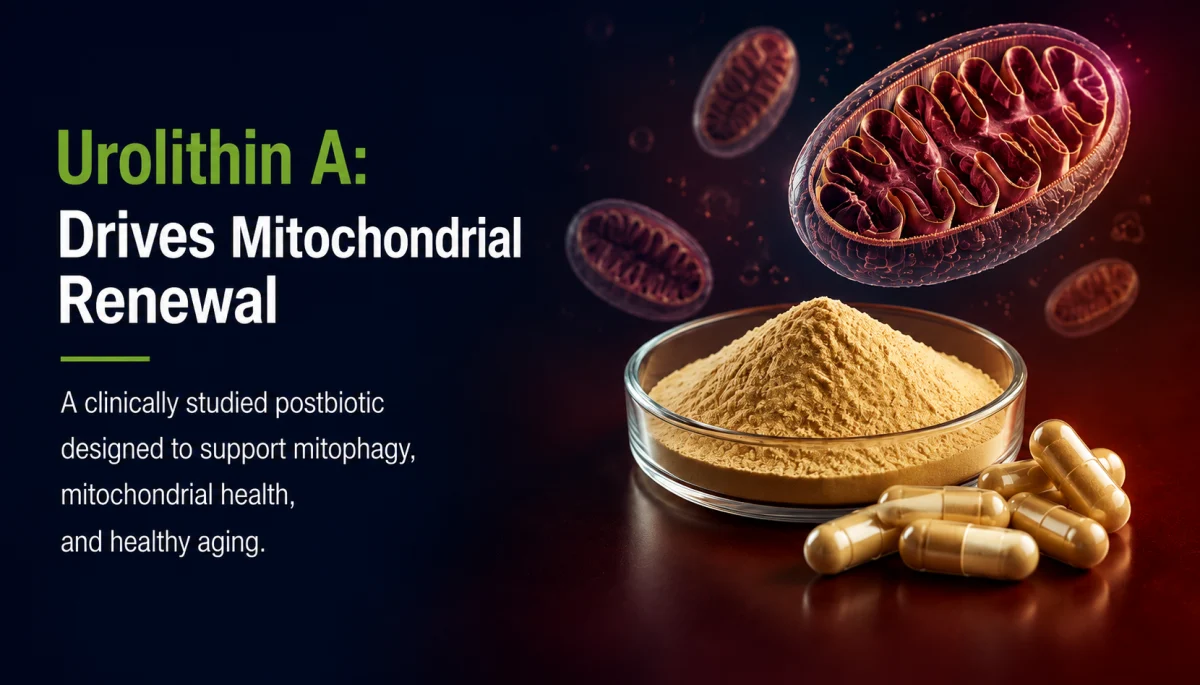
Powering Mitochondrial Renewal for Healthy Aging
Urolithin A is a gut microbiome-derived postbiotic clinically studied for its ability to support mitophagy—the cellular process that identifies, removes and recycles damaged mitochondria.
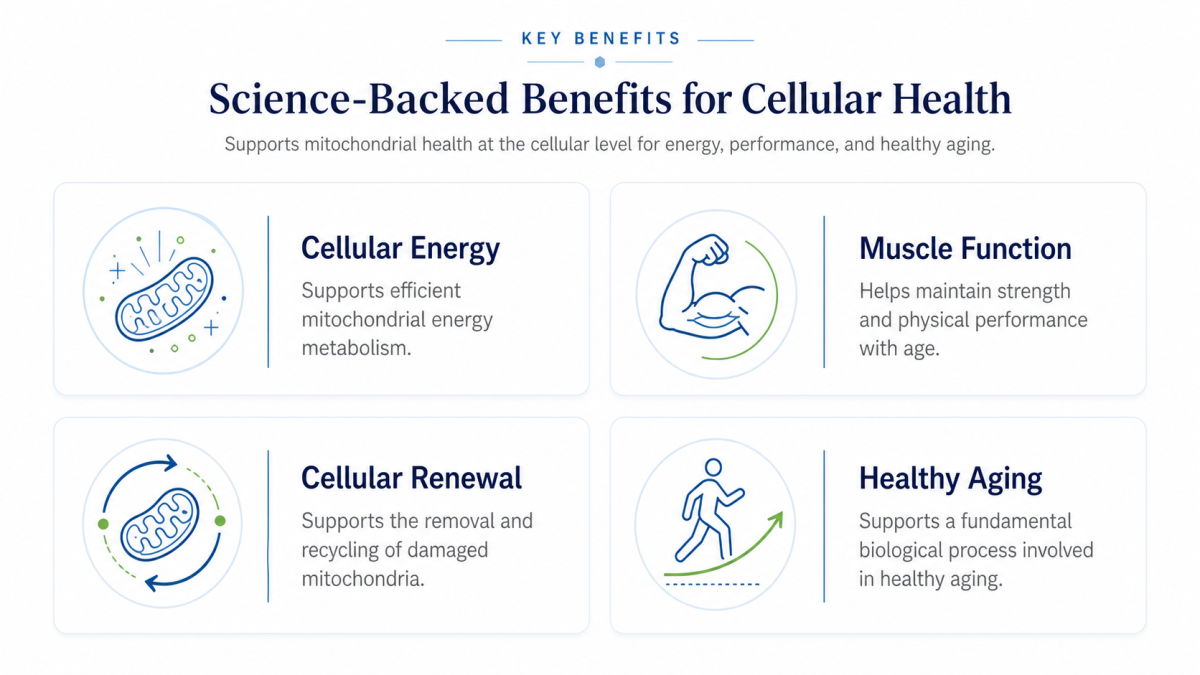
By supporting mitochondrial quality control, Urolithin A offers a science-driven nutritional strategy for healthy aging, muscle function, endurance and cellular resilience.
Mitophagy Support · Human Clinical Research · Active Aging
SECTION 1 — HEALTHY AGING BEGINS AT THE CELLULAR LEVEL
The Mitochondrial Challenge of Aging
Mitochondria generate the energy required for muscle contraction, cellular repair and everyday physical function. As we age, mitochondria accumulate damage while the body’s ability to remove dysfunctional mitochondria gradually becomes less efficient.
This decline in mitochondrial quality control may contribute to:
- Reduced cellular energy production
- Lower muscle strength and endurance
- Slower physical recovery
- Increased oxidative and metabolic stress
- Reduced cellular resilience
Supporting mitochondrial renewal is therefore emerging as an important nutritional approach to maintaining healthspan—the years of life spent in good health and physical function.
SECTION 2 — WHAT IS UROLITHIN A?
A Next-Generation Postbiotic for Cellular Health
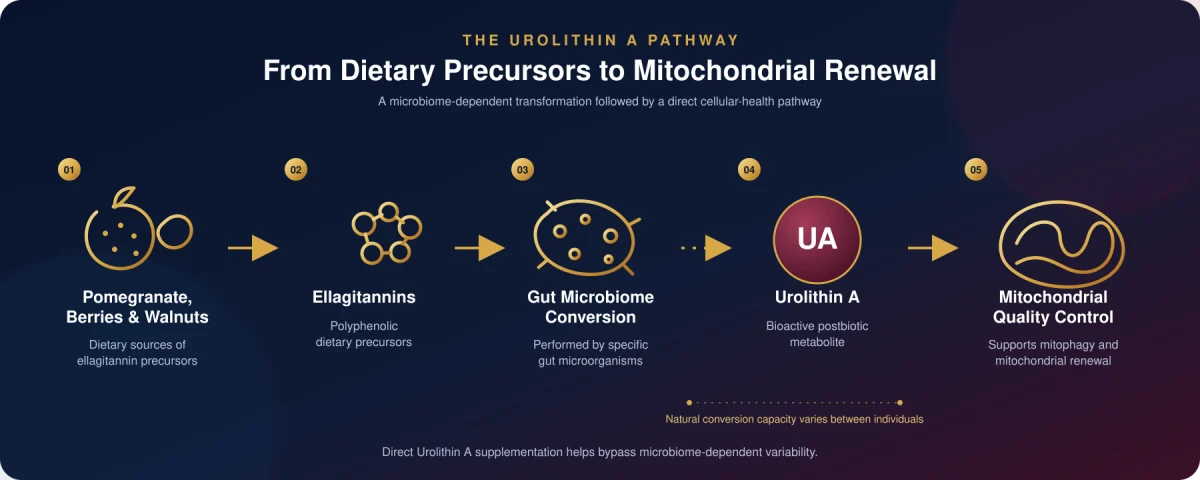
Urolithin A is a naturally occurring metabolite produced when specific gut microorganisms transform ellagitannins and ellagic acid found in foods such as pomegranates, berries and walnuts.
However, this natural conversion varies considerably between individuals.
In a study of 100 healthy adults, only 12% had detectable Urolithin A at baseline, while approximately 40% produced significant amounts following a pomegranate juice challenge. Direct supplementation with 500 mg of Urolithin A produced more than six times the total exposure achieved with one glass of pomegranate juice. Singh et al., 2022
Why direct supplementation matters
- Provides a precise and standardized amount
- Reduces dependence on individual microbiome composition
- Delivers more consistent exposure across consumers
- Supports the development of evidence-based formulations
SECTION 3 — MECHANISM OF ACTION
How Urolithin A Supports Mitochondrial Renewal
Targeting Mitophagy—the Cell’s Mitochondrial Recycling System
Mitophagy is a selective form of autophagy through which cells identify, dismantle and recycle dysfunctional mitochondria. This process helps maintain a healthier and more efficient mitochondrial network.
Preclinical research first identified Urolithin A as a potent nutritional activator of mitophagy. Human studies have subsequently demonstrated changes in mitochondrial gene expression, mitophagy-related proteins and circulating metabolic biomarkers following supplementation. pubmed.ncbi.nlm.nih.gov, pubmed.ncbi.nlm.nih.gov
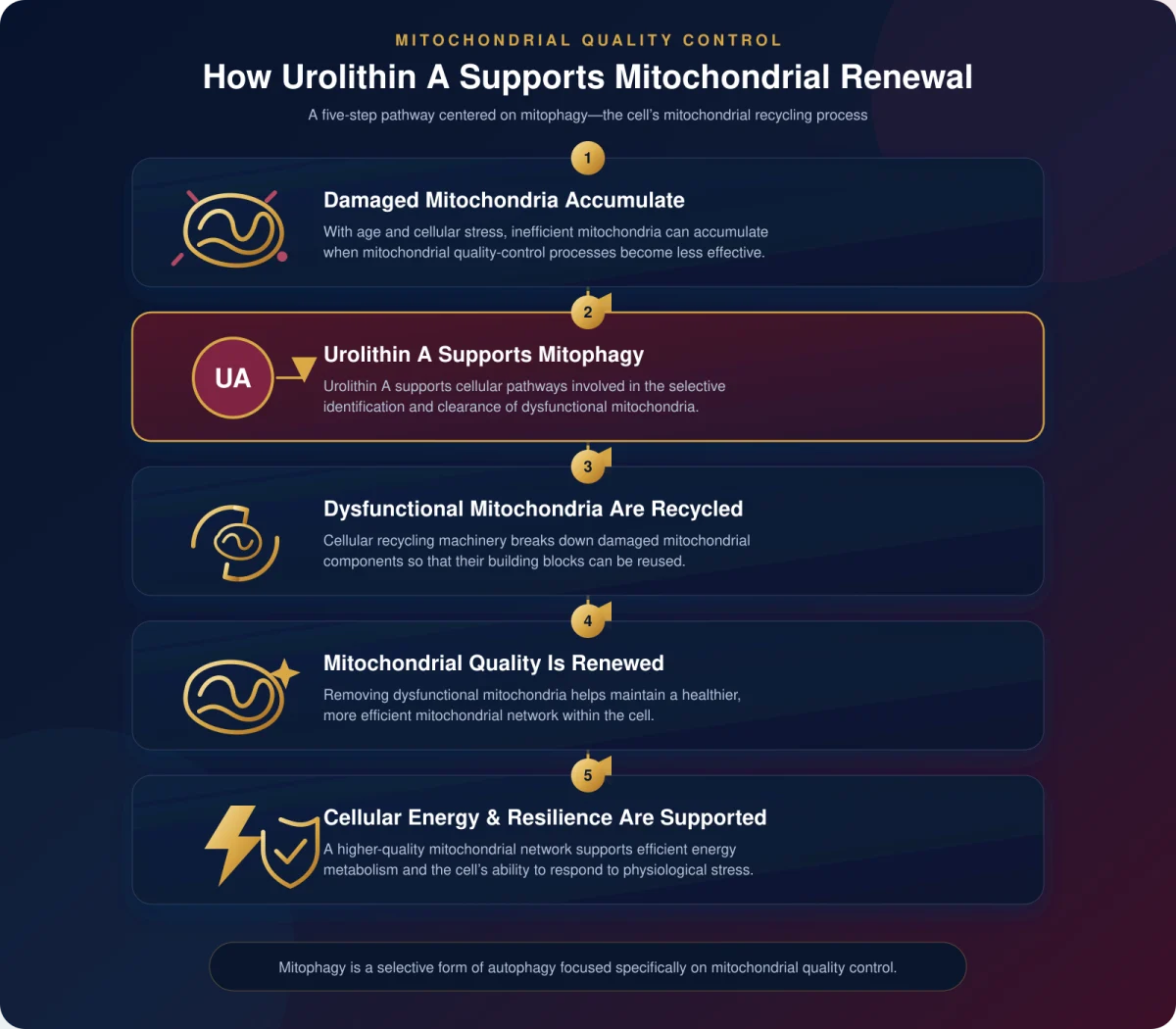
Urolithin A Mitophagy-Mechanism
01 · MITOPHAGY ACTIVATION
Urolithin A supports signaling involved in the recognition and recycling of damaged mitochondria.
02 · MITOCHONDRIAL QUALITY CONTROL
The selective removal of dysfunctional mitochondria helps cells maintain a healthier mitochondrial network.
03 · MITOCHONDRIAL BIOGENESIS
Human skeletal-muscle research has identified increased expression of mitochondrial gene sets following four weeks of supplementation with 500 or 1,000 mg of Urolithin A.
04 · METABOLIC EFFICIENCY
Clinical studies have reported reductions in selected circulating acylcarnitines—biomarkers associated with mitochondrial fatty-acid metabolism.
05 · CELLULAR RESILIENCE
By supporting mitochondrial turnover and metabolic function, Urolithin A may help cells respond more effectively to the physiological challenges associated with aging.
SECTION 4 — HEALTHY-AGING BENEFITS
Multi-Dimensional Support for Active Aging
Mitochondrial Health
Urolithin A targets mitochondrial quality control rather than simply providing a temporary source of energy. Human trials have demonstrated changes in mitochondrial gene expression, mitophagy-related proteins and metabolic biomarkers.
Suggested claim: Supports mitochondrial health and cellular energy metabolism.
Muscle Strength
In a four-month randomized controlled trial involving sedentary adults aged 40–64, supplementation with 500 or 1,000 mg of Urolithin A significantly improved selected measures of leg muscle strength compared with placebo.
Hamstring strength increased approximately 12% from baseline in the 500 mg group and approximately 10% in the 1,000 mg group. Singh et al., 2022
Suggested claim: Supports muscle strength and healthy physical function.
Muscle Endurance
In a randomized trial involving 66 adults aged 65–90, 1,000 mg of Urolithin A daily significantly improved hand and leg muscle endurance after two months compared with placebo.
The study also reported improvements in several circulating biomarkers associated with mitochondrial health. Liu et al., 2022
Suggested claim: Helps support muscle endurance during healthy aging.
Physical Performance
In middle-aged adults, 1,000 mg per day produced clinically meaningful within-group improvements in peak oxygen consumption and six-minute walking distance after four months. However, not every performance endpoint was significantly different from placebo.
Suggested claim: Supports physical performance and active lifestyles.
Metabolic and Inflammatory Balance
Clinical studies have reported changes in acylcarnitines, selected ceramides and C-reactive protein following Urolithin A supplementation. These findings support a potential connection between mitochondrial efficiency and healthy inflammatory balance.
Suggested claim: Supports metabolic efficiency and a healthy inflammatory response.
Emerging Immune-Aging Research
A 2025 randomized, double-blind, placebo-controlled study evaluated 1,000 mg of Urolithin A daily for four weeks in 50 healthy adults aged 45–70.
Compared with placebo, Urolithin A increased a population of naive-like, less terminally exhausted CD8⁺ T cells and improved their fatty-acid oxidation capacity. These results suggest an emerging role for mitochondrial renewal in supporting immune-cell fitness during aging. Denk et al., 2025
Suggested claim: Emerging research supports the role of Urolithin A in immune-cell metabolic health.
SECTION 5 — HUMAN CLINICAL EVIDENCE
From Cellular Mechanism to Human Performance
| Study | Population and Intervention | Key Findings |
|---|---|---|
| Andreux et al., 2019 | 60 healthy, sedentary older adults; single and four-week dosing study | Urolithin A was bioavailable and well tolerated. Daily intake of 500 or 1,000 mg modulated plasma acylcarnitines and mitochondrial gene expression in skeletal muscle. |
| Singh et al., 2022 — Bioavailability | 100 healthy adults; 500 mg Urolithin A versus approximately 240 mL pomegranate juice | Direct supplementation delivered more than sixfold greater total exposure and more consistent circulating levels. |
| Singh et al., 2022 — ATLAS | 88 sedentary adults aged 40–64; 500 or 1,000 mg/day for four months | Selected leg-strength outcomes improved by approximately 10–12%. The 1,000 mg group showed within-group improvements in aerobic endurance and walking distance. The primary peak-power endpoint was not significantly improved. |
| Liu et al., 2022 — ENERGIZE | 66 adults aged 65–90; 1,000 mg/day for four months | Hand and leg muscle endurance improved significantly at two months. Selected mitochondrial and inflammatory biomarkers improved. Primary outcomes for six-minute walking distance and ATP production were not significantly different from placebo. |
| Denk et al., 2025 — MitoImmune | 50 adults aged 45–70; 1,000 mg/day for four weeks | Increased naive-like CD8⁺ T-cell populations and improved T-cell fatty-acid oxidation capacity. No significant differences in kidney or liver safety parameters were observed. |
SECTION 6 — PRODUCT DEVELOPMENT OPPORTUNITIES
Built for the Growing Healthy-Aging Market
Urolithin A can support the development of differentiated products across multiple consumer categories.
Healthy Aging
Daily nutritional products designed to support mitochondrial health, muscle function and long-term vitality.
Active Aging
Formulas for middle-aged and older consumers focused on strength, mobility, endurance and independence.
Sports and Recovery
Mitochondrial-support formulations for endurance, exercise recovery and sustained physical performance.
Cellular Energy
Premium energy products positioned around mitochondrial efficiency rather than short-term stimulation.
Longevity Formulas
Advanced healthy-aging combinations with NAD⁺ precursors, CoQ10, PQQ, spermidine, ergothioneine or antioxidant nutrients.
Available dosage forms
- Capsules
- Tablets
- Sachets
- Functional powders
- Stick packs
- Multi-ingredient longevity formulas
SECTION 7 — SCIENCE-LED POSITIONING
A Precision Approach to Postbiotic Nutrition
Unlike pomegranate extracts that provide only Urolithin A precursors, direct Urolithin A supplementation delivers the active postbiotic in a standardized form.
This allows formulators to develop products with:
- Consistent Urolithin A delivery
- Clinically relevant formulation concepts
- Clear mitochondrial-health positioning
- Strong differentiation in the longevity market
- Broad application across healthy-aging categories
Bring Mitochondrial Renewal to Your Next Formula
Contact us for specifications, COA, formulation support, sample availability and bulk quotation.
Request Product InformationFAQ
Is Urolithin A found directly in pomegranate?
Urolithin A is generally not present in meaningful amounts in pomegranate itself. Pomegranate provides ellagitannins and ellagic acid, which must be converted into Urolithin A by specific gut microorganisms.
Can everyone naturally produce Urolithin A?
No. Natural production varies according to microbiome composition. In one study, approximately 40% of participants produced significant Urolithin A after consuming pomegranate juice.
Why use direct Urolithin A instead of pomegranate extract?
Direct supplementation bypasses variable microbial conversion and provides a more precise and consistent amount of Urolithin A.
What daily amounts have been studied?
Human studies have commonly evaluated 500 and 1,000 mg per day. These research doses should not automatically be treated as universal intake recommendations; final dosage should reflect the formulation, target market and applicable regulations.
Does Urolithin A extend human lifespan?
No human clinical study has demonstrated that Urolithin A extends lifespan. Current human evidence primarily supports mitochondrial biomarkers, selected muscle-function outcomes and emerging immune-cell metabolic effects.
Is Urolithin A an antioxidant?
Urolithin A should be positioned primarily as a postbiotic that supports mitochondrial quality control and mitophagy—not simply as a conventional antioxidant.
REFERENCE LIST
Cerdá, B., Periago, P., Espín, J. C., & Tomás-Barberán, F. A. (2005). Identification of Urolithin A as a metabolite produced by human colon microflora from ellagic acid and related compounds. Journal of Agricultural and Food Chemistry, 53(14), 5571–5576. https://doi.org/10.1021/jf050384i
Ryu, D., Mouchiroud, L., Andreux, P. A., et al. (2016). Urolithin A induces mitophagy and prolongs lifespan in C. elegans and increases muscle function in rodents. Nature Medicine, 22, 879–888. https://doi.org/10.1038/nm.4132
Andreux, P. A., Blanco-Bose, W., Ryu, D., et al. (2019). The mitophagy activator Urolithin A is safe and induces a molecular signature of improved mitochondrial and cellular health in humans. Nature Metabolism, 1, 595–603. https://doi.org/10.1038/s42255-019-0073-4
Singh, A., D’Amico, D., Andreux, P. A., et al. (2022). Direct supplementation with Urolithin A overcomes limitations of dietary exposure and gut microbiome variability in healthy adults. European Journal of Clinical Nutrition, 76, 297–308. https://doi.org/10.1038/s41430-021-00950-1
Liu, S., D’Amico, D., Shankland, E., et al. (2022). Effect of Urolithin A supplementation on muscle endurance and mitochondrial health in older adults: A randomized clinical trial. JAMA Network Open, 5(1), e2144279. https://doi.org/10.1001/jamanetworkopen.2021.44279
Singh, A., D’Amico, D., Andreux, P. A., et al. (2022). Urolithin A improves muscle strength, exercise performance, and biomarkers of mitochondrial health in a randomized trial in middle-aged adults. Cell Reports Medicine, 3(5), 100633. Redirecting
Jiménez-Loygorri, J. I., et al. (2024). Mitophagy curtails cytosolic mtDNA-dependent activation of cGAS/STING inflammation during aging. Nature Communications, 15, 830. https://doi.org/10.1038/s41467-024-45044-1
Denk, D., Singh, A., Kasler, H. G., et al. (2025). Effect of the mitophagy inducer Urolithin A on age-related immune decline: A randomized, placebo-controlled trial. Nature Aging, 5, 2309–2322. https://doi.org/10.1038/s43587-025-00996-x