
Quick Answer: Urolithin A (UroA, C13H8O4) is a defined, gut-microbiota-derived metabolite that formulation teams source as a bulk powder ingredient rather than relying on botanical precursor conversion. For B2B purchasing, the decision points are: production route (chemical synthesis, microbial fermentation, or botanical bioconversion), HPLC assay target (≥98% or ≥99%), COA parameters (assay, impurities, residual solvents, heavy metals, microbiology), destination-market regulatory status (US GRAS, EU Novel Food, China cross-border only), sample testing in the real formula, and the document set (COA, spec sheet, SDS, chromatograms, certificate of origin). HERBSEA supports this review with specification, COA, and sample support for qualified projects before quotation.
What Is Urolithin A and Why Sourcing Teams Specify It Directly
Urolithin A is a dibenzopyranone metabolite formed when gut microbiota convert ellagitannins and ellagic acid from pomegranate, walnuts, raspberries, and other plant materials. Conversion efficiency varies widely between individuals because it depends on the presence of specific bacterial strains — many adults produce little or no UroA from diet alone. For product development teams, this variability is exactly why direct UroA supply matters: instead of depending on an individual’s gut conversion, a finished formula can use a defined ingredient with a known assay, impurity profile, and batch record.
Two points separate ingredient storytelling from the commercial raw material question:
- UroA is a molecule, not an extract. It has a defined molecular formula (C13H8O4), a CAS number (1143-70-0), and a defined HPLC assay target. It should be purchased against a specification, not against a botanical “standardized to” label.
- Purity tiers behave differently in formulation. Food-grade material is commonly supplied at ≥98% (HPLC area normalization), with premium grades at ≥99%. The tier affects cost, impurity headroom, and which destination markets and regulatory dossiers the material can support.
For buyers, the practical workflow is: define the assay and physical targets → review the COA against a written checklist → test the sample in the actual formula → confirm batch documents before bulk order.
Urolithin A Market Context (2023–2032)
The commercial UroA category has moved from niche academic research into mainstream healthy-aging and sports-nutrition formulation. Reported market figures vary by scope, so buyers should compare like-for-like:
| Market scope | Base value | Forecast | CAGR | Source (year) |
|---|---|---|---|---|
| Global UroA (all grades) | USD 37.9M (2023) | USD 56.2M by 2030 | 6.1% | Valuates Reports (2025) |
| UroA dietary supplements | USD 115.0M (2025) | USD 377.7M by 2032 | 18.5% | Pmarketresearch (2025) |
| Food-grade UroA | USD 18.5M (2024) | USD 28.7M by 2034 | 6.6% | Intel Market Research (2024) |
| Global urolithin (A+B) | USD 65.4M (2025) | USD 190.3M by 2032 | 16.5% | Pmarketresearch (2026) |
Formulation-level context: in 2025, capsules and softgels accounted for about 66% of the UroA supplement segment, and healthy-aging/mitochondrial-support applications for about 54%; North America led regional demand at roughly USD 55M, followed by Europe at USD 35.5M and Asia-Pacific at USD 18.3M. Food-grade production costs are estimated at 30–40% above conventional nutraceutical ingredients, which is one reason high-purity UroA carries a premium price point and why buyers negotiate around assay tier, volume, and document scope.
Clinical literature gives the category its formulation pull. The ATLAS trial (Singh et al., Cell Reports Medicine, 2022; n=88, adults 40–64, double-blind, placebo-controlled) reported hamstring muscle strength gains of 12% at 500 mg/day and 9.8% at 1,000 mg/day over four months, with knee-flexion strength up ~10.5% at both levels; a 1,000 mg/day group also showed a ~10% gain in peak VO2 and +33 m on the 6-minute walk test. A separate RCT in adults 65–90 reported improved hand and leg muscle endurance. Buyers should review these studies directly and confirm how their destination market allows claims — the studies inform ingredient selection, not consumer copy.
Bulk Urolithin A Specification Checklist
A practical specification review covers identity, assay, physical properties, and contamination limits. The table below is the checklist HERBSEA works from when quoting:
| Parameter | Typical target | Why it matters |
|---|---|---|
| Identity (IR/UV, retention time) | Matches UroA reference standard | Confirms the molecule, not a related urolithin or precursor |
| Assay (HPLC) | ≥98% standard; ≥99% premium | Drives cost, impurity headroom, regulatory fit |
| Appearance | Off-white to light-yellow powder | Visual QC on receipt |
| Particle size / flow | D50 target per formulation (micronized options) | Blending uniformity, encapsulation behavior |
| Loss on drying | ≤1.0% (typical) | Moisture stability and shelf-life planning |
| Residual solvents | Per ICH Q3C limits | Confirms purification/removal from synthesis |
| Heavy metals | Per destination-market limits (ICP-MS) | Export compliance and toxicological review |
| Microbiology | Food-grade limits (TAMC/TYMC, pathogens) | Finished-product safety in supplements/foods |
| Related substances / impurity profile | Total related substances ≤2.0% (typical), unknowns controlled | Batch consistency and long-term stability |
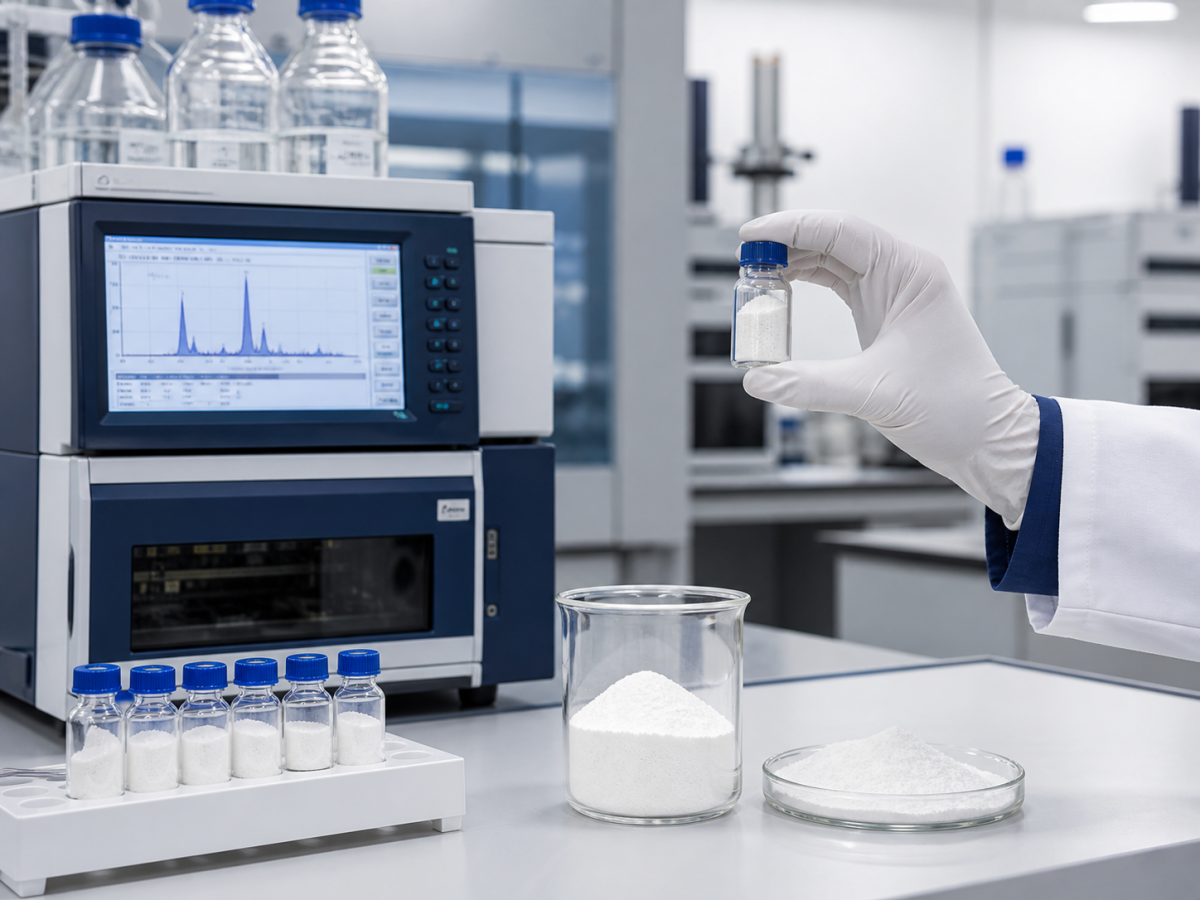
Ask for the HPLC chromatogram and residual-solvent GC-MS report, not just a summary assay number. A COA that lists only “assay ≥98%” without method reference, batch number, and impurity detail is not enough to approve a commercial batch.
Production Route Comparison: Synthesis, Fermentation, Extraction
UroA on the market today comes from three routes, and each changes the specification, impurity profile, and cost position a buyer should expect:
| Route | Typical purity | Impurity considerations | Cost / scale position | Fit |
|---|---|---|---|---|
| Chemical synthesis (copper-catalyzed coupling from resorcinol + halogenated benzoic acid) | ≥98% to 99.9% | Residual catalysts, brominated residues, residual solvents — managed by purification and ICH Q3C | Most scalable; ~USD 8,000–12,000 per metric ton at scale (industry estimates) | Mainstream commercial supply; consistent batch-to-batch identity |
| Microbial fermentation / biotransformation (ellagic acid or ellagitannin substrate, engineered strains) | ≥98% possible; yields vary by strain | Complex broth matrix; heavier downstream purification | Generally higher unit cost; volumes limited by conversion rate | “Bio-based” positioning; clean-label programs |
| Botanical extraction / bioconversion from pomegranate | 90–95% typical | Residual polyphenols, waxes, allergen traceability | ~USD 45,000–60,000 per metric ton equivalent; ~50 t of fruit per kg of high-purity UroA | Niche natural positioning; limited scale |
Sourcing implication: if a buyer needs multi-batch commercial consistency, pharmaceutical-grade impurity control, and export documentation, synthesis is the route most suppliers (including HERBSEA’s recommended partners) standardize on; fermentation is worth evaluating when clean-label or bio-based positioning is a brand requirement. Whatever the route, request the route-specific impurity profile so the COA can be reviewed against the process.
Regulatory Status by Destination Market
UroA’s legal status differs sharply by region, and it determines what documents a buyer must collect before import:
| Market | Status | Buyer action |
|---|---|---|
| United States | FDA GRAS with no questions (GRN No. 000791, 2018) for specified food and supplement uses (typically 250–500 mg per serving, up to 1,000 mg for some formats) | Confirm intended use falls within the GRN scope; keep the notice reference in the dossier |
| European Union | Evaluated by EFSA (2021 opinion on synthetic UroA safety); Novel Food authorization process under EU rules — verify current authorization and conditions of use before placing on the market | Request supplier’s Novel Food authorization reference and compliance statement; EU health claims remain strictly limited |
| China | Not approved as a new food raw material; cross-border e-commerce channel only | Confirm import channel and customs documentation before quoting |
| Japan / South Korea | Not approved as functional/health food ingredient; listed as cosmetic ingredient | Route to food use needs local regulatory review |
| Australia / New Zealand | Non-traditional/novel food status | Check FSANZ status for the intended product category |
Because the same molecule can have different legal status in different regions, buyers should state the destination market in every RFQ — it changes the required certificate set and can change which production route is acceptable.
How to Review a Urolithin A COA
Use a written checklist, not visual inspection, when the COA arrives:
- Header identity: supplier name, batch number, manufacturing date, expiry/retest date, specification version — confirm the batch number matches the shipped goods.
- Assay method and value: HPLC with reference standard; verify the method (area normalization vs. external standard) and the actual result, not just “conforms.”
- Chromatogram: request the HPLC trace; check peak separation and that the main peak integrates cleanly without shoulder peaks.
- Impurity and residual solvents: review related-substance totals and ICH Q3C residual-solvent results.
- Heavy metals and microbiology: confirm limits match the destination market’s food/supplement requirements.
- Physical data: appearance, loss on drying, particle size — these predict blending and encapsulation behavior in the real process.
- Signature and traceability: who released the batch, and whether a COA can be re-issued for customs without delay.
Keep the COA, spec sheet, SDS, packing photo, sample feedback, and final quote in one record per batch. This file makes reorder checks fast and helps confirm a later batch follows the same sourcing brief.
Certificate and Document Set to Request
| Document | What it confirms | Priority |
|---|---|---|
| COA | Batch assay, impurities, heavy metals, microbiology | Required every batch |
| Specification sheet | Full parameter table and methods | Required |
| SDS | Handling and transport safety | Required |
| HPLC chromatogram | Peak purity and separation quality | High |
| Residual-solvent GC-MS / ICP-MS metals | Synthesis cleanup and export compliance | High |
| Certificate of origin | Customs and tariff processing | On request |
| Non-GMO / allergen statements | Labeling and market access | On request |
| Facility certification (ISO 22000 / HACCP / FSSC 22000) | Food-safety management system | Verify scope and validity |
Certification tier is a negotiation point: food-grade GMP/ISO 22000 facilities are the baseline for supplement use, while export to stricter markets may require FSSC 22000 or client audits. Confirm the certificate’s scope actually covers the site and the UroA line.
Sample Testing Before Bulk Order
Test the sample in the real formula or process before approval — color, particle size, flowability, solubility, carrier selection, and packing format all affect production handling and finished-product consistency.
Typical sample tiers from suppliers:
| Sample type | Typical turnaround | Use |
|---|---|---|
| Stock sample | Days | Screening assay, color, odor, basic flow |
| Custom sample (specified assay/particle size) | 1–3 weeks | Matching project specification |
| Pre-production sample (trial batch) | 3–6 weeks | Process validation and stability |
Share the finished-product format (capsule, tablet, powder blend, functional food) and target assay so the supplier can recommend a practical sample direction. Keep sample labels, batch numbers, quote notes, and document files together for reorder review.
Packaging, MOQ and Lead Time
Packaging, MOQ, and lead time depend on project stage. For early development, request a sample and technical document review. For commercial orders, confirm: batch size, carton or drum packaging, inner bag requirement, label language, shipping terms (FOB/CIF/DDP), and destination-country document needs before quotation. HERBSEA confirms these details per project so the quotation matches the actual import and production plan.
FAQ: Urolithin A Bulk Supply
Share the target assay or purity requirement, application format (capsule, tablet, powder blend, functional food), estimated order quantity, destination market, packaging preference, sample request, and required documents (COA, chromatograms, certificate of origin). Destination market matters most because it drives the regulatory document set.
Sample support and COA review are available for many qualified B2B projects. Buyers confirm the grade, specification fit, packing format, and document set before moving to a commercial order.
No. Pomegranate and other ellagitannin-rich materials provide upstream compounds, while Urolithin A is a defined downstream metabolite. Buyers decide whether the project needs a botanical extract route, a purified UroA ingredient, or a combination – and that decision affects assay targets, regulatory fit, and cost.
Most supplement projects standardize on 98% or higher (HPLC). Premium brands, clinical-grade dossiers, and stricter markets often specify 99% or higher. The tier changes cost and impurity headroom, so define it in the RFQ rather than accepting a default grade.
Compare identity method, assay method and value, impurity profile, residual solvent limits, heavy metals, microbiology, batch consistency (past batch COAs), production route, document responsiveness, and export packaging support. Request chromatograms, not summary numbers.
Regulatory status differs by region – the same molecule may need a different certificate set or production route depending on where the finished product is sold – so buyers should state the market in every RFQ.
Summary
Urolithin A is a defined ingredient with clear specification, production-route, regulatory, and documentation decision points. Start with the assay target and destination market, review the COA against a written checklist, test the sample in the real formula, and keep batch documents in a per-batch record. HERBSEA supports this review with specifications, COA, and sample support for qualified projects.
Related sourcing guides: Urolithin A vs CoQ10 supplier comparison · CoQ10 powder supplier formulation guide · Urolithin A and CoQ10 formulation checklist · Plant Extract COA Review Checklist · Contact HERBSEA
Compliance Note
HERBSEA provides raw materials for B2B manufacturing and formulation use. The information on this page is for ingredient sourcing, specification review, and supplier communication only. It is not medical advice and does not provide consumer-use guidance. Buyers are responsible for verifying regulatory status and permitted claims in their destination market.