
Pea Protein Powder Price Is Not Just Unit Price
Pea Protein powder price depends on more than the number listed in a supplier email. For B2B buyers, the final quote can be influenced by protein content, product grade, particle size, dispersibility, COA scope, sample requirements, order quantity, packaging, lead time and destination-country shipping support.
A low price is not automatically a better quote if the specification, COA, packaging and document scope are unclear. Procurement teams should compare the full sourcing package, not only the price per kilogram.
This guide explains which details affect a bulk quote and how buyers can send a clearer RFQ to a Pea Protein supplier. It is written for supplement brands, beverage formulators, private label developers, contract manufacturers, ingredient distributors and importers that need to compare supplier replies in a practical way.
The core page for this topic is the Pea Protein supplier page. This article supports that page by explaining price and RFQ factors in more detail.
Specification Is the First Price Factor
Specification is usually the first reason Pea Protein prices vary between suppliers. A quote for a defined protein content, product grade, mesh size, dispersibility note and document scope is different from a general product listing. The buyer should confirm whether the price refers to the requested grade, the current batch and the intended document package.
Two suppliers may both write “Pea Protein” in a quotation, but the technical basis may be different. One quote may include a defined specification, batch COA, sample support and packaging notes. Another quote may only show a product name and unit price. These offers should not be compared as if they are equivalent.
Before comparing price, align the specification. Otherwise the buyer may be comparing different materials under the same product name.
Useful specification questions include:
What protein content is being quoted?
Is the material described as isolate, concentrate or another grade?
Which particle size or mesh information is available?
How does the powder perform in water or dry blends?
Can the supplier provide a current specification sheet?
Does the batch COA match the quoted material?
Will the same grade support sample and commercial order stages?
Can the packaging format match the buyer’s receiving process?
Long-Tail Section: Pea Protein Bulk Quote
A pea protein bulk quote should include more than price per kilogram. A serious quote should explain the specification basis, MOQ, sample availability, COA scope, packaging assumption, lead time and destination-country document support.
A useful bulk quote tells the buyer what the price includes. A weak quote only gives a number.
For example, a buyer may ask for “Pea Protein powder price” and receive three very different replies. Supplier A may quote a general plant protein powder without detailed document support. Supplier B may quote a defined pea protein grade with COA and standard packaging. Supplier C may quote a grade that fits beverage formulation but needs a different MOQ or packing basis.
A better RFQ would ask:
Please quote Pea Protein powder for formulation use.
Include current specification, batch COA, MOQ, sample availability, packaging format, lead time and available document scope.
The intended application is beverage, RTD, powder blend, bar, capsule or tablet formulation.
Our destination market and estimated order quantity are listed below.
This type of RFQ helps the supplier provide a quotation that procurement and QA can actually evaluate.
Protein Content and Product Grade Affect Cost
Protein content is one of the most visible price factors. A higher protein target, different grade or more specific physical requirement may change the quote. But protein percentage should not be reviewed alone. Product grade, taste profile, dispersibility, mesh size and COA scope also matter.
Protein content is important, but it is not the full buying standard.
A quote should clarify whether the supplier is offering a pea protein isolate, concentrate or another grade direction. If the buyer needs a specific protein content for a beverage, powder blend or private label formula, that target should be written into the RFQ before sample approval.
When product grade is unclear, price comparison becomes weak. A buyer may think two suppliers are quoting the same material when one is actually offering a different grade with a different application fit.
Particle Size and Application Fit
Particle size, mesh size and dispersibility can affect price because they influence formulation performance and process fit. A grade suitable for dry powder blends may not be the same as a grade preferred for beverage formulation. Some buyers need easier dispersion, cleaner mouthfeel or better blending behavior, while others mainly need a stable bulk ingredient for dry applications.
Application fit can change the value of a quote even when the unit price looks similar.
Technical questions to include:
Which finished format is the material intended for?
How does the powder disperse in the target system?
Will the grade support beverage or RTD development?
Can the sample be tested in a powder blend?
Is the particle size suitable for the contract manufacturer’s process?
Could another grade be more practical for the same project?
The goal is not to find the cheapest line item. The goal is to find the material that fits the buyer’s formula and document process.
COA Scope Changes Supplier Comparison
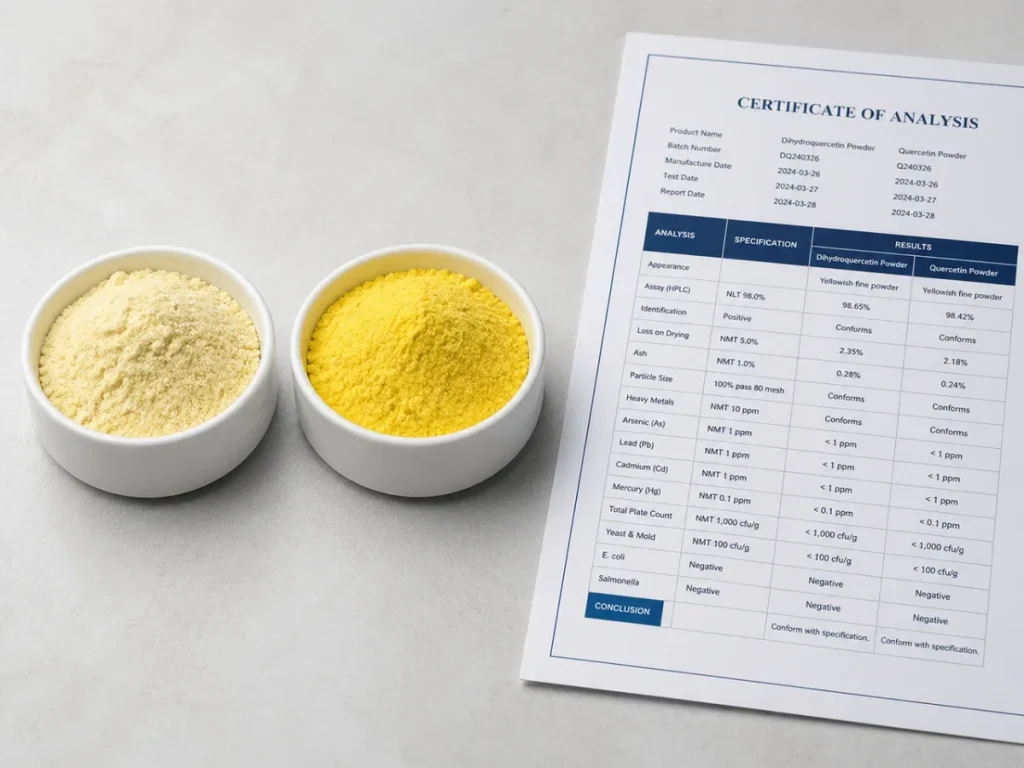
COA scope can affect both supplier comparison and internal approval. A standard COA may include product identity, protein content, appearance, moisture, ash, heavy metals and microbiology. Some buyers may require additional testing or a different reporting style.
If the COA does not support the buyer’s quality review, the lower price may create more work later.
A buyer should check whether the COA is batch-specific, whether the product name matches the quotation, whether protein content is shown clearly and whether test items match the buyer’s internal checklist. If an importer, distributor or contract manufacturer needs specific documents, those needs should be discussed before quotation.
Practical COA questions include:
Is the COA batch-specific?
Does the COA match the sample?
Can the supplier provide a current specification sheet?
Which protein content method is used?
Are heavy metals and microbiology included?
What storage information is listed?
Which additional documents can be provided if the buyer’s QA team requests them?
For broader document thinking, buyers can review HERBSEA’s mushroom extract COA guide as a general batch-document reading model, then apply the same logic to Pea Protein sourcing.
Long-Tail Section: Pea Protein MOQ
Pea Protein MOQ should be discussed together with sample approval, packaging and reorder planning. A small test quantity may support early evaluation, while commercial orders may require a different packing format, production schedule or shipment arrangement.
MOQ should never be reviewed as a standalone number. The buyer needs to know what the MOQ includes.
A stronger MOQ discussion includes:
Sample quantity
Pilot order quantity
Commercial order volume
Annual demand estimate
Packaging format
Lead time
Destination market
Document requirements
Reorder expectation
If the supplier quotes a low MOQ but cannot support the required document scope or repeat supply, the offer may not fit the project. Another supplier may require a higher MOQ but provide stronger documentation and stable packaging. In that case, the better choice depends on the project stage and approval requirements.
Packaging and Shipping Requirements
Packaging requirements can affect both material handling and shipping cost. Buyers should specify whether they prefer small bags, cartons, drums or other bulk packing formats. For international shipments, the supplier also needs destination details and any required invoice, packing list, SDS or buyer-side quality files.
Packaging assumptions should be confirmed before price approval, not after the purchase order is ready.
The destination country can affect shipping route, delivery time and document preparation. A buyer should avoid asking for a single “best price” without explaining the destination market and expected shipping arrangement. If the supplier does not know the destination country, the quote may exclude important logistics assumptions.
A clear shipping brief should include:
Destination country
Preferred shipping method, if known
Target delivery timing
Document checklist
Packaging preference
Consignee or importer requirements where applicable
Warehouse or contract manufacturer receiving notes
Long-Tail Section: Plant Protein Price Factors
Plant protein price factors usually include raw material source, protein content, grade, physical profile, dispersibility, COA scope, order quantity, packaging format, logistics and supplier communication. For Pea Protein, buyers should also consider whether the quoted grade is aligned with the approved sample and whether future repeat orders can follow the same specification direction.
If the buyer is comparing multiple plant protein materials, the Plant Protein category can help organize adjacent options. The core inquiry page for this cluster remains the Pea Protein supplier page.
The best price is the price attached to the right material, not just the lowest number.
Lead Time and Batch Availability
Lead time is not only a shipping question. It can include inventory confirmation, production schedule, testing time, packing preparation and export documentation. A buyer with a tight launch timeline should state that timeline clearly.
If the supplier needs additional testing or special packing, the buyer should understand how those requests affect delivery planning. A fast quote is not useful if the supplier cannot explain stock status, sample timing or commercial batch availability.
Lead time should be confirmed together with batch availability and document readiness. This is especially important when the buyer needs a launch sample, pilot batch or repeat order under a fixed schedule.
Supplier Communication Quality
Communication quality is a real sourcing factor. If a supplier answers only part of the RFQ, skips document questions or avoids specification clarification, the buyer may face more work later. A responsive supplier should be able to explain what is available, what needs confirmation and what details are required from the buyer.
Not every answer will be immediate. Inventory checks, production schedule review or document record confirmation may take time. What matters most is whether the supplier can communicate clearly and keep the buyer’s technical brief organized.
For B2B ingredient sourcing, communication quality often affects project speed as much as unit price.
How to Request a More Accurate Bulk Quote
A more accurate RFQ should state the product name and target specification direction, share sample quantity or bulk order volume, list required documents before quotation, include destination country and target delivery timing, explain finished product format and describe packaging needs.
Buyers can send these details through the HERBSEA contact page to request Pea Protein samples, COA and quotation support.
The strongest RFQ connects commercial details with technical details: specification, sample, COA, MOQ, packaging, lead time and destination requirements.
A practical RFQ template:
Product name: Pea Protein powder
Application: Beverage, RTD, powder blend, bar, capsule, tablet or other formulation
Target specification: Protein content, grade, mesh size or buyer-defined requirement
Quantity: Sample, pilot order or commercial order volume
Documents: COA, specification sheet, SDS and other required files
Packaging: Preferred pack size, carton, drum or pallet request
Destination: Country and delivery timing
Next step: Sample approval, quotation review or bulk purchase planning
External References for Buyer Context
For general U.S. dietary supplement context, buyers may review the FDA’s dietary supplements resource. For quality-system context, the eCFR provides the current text of 21 CFR Part 111. Research databases such as PubMed results for pea protein can support background review.
These authority links are useful for buyer-side understanding, but supplier selection should still rely on the actual specification, COA and sample testing for the material being purchased.
Related Buyer Reading
For product-specific sourcing, use the Pea Protein supplier page. For adjacent plant protein options, review the Plant Protein category. Buyers preparing a quote request can contact HERBSEA through the plant extract supplier contact page.
Every support article in this cluster should guide qualified buyers back to the core Pea Protein inquiry page.
FAQ
Why do Pea Protein powder prices vary between suppliers?
Prices vary because suppliers may quote different protein content, product grades, particle size, COA scope, order quantities, packaging formats and shipping assumptions.
Should buyers choose the lowest Pea Protein price?
Not automatically. Buyers should first compare specification fit, COA completeness, sample support, MOQ, packaging, lead time and supplier communication.
What should be included in a Pea Protein RFQ?
A clear RFQ should include product name, target protein content, grade direction, sample quantity or bulk quantity, document checklist, destination country, packaging preference and intended application format.
Where should buyers request pricing?
Buyers can start from the Pea Protein supplier page or submit a detailed brief through the HERBSEA contact page.
How can buyers avoid comparing mismatched quotes?
Align specification, protein content, COA scope, sample stage, MOQ, packaging and destination assumptions before comparing price. A quote is only comparable when the technical and commercial basis is comparable.
HERBSEA provides raw materials for B2B manufacturing and formulation use. The information on this page is for ingredient sourcing and specification review only. It is not medical advice and does not provide diagnosis, treatment, cure, prevention, dosage, or consumer use recommendations.
Align specification, protein content, COA scope, sample stage, MOQ, packaging and destination assumptions before comparing price. A quote is only comparable when the technical and commercial basis is comparable.
HERBSEA provides raw materials for B2B manufacturing and formulation use. The information on this page is for ingredient sourcing and specification review only. It is not medical advice and does not provide diagnosis, treatment, cure, prevention, dosage, or consumer use recommendations.