
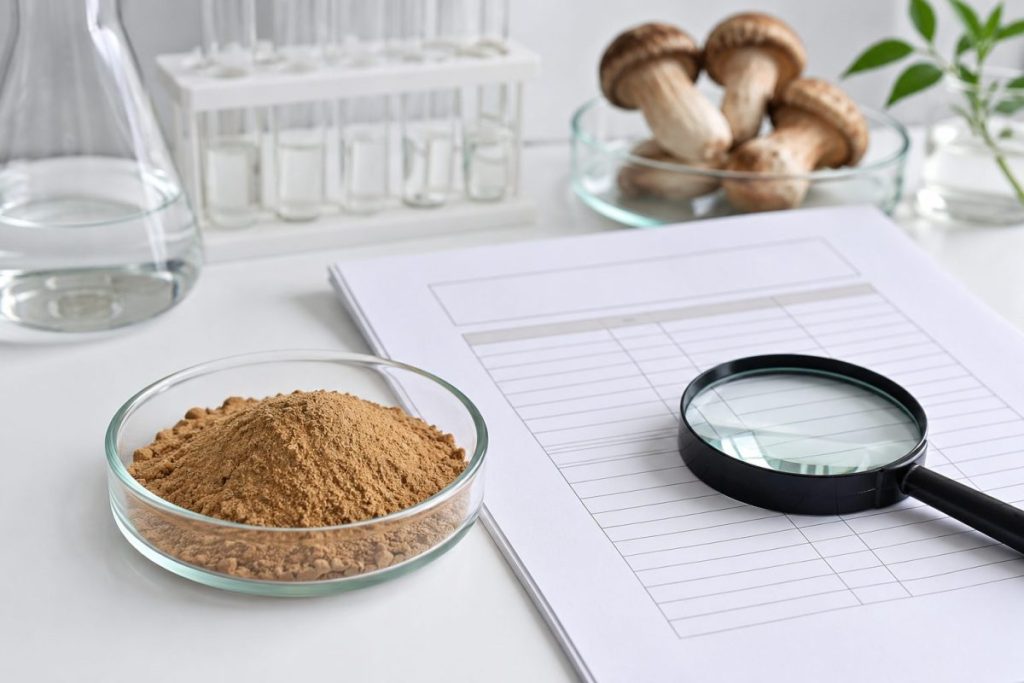
HERBSEA supplies bulk mushroom extracts for supplement, beverage, functional food, capsule, tablet, powder blend and multi-mushroom formula projects. This guide is written for purchasing, R&D and quality teams that need clear raw material information before quotation, sample evaluation and commercial order planning.
A mushroom extract COA should do more than list a product name and a few numbers. Buyers should confirm mushroom species, source material, fruiting body or mycelium status, extraction ratio, beta-glucan or polysaccharide value, assay method, carrier status, particle size, microbiology, heavy metals, packaging, MOQ and lead time. These details help the buyer connect the approved sample with the exact commercial grade.
For broader category review, buyers can start with HERBSEA’s Mushroom Extract category and the related Mushroom Extract vs Mushroom Powder comparison guide.
Specification Items to Compare
Mushroom extracts with similar names can be very different materials. A useful RFQ should compare identity, source, extraction process, test method and application fit before price.
| Review item | What buyers should compare |
|---|---|
| Ingredient | Mushroom extract, mushroom powder, multi-mushroom blend or customer-approved extract grade |
| Source | Fruiting body, mycelium, fermented material or customer-approved mushroom source |
| Specification focus | Beta-glucan, polysaccharides, extract ratio, carrier status, particle size, color, taste and microbiology limits |
| Assay method | Enzymatic beta-glucan method, UV, titration, HPLC or customer-agreed method depending on the marker |
| Document package | COA, specification sheet, production flow chart, allergen statement and quality questionnaire on request |
| Commercial details | Sample availability, MOQ, lead time, standard packaging, export documents and approved sample reference |
For U.S. supplement projects, the eCFR listing for 21 CFR Part 111 is an important reference for dietary supplement current good manufacturing practice expectations. FDA’s small entity compliance guide for dietary supplement CGMP is also useful when quality teams review documentation and manufacturing-control expectations.
Why Mushroom Extract COA Review Needs Extra Care
Mushroom extract sourcing often involves several terms that can be misunderstood: beta-glucan, polysaccharides, fruiting body, mycelium, extract ratio and carrier. If these terms are not clearly defined, buyers may compare materials that are not equivalent.
Beta-glucan versus polysaccharides
Polysaccharides are a broad group. Beta-glucan is a more specific marker often requested for mushroom extracts, but the value depends on the method used. A COA that lists total polysaccharides should not automatically be treated as equivalent to beta-glucan. For buyers focused on beta-glucan, HERBSEA’s Beta-Glucan Mushroom Extracts Guide gives a more focused review path.
A peer-reviewed paper in the Journal of AOAC International describes measurement of beta-glucan in mushroom and mycelial products and is a useful external reference when discussing why method selection matters (PubMed).
Fruiting body versus mycelium
Buyers should confirm whether the material is made from fruiting body, mycelium or another approved source. The right choice depends on brand positioning, specification target, cost, sensory profile and internal quality standard. The COA, specification sheet and product label plan should use consistent language.
Carrier status and extract ratio
Some mushroom extract powders may use carriers or excipients to support spray drying, flow, standardization or blending. Buyers should ask whether a carrier is present and whether the extract ratio is based on raw material input, extract solids or another basis. These details matter for label review, formula calculation and supplier comparison.
Application Fit and Sample Review
Mushroom extracts can be reviewed for capsules, tablets, beverage powders, dry blends, coffee mixes, gummies and multi-mushroom formulas. During sample review, buyers should evaluate appearance, odor, taste profile, solubility target, dispersibility, color impact, particle size, bulk density, flow properties and compatibility with the intended formula system.
| Application | What the buyer should review | Suggested sample check |
|---|---|---|
| Capsules | Particle size, flow, density, color and fill behavior | Small blend trial with target capsule format |
| Tablets | Compressibility, particle size, excipient compatibility and taste | Pilot tablet or compression review |
| Beverage powder | Taste, color, dispersibility, sediment and interaction with flavors | Water test and final matrix test |
| Coffee or cocoa blend | Flavor masking, color, bitterness and powder uniformity | Dry blend and reconstitution test |
| Multi-mushroom formula | Species mix, marker basis, carrier status and blend uniformity | COA review plus finished blend test |
For application planning beyond COA review, HERBSEA’s Functional Beverage Ingredient Sourcing Guide can help beverage teams align solubility, flavor, sample testing, packaging and documentation.
Quality Checklist
Before approving a sample or requesting a bulk quotation, use a checklist that connects the COA to the real commercial material.
- Confirm mushroom species, source material and whether the extract is fruiting body, mycelium or another approved source.
- Compare beta-glucan, polysaccharide value, extract ratio and any other marker claimed on the specification.
- Confirm assay method, carrier status, particle size, color and appearance.
- Review heavy metals, microbiology, residual solvents, pesticide residues and shelf-life information where applicable.
- Check whether the sample COA matches the exact sample lot and intended commercial grade.
- Confirm packaging format, MOQ, lead time and export document availability.
- Keep the approved sample, COA, specification sheet and internal test notes together.
For a broader botanical quality framework, HERBSEA’s Botanical Extract Quality Testing Guide explains how buyers can review COA, assay method, contaminants, batch consistency and sample-to-batch traceability across botanical extracts.
Product-Specific Sourcing Paths
If the buyer already knows the target mushroom, the sourcing conversation can move from category review to product-specific specification review.
| Product path | Best next review |
|---|---|
| Reishi mushroom extract | Compare triterpenes, polysaccharides, beta-glucan request, taste and extraction details |
| Lion’s Mane mushroom extract | Compare fruiting body/mycelium status, marker target, particle size and sensory profile |
| Maitake, Turkey Tail or other mushroom extracts | Compare species identity, beta-glucan or polysaccharide method and application fit |
| Multi-mushroom blend | Confirm species ratio, marker basis, carrier status and blend uniformity |
Relevant HERBSEA pages include Reishi Mushroom Extract Supplier, Reishi Triterpenoids Supplier Guide and Lion’s Mane Mushroom Extract Bulk Guide.
Contaminants, Identity and Laboratory Review
Mushroom extract buyers should review identity and contaminant testing with the same care as marker values. A strong COA should show relevant limits and actual values, not only “pass” statements where numeric results are needed for internal review.
Key areas include:
- Heavy metals such as lead, arsenic, cadmium and mercury.
- Microbiology limits, including total plate count, yeast and mold, E. coli and Salmonella where applicable.
- Residual solvents when solvent extraction is relevant.
- Pesticide residues when the destination market or buyer standard requires it.
- Identity and source traceability.
NIST describes botanical dietary supplement testing around identity, purity, strength, composition and contaminant limits in its Measurements and Standards for Botanical Dietary Supplements program overview. For elemental contaminant review, FDA’s Elemental Analysis Manual is a useful reference for laboratories reviewing elemental analysis methods for food and related products.
Supplier Comparison Scorecard
When several suppliers offer mushroom extracts with similar names, compare more than unit price. A low price can become expensive if the sample does not match the formula, if the COA is incomplete or if the test method is not comparable.
| Scorecard item | What to compare | Why it matters |
|---|---|---|
| Identity clarity | Species, source material, fruiting body or mycelium status | Prevents comparing different materials under one common name |
| Marker method | Beta-glucan, polysaccharides, triterpenes or other marker method | Determines whether supplier values are truly comparable |
| COA completeness | Batch number, limits, actual values, methods and date | Supports internal quality review and traceability |
| Carrier transparency | Carrier type, excipient status and extract ratio basis | Affects labeling, formula calculation and comparison |
| Application fit | Taste, color, particle size, dispersibility and flow | A compliant extract still needs to work in the final product |
| Scale readiness | MOQ, lead time, packaging and export support | The approved sample must connect to commercial supply |
How to Write a Better RFQ
A better RFQ starts with the target specification and application, not only the ingredient name. Instead of asking for a general quote, send a concise project brief.
Include:
- Mushroom species and source preference: fruiting body, mycelium or approved alternative.
- Target marker value: beta-glucan, polysaccharides, triterpenes or customer-defined marker.
- Required assay method or preferred COA format.
- Application format: capsule, tablet, beverage powder, coffee blend, gummy or custom formula.
- Required documents: COA, specification sheet, flow chart, allergen statement and quality questionnaire.
- Heavy metal, microbiology, residual solvent or pesticide residue expectations.
- Sample quantity, test method, packaging preference, destination market and annual volume estimate.
This information helps HERBSEA confirm specification match, document availability, MOQ and lead time before quotation.
FAQ: Mushroom Extract COA Review
What should a mushroom extract COA include?
A useful COA should include batch number, product name, species or source reference, tested items, limits, actual values, test methods, date, and quality approval information. Buyers may also request a specification sheet, flow chart and allergen statement.
Is polysaccharide value the same as beta-glucan?
No. Polysaccharides are a broad group, while beta-glucan is a more specific marker. Buyers should confirm the exact marker and assay method before comparing supplier COAs.
Why does fruiting body versus mycelium matter?
The source material affects positioning, marker profile, cost, sensory behavior and buyer specifications. The COA and specification sheet should clearly state the approved source.
Should buyers test mushroom extract samples in the final formula?
Yes. Water testing is useful, but the final decision should be based on the real capsule, tablet, beverage, coffee blend, gummy or powder matrix.
What documents should be requested before bulk order?
Request a current COA, specification sheet, sample reference, flow chart, allergen statement, quality questionnaire, packaging details, shelf-life guidance, MOQ, lead time and export document support.
Request Samples and Quotation
To review mushroom extracts for a B2B project, share your target specification, mushroom species, source preference, application format, annual volume estimate, destination market, packaging preference, required documents and sample quantity. HERBSEA can confirm specification match, document availability, MOQ and lead time for your project.
Contact HERBSEA to request specifications, sample availability and quotation details.
B2B Sourcing Takeaways
This guide is most useful when it is connected to a real purchasing brief. Buyers can use the topic as a starting point, then confirm mushroom extract or mushroom powder specification, beta-glucan direction, source material, particle size, carrier status and COA review before sample approval. HERBSEA works with procurement, R&D and quality teams that need supplier communication, repeatable documentation and practical bulk order planning.
| Review step | Buyer action |
|---|---|
| Define requirement | Clarify the ingredient name, target specification, application format and expected order quantity. |
| Check documents | Request COA, specification sheet, available test data, packing details and export document support. |
| Test sample | Evaluate color, odor, solubility, particle size, flowability and formula compatibility in the intended process. |
| Plan purchase | Confirm MOQ, lead time, packaging, shipment terms, destination market and reorder expectations. |
RFQ Checklist for HERBSEA
- Target ingredient and preferred specification or assay range.
- Finished-product format and key processing requirements.
- Sample quantity, commercial volume estimate and requested packing format.
- Destination country and documents needed for internal quality review.
- Timeline for sample testing, purchase approval and first shipment.
For related ingredient options, review the Mushroom Extract category. To request a sample, COA or quotation, contact HERBSEA through the plant extract supplier contact page and include the details above so the team can match a suitable grade.
Supplier Comparison Notes
When comparing suppliers, avoid judging the page only by a broad ingredient name. A useful comparison should connect the specification with the intended application, document package and repeat order plan. Two materials with similar names can differ in assay method, particle size, carrier status, sensory profile, packing format and shipment readiness.
For a faster review, send the same RFQ details to each supplier and compare replies side by side. Look for clear answers on available grades, sample timing, COA fields, MOQ, lead time, export documents and whether the supplier can keep future batches aligned with the approved sample. This gives procurement and quality teams a practical basis for shortlisting.
Because ingredient pages can be revisited during later purchasing cycles, keep notes on the approved specification, supplier response, internal sample result and any requested document updates. Those notes make it easier to reopen the project, compare a replacement material or brief a new quality reviewer without starting the sourcing process from zero.
FAQ: Mushroom Extract COA Guide for Supplement Brands
Use it as a sourcing checklist before sample request or supplier comparison. Confirm the target specification, application format, quality documents, MOQ, lead time and packing requirements with HERBSEA.
B2B buyers commonly review the specification sheet, COA, assay method summary, microbiology and heavy metals data, packing details and available export document support.
Custom specification review may be available for qualified projects. Share the desired assay, physical requirements, application, order volume, destination market and document checklist before quotation.