
Quick Answer — How do you compare matcha powder bulk suppliers?
Confirm eight things before any quotation: (1) application and process route; (2) grade defined by objective data — D50 particle size, L*-value color, L-theanine assay — not a marketing label; (3) origin and harvest/milling dates; (4) batch-specific COA covering microbiology, heavy metals and pesticides; (5) sample lot tied to the same batch you will buy; (6) MOQ tier and packing size; (7) lead time and destination-market compliance (US FDA/FSMA vs EU Regulation (EC) 396/2005); and (8) cold-chain storage evidence. The global matcha powder market reached about USD 1.6 billion in 2025 and is forecast to grow at roughly 8.6% per year through 2032, while Japanese powdered-green-tea (mostly matcha) exports grew 71% in volume in 2025 — supply is tightening and grade claims are unregulated, so objective specification data matters more than ever. Use the Bulk Matcha Powder Supplier product page as the commercial reference point, then send the RFQ checklist below to every shortlisted supplier.
The Matcha Market in 2025–2026: Why Sourcing Has Changed
Matcha is no longer a niche tea-ceremony ingredient. It is a bulk industrial input for RTD beverages, café chains, ice cream, confectionery, bakery, supplements and food-service operators, and the sourcing dynamics shifted sharply in 2025:
- Global matcha green tea powder market: about USD 1.47 billion in 2024, USD 1.59 billion in 2025, projected USD 2.86 billion by 2032 (CAGR about 8.61%). Source: Research and Markets / 360iResearch.
- Alternative estimates put the broader market at USD 2.1 billion (2024) with a 7.1% CAGR to 2035 (WiseGuy Reports). China Tea Marketing Association reported 2024 global matcha output value around USD 360 million and a total market size above USD 4 billion, growing 8–10% per year.
- Global matcha production roughly doubled in five years: about 8,266 tonnes in 2020, an estimated 17,600 tonnes in 2025 (China Tea Marketing Association, 2025 Matcha Conference). China and Japan together account for over 90% of global production.
- Japan’s powdered green tea (predominantly matcha) exports surged 71% in volume in 2025 to about 8,718 tonnes, worth USD 403 million — average unit value jumped 124% to about USD 46.2/kg. For comparison, 2024 exports were about 5,092 tonnes worth USD 185 million.
- Japan’s total tea exports reached 12,612 tonnes in 2025, about triple the level of a decade earlier; the US takes roughly 32% of Japanese tea exports, followed by Southeast Asia (20%), Taiwan (19%) and the EU/UK (16%).
What this means for buyers: raw-material competition is real, prices are inflating (Kyoto tencha auction prices rose 116% year-on-year in 2025), and “ceremonial grade” has no legal definition anywhere — grade labels are marketing, not standards. The practical consequence is that RFQs must be built around measurable specification data, batch documentation and compliance requirements rather than supplier claims.
| Market indicator | Figure | Year | Source |
|---|---|---|---|
| Global matcha green tea powder market | USD 1.47B to 1.59B; CAGR 8.61% to 2.86B by 2032 | 2024–2025 | Research and Markets / 360iResearch |
| Broader market estimate | USD 2.1B; CAGR 7.1% to 4.5B by 2035 | 2024 | WiseGuy Reports |
| Global matcha output | 8,266 t to about 17,600 t (doubled in 5 yrs) | 2020 to 2025 | China Tea Marketing Association |
| China + Japan share of global output | Over 90% | 2025 | China Tea Marketing Association |
| Japan powdered green tea exports | 8,718 t; USD 403M; +71% volume; +124% unit value | 2025 | CAPICA / industry trade data |
| Japan total tea exports | 12,612 t (about 3x decade-ago level) | 2025 | Asahi / Forbestea digest |
Matcha Grades: No Legal Standard — Use Objective Benchmarks
There is no regulatory definition of “ceremonial grade”, “barista grade” or “culinary grade” under JAS, USDA or any other framework. These are trade terms, and the same word can describe very different powders depending on the supplier. Instead of arguing about labels, put three objective numbers in your RFQ:
- Particle size (D50 / D90) — laser diffraction per ISO 13320. Stone-milled ceremonial matcha typically runs D50 of 5–10 μm; culinary-grade machine-ground powder is commonly 15–30 μm. A coarse “ceremonial” powder above 25 μm is a red flag.
- Color (CIELAB L*a*b*) — premium matcha shows high L* (lightness) and strongly negative a* (green). A common benchmark for commercial green is a* below −14. CIELAB values turn color from a subjective impression into a numeric spec you can enforce on every lot.
- L-theanine assay — a functional amino-acid marker that tracks with umami and overall leaf quality: ceremonial benchmarks typically exceed 2.0%, latte/premium grades around 0.6–1.0%, culinary grades lower.
Beyond the numbers, ask how the powder was ground (stone mill vs jet/ball mill), how long the leaves were shaded before harvest (premium matcha is typically shaded 20–30+ days), and whether the lot is first-harvest or a blend.
| Grade label (trade terms) | Typical D50 particle size | Typical L-theanine | Typical use | 2026 price (FOB USD/kg) Japan | 2026 price (FOB USD/kg) China |
|---|---|---|---|---|---|
| Ceremonial | 5–10 μm (stone-milled) | Over 2.0% | Straight matcha drinks, premium retail, high-end foodservice | 100–300 (heritage lots 300–600+) | 30–80 |
| Premium / latte | 10–15 μm | About 0.6–1.0% | Café lattes, premium RTD, ice cream, desserts | 40–120 | 15–40 |
| Culinary | 15–30 μm | About 0.3–0.6% | Baking, confectionery, blended beverages, cooking | 25–70 | 5–20 |
| Industrial | Varies, coarser | Lower | Supplements, large-scale food manufacturing, RTD at volume | 20–40 | 3–10 |
Price ranges reflect 2026 market conditions after significant supply-driven inflation (CHTMatcha 2026 B2B sourcing review); 2023 ceremonial levels were roughly USD 80–120/kg. Use ranges for budgeting only — lot-specific quotation is always required.
Japan vs China Matcha: What Each Origin Actually Delivers
Japan and China together supply over 90% of the world’s matcha, and the two origins behave differently in practice. Japanese matcha carries provenance, tighter stone-milling traditions and premium pricing; Chinese matcha (Guizhou, Zhejiang, Hubei, Sichuan, Anhui, Hunan and Fujian are the major producing provinces, per the China Tea Marketing Association 2025 report) offers competitive pricing, industrial-scale capacity and increasingly standardized grades. China’s matcha output is estimated to have grown from about 3,966 tonnes in 2020 to about 12,000 tonnes in 2025.
| Dimension | Japan origin | China origin |
|---|---|---|
| Price position | Premium: ceremonial USD 100–300+/kg | Cost-competitive: same nominal grade often 3–5x cheaper |
| Stone milling | Traditional, slow (30–40 g/hour), tight particle distribution | Increasingly available; larger share of jet/ball milling for culinary grades |
| Grade documentation | No legal grade standard; provenance and auction pricing signal quality | No legal grade standard; certify via COA and spec data |
| Supply pressure 2025–26 | Severe: Uji tencha auction +116% YoY; cultivator base down from 54,000+ (2000) to about 12,000 (2025) | Growing: production roughly tripling in five years |
| Lead time for ceremonial | 8–16 weeks typical post-shortage | Usually shorter; factory-direct |
| Best fit | Premium drinks, heritage/ceremonial programs, brand storytelling | Volume culinary, RTD, industrial blends, cost-sensitive programs |
The takeaway is not that one origin is better — it is that origin must be matched to application and price point, and that regardless of origin, the same objective spec (D50, CIELAB, L-theanine, COA) should govern approval.
The COA: Parameters That Decide Whether a Batch Ships
A batch-specific Certificate of Analysis is the single most important document in matcha sourcing. A generic COA from last year is not acceptable — the report must match the lot number of the sample or shipment you receive. Matcha is consumed as whole ground leaf (not an infusion), so contaminant limits bind differently than for leaf tea.
| Parameter group | Parameter | Typical acceptance benchmark | Method |
|---|---|---|---|
| Microbiology | Total plate count | Below 10,000 CFU/g standard; below 3,000 CFU/g for strict/pasteurized spec | ISO 4833 |
| Microbiology | Coliforms | Below 100 CFU/g (strict: below 10 CFU/g) | ISO 4832 |
| Microbiology | Yeast & mold | Below 500 CFU/g (strict: below 100 CFU/g) | ISO 21527 |
| Microbiology | Salmonella | Absent / 25 g | ISO 6579-1 |
| Heavy metals | Lead (Pb) | Below 2.0 mg/kg (EU supplement limit 3.0; California Prop 65 exposure limit applies in CA) | ICP-MS |
| Heavy metals | Arsenic (As) | Below 1.0 mg/kg | ICP-MS |
| Heavy metals | Cadmium (Cd) | Below 1.0 mg/kg | ICP-MS |
| Pesticides | Multi-residue screening | EU MRL default 0.01 mg/kg (EC 396/2005); US: no tolerance = zero tolerance | GC-MS/MS + LC-MS/MS, 400+ compounds typical |
Two compliance traps worth flagging. (1) EU vs Japan pesticide limits differ by 100–600x: acetamiprid is permitted at 30 ppm under Japanese domestic limits but 0.05 ppm in the EU, and dinotefuran at 25 ppm in Japan vs 0.01 ppm in the EU. Matcha that is fully legal in Japan can fail EU import. If your destination is the EU, specify “EU MRL compliant” and require 400+ compound screening on every batch. (2) Tea plants accumulate soil heavy metals — lead, cadmium and arsenic are the metals that matter, and Japanese matcha typically tests 0.03–0.12 mg/kg lead and 0.01–0.035 mg/kg cadmium. Require ICP-MS analysis per lot, not a one-time certificate.
Steam sterilization is effectively mandatory for US and EU import compliance and adds roughly USD 7–14/kg to cost (CHTMatcha 2026). Ask the supplier directly whether the lot is steam-sterilized.
Particle Size and Powder Behavior: Specify D50 and D90
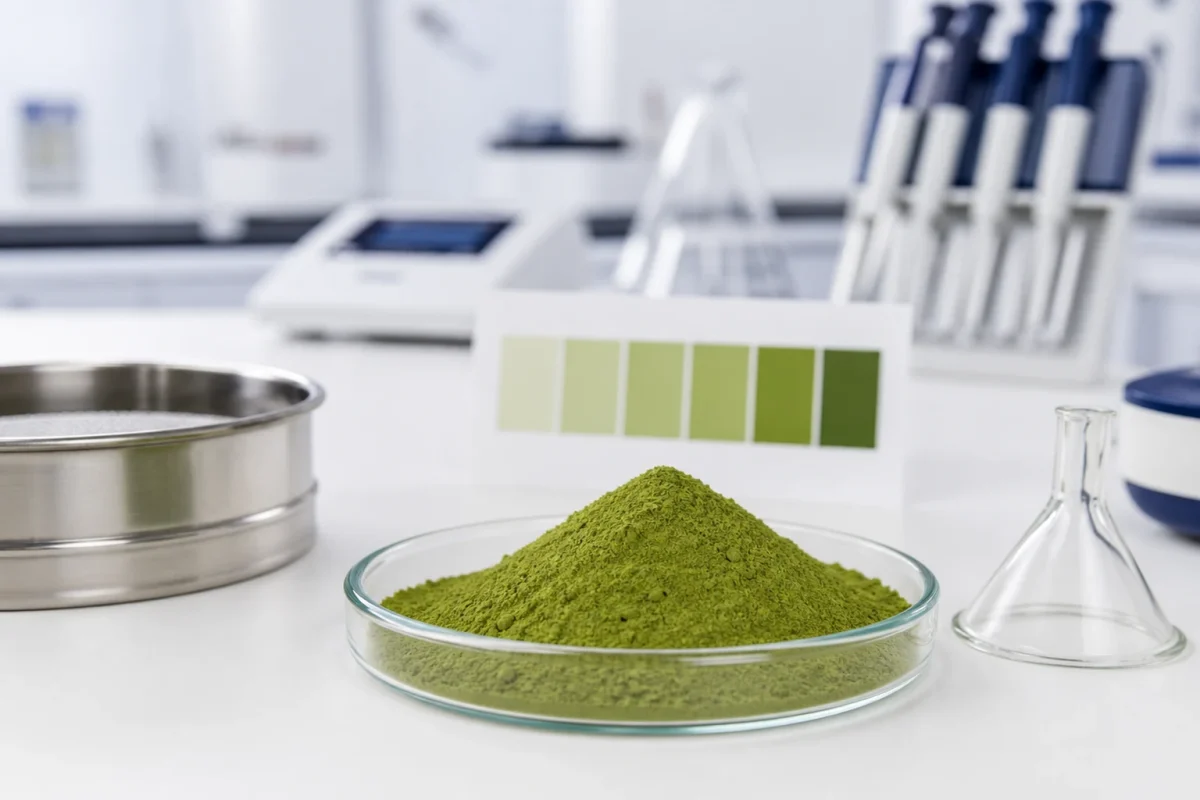
Particle size drives everything downstream: mouthfeel, suspension, foam stability, color yield and blend behavior. The human tongue perceives particles above roughly 25 μm as gritty, so D90 below 25 μm is a common practical target for beverage and premium applications; for chocolate and premium beverages, D90 below 20 μm is preferred.
- Specify D50 and D90, not a single “micron” number — the distribution matters as much as the average.
- Ask for the grinding method: stone milling (30–40 g/hour, minimal heat, tight distribution) vs jet/ball milling (faster, coarser, more heat exposure). Finer particles oxidize faster — matcha is a fresh, perishable ingredient, not a stable extract.
- Set moisture and water activity: moisture below 5.0% (below 3.0% for chocolate applications), water activity below 0.3.
- Check powder behavior in your process: wetting, dispersion and foam stability are best verified by a small-scale test with your own formula — exactly what a matched sample lot is for.
Certification and Export Compliance: US vs EU
Certification and import compliance are destination-driven. Confirm the supplier holds current certificates for your market — request copies dated within validity, not expired scans — and confirm which certificates cover the actual production facility and lot.
| Requirement | US market | EU market |
|---|---|---|
| Pesticide residue basis | EPA tolerances; no tolerance = zero tolerance (FDA enforcement); 500+ substance screening advised | Regulation (EC) 396/2005 MRLs, default 0.01 mg/kg; neonicotinoid limits tightened Mar 2026 |
| Supplier program | FDA FSMA / FSVP: importer must verify supplier food-safety practices; facility registration (11-digit FDA number, renewed in even years) | EU importer responsibilities under general food law; organic imports need equivalency (COI via TRACES) |
| Microbial basis | FDA standards | Regulation (EC) 2073/2005 microbiological criteria |
| Certificates commonly requested | USDA Organic, HACCP, FSSC 22000, Kosher, Halal, non-GMO statements | EU Organic, JAS equivalency, HACCP, FSSC 22000, Kosher, Halal |
| Tariff / duty note | 10% Section 122 duty applied to imports in Feb 2026 (per trade commentary) | Standard EU import duties; monitor MRL changes per commodity |
Organic is often required for EU export and increasingly for premium US programs, but note that organic certification guarantees cultivation standards, not flavor — for taste-critical applications a conventionally grown premium lot may outperform an organic one, so decide by market requirement and objective specs.
Samples: Cost Tiers, Quantity and Evaluation Protocol
Sample cost tiers in the bulk-ingredient trade cluster into three ranges, and the tier tells you how much supplier engineering is involved:
| Sample type | Typical cost | What it proves | Typical quantity |
|---|---|---|---|
| Stock sample | USD 0–50 | Existing inventory; color, flavor and document fit check | 50–500 g |
| Custom sample | USD 50–500 | Small adjustments to spec (color target, particle size, blending) | 500 g – 5 kg |
| Pre-production sample | USD 100–1,000+ | Full production-scale process validation | 5–50 kg |
Sample-to-order conversion in this category typically runs 20–30%, so suppliers generally handle samples seriously — but the conversion only works if the sample lot is traceable to the batch you will buy. Demand a sample-lot number, and ask that the COA, packing note and batch record match that number. For a strict color or process fit, budget for at least two evaluation rounds (sample review, adjusted sample, then bulk approval) before committing to production.
MOQ, Packing, Lead Time and Logistics
Commercial terms convert a good sample into a supply plan. Tiered MOQs are the norm: roughly 100 kg for trials, 500 kg for standard orders and 5,000+ kg for volume pricing. Matcha is perishable and light-sensitive, so packing and logistics are quality decisions, not paperwork:
- Packing: light-proof, oxygen-barrier packaging (foil-lined), nitrogen flush preferred; specify net weight per bag and carton configuration for your line.
- Cold chain: tencha is refrigerated at 0–10°C pre-milling (long-term stock often frozen at −20°C). Matcha shelf life depends on storage: frozen −18°C nitrogen-packed about 24 months; refrigerated 4°C about 12–18 months; ambient 20°C about 6–12 months; opened stock should be used within 30–60 days.
- Lead time: Japanese ceremonial lots commonly run 8–16 weeks in the 2025–26 shortage environment; Chinese factory-direct lots are usually shorter. Ask for harvest date AND milling date, not just packing date.
- Shipping: air freight preserves freshness (1–2 weeks) at higher cost; sea freight needs a reefer container — standard containers can spike to 60°C in transit and accelerate oxidation.
RFQ Checklist: 10 Questions to Send Before Quotation
Use the Food Ingredient RFQ Template and the Bulk Ingredient Sample Request Template to structure the exchange. At minimum, every RFQ should capture:
- Application, process route and finished-product spec (color, flavor, target D50/D90, moisture).
- Objective grade data: D50/D90 particle size, CIELAB color values, L-theanine assay.
- Origin, harvest date, milling date and shading days.
- Batch-specific COA fields: microbiology, heavy metals (Pb/As/Cd), pesticide screening scope and limits.
- Sample lot details and quantity, tied to the same batch number as the quotation.
- Steam sterilization status.
- Certifications covering the actual facility, valid at ship date (organic, HACCP, FSSC 22000, Kosher, Halal as applicable).
- MOQ tier (trial vs standard vs volume), packing size and configuration.
- Lead time and logistics mode (air vs reefer sea), Incoterms and destination port.
- Destination market and its compliance basis (US FDA/FSMA or EU 396/2005) so the supplier quotes the right document set.
FAQ
Compare objective spec data first: D50/D90 particle size, CIELAB color, L-theanine assay, moisture, batch-specific COA (microbiology, heavy metals, pesticide screening), sample lot traceability, MOQ tier, packing, lead time and destination-market compliance. Grade labels like "ceremonial" have no legal definition and should not be the basis for comparison.
Tiered MOQs are typical: about 100 kg for trials, 500 kg for standard orders and 5,000+ kg for volume pricing. Confirm the tier that matches your annual program, and note that sample quantities (50 g to 5 kg) are always separate from production MOQs.
Supply tightened while demand grew: Kyoto Uji tencha auction prices rose 116% year-on-year, Japan's cultivator base declined from over 54,000 farms in 2000 to about 12,000 in 2025, and Japanese powdered green tea exports grew 71% in volume. Global market forecasts still show 7–9% annual growth, so competition for premium lots is expected to persist.
Yes — especially when color, flavor direction, dispersion or blend behavior affects finished-product approval. Use a matched sample lot tied to the quotation's batch number, and budget for two evaluation rounds if the color or process fit is strict.
That depends on your destination: US programs typically require FDA FSMA/FSVP compliance and USDA Organic where applicable, plus HACCP, FSSC 22000, Kosher or Halal as your market needs; EU programs require EC 396/2005 MRL compliance, EU Organic or JAS equivalency, and microbiological compliance with EC 2073/2005. Request current certificates covering the actual production facility.
Use light-proof, oxygen-barrier foil packaging with nitrogen flush; choose reefer sea freight or air freight rather than standard containers, which can exceed 60°C in transit. Shelf life ranges from about 24 months frozen (−18°C, nitrogen-packed) down to 3–6 months at ambient temperature, and opened stock should be used within 30–60 days.
Summary
Comparing matcha suppliers in the current market means replacing grade labels with measurable data: set your application and process route, require objective specs (D50/D90, CIELAB, L-theanine, moisture), demand a batch-specific COA covering microbiology, heavy metals and 400+ compound pesticide screening, tie sample lots to the quotation batch, and confirm MOQ, packing, cold-chain logistics, lead time and destination-market compliance before quotation. Align application, visual target, particle size, powder behavior, COA fields, sample plan, MOQ, packing and destination market first — then request samples or quotation from the Bulk Matcha Powder Supplier product page.
Related Sourcing Resources
- Bulk Matcha Powder Supplier product page — commercial page for matcha samples and RFQ.
- Instant Green Tea Powder Supplier — adjacent beverage powder sourcing path.
- Green Tea Extract Supplier — adjacent extract sourcing path.
- Instant Tea Powder Supplier hub — category-level comparison.
- Bulk Ingredient Sample Request Template — sample quantity, specification, COA and MOQ fields.
- Food Ingredient RFQ Template — supplier comparison, packing and quotation fields.
- Ingredient Export Documentation Checklist — COA, packing and destination-market document review.
- Ingredient Supplier Audit Checklist — supplier scope, sample control and document readiness.
- Ingredient Sourcing Guide Index — grouped tea powder, plant extract, fruit powder and documentation resources.
- Contact HERBSEA — send application, sample, COA and RFQ details.
Data Sources
Market and benchmark figures cited above draw on: Research and Markets / 360iResearch matcha green tea powder market forecasts (2024–2032); WiseGuy Reports global matcha market (2024–2035); China Tea Marketing Association 2025 Matcha Conference industry briefing (production, output value, regional structure); China Association for the Promotion of International Agricultural Cooperation Japan powdered green tea export data (2024–2025); Nippon.com / Japan tea export trade summaries (2024–2025); CHTMatcha 2026 B2B matcha sourcing and quality standards review (price bands, MOQ, certification, EU MRL changes); First Agri matcha quality and formulation guidance (COA acceptance ranges, particle size, storage); Demeter Biotech EU-standard matcha documentation (heavy metal and microbiological limits). Figures are indicative planning data, not quotations — confirm all parameters with the supplier before ordering.