
Quick Answer — What is the difference between a matcha powder COA and a specification sheet?
A specification sheet is the fixed product reference: it defines the agreed grade, physical limits (particle size, moisture, ash), heavy metals and microbiology limits, and packing and storage rules that stay constant across batches. A COA (Certificate of Analysis) is the per-batch proof that a specific lot met that specification — it carries the batch/lot number, production and expiry dates, and the actual measured results for each agreed test. Buyers should compare the COA of a given sample lot against the specification sheet line by line, then keep both documents linked to the sample record before quotation or scale-up. Use the Bulk Matcha Powder Supplier product page as the commercial reference for specification, COA, sample and quotation.
1. Why Matcha Documentation Matters More in 2025–2026
Matcha is one of the fastest-growing tea categories, and tight supply is putting pressure on buyers to verify documents early. The global matcha green tea powder market was valued at roughly USD 1.47 billion in 2024 and is projected to reach USD 2.86 billion by 2032 at a CAGR of about 8.6% (Research and Markets / 360iResearch, 2025). China Tea Marketing Association data cited in December 2025 puts global matcha output at around 8,266 tons in 2020 rising to an estimated 17,600 tons in 2025, with China and Japan together accounting for over 90% of production.
Supply, not just demand, is tightening. Japan exported about 5,092 tons of matcha in 2024 — up 18.7% in volume and about 25.9% in value year-on-year to roughly USD 185 million (Japan Customs data compiled by Firsd Tea, 2025). The Uji tencha auction price reached about JPY 8,235/kg in May 2025, up roughly 170% year-on-year after record summer heat cut tencha yields (Reuters/CCTV, 2025). When prices rise and buyers switch suppliers or renegotiate contracts, the COA becomes the first line of defense against mis-graded or adulterated material.
| Market indicator | Value | Source / year |
|---|---|---|
| Global matcha powder market | USD 1.47B (2024) → USD 2.86B (2032E), CAGR ~8.6% | Research and Markets / 360iResearch, 2025 |
| Global matcha production | ~8,266 t (2020) → ~17,600 t (2025E), 20%+ annual growth | China Tea Marketing Association, Dec 2025 |
| China + Japan share of global production | >90% | China Tea Marketing Association, 2025 |
| Japan matcha exports 2024 | 5,092 t / ~USD 185M, +18.7% volume / +25.9% value | Japan Customs / Firsd Tea, 2025 |
| Uji tencha auction price | ~JPY 8,235/kg (May 2025), +170% YoY | Reuters / CCTV, 2025 |
2. Specification Sheet vs COA: What Each Document Actually Does
A spec sheet is the contract for quality. A COA is the evidence for a single lot. If the two disagree on any checked field, the lot should not move to quotation without a written resolution.
| Dimension | Specification sheet | COA (Certificate of Analysis) |
|---|---|---|
| Role | Fixed product reference, valid across batches | Per-lot test evidence, valid for one batch only |
| Covers | Grade direction, physical limits, packing and storage rules | Batch/lot number, actual measured results, test methods |
| Key fields | Product name, particle size, moisture, ash, heavy metals, microbiology, packing | Batch no., production/expiry dates, appearance, moisture, ash, heavy metals, microbiology, residue tests |
| Changes when | Product is reformulated or grade is revised | Every new production batch |
| Buyer use | Supplier comparison and approval baseline | Lot acceptance, sample review, customs and audit records |
3. The Eight Fields to Check on a Matcha Specification Sheet
These are the fields that consistently separate usable matcha specifications from marketing sheets. Ask the supplier to confirm each one in writing before samples.
- Product name and botanical identity — Matcha is powdered Camellia sinensis leaf; confirm no blends, fillers, or added colorants are permitted.
- Grade direction — Ceremonial (fine grind, bright green, low astringency, for direct whisking), culinary (for lattes, baking, confectionery, food service), or ingredient (for dry mixes and RTD formulations). Grade drives the physical and sensory limits.
- Particle size — Typically expressed as mesh pass or D50. Common specifications: D50 ≤ 10 µm, or 100% through 100 mesh with min 70–95% through 800 mesh; fine stone-milled matcha generally runs 5–10 µm. Particle size drives dispersion, color, and mouthfeel in beverages.
- Moisture and ash — Moisture is usually ≤ 4.5–6.0% and total ash ≤ 5.5–8.0%. High moisture shortens shelf life and risks clumping in shipping.
- Color and sensory direction — Bright jade green, fresh grassy aroma, umami/sweet taste with controlled astringency. Ask for the visual target and, if possible, a reference sample photo.
- Heavy metals limits — Lead, arsenic, cadmium, mercury with explicit mg/kg limits and test methods (see Section 5 for benchmark ranges).
- Microbiology limits — Total plate count, yeast and mold, coliforms, E. coli, Salmonella with explicit cfu/g limits and “negative/25 g” requirements.
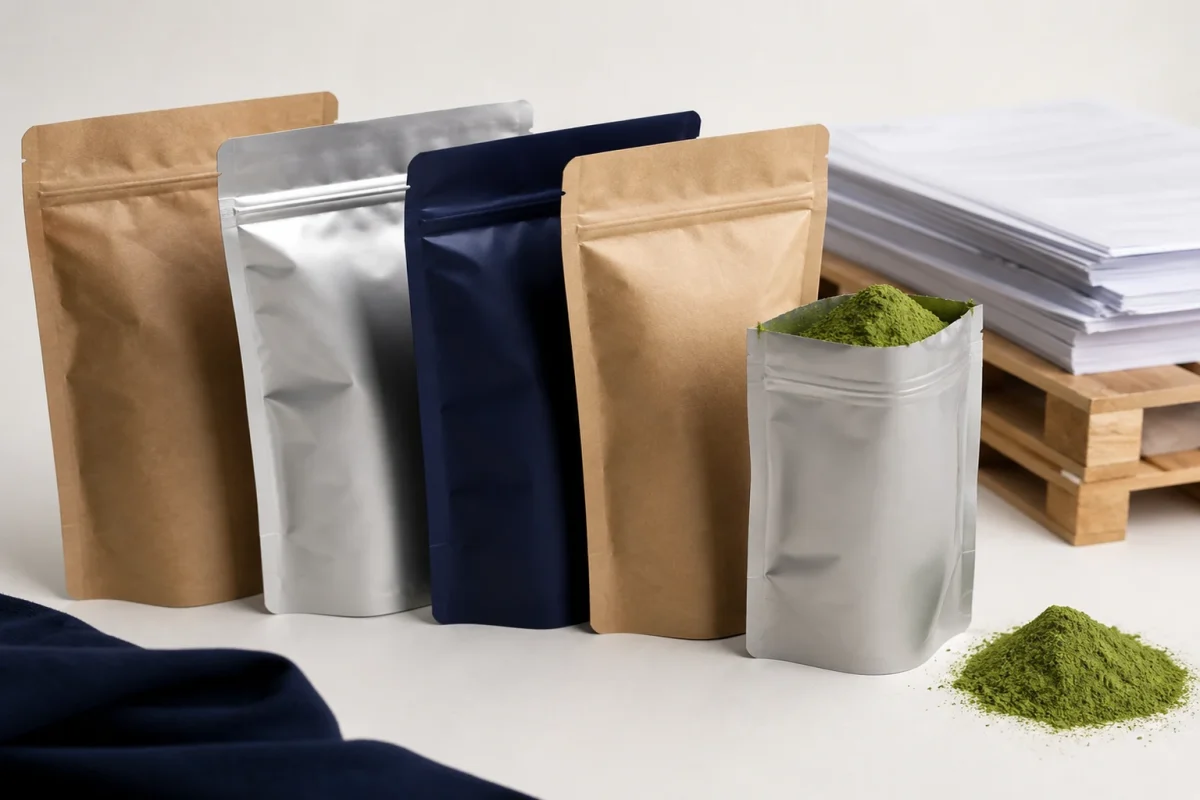
- Packing and storage — Inner packing material, net weight, shelf life, and storage conditions (cool, dry, away from light). 25 kg paper-drums with double PE liners are the bulk standard; 30–100 g tins are common for retail-grade packing.
4. What a Matcha COA Should Report for Every Batch
When you receive a COA, verify that it is batch-specific and carries every field listed below with the actual measured result and the test method. A COA that only quotes limits (“conforms”) without measured values is a certificate of existence, not evidence.
| Parameter | Typical matcha specification range | Common test methods |
|---|---|---|
| Particle size | D50 ≤ 10 µm or ≥95% pass 800 mesh | Laser diffraction / sieve analysis |
| Moisture (loss on drying) | ≤ 4.5–6.0% | GB 5009.3 / vacuum oven |
| Total ash | ≤ 5.5–8.0% | GB 5009.4 / incineration at 525–550°C |
| Lead (Pb) | ≤ 0.8–2.0 mg/kg | AAS / ICP-MS (GB 5009.12) |
| Arsenic (As) | ≤ 0.2–1.0 mg/kg | AFS / ICP-MS (GB 5009.11) |
| Cadmium (Cd) | ≤ 0.1–0.5 mg/kg | AAS / ICP-MS (GB 5009.15) |
| Mercury (Hg) | ≤ 0.03–0.1 mg/kg | AFS / ICP-MS (GB 5009.17) |
| Total plate count | ≤ 1,000–10,000 cfu/g | ISO 4833-1 / GB 4789.2 |
| Yeast and mold | ≤ 50–100 cfu/g | GB 4789.15 / ISO 21527 |
| Coliforms / E. coli | < 10 cfu/g / negative | GB 4789.3 / ISO 16649-2 |
| Salmonella | Negative / 25 g | GB 4789.4 / ISO 6579 |
Benchmark ranges above are compiled from published matcha COA examples of Chinese and Japanese suppliers (NewSeed, Hebei Abiding, TOBRAND, BiofIngredients, 2024–2025). Always confirm the exact limits in the supplier’s own specification sheet and against your destination-market regulation.
5. Heavy Metals and Pesticide Residue Limits: The Destination-Market Check
The same matcha can pass one market’s limits and fail another’s. This is the most common reason bulk tea consignments are detained at EU customs.
- EU pesticide residues — Regulation (EC) No 396/2005 applies a default MRL of 0.01 mg/kg to any pesticide without a specific tea MRL — effectively a zero-tolerance standard for most of the 400+ compounds on the EU list. Compliance requires a multi-residue screen of 300–500+ compounds by GC-MS/MS and LC-MS/MS (per SANTE/11945/2015), not a basic 12-compound panel. Anthraquinone, acetamiprid, clothianidin, thiamethoxam, and tricyclazole are frequent rejection triggers for Chinese-origin tea entering the EU.
- Heavy metals — EU/CODEX-oriented buyers typically require lead ≤ 1.0–2.0 mg/kg with strict cadmium control; Japanese and high-end food-service buyers often specify tighter lead limits (≤ 0.8–1.0 mg/kg) and full heavy metal panels including arsenic and mercury.
- Organic claims — If the specification says organic, the COA should reference the certification body and standard (USDA NOP, EU Organic Regulation 2018/848, JAS), and the certificate should be attached — not just the word “organic” on the spec.
When you request a quotation for an EU destination, ask the supplier explicitly: “Does the pesticide COA use a multi-residue method covering 300+ compounds with a 0.01 mg/kg default, and what is the anthraquinone result?”
6. Sample Review vs Bulk RFQ: How to Link the Sample Lot to the COA
Never let the sample COA float free from the sample record. If the sample lot number is not recorded at the time of tasting, the approval has no audit trail — and the bulk shipment can arrive with a different lot, different color, and different particle size.
| Dimension | Sample review | Bulk RFQ |
|---|---|---|
| Main purpose | Confirm color, flavor direction, particle size, dispersion, and document fit | Confirm supply plan, MOQ, packing, lead time, and export documents |
| Buyer input | Application, sample quantity, test matrix, COA needs | Quantity, packing size, destination market, reorder expectation |
| Documents to keep | Sample label, batch number, COA version, internal approval record | Proforma invoice, final COA, packing list, certificates of origin and analysis |
| Commercial limit | Needs later commercial confirmation | Should follow sample approval when color or process fit is strict |
7. RFQ Checklist for Matcha COA and Specification Review
- Specification sheet version and target grade (ceremonial / culinary / ingredient).
- Representative COA and sample lot number, linked to the physical sample.
- Particle size, color direction, and powder behavior notes for your application.
- Heavy metals and pesticide residue limits matched to the destination market.
- Packing, MOQ, lead time, and shelf life confirmed in writing.
8. FAQ
Check whether batch fields, appearance, physical data, microbiology, heavy metals, and packing details on the COA match the agreed specification fields, and confirm the COA carries measured values (not just “conforms”) plus the test methods.
A clear sample lot and COA connection helps QA and procurement keep approval records consistent before bulk quotation — the bulk lot can then be checked against the same baseline instead of being approved on memory.
Ceremonial-grade commands the highest price and is the most frequently mislabeled. Verify particle size, color, harvest origin, and organic certificate; if a price looks too good for ceremonial grade, ask for the COA and a reference sample photo.
Pesticide residues above the default 0.01 mg/kg MRL under Regulation (EC) No 396/2005 — usually because the supplier’s COA only tested a small compound panel. Ask for a 300+ compound multi-residue result.
Not automatically. Finer particle size improves dispersion and color intensity but increases milling cost and oxidation risk. Choose particle size by application — whisked ceremonial use needs the finest grind, while bakery fillings and dry mixes may prefer a slightly coarser, more stable powder.
Use the Bulk Matcha Powder Supplier product page and include application, sample quantity, document needs, and destination market so the supplier ships a lot you can actually evaluate.
9. Summary
Align application, visual target, particle size, powder behavior, COA fields, sample plan, MOQ, packing, and destination market first. Use the specification sheet as the fixed contract and the COA as per-batch evidence, link the sample lot to the COA before approval, and check pesticide residue methodology against your destination market. Then request samples or quotation from the relevant product page.
10. Related Sourcing Pages
- Bulk Matcha Powder Supplier — main page for matcha COA, samples, and quotation.
- EGCG 98 Powder Supplier — adjacent green tea active specification path.
- L-Theanine Green Tea Extract Supplier — adjacent HPLC documentation path.
- Ingredient Export Documentation Checklist — COA, packing, and destination-market document review.
- Ingredient Sourcing Guide Index — grouped tea powder, plant extract, fruit powder, and documentation resources.
- Contact HERBSEA with application, sample, COA, and RFQ details.
Data sources: market and regulatory data cited in this guide — Research and Markets / 360iResearch matcha market forecast (2025); China Tea Marketing Association matcha industry briefing (Dec 2025); Japan Customs matcha export statistics compiled by Firsd Tea (Aug 2025) and the 2024 Japan Matcha Export Research Report (China Association for the Promotion of International Agricultural Cooperation, Sep 2025); Reuters/CCTV tencha price reporting (Jul 2025); EU Regulation (EC) No 396/2005 MRL framework; published matcha COA examples from NewSeed, Hebei Abiding, TOBRAND, and BiofIngredients (2024–2025). Limits are benchmarks for comparison — always confirm exact specifications with the supplier and your destination-market regulation.