
Quick Answer: A complete organic matcha powder sample request should confirm six things before the supplier quotes: (1) the target market and the organic certificate that market accepts (USDA Organic, EU Organic or JAS), (2) the application and grade direction, (3) the visual target for color and particle size, (4) the COA and specification-sheet package, (5) sample quantity and sample-lot traceability, and (6) commercial terms — MOQ, packing, lead time and destination port. Send all six in one RFQ and the supplier can respond with one document set instead of five follow-up emails. Use the Bulk Matcha Powder Supplier product page as the commercial reference for specifications, sample availability and quotation.
1. Why the Sample Request Now Decides the Whole Deal
Matcha powder is in a structural supply squeeze, and that changes what a good sample request looks like.
Global matcha powder demand has moved from a niche Japanese tea tradition into mainstream beverages, bakery, confectionery and ready-to-drink formats. The global matcha green tea powder market was estimated at USD 2.17 billion in 2025 and is projected to reach USD 2.35 billion in 2026 (CAGR 8.83%, 360iResearch, 2026). Meanwhile, Japan — the traditional benchmark supplier — cut production in 2025: tencha output is estimated to have fallen 20–30% on extreme heat, late frosts and an aging farming workforce (CCTV / China Tea Marketing Association reporting, 2026).
China has filled the gap and is now the largest producing country. According to the 2026 China Matcha Industry Development Report, China produced over 12,000 tonnes of matcha in 2025 — roughly 70% of global output — with a five-year CAGR of 28.67%. Zhejiang alone produced 8,851 tonnes (2025), and Zhejiang matcha exports grew 7.3× year-on-year in Q1 2026 (1,241.97 tonnes, RMB 140 million). Guizhou Tongren — the largest single matcha production base — exported 1,300 tonnes in 2025, up 3× year-on-year, to 54 countries.
For a buyer, this shift has two practical consequences:
- Allocation, not availability, is the first question. In-demand organic grades are often sold out 2–3 months ahead; one Zhejiang producer reported order-to-delivery cycles of 2–3 months in 2025 (CCTV, 2026). A sample request that takes three email rounds to clarify is a sample that arrives too late.
- Documentation is the differentiator between suppliers. With supply tight, buyers who send a complete checklist get priority allocation and faster COA responses, because the supplier can match the request to a specific lot immediately.
Market Data Snapshot
| Indicator | Value | Year / Source |
|---|---|---|
| Global matcha green tea powder market | USD 2.17B → 2.35B (2026), CAGR 8.83% | 360iResearch forecast |
| China matcha production | 12,000+ t, ~70% of global output | 2026 China Matcha Industry Development Report |
| Zhejiang production | 8,851 t (RMB 1.1B value) | Zhejiang industry data, 2025 |
| Zhejiang Q1 matcha export growth | +7.3× YoY (1,241.97 t) | Hangzhou Customs, Q1 2026 |
| Tongren (Guizhou) exports | 1,300 t, +3× YoY, 54 destinations | Tongren city data, 2025 |
| Japan tencha production change | −20% to −30% | Industry estimates, 2025 |
| Typical order-to-delivery cycle | 2–3 months for in-demand grades | Producer interviews, 2026 |
2. The Six-Point Sample Checklist (Send This in Your First Message)
A sample request is a mini-RFQ. Include all six fields below; anything missing becomes a clarification round that delays allocation.
| # | Review point | Buyer input | Why it matters |
|---|---|---|---|
| 1 | Organic document need | Target market + certificate request (USDA Organic, EU Organic, JAS or buyer-specified) | Organic sourcing must be document-aligned before sample approval; the certificate defines the compliance burden |
| 2 | Grade and application | Beverage, bakery, confectionery, food-service or dry-blend direction | Application determines grade, color depth and flavor priorities |
| 3 | Physical targets | Color direction (shade/lab value), particle size, dispersion and flow expectations | Physical review is how buyers compare supplier fit before committing |
| 4 | COA package | Representative COA, specification sheet, sample-lot number, testing scope | Documents support QA and procurement screening in parallel |
| 5 | Sample plan | Quantity, sample type (stock / custom / pre-production), test matrix | Defines what the supplier must produce and when |
| 6 | Commercial terms | MOQ expectation, packing size, lead time, destination market | Prepares the next RFQ step and tells the supplier which lot to allocate |
Practical recommendation: if the grade is fixed, send the target powder behavior, color direction, document list, sample quantity, MOQ, packing and destination market. If the grade is still open, ask for the supplier’s available matcha options with representative COA and sample-lot details, then narrow by physical review.
3. Organic Certification: Match the Certificate to the Destination Market
Organic matcha is certified under three main frameworks, and the one that matters is the one your destination market accepts. A JAS certificate satisfies USDA organic equivalency (the two programs have a mutual recognition agreement), but buyers who sell to US retailers often prefer explicit USDA Organic certification, and EU-bound shipments face their own import requirements.
| Dimension | USDA Organic (NOP) | EU Organic (Reg. 2018/848) | JAS Organic (Japan) |
|---|---|---|---|
| Governing regime | USDA National Organic Program | EU Regulation 2018/848 | MAFF Japanese Agricultural Standard |
| Organic content threshold | ≥95% of ingredients certified | ≥95% of ingredients certified | ≥95% organic content |
| Transition period | 3 years chemical-free | 2–3 years (transition categories) | 3 years without synthetic inputs |
| Key extra for importers | FDA facility registration + Prior Notice (US entry) | Certificate of Inspection per shipment (mandatory 2022+) | Transaction Certificate per shipment; JAS↔USDA equivalence for US |
| Typical buyer context | US retail, natural chains, wellness marketplaces | EU retail, bakery/confectionery, organic channels | Japan-origin claims, premium foodservice |
| Cost signal | Organic premium 20–40% at wholesale vs conventional | Same premium band; strict EU MRL testing expected | JAS certification USD 2,500–8,000/farm/year; transaction cert USD 50–150/shipment |
What to request in the sample stage (not later):
- The supplier’s organic certificate (farm-level) and its validity year — a certificate that expired last December is not evidence for this season’s crop.
- A transaction certificate for the sample lot where the destination requires one — this proves the organic claim is tied to that specific lot, not just to the company logo.
- For EU destinations: pesticide residue test data against current EU MRLs — leading Chinese producers now pass 500+ EU residue parameters (Tongren, 2025), so this is a realistic ask, not a premium-only one.
- For US destinations: confirmation that FDA Prior Notice / FSVP documentation can be supplied per shipment, plus a phytosanitary certificate if the destination requests it.
Red flag to check: an organic logo on packaging without a lot-level transaction certificate. The certificate is the evidence; the logo is just a print.
4. Grade, Color and Particle Size: The Three Physical Specs That Decide Fit
Matcha quality is negotiated on three objective specs, not adjectives. Put numbers on all three before you compare suppliers.
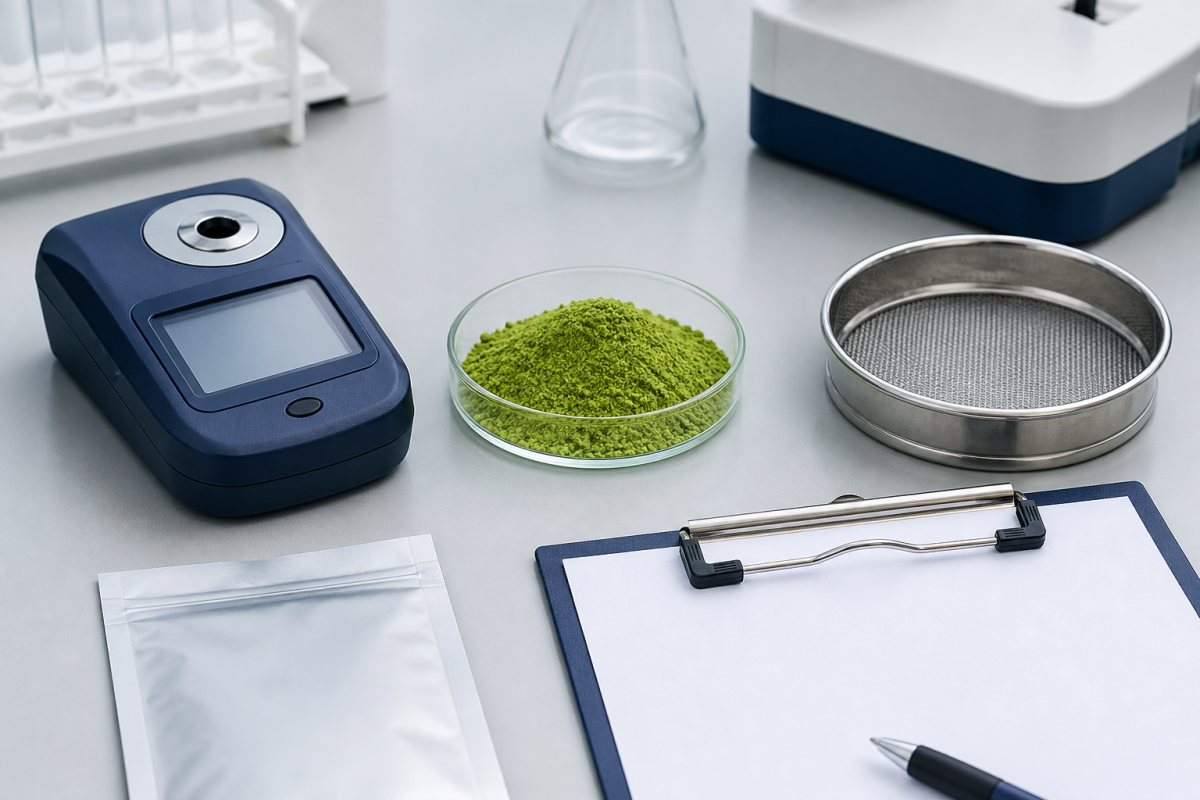
- Color (Lab* values): a* strongly negative = vivid green; high b* means yellowness from insufficient shading or poor storage. Buyers who need a bright green latte or ice-cream color should state the direction explicitly and approve a color target at the sample stage — color is one of the most common reasons bulk orders get rejected after sample approval.
- Particle size: matcha is milled to roughly 800–1,000 mesh for standard culinary grades and up to 1,200–1,300 mesh on advanced lines (Gui Tea Group, 2026). Finer powder disperses better in cold beverages; coarser powder is acceptable in baked goods. Ask for the mesh/micron spec, not “fine powder”.
- Flavor and behavior: umami and sweetness (high L-theanine) versus bitterness and astringency (high catechins) determine application fit. For food-service blending, also check dispersion and flow — how the powder behaves when whisked, dosed or blended.
| Spec | What to state in the request | Typical benchmark |
|---|---|---|
| Color direction | Shade target or Lab* reference; approve color at sample stage | a* strongly negative for vivid green |
| Particle size | Mesh/micron target per application | 800–1,000 mesh culinary; up to 1,200–1,300 mesh premium lines |
| Flavor profile | Umami-forward vs balanced vs astringent-tolerant | Theanine-to-catechin ratio drives perceived quality |
| Powder behavior | Dispersion (cold vs hot), flow, clumping | Finer grind = better cold dispersion |
5. Sample Types and Realistic Cost Tiers
Matcha samples are not one-size-fits-all. Choose the sample type that matches where you are in the decision process, and budget accordingly.
| Sample type | What it covers | Typical cost band | When to use it |
|---|---|---|---|
| Stock sample | Off-the-shelf grade, standard spec, representative COA | USD 0–50 (often free or freight-only) | Early screening of color, flavor and document fit |
| Custom / tailored sample | Grade adjusted to your color or particle target | USD 50–500 | When a fixed spec must be validated before commitment |
| Pre-production sample | Batch from the actual production line / lot for your order | USD 100–1,000+ | Final approval before bulk, especially for color-critical or certified lots |
Sample-to-order conversion in ingredient sourcing typically runs 20–30% — most samples do not convert. That is normal; it is also why suppliers price custom and pre-production samples. Regard the sample budget as part of the sourcing cost, and make the sample request specific enough that a reject tells you why (color, flavor, documents, price), not just that it was rejected.
6. Sample Review vs Bulk RFQ: When to Move to the Next Stage
A sample review answers “does this powder fit?”; a bulk RFQ answers “can this supplier deliver it, repeatedly?” Keep the two stages separate — approving a sample without commercial terms is how color-fit problems turn into delivery problems.
| Dimension | Sample review | Bulk RFQ |
|---|---|---|
| Main purpose | Check color, flavor direction, particle size, dispersion and document fit | Confirm supply plan, MOQ, packing, lead time and export needs |
| Buyer input | Application, sample quantity, test matrix and COA needs | Quantity, packing size, destination market and reorder expectation |
| Document focus | Representative COA + spec sheet + sample-lot traceability | Lot-level COA commitment, organic transaction certificate, phytosanitary/entry documents |
| Limit | Needs later commercial confirmation | Should follow sample approval when color or process fit is strict |
Practical rule: move to bulk RFQ only after the sample passes your physical review and the supplier confirms the same spec can be held at bulk scale (same milling line, same lot discipline). If the supplier offers a pre-production sample, take it — it is the strongest evidence of bulk consistency.
7. The COA and Specification Package to Request With Every Sample
A representative COA is not enough — it should be tied to the sample lot. Request these fields explicitly:
- Sample-lot number and production date (so bulk QC can be traced back to the approved sample).
- Pesticide residue scope: the parameter list and detection limits, aligned to your destination market (EU MRLs are the strictest reference; 500+ parameter panels are now common from leading producers).
- Heavy metals (lead, cadmium, arsenic, mercury) with the lab method used.
- Microbiology (total plate count, coliforms, E. coli, salmonella as applicable) for food-safety screening.
- Specification sheet covering cultivar, origin, harvest season, particle size, moisture, color values and the organic certificate reference.
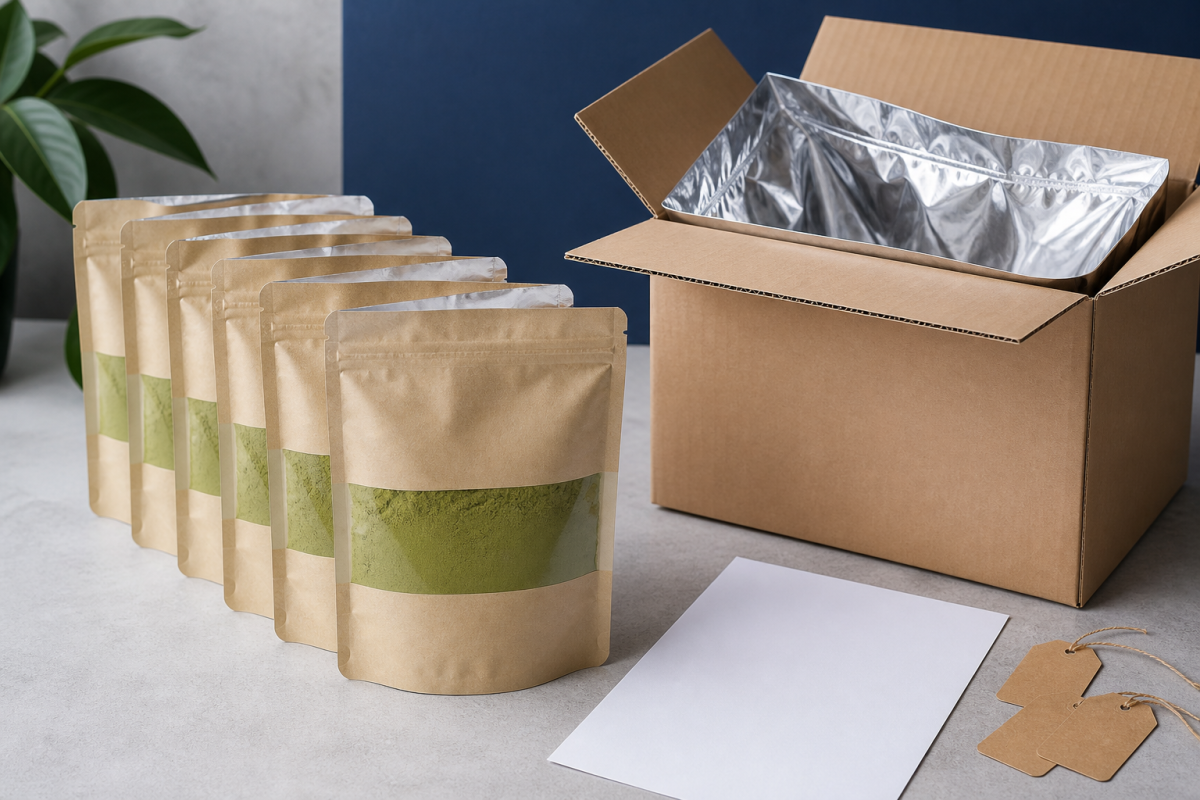
- Packing note: sample pack format and the bulk packing options (e.g., kraft/foil-lined bags, cartons, inner PE liner) — packing affects shelf life and customs documentation.
8. MOQ, Packing and Lead Time in the 2025–2026 Supply Environment
Three commercial facts change how you set expectations:
- Lead time is the constraint. In-demand grades run 2–3 months order-to-delivery (Zhejiang producer interviews, 2026). Ask for the current allocation window in the sample request — if the supplier quotes delivery “when the line is free”, that is a supply-risk signal, not an answer.
- MOQ should be quoted per grade. Culinary-grade stock lots carry lower MOQs; organic certified lots and custom grinds carry higher ones. Confirm MOQ per container or per SKU, and confirm whether sample approval reserves your place in the production schedule.
- Packing is a document issue, not just a logistics one. Foil-lined bags, inner liners and export cartons matter for shelf life and for the packing list that accompanies customs clearance. State the destination port so the supplier can flag any document requirement early.
9. FAQ
Include the target market and organic document need, application and grade direction, color and particle-size targets, COA and specification needs, sample quantity and sample type, MOQ expectation, packing and destination market — all in one message.
Ask for the certificate your destination market accepts: USDA Organic for US retail, EU Organic (Reg. 2018/848) for the EU, and JAS for Japan-origin claims. A lot-level transaction certificate is the evidence that the organic claim applies to your sample lot.
Yes, when matcha color is important to the finished product or customer-facing formula. Approve a color target (shade direction or Lab* reference) at the sample stage and require a pre-production sample if color tolerance is strict.
A stock sample is an off-the-shelf grade with a representative COA (usually low-cost or free); a pre-production sample is produced from the actual lot or line for your order and costs more, but is the strongest evidence of bulk consistency.
The destination market determines the organic certificate, residue-testing scope, entry documentation (e.g., FDA Prior Notice for the US, Certificate of Inspection for the EU) and phytosanitary needs — all of which affect the lot allocated and the quote.
For in-demand organic grades, 2–3 months order-to-delivery is common in the 2025–2026 supply environment. Confirm the current allocation window in the sample request and reserve your production slot at sample approval.
10. Summary
Matcha supply has tightened and China now produces ~70% of global output, so the buyer who sends a complete, document-ready sample request gets faster answers and better allocation. Align six things first: target-market certificate, application and grade, color and particle-size targets, COA package, sample plan, and commercial terms (MOQ, packing, lead time, destination). Then compare suppliers on the physical review and the document set — not on adjectives — and move to bulk RFQ only after sample approval with a confirmed spec-hold at scale.
Data sources: 360iResearch Matcha Green Tea Powder Market – Global Forecast 2026–2032 (2026); 2026 China Matcha Industry Development Report / China Tea Marketing Association (2026); Hangzhou Customs and Zhejiang provincial matcha data (2025–2026); Guizhou Tongren matcha industry data (2025); CCTV Business (2026) producer reporting on lead times and pricing; JAS/USDA/EU organic program documentation (MAFF, USDA NOP, EU Reg. 2018/848). Figures cited as industry estimates for planning; confirm current values with the supplier before commitment.
Related Resources
- Bulk Matcha Powder Supplier — main product page for organic matcha sample questions, specifications and quotation.
- Instant Tea Powder Supplier hub — category comparison for tea powder projects.
- Instant Green Tea Powder Supplier — adjacent green tea powder sourcing path.
- Bulk Ingredient Sample Request Template — sample quantity, specification, COA and MOQ fields.
- Food Ingredient RFQ Template — supplier comparison, packing and quotation fields.
- Ingredient Export Documentation Checklist — COA, packing and destination-market document review.
- Ingredient Sourcing Guide Index — grouped tea powder, plant extract and documentation resources.
- Contact HERBSEA — send application, sample, COA and RFQ details.