
Instant Tea Powder Suppliers Comparison Checklist
Supplier quotes are hard to compare when COA, sample conditions and MOQ are missing.
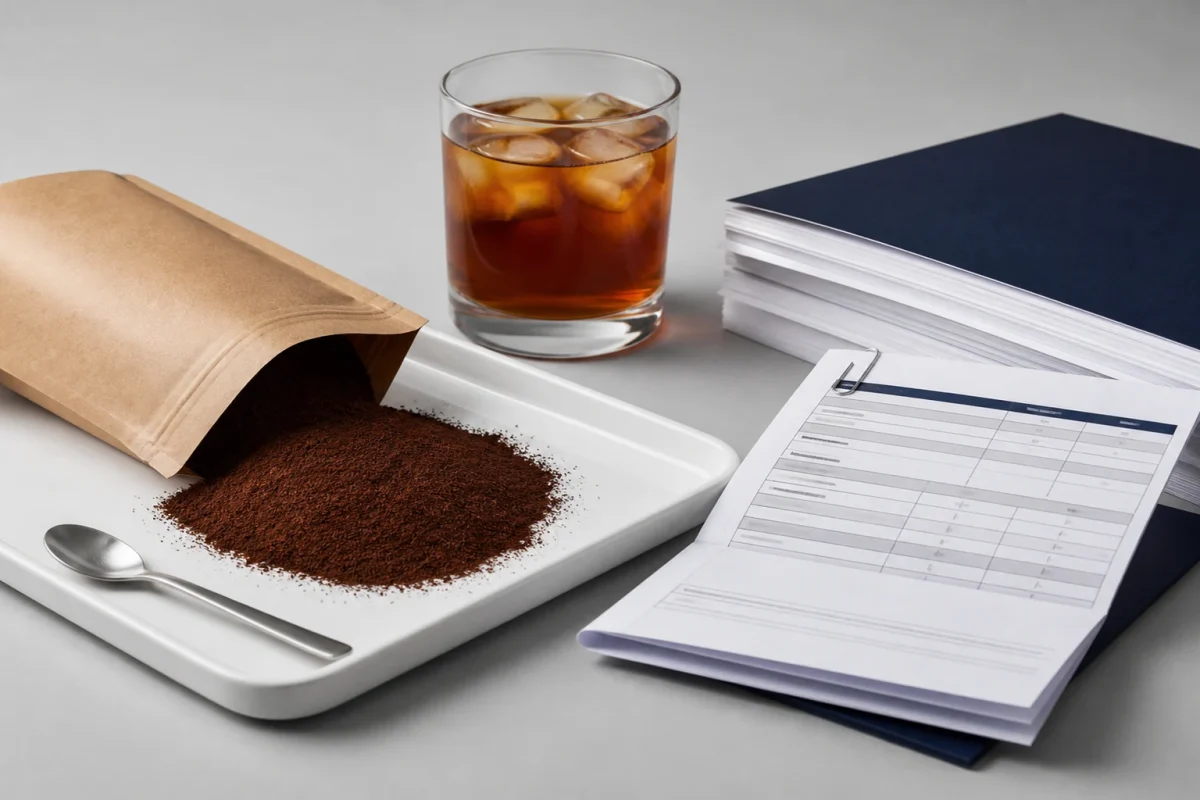
For beverage brands, contract manufacturers and ingredient distributors, instant tea powder suppliers should be screened on the same baseline: specification, COA, sample fit, MOQ, packing and lead time. If one supplier quotes a stronger tea note and another quotes a finer dispersion target, the prices are not comparable yet.
HERBSEA supplies bulk instant tea powder for B2B beverage and dry-mix projects. Start with the Instant Tea Powder category, then review the bulk instant tea powder supplier guide and the relevant product page before requesting samples or quotation.
Buyer Needs
Before sending RFQs, define what the finished product needs to do. The same instant tea powder can behave very differently in RTD tea, milk tea, dry-mix sachets or tea latte systems. If the buyer does not define the application first, each supplier may quote a different grade and the comparison becomes noisy.
Start with the buyer brief:
- Finished format: RTD, milk tea, iced tea or dry mix
- Tea direction: black tea, green tea, oolong or blended tea base
- Solubility target: hot water, cold water or both
- Sensory target: color depth, aroma direction and bitterness level
- Commercial target: sample quantity, annual forecast and launch timeline
If the project already has a main formulation direction, share it early. As a result, the supplier can quote a material that fits the process conditions instead of a generic tea powder that only looks similar on paper.
Screening Criteria
A supplier comparison works only when every candidate is reviewed against the same checklist. Therefore, procurement teams should ask for the same document set, the same sample conditions and the same commercial assumptions from every supplier.
Use this core RFQ checklist:
| Checkpoint | What to confirm | Why it matters |
|---|---|---|
| Specification | Tea type, color direction, particle size, carrier and solubility target | Prevents mismatched quotations |
| COA | Appearance, assay, moisture, microbiology and heavy metals | Shows whether the batch fits the agreed target |
| Sample | Sample size, batch reference and test conditions | Lets buyers compare in the real formula |
| MOQ | Pilot quantity, launch quantity and repeat order quantity | Shows whether the supplier fits the buying plan |
| Packing | Net weight, bag type, moisture barrier and pallet plan | Affects storage, transport and shelf stability |
| RFQ scope | Destination market, forecast, document list and lead time | Helps suppliers quote on the same basis |
Stock Grade vs Custom Grade vs Dual-Source Plan
| Dimension | Stock grade | Custom grade | Dual-source plan |
|---|---|---|---|
| Speed | Fastest for trial and short lead time projects | Slower because spec alignment takes longer | Depends on which source is used first |
| Fit | Good for early screening | Better for tighter formulation targets | Best for risk control and backup planning |
| MOQ | Usually lower | Usually higher | Split by approved supplier and project stage |
| Risk | Limited flexibility | Longer commercial cycle | More coordination, but less single-source pressure |
By contrast, a quote that only shows price without spec and COA is not a useful comparison point. It is only a number. The real decision starts when the technical and commercial inputs are the same.
Practical Advice
Compare suppliers in three rounds. First, screen the document set and application fit. Second, test the sample in the final formula. Third, compare MOQ, packing and lead time against the launch plan.
- Send one RFQ sheet to every supplier.
- Use the same beverage format, same water system and same test conditions.
- Record dispersion, color, sediment, aroma and formula compatibility.
- Compare commercial terms only after the sample result is stable.
- Keep a second supplier in reserve if volume risk matters.
For product-level context, review the Instant Black Tea Powder page, the Instant Green Tea Powder page and the Instant Black Tea Powder for RTD Beverages guide. For sourcing structure, the Black Tea Powder Supplier Guide is also useful.
If you are preparing a quotation request now, send the target application, sample quantity, forecast volume and document list through the HERBSEA quotation form.
Summary
If your main problem is inconsistent supplier quotes, fix the comparison baseline first. Define the application, review COA and sample conditions, then compare MOQ and packing on the same spec. That is the cleanest way to choose among instant tea powder suppliers.
For RTD tea, milk tea and dry-mix projects, a clear RFQ sheet is more useful than a long price list. It keeps the buyer, supplier and formulation team aligned on the same target.
FAQ
What should an instant tea powder RFQ include?
It should include the finished format, tea direction, solubility target, sample quantity, specification target, MOQ, packing, destination market and document list.
Why test the sample in the final formula?
Because tea powders can behave differently in water, sugar systems, acids and milk systems. Final-formula testing gives a more realistic comparison.
When is stock grade enough?
Stock grade is usually enough for fast trials or early market testing. If the project needs tighter sensory or process control, custom spec is usually a better fit.