
Quick answer: A serious black tea powder supplier check covers six dimensions: certifications (HACCP baseline; FSSC 22000 / BRCGS for export-grade food safety), quality & testing (ISO 3720 black tea definition, COA assay, pesticide MRL compliance for destination markets), supply stability (origin concentration and climate risk — Kenya’s 2025 crop fell ~8%), cost structure (origin-dependent; e.g., Kenya black tea export unit value ~US$2.24/kg vs China tea export average US$3.79/kg in 2024), documentation (spec, COA, SDS, origin certificate) and cooperation process (qualification → spec alignment → sample → trial order → batch approval). Global black tea demand supports this: the black tea market was ~US$18.2B in 2024 (CAGR ~4.3% to 2033), black tea is ~75% of world tea consumption, and China + India produce ~69% of world tea.
This B2B sourcing guide helps buyers run a focused supplier review before requesting samples or quotation. The Instant Black Tea Powder product page remains the main commercial page for ingredient identity, specification, sample support, packaging and RFQ details; this page organizes the questions to confirm before comparing suppliers.
1. Certification Levels Compared (What Each Tier Actually Buys You)
Not all “certified suppliers” are equal. Match the certification tier to your market and risk tolerance.
| Certification tier | Typical requirements | Price signal | Supply assurance | Best suited for |
|---|---|---|---|---|
| Uncertified trader / reseller | No food-safety scheme; product may be re-packaged | Lowest, volatile | Weak — batch identity hard to verify | Only very low-risk, low-volume trials (not recommended for food) |
| HACCP + ISO 9001 factory | HACCP plan, quality management system, traceability basics | Low-mid | Moderate — process control documented | Dry-mix, bakery and general food buyers starting out |
| FSSC 22000 / BRCGS certified factory | GFSI-recognized food safety scheme, supplier audits, strong traceability | Mid | High — audited food safety & recall capability | Export food, beverage and supplement brands; most destination markets |
| Organic + Fairtrade / Rainforest Alliance | Certified inputs, ethical sourcing, smallholder coverage (common in Kenya/Sri Lanka) | Highest | High — sustainability + brand claims | Premium, clean-label and EU/US brand programs |
Rule of thumb: for bulk beverage or food-grade projects, regard FSSC 22000 or BRCGS as the practical baseline for export-ready suppliers, and HACCP as the minimum floor. Ask for the certificate number and verify it against the certification body’s register — this is the fastest way to filter out “certified on paper” claims.
2. Origin Comparison: China / India / Sri Lanka / Kenya (Supply Profile)
Origin drives price, lead time, taste direction and supply risk. Use this table to shortlist by your priorities.
| Dimension | China | India | Sri Lanka | Kenya |
|---|---|---|---|---|
| Black tea production scale | ~0.5 Mt/yr black tea (largest overall tea producer, mostly green) | ~1.3 Mt/yr, nearly all black tea — world’s largest | Top-tier exporter, orthodox/Ceylon profile | ~0.6 Mt/yr; world’s largest black tea exporter (auction-led) |
| Export value (HS 0902.40, 2024) | ~US$199M (5.8% share) | ~US$667M (19.3%) | ~US$674M (19.5%) | ~US$1.36B (39.2%) |
| Export unit value signal | China tea export average ~US$3.79/kg (2024) | Commodity CTC, competitive | Orthodox premium, higher unit value | ~US$2.24/kg (2024) — cost-efficient |
| Typical product direction | Instant tea, green-tea-based, custom grades | CTC granule, strong brew, milk-tea base | Ceylon orthodox, flavor-forward | CTC strong, RTD base, volume supply |
| Lead time / MOQ | Flexible, 25 kg trial-friendly | Volume-oriented, higher MOQ typical | Mid; orthodox lots vary | Auction-linked, bulk-oriented |
| Supply risk (2024-2025) | Domestic demand pulls volumes (Pu’er growth) | Monsoon-dependent | Weather-sensitive orthodox crops | 2025 crop fell ~8% on erratic rainfall |
| Best fit | Custom instant grades, small batches, brand programs | Milk tea, strong-brew CTC, cost-focused volume | Premium sensory, flavor programs | RTD, iced tea, high-volume cost efficiency |
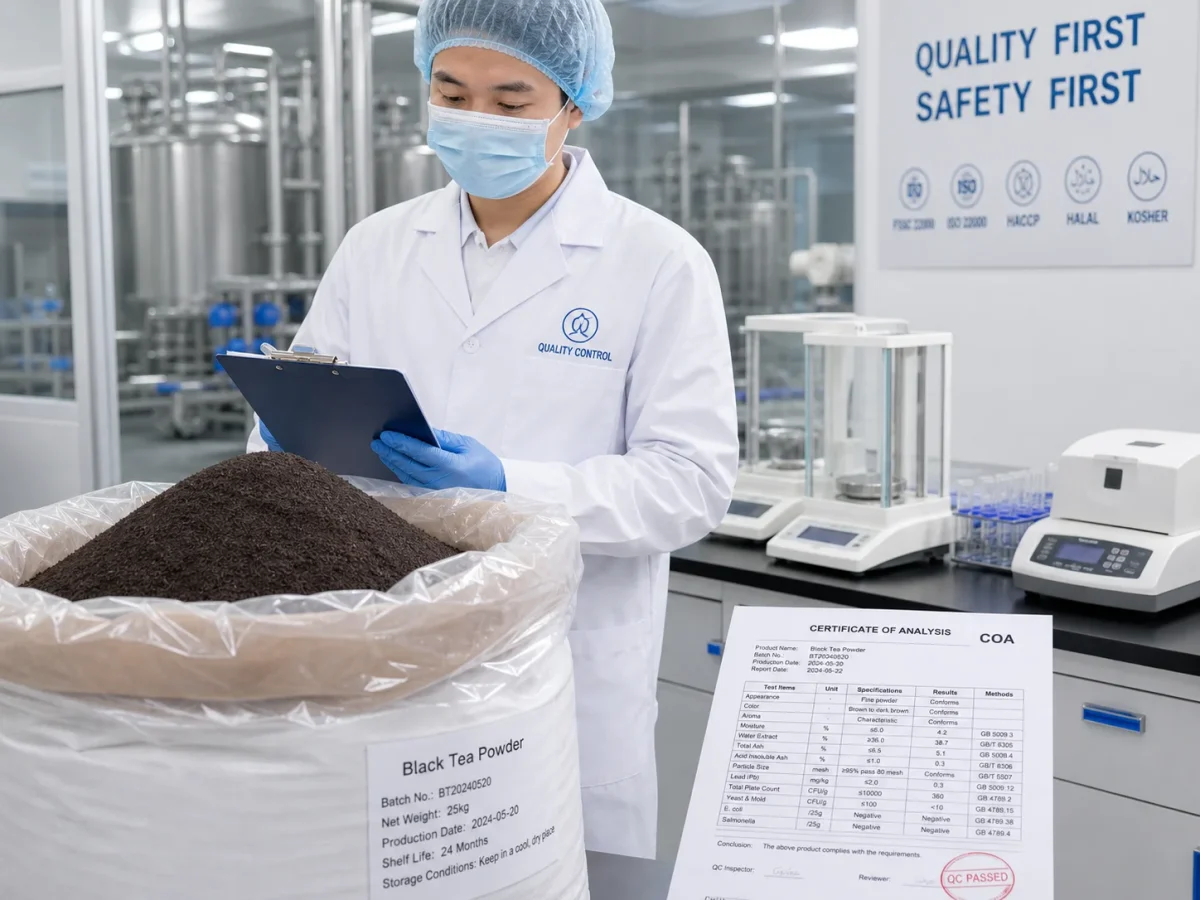
The four samples above mirror the origin table — China (malty, smooth), India (bold, full-bodied CTC), Sri Lanka (aromatic, full-bodied orthodox) and Kenya (bright, citrusy, robust CTC).
Buyer takeaway: no single origin wins. Match origin to application — China for custom instant powder and flexible MOQs, Kenya/India for cost-efficient CTC volume, Sri Lanka for premium sensory. Multi-source qualification (two origins, same spec) is the standard hedge against the climate-driven volatility seen in East Africa.
3. Quality, Testing & Certification Standards (What to Verify)
| Standard / document | What it covers | Why it matters |
|---|---|---|
| ISO 3720:2011 | Definition and basic requirements for black tea | Common reference for identity and grade |
| HACCP | Hazard analysis & critical control points | Minimum food-safety process requirement |
| FSSC 22000 / BRCGS | GFSI-recognized food safety schemes | Export-ready; required by many EU/US buyers |
| COA (Certificate of Analysis) | Assay, appearance, moisture, heavy metals, microbiology | Batch-level proof the spec was met |
| Pesticide MRL compliance | e.g., EU Regulation (EC) 396/2005 (~562 parameters for tea; default 0.01 mg/kg) | The #1 rejection cause for tea imports to the EU |
| Organic / Fairtrade / Rainforest Alliance | Inputs, ethics, smallholder coverage | Premium & clean-label market access |
COA fields to always check: assay (content), appearance, loss on drying, heavy metals (arsenic/lead/cadmium/mercury), microbial counts, residual solvents (for extract-type powders), batch number + manufacture/expiry. Verify the batch number matches across COA, sample label and quotation record.
4. Supply Stability Assessment (Before You Commit MOQ)
- Concentration risk: China + India produce ~69% of world tea (FAOSTAT 2022); top three black tea exporters (Kenya, Sri Lanka, India) shipped ~78% of HS 0902.40 exports in 2024 — origin shocks move the whole market.
- Climate risk is real: Kenya’s 2025 production fell ~8% on erratic rainfall (Tea Board of Kenya, 2025); models project up to 30% loss of suitable tea land by 2050 in East Africa and South Asia.
- Practical checks: ask for (1) two-origin backup supply, (2) warehouse/stock levels and buffer stock policy, (3) batch-to-batch consistency records, (4) production capacity vs your forecast, (5) force-majeure and lead-time clauses.
5. Cost Structure & Price Comparison (Origin Signal, Not Final Price)
| Cost component | Typical driver | Notes |
|---|---|---|
| Raw material (tea leaf/powder) | Origin, grade, harvest | Kenya export unit value ~US$2.24/kg; China tea export average ~US$3.79/kg (2024) |
| Processing (instant/extract) | Extraction, drying, custom spec | Custom grades cost more; stock grades cheapest |
| Certification & testing | FSSC/BRCGS, pesticide panels | EU MRL panels (300-500+ compounds) add cost |
| Logistics & duties | Destination, Incoterm | Samples by express; bulk by sea (FOB/CIF/DDP) |
Caution: origin unit values are signals, not quotes. Instant powder, extract powder and custom grades price differently from bulk leaf. Always compare on the same spec, same packing, same Incoterm.
6. Supplier Cooperation Process (5 Steps)
- Qualify: verify business license, certification numbers (check with the certifying body), export track record
- Align spec: application, solubility/sensory targets, assay, particle size, document list
- Sample: request representative COA + sample; test dispersion, sediment, color, taste, formula fit
- Trial order: confirm MOQ, packing (10/20/25 kg), lead time, Incoterm, QC at origin if needed
- Batch approval + audit: compare first commercial batch with approved sample; schedule factory audit or third-party inspection
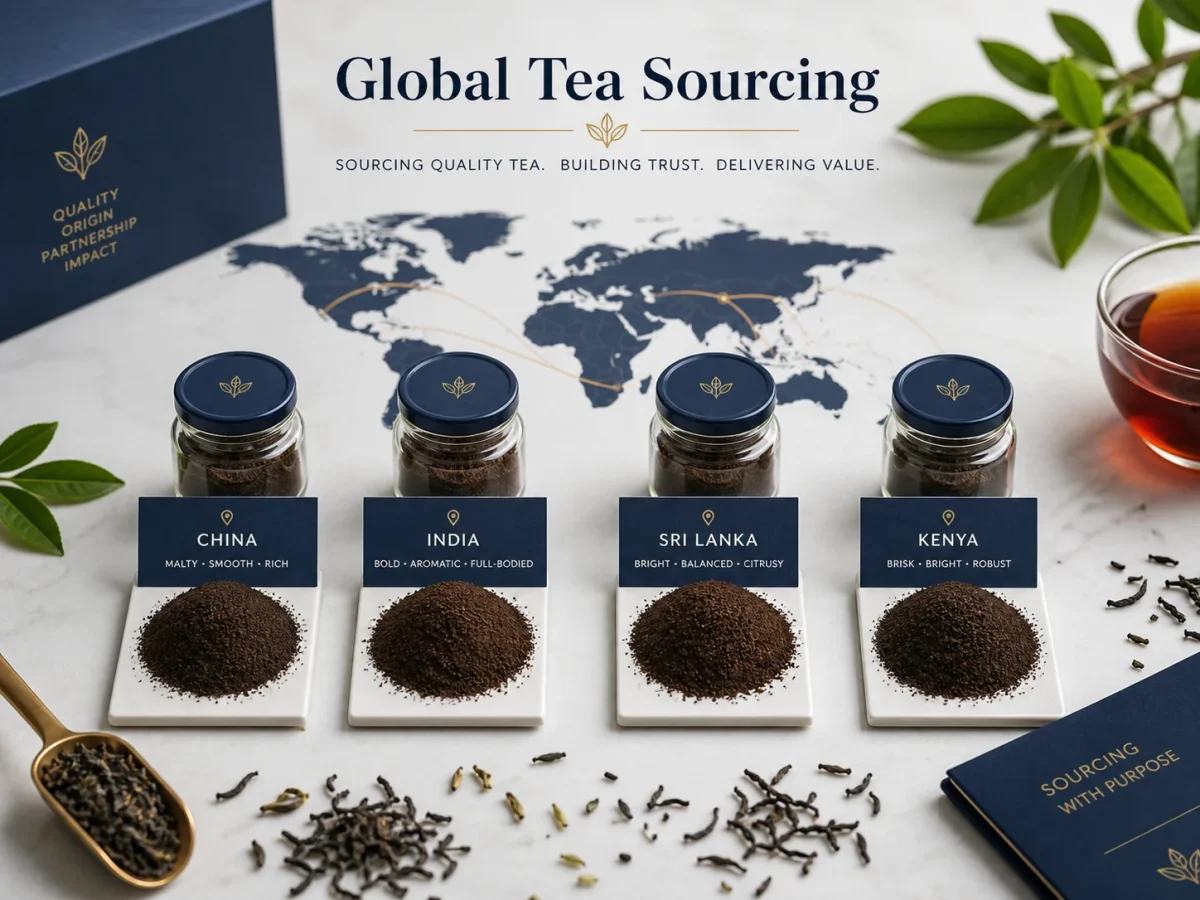
The QC station above illustrates step 4-5 of the cooperation process — supplier-side documentation, batch COA review and on-site audit before bulk release.
7. Market Context (Why This Category Matters, 2024-2026 Data)
| Data point | Value | Source |
|---|---|---|
| Global black tea market | ~US$18.2B in 2024 → ~US$26.8B by 2033 (CAGR ~4.3%) | DataHorizon Research (2025) |
| Black tea share of world tea consumption | ~75% | Industry reports (2024-2025) |
| Global tea production | ~7.1 Mt in 2024; black tea ~75% (~5.3 Mt) | FAO / industry estimates |
| China + India share of world tea production | ~69% | FAOSTAT (2022) |
| Top black tea exporters (HS 0902.40, 2024) | Kenya $1.36B / Sri Lanka $674M / India $667M — ~78% combined | UN Comtrade 2024 |
| China black tea exports (2024) | 24,800 t / ~US$172M | General Administration of Customs of China |
| Kenya 2025 production change | -8% (erratic rainfall) | Tea Board of Kenya (2025) |
Takeaway for buyers: instant black tea powder feeds two fast-growing lanes (instant drinks and RTD tea), and supply is concentrated in a few origins. Sample evaluation is the cheapest way to verify that a supplier’s spec, COA and powder behavior actually fit your finished product before you commit to MOQ.
8. Sample Request vs Bulk RFQ
| Dimension | Sample request | Bulk RFQ |
|---|---|---|
| Main purpose | Grade screening and document review | Commercial supply planning after approval |
| Buyer input | Application, sample quantity, specification target and COA needs | Quantity, packing, lead time, destination and document package |
| Best next page | Bulk Black Tea Powder Supplier checklist | Instant Black Tea Powder product page |
9. FAQ
What should buyers ask a black tea powder supplier first?
Start with application, solubility target, sensory direction, specification, COA, certifications (HACCP/FSSC 22000/BRCGS), sample quantity, MOQ, packing and destination market.
Which certifications matter for black tea powder?
HACCP is the minimum floor; FSSC 22000 or BRCGS is the practical baseline for export food/beverage projects. Organic, Fairtrade and Rainforest Alliance add value for premium and clean-label programs.
Is instant black tea powder the same as black tea extract powder?
Not always. Instant black tea powder is often selected for beverage dispersion and sensory profile, while extract powder may focus more on marker or concentration direction. Confirm the identity and assay on the COA.
How do I compare suppliers across origins?
Compare on the same specification, packing and Incoterm — not on origin alone. Use the origin table in this guide to shortlist, then verify certification numbers, COA fields and batch traceability.
Which page should buyers use for quotation?
Use the Instant Black Tea Powder product page for quotation and this guide for supplier screening preparation.
10. Summary
Shortlist suppliers by certification tier first (HACCP minimum, FSSC 22000/BRCGS for export), then by origin fit (China for custom instant, Kenya/India for volume CTC, Sri Lanka for premium), verify COA and batch traceability, and qualify a second origin as a climate hedge. Move to samples only after spec alignment — then a trial order, then batch approval.
Contact HERBSEA for specification, COA, samples and RFQ support.
Ingredient Sourcing Resource Center
Use these HERBSEA resources to keep supplier, COA, sample, MOQ, RFQ and export documentation review in one practical sourcing path.
- Ingredient Sourcing Guide Index for grouped tea powder, plant extract, fruit powder and documentation resources.
- Bulk Ingredient Sample Request Template for sample quantity, specification, COA and MOQ fields.
- Food Ingredient RFQ Template for supplier comparison, packing and quotation fields.
- Ingredient Export Documentation Checklist for COA, packing and destination-market document review.
- Ingredient Supplier Audit Checklist for supplier scope, sample control and document readiness.
Data sources: DataHorizon Research black tea market (2024 base, 2033 forecast); FAOSTAT 2022 world tea production shares (China+India ~69%); UN Comtrade 2024 black tea export data (HS 0902.40, via public trade-data aggregators); General Administration of Customs of China 2024 tea trade statistics; Tea Board of Kenya 2025 performance report; EU Regulation (EC) 396/2005 pesticide MRL framework; ISO 3720:2011; GFSI-recognized schemes (FSSC 22000, BRCGS). Prices, certifications and policies must be verified with the specific supplier and destination market before commitment.