
Instant green tea powder is a spray-dried or agglomerated soluble green tea ingredient used in ready-to-drink beverages, tea lattes, vending drinks, food-service recipes and dry mixes. Before you compare suppliers, lock down four things: the target application (which decides solubility and sensory review), the specification sheet plus COA (which supports QA and quotation), the sample test plan (test in your own water, sweetener, acid and process route), and the commercial terms (MOQ, packing, sample quantity, lead time, destination market). The instant green tea powder product page is the commercial page for specification, sample support, packaging and RFQ; this guide organizes the supplier-review questions that come before quotation.
Why the Instant Green Tea Powder Category Is Growing
Instant green tea powder sits inside two overlapping markets. The broader instant tea powder market was valued at roughly US$1.8 billion in 2024 and is projected to reach about US$2.9 billion by 2033, a CAGR of about 5.4%, with the green tea segment growing fastest (DataHorizzon Research, 2024 base year). A narrower definition — instant green tea powder extract — was valued at US$3.7 billion in 2024 and is projected to reach US$6.8 billion by 2033, a CAGR of about 7.8% (DataHorizzon Research, 2025). At the processing level, QYResearch sized hot-water-soluble instant tea powder at US$321 million in 2024 with global sales volume of about 32,000 tonnes at an average price near US$10/kg, produced mainly by spray drying and agglomeration (Valuates/QYResearch, 2024).
The supply side is anchored in China’s tea industry. China Customs data for 2024 (compiled by China Association for the Promotion of International Agricultural Cooperation tea branch) show total tea exports of 374,100 tonnes worth US$1.419 billion; green tea alone accounted for 323,900 tonnes (86.6% of volume) and US$1.073 billion (75.6% of export value), with an average export price of US$3.31/kg. The leading green tea export provinces are Zhejiang, Anhui, Hunan, Hubei and Fujian, and the top destination markets are Morocco, Ghana, Uzbekistan, Russia and Mauritania. For a buyer, this means a deep, export-oriented supplier base and strong price competition — which makes specification control more important, not less.
What this means for sourcing: the category is growing on convenience and functional-beverage demand, but a fast-growing category also attracts inconsistent suppliers. The differentiator is documentation and test discipline, not the raw material name.
Match the Grade to Your Application
Instant green tea powder is not one product. The same name covers different solubility targets, particle sizes and flavor profiles. Confirm the use case first, because it decides every downstream test.
| Application | Key requirement | Typical review points | Commercial implication |
|---|---|---|---|
| RTD beverage / canned or bottled tea | Fast cold-water or hot-fill solubility, clear or light-haze solution, stable over shelf life | Wetting time, dispersion, clarity, sediment, color after pasteurization | Demand larger samples for shelf-life and heat-stability tests |
| Tea latte / milk tea / food service | Creamy mouthfeel, no astringency spike, blends with dairy or oat base | Solubility in milk base, color, taste balance, pH behavior | Confirm the formula matrix (sweetener, acid, dairy) before sampling |
| Vending drink | Instant dissolution, consistent color per cup, no nozzle clogging | Particle size, flowability, wetting, foaming | Check particle-size spec and free-flow additives |
| Dry mix / powder sachet | Low moisture, stable in blend, no caking | Moisture, particle size distribution, flow, hygroscopicity | Ask for a moisture spec and packing that supports shelf life |
| Food-service recipe / bakery-adjacent use | Reliable color and flavor usage rate per batch | Color strength, dosing consistency, lot-to-lot stability | Request batch-level COA consistency across lots |
Rule of thumb: if the application is still open, start with the application and sample-testing path; if the specification is already fixed, send the target assay, method, particle size, document list, packaging size and destination market in the first message.
The Core Specification Sheet: What to Confirm Before RFQ
A COA only means something if you know which parameters matter for your product. These are the fields a practical green tea powder specification normally covers (typical commercial ranges shown as orientation only — the supplier’s COA and specification sheet are the binding documents):
| Parameter | Typical commercial range (orientation) | Why it matters |
|---|---|---|
| Polyphenols (as catechins) | 10–40% depending on grade | Core identity of the ingredient; decides usage rate |
| Solubility / wetting time | Fully disperses in hot water within 30–60 s with stirring | Decides whether your process line can use it directly |
| Clarity / sediment | Clear to light-haze solution, minimal sediment | Affects finished-product appearance |
| Particle size | e.g., 95% through 60–80 mesh (or agglomerated for RTD) | Affects dissolution speed, flow, dusting in blending |
| Moisture | ≤ 5% (typical) | Affects shelf life, caking, microbiological stability |
| Ash / acid-insoluble ash | Low, per grade | Purity and leaf-quality indicator |
| Heavy metals | Pb, As, Cd within destination-market limits | Export/import compliance gate |
| Pesticide residues | Compliant with destination MRLs, e.g., EU Regulation (EC) 396/2005 | The most common reason an ingredient fails import review |
| Microbiological limits | TPC, yeast & mold, E. coli, Salmonella per food-grade spec | QA gate for beverage and food use |
| Caffeine content | Optional parameter, varies with grade | Relevant for beverage labeling and usage rate |
Do not compare suppliers on price until the specification sheets are aligned; a “cheaper” quote usually means a different assay, particle size or residue program.
Certification and Document Tiers: Know What You Are Asking For
Buyers frequently ask for “certificates” without specifying which ones. In practice the request breaks into four tiers, and each tier maps to a different verification effort:
| Document tier | What it covers | Typical holder | Buyer action |
|---|---|---|---|
| Product-level spec + COA | Identity, assay, physical/chemical/micro results per lot | All credible suppliers | Mandatory baseline; verify per-batch values match spec |
| Food-safety management system | ISO 22000 or FSSC 22000, HACCP-based production control | Export-oriented manufacturers | Verify certificate scope and audit date |
| Raw-material/green-tea standard | ISO 11287:2011 (green tea — definition and basic requirements) for the leaf input | Manufacturers processing whole-leaf green tea | Confirm the supplier’s incoming-leaf control references the standard |
| Destination-market compliance | EU MRLs ((EC) 396/2005, covering hundreds of parameters for tea), US FDA requirements, organic certification, Kosher/Halal where relevant | Suppliers serving those markets | Ask for residue test reports aligned to YOUR destination market, not the supplier’s home market |
Two practical points. First, an EU-market buyer should ask specifically for pesticide residue testing against Regulation (EC) 396/2005 — a general COA does not always include a full residue panel. Second, certification scope matters: an ISO 22000 certificate covers a defined production scope, so confirm that instant green tea powder production (including extraction and spray drying) is inside the scope, not just packing.
Sample Strategy: Stock, Custom, or Pre-Production
Samples are the cheapest insurance in ingredient sourcing, but only if you test them the right way. A common industry pattern for sample cost tiers is: stock/off-the-shelf samples typically US$0–50, custom-formulated samples typically US$50–500, and pre-production or trial-run samples typically US$100–1,000+. Industry experience commonly cited for food-ingredient sourcing puts sample-to-order conversion around 20–30% — most samples never become orders, which is exactly why disciplined suppliers ask for application context before shipping samples.
| Sample type | Cost band (typical) | Lead time (typical) | Use it when |
|---|---|---|---|
| Stock sample (existing grade) | US$0–50 | Days | Application and grade direction are already clear |
| Custom sample (adjusted spec) | US$50–500 | 1–3 weeks | You need a specific assay, particle size or flavor direction |
| Pre-production / trial run | US$100–1,000+ | Weeks | You are validating a full production grade before bulk RFQ |
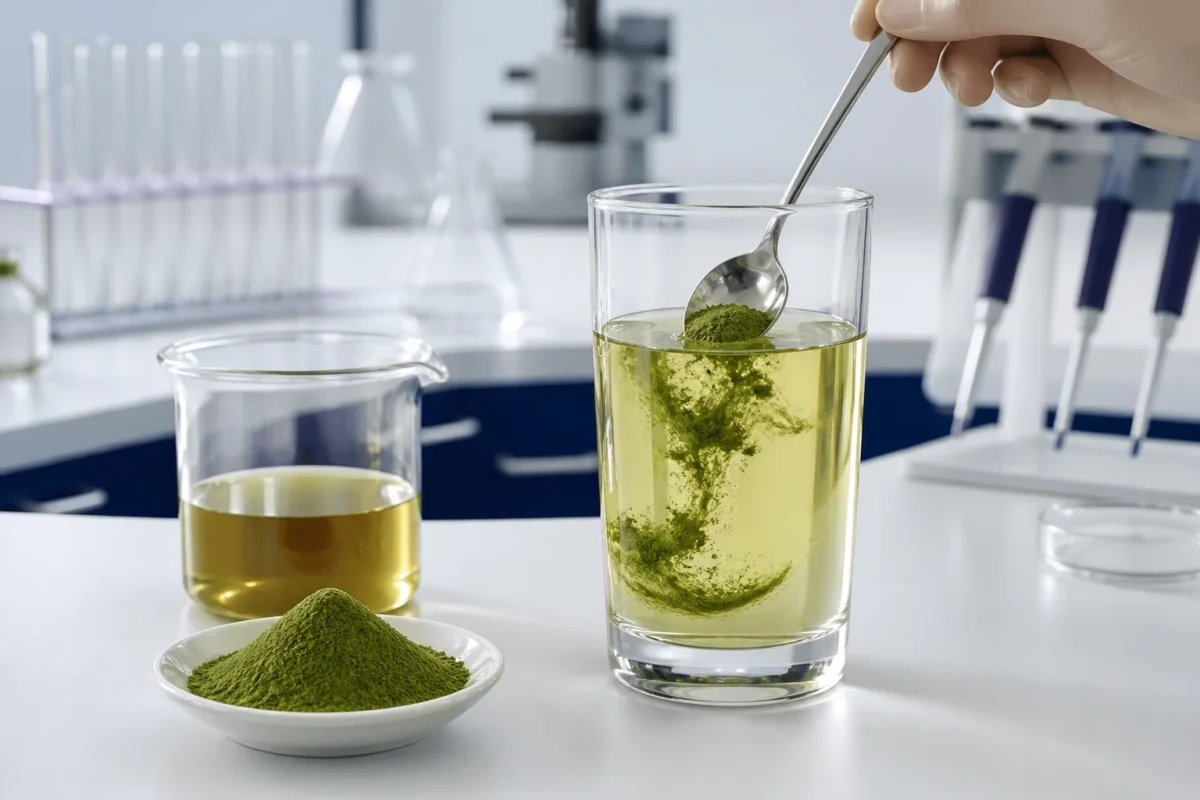
Test the sample in your real formula matrix — the target water, sweetener, acid and process route — because visible performance (clarity, sediment, color, taste) can change completely between a water-only cup test and the actual beverage base. See the Green Tea Extract Sample Request Checklist for the fields to send with a sample request.
Sample Request vs Bulk RFQ: Two Different Conversations
| Dimension | Sample request | Bulk RFQ |
|---|---|---|
| Main purpose | Grade screening and document review | Commercial supply planning after approval |
| Buyer input | Application, sample quantity, specification target, COA needs | Quantity, packing, lead time, destination, document package |
| Supplier response | Sample + spec sheet + COA | Quotation, MOQ, lead time, packing, Incoterms, export documents |
| Best next page | Green Tea Extract Sample Request Checklist | Instant Green Tea Powder product page |
The RFQ Checklist: Fields That Speed Up a Correct Quote
- Application and process route (RTD, latte, vending, dry mix, food service).
- Solubility, clarity and sensory target (plus water type, sweetener, acid if known).
- Target assay and test method (e.g., polyphenols, catechins, particle size).
- COA and specification sheet needs, including residue, micro and heavy-metal limits for your destination market.
- Sample quantity and internal test method (who tests, how, against what).
- MOQ, packing size, lead time, destination market and shipping terms.
FAQ
It is commonly reviewed for beverage, tea latte, vending drink, food-service and dry mix formulation projects where soluble green tea flavor, color and dispersion matter. The application decides which specification fields and tests matter most.
Instant green tea powder is a water-soluble extract (typically spray-dried or agglomerated) that dissolves to a clear or light-haze solution, while matcha is finely milled whole green tea leaf that stays suspended. They behave differently in solubility, color, cost and usage rate, so the application determines which is appropriate.
Test solubility, wetting time, sediment, color, sensory profile, pH behavior and whether the sample matches the supplied COA and specification sheet. For RTD use, add heat-stability and shelf-life tests; for dry mixes, add moisture and flow checks.
Commonly requested items are a per-lot COA, a specification sheet, a food-safety management system certificate such as ISO 22000 or FSSC 22000, and destination-market residue compliance such as EU Regulation (EC) 396/2005. Confirm the certificate scope covers extraction and spray-drying, not only packing.
Both vary by supplier and grade. Provide quantity, packing size and destination market with the first RFQ; suppliers respond with MOQ, lead time and Incoterms that match their production and export schedule.
Use the Instant Green Tea Powder product page for product-level RFQ and this guide for supplier comparison preparation.
Summary
If you are comparing suppliers, confirm the application, target specification, COA fields, certification scope, sample test plan, MOQ, packaging and destination market first. Then request a representative sample and quotation from the relevant product page. Use the COA and spec sheet as the comparison baseline — price only matters once the documents describe the same product.
Contact HERBSEA for specification, COA, samples and RFQ support.
Related Sourcing Pages
- Instant Green Tea Powder product page — product-level specification, samples and quotation.
- Instant Tea Powder Supplier hub — category-level comparison.
- Green Tea Extract Sample Request Checklist — adjacent sourcing review.
- Ingredient Sourcing Guide Index — grouped tea powder, plant extract and documentation resources.
- Bulk Ingredient Sample Request Template — sample quantity, specification, COA and MOQ fields.
- Food Ingredient RFQ Template — supplier comparison, packing and quotation fields.
- Ingredient Export Documentation Checklist — COA, packing and destination-market document review.
- Ingredient Supplier Audit Checklist — supplier scope, sample control and document readiness.
Data Sources
- DataHorizzon Research — Instant Green Tea Powder Extract Market (2024 base; CAGR 2025–2033) and Instant Tea Powder Market (2024 base; CAGR 2025–2033).
- QYResearch via Valuates Reports — Global Hot Water Soluble Instant Tea Powder Market (2024; US$321M; 32,000 t; ~US$10/kg).
- China Customs 2024 tea export statistics as compiled by the China Association for the Promotion of International Agricultural Cooperation (tea branch) — total 374,100 t / US$1.419B; green tea 323,900 t / US$1.073B / US$3.31 per kg.
- ISO 11287:2011 — Green tea: definition and basic requirements (confirmed current).
- EU Regulation (EC) 396/2005 — maximum residue levels for tea.
- Sample cost tiers and sample-to-order conversion (20–30%) are industry-practice benchmarks commonly cited in ingredient sourcing; verify with the supplier for your specific case.