
Quick Answer — What should a green tea extract bulk supplier questionnaire include?
Confirm nine fields before requesting samples or a quotation: (1) target marker — L-Theanine, tea polyphenols, catechins or EGCG; (2) assay method — HPLC, UV or buyer-specified; (3) specification range for the marker, caffeine and particle size; (4) COA fields that must appear on the batch certificate; (5) application — capsule, tablet, powder blend, beverage or food project; (6) sample quantity matched to a test plan; (7) MOQ expectation; (8) packing size and destination market; and (9) the document package — specification sheet, representative COA, facility certificates and export files. A complete questionnaire lets the supplier quote a practical grade in one round; a generic one starts a three-round clarification loop. Use the L-Theanine Green Tea Extract product page for the commercial quotation and this questionnaire for pre-RFQ preparation.
1. Lock the Marker First — “Green Tea Extract” Is Not One Specification
Green tea extract is a family of standardized grades defined by which compound is measured. The single most costly sourcing mistake is confusing one marker with another: a product labeled “50% polyphenols” does not deliver 50% EGCG, and the two numbers are frequently mixed up in buyer RFQs.
| Marker direction | Typical grades | Assay method | What the buyer must confirm |
|---|---|---|---|
| Tea polyphenols | 50%, 70%, 90%, 98% | UV-Vis (Folin-Ciocalteu) | Total phenolic content only; does not state which catechins |
| Catechins (EGCG + EGC + ECG + EC) | 40–80% total catechins | HPLC, individual isomers reported | Catechin breakdown per isomer, not a combined total |
| EGCG (specific catechin) | 30%, 50%, 70%, 90%, 98% | HPLC against a reference standard | EGCG percentage alone, not total polyphenols |
| L-Theanine | 20%, 40% | HPLC | Amino-acid marker; different review path from polyphenols |
| Decaffeinated extract | <1% caffeine | HPLC | Caffeine ceiling for caffeine-sensitive applications |
Industry practice for green tea extract is dual standardization: total polyphenols quantified by UV-Vis and individual catechins (especially EGCG) by HPLC (SV Botanica, 2026). A qualified COA should report the four primary catechins separately — EGCG, EGC, ECG and EC — rather than a single combined figure. Write the marker name and the assay method into the questionnaire; the method wording determines how COA values and specifications can be compared across suppliers.
2. Choose the Assay Method Before Comparing COAs
Assay method is a comparability question, not a technical detail. HPLC and UV answer different questions: UV measures total phenolic content quickly and cheaply, while HPLC separates and quantifies individual catechins. Two suppliers quoting “90% extract” may be measuring different things.
| Assay method | What it measures | Typical use | COA comparability |
|---|---|---|---|
| UV-Vis (Folin-Ciocalteu) | Total polyphenols | Food-grade polyphenol claims, cost-driven specs | Broad; cannot separate catechins or EGCG |
| HPLC | Individual catechins, EGCG, L-Theanine, caffeine | Supplement-grade and pharma-grade specifications | Strict; needs a named reference standard |
| HPLC + GCG resolution check | Separates EGCG from its heat-epimerized form GCG | High-purity EGCG grades | Fast-gradient methods can overstate EGCG by 2–8% |
If the destination application is a dietary supplement with a declared EGCG content, the questionnaire should require HPLC with a named reference standard and a stated resolution between EGCG and GCG. If the application is a food or beverage where total polyphenols are the relevant claim, UV with a declared limit may be sufficient. State the method in the questionnaire so the COA you receive is comparable to the next supplier’s.
3. Specification Fields to Lock Before RFQ
A usable green tea extract specification is a set of numbers with limits and methods, not a marketing name. The table below shows the parameter set a serious buyer expects on the specification sheet and the batch COA, with typical ranges drawn from published supplier CoAs (SV Botanica, 2026):
| Parameter | Typical specification | Typical result on a 90% grade |
|---|---|---|
| Total polyphenols | NLT 90.0% (UV) | 91.6% |
| Total catechins | NLT 80.0% (HPLC) | 81.3% |
| EGCG | NLT 45.0% (HPLC) | 47.8% |
| Caffeine | NMT 10.0% (standard grade) | 6.2% |
| Loss on drying | NMT 5.0% | 3.42% |
| Ash content | NMT 5.0% | 1.86% |
| Particle size | NLT 95% through #40 mesh | 98.10% |
| Heavy metals (ICP-MS) | Pb ≤1.0, As ≤1.0, Cd ≤0.3, Hg ≤0.1 ppm | Complies |
| Pesticide residues | Compliant with EU MRL (EC) 396/2005 | Complies |
| Total plate count | NMT 1,000 CFU/g | 140 CFU/g |
| Yeast & mould | NMT 100 CFU/g | 18 CFU/g |
| E. coli / Salmonella / S. aureus | Absent | Absent |
| Shelf life | 24–36 months sealed, ≤25°C | — |
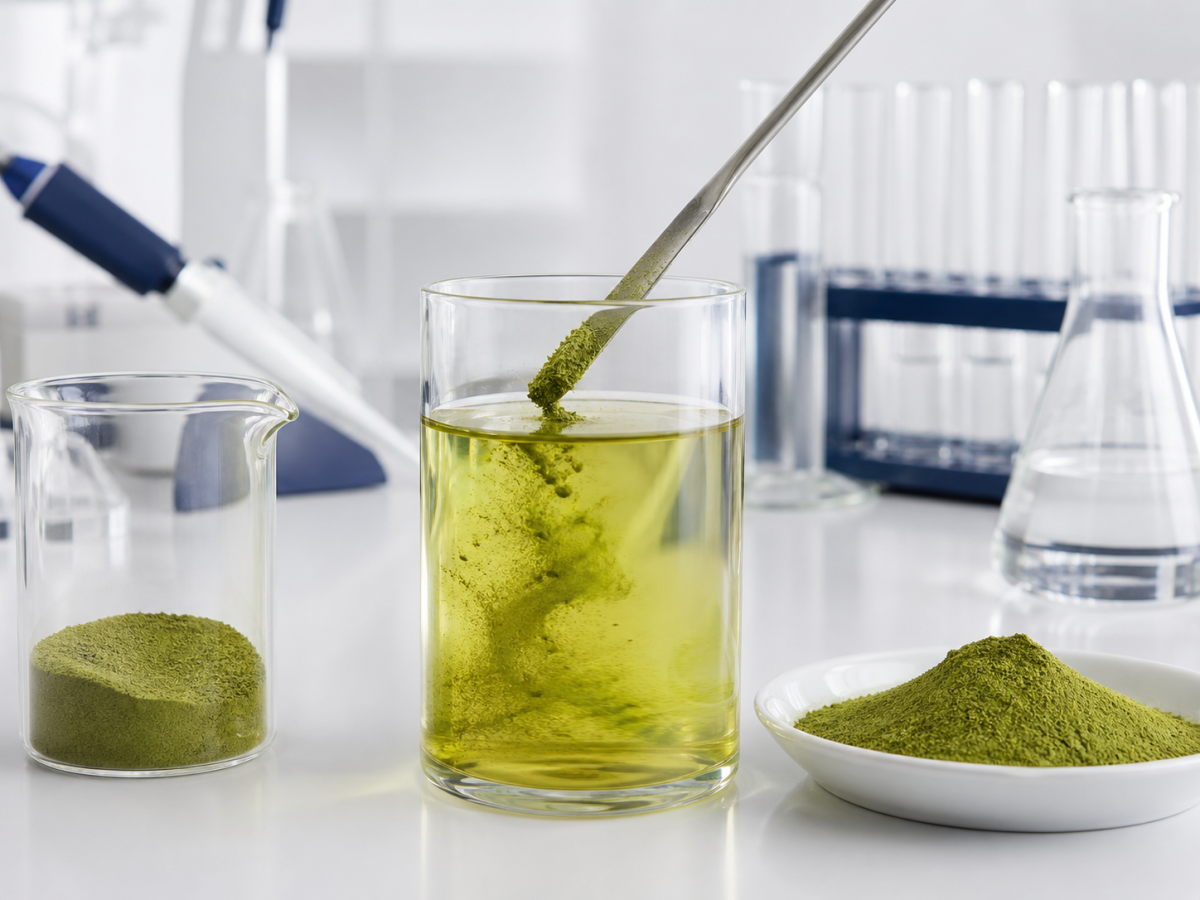
Buyers commonly request 50%, 70%, 90% or 98% polyphenol grades, EGCG grades from 30% to 98%, L-Theanine grades at 20% and 40%, and decaffeinated grades below 1% caffeine (ChemicalBook supplier data, 2026). Ask for a COA that is lot-matched to the sample — a representative COA from another batch is a starting point only.
4. Pick the Right Grade Tier for the Application — and the Price
Commercial grades fall into four tiers, and over-specifying is as costly as under-specifying. A pharma-grade EGCG at US$80+/kg is wasted on a beverage that only needs total polyphenols (BlueEyes Bio, 2026).
| Grade tier | EGCG content | Total polyphenols | Typical price range (USD/kg) | Best fit |
|---|---|---|---|---|
| Standard / food grade | 25–40% | ≥50% | US$15–35 | Functional food, RTD beverages, cosmetics, entry-level supplements |
| High-potency supplement grade | 45–70% | ≥80% | US$35–80 | Dietary supplement capsules and tablets, sports nutrition |
| Ultra-pure / pharma grade | 90–98% | ≥95% | US$80+ (on request) | Clinical-grade nutraceutical, novel-food applications |
| Decaffeinated grade | 25–50% | ≥50% | Grade-dependent | Caffeine-sensitive formulations and PM products |
Market context supports the demand for standardized grades: the global green tea extract market was estimated at about US$1.8 billion in 2023 and is projected to reach roughly US$4 billion by 2030, a compound annual growth rate of about 12% (Citius Research, 2023). The narrower green tea catechins segment was valued at US$737.5 million in 2025, with EGCG accounting for the largest type share at 53% and dietary supplements for the largest application share at 42.1%; the segment is projected to reach US$1.27 billion by 2032 at a CAGR of about 8.1% (PW Consulting, 2026). The Camellia sinensis leaf extract market reached US$562.4 million in 2024 and is forecast to grow to US$1.12 billion by 2032 at a CAGR of about 9.3% (24ChemicalResearch, 2025). For buyers, the practical implication is simple: standardized, batch-traceable grades command a premium because formulators can quote reproducible finished products.
5. Certification and Regulatory Checks by Destination Market
Green tea extract is a regulated botanical in most destinations. The questionnaire should list the certificates the exact SKU must carry — facility-level certificates are not the same as product-level coverage. The most relevant regulatory point for EU-bound buyers is Regulation (EU) 2022/2340: since full enforcement on 21 June 2023, the daily portion of a food containing green tea extract must deliver less than 800 mg of EGCG, and the label must carry four mandatory warnings plus the EGCG content per portion (Official Journal of the EU, 2022). Highly purified EGCG (≥90%) sits outside that restriction and is regulated as a novel food under Regulation (EU) 2015/2283 and Implementing Regulation (EU) 2017/2470.
| Destination / application | Certificates and checks to request | Why it matters |
|---|---|---|
| EU food & supplements | EGCG content per portion below 800 mg (Reg. 2022/2340); EU MRL compliance against (EC) 396/2005 — roughly 562 pesticide parameters for tea, default limit 0.01 mg/kg | Directly applicable law; label warnings are mandatory |
| US dietary supplements | FDA facility registration, Prior Notice readiness, cGMP documentation, Prop 65 review where applicable | Entry and retail compliance start at the ingredient |
| Middle East / Southeast Asia | Halal certificate covering the exact SKU | Market access for food and beverage applications |
| Global food brands | HACCP, ISO 22000 or FSSC 22000 (GFSI-recognized tier) at facility level; Kosher where required | Retailer audit and supplier-qualification standard |
| Organic claims | Organic certificate covering the specific grade, not only the facility | “Organic” on a COA must match a certificate |
Add a line to the questionnaire asking which certificates are available for the exact grade and batch — many suppliers hold facility certificates but cannot issue product-level coverage for every SKU.
6. Sample Request vs Bulk RFQ: Send the Right Request at the Right Time
Samples verify physical behavior and document fit; RFQs verify commercial supply. Collapsing the two stages produces neither a useful sample nor a reliable quotation.
| Dimension | Sample request | Bulk RFQ |
|---|---|---|
| Main purpose | Grade screening, physical behavior and document review | Commercial supply planning after approval |
| Buyer input | Application, sample quantity, specification target, COA needs, test plan | Quantity, MOQ, packing, lead time, destination and document package |
| Document focus | Lot-matched COA, specification sheet, certificates covering the SKU | Proforma invoice, packing list, export documents, certificate validity |
| Cost expectation | Stock sample US$0–50 (often free, freight by buyer); custom sample US$50–500; pre-production sample US$100–1,000+ | FOB or CIF quotation against a defined quantity |
| Conversion benchmark | Sample-to-order conversion typically 20–30% across the ingredient trade | Not applicable — RFQ follows approval |
Practical rule: request the sample first, evaluate it against your own matrix, then send the RFQ with the approved sample lot number attached. For green tea extract specifically, include the marker and assay method in the sample request — a sample measured by UV cannot be compared against another supplier’s HPLC COA.
7. The Nine-Point RFQ Checklist
- Target marker (L-Theanine, polyphenols, catechins, EGCG) and assay method (HPLC, UV or buyer-specified).
- Specification range: marker percentage, caffeine ceiling, particle size, moisture and ash limits.
- Application and process route: capsule, tablet, powder blend, beverage, food or cosmetic project.
- COA fields required, including lot-match to the sample batch.
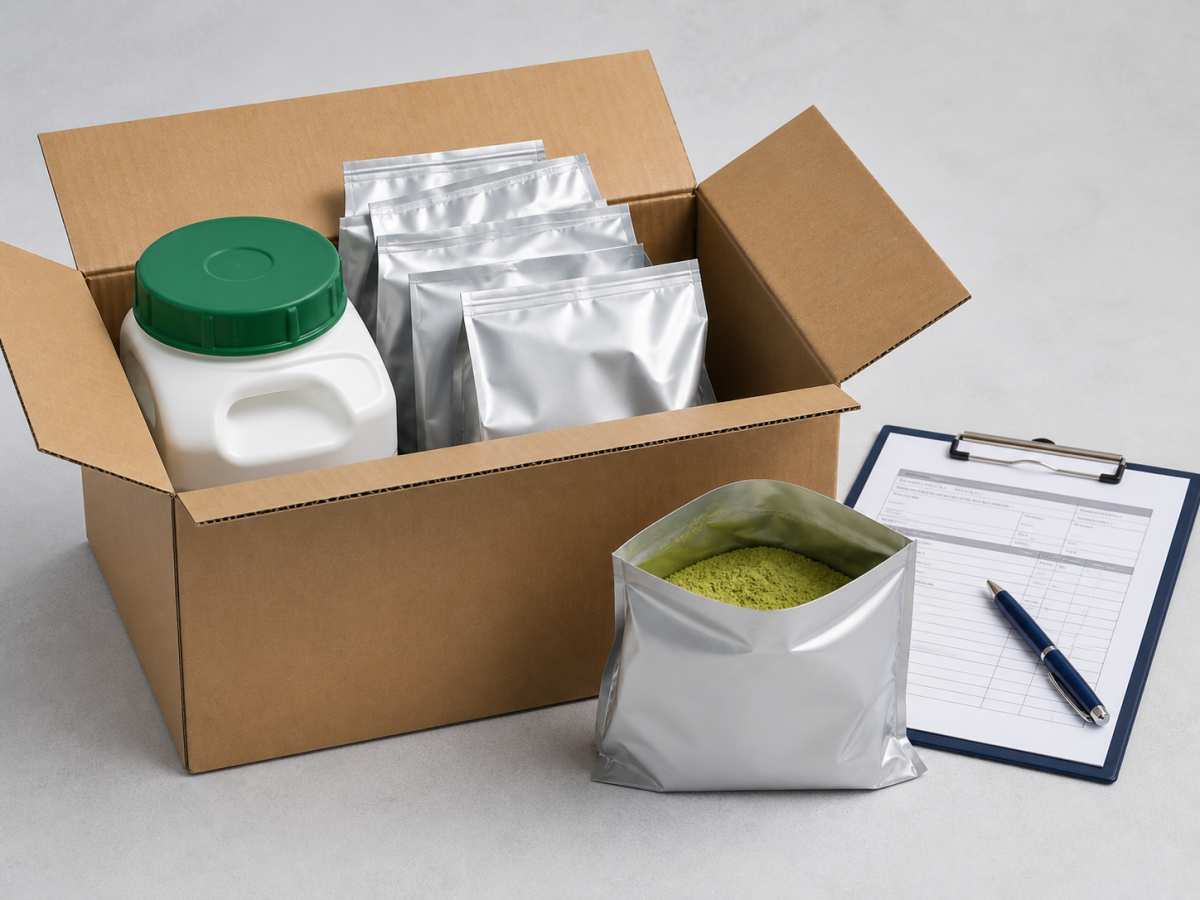
- Sample quantity and test plan (50–200 g for in-house work; 500 g–2 kg for third-party testing).
- MOQ expectation and commercial tolerance.
- Packing size and construction (25 kg drum with inner PE liner, FIBC on request).
- Lead time and destination market, including Incoterms preference.
- Document package: specification sheet, representative COA, facility and product certificates, export files.
8. FAQ
Include the marker target, assay method, specification range, COA fields, application, sample request with test plan, MOQ, packing, lead time and destination market. Stating the marker and method first is the highest-value step because it makes COAs comparable across suppliers.
Yes. L-Theanine percentage, HPLC wording, COA fields and sample approval should be reviewed as one connected document set, separate from polyphenol or EGCG grades. L-Theanine is an amino-acid marker with its own specification and analytical path.
Total polyphenols (measured by UV) include catechins, tannins, flavonoids and gallic acid, so a 50% polyphenol grade typically delivers only 12–22% EGCG. A 50% EGCG grade is specifically 50% epigallocatechin-3-gallate verified by HPLC. Always specify the EGCG percentage when the finished product label declares EGCG.
Request EGCG content per portion below 800 mg in line with Regulation (EU) 2022/2340, EU MRL compliance against (EC) 396/2005, and the facility food-safety certificates (HACCP, ISO 22000 or FSSC 22000) plus any market certificates covering the exact SKU.
Size the quantity to the test plan: 50–200 g for in-house sensory and physical checks, 500 g–2 kg for full third-party testing including microbiology and pesticide residues. Request the sample COA with the same lot number as the sample.
Use the L-Theanine Green Tea Extract product page for product-level specification, samples and quotation, and this questionnaire for pre-RFQ preparation. Send the completed questionnaire with your RFQ so the supplier matches the discussion to a practical grade.
Summary
A green tea extract bulk supplier questionnaire earns its value when it forces three decisions up front: the marker (polyphenols, catechins, EGCG or L-Theanine), the assay method (HPLC or UV), and the destination-market regulatory set (EU EGCG limits, US FDA entry, Halal/Kosher where required). Lock those three, then confirm the specification range, COA fields, sample test plan, MOQ, packing and lead time before comparing quotations. Send the completed questionnaire together with your RFQ to the product page for a grade-matched response. Contact HERBSEA for specification, COA, samples and RFQ support.
Data Sources
Market and regulatory figures cited in this guide: green tea extract market US$1.8B (2023) to US$4B (2030), CAGR ~12% (Citius Research, 2023); green tea catechins US$737.5M (2025) to US$1.27B (2032), CAGR ~8.1%, EGCG 53% type share, dietary supplements 42.1% application share (PW Consulting, 2026); Camellia sinensis leaf extract US$562.4M (2024) to US$1.12B (2032), CAGR ~9.3% (24ChemicalResearch, 2025); grade price tiers US$15–80/kg+ (BlueEyes Bio, 2026); typical COA parameter ranges (SV Botanica, 2026); common commercial grades (ChemicalBook supplier data, 2026); EU EGCG restriction under Regulation (EU) 2022/2340 amending (EC) 1925/2006, in force 20 December 2022, full enforcement 21 June 2023 (Official Journal of the EU, 2022). Figures are indicative for buyer reference and should be verified against current supplier COAs before specification sign-off.
Related Sourcing Pages
- L-Theanine Green Tea Extract product page — product-level specification, samples and quotation.
- Plant Extract Supplier hub — category-level comparison.
- L-Theanine COA and MSDS documentation guide — adjacent sourcing and document review.
- Ingredient Sourcing Guide Index — grouped tea powder, plant extract and documentation resources.
- Bulk Ingredient Sample Request Template — sample quantity, specification, COA and MOQ fields.
- Food Ingredient RFQ Template — supplier comparison, packing and quotation fields.
- Ingredient Supplier Audit Checklist — supplier scope, sample control and document readiness.
Contact HERBSEA with application, sample, COA and RFQ details.