
Request L-Theanine COA, Specification and SDS
Need supplier documents? Identify the material and grade before requesting a matching COA, specification sheet and current SDS.
| Document | What to request | What it does not replace |
|---|---|---|
| Specification sheet | Grade, assay method, acceptance limits and revision | A measured batch result |
| Representative COA | A clearly identified example lot and test results | The COA for your delivered batch |
| Current SDS / MSDS | Material identity, issuer and revision date | Product quality acceptance |
| Sample record | Sample code, lot reference and dispatch details | Application testing |
HERBSEA product path: tea-derived L-Theanine Green Tea Extract 20%-40% HPLC. High-purity L-Theanine monomer requires a separate material and document review; this guide does not establish its supply availability.
Download the L-Theanine document request checklist (CSV) · Request matching COA, specification, SDS and sample details
The downloadable file is a blank procurement checklist, not a supplier COA or SDS. Ask which grade-specific files can be shared and whether they describe a representative lot or your proposed sample batch.
Quick answer — what should a bulk buyer check first?
- Specification sheet: sets the agreed assay range and quality limits.
- COA: confirms batch-level HPLC results, lot number, dates and required quality tests.
- SDS/MSDS: supports handling, storage, transport and import-document review.
- Before approval: match the material identity, CAS 3081-61-6 where applicable, batch records and sample label; regard HS 2922.49 vs 1302.19 as a broker-review question, not an automatic classification.
This guide helps sourcing, quality and formulation teams compare HPLC assay data, sample records, document revisions and RFQ requirements. It also separates tea-derived L-Theanine extract from high-purity L-Theanine monomer, because material identity can change the specification and customs review path.
For HERBSEA projects, the core product page remains the starting point for grade, assay range, sample request and RFQ details: L-Theanine Green Tea Extract 20%-40% HPLC supplier.
In this guide
- Identify the material and grade
- Review the L-Theanine COA
- Compare COA, SDS and specification roles
- Prepare the customs classification review
- Build the document package
- Connect documents to sample testing
- Prepare the RFQ
- Read the buyer FAQ
L-Theanine Ingredient Profile: Identify the Material First
| Parameter | Typical value | Why it matters for documentation |
|---|---|---|
| Chemical name | L-Theanine (N-ethyl-L-glutamine / γ-glutamylethylamide) | Name on COA must match the specification sheet and sample label |
| CAS number | 3081-61-6 | Used to cross-check SDS, customs and import records |
| Source | Tea (Camellia sinensis), fermentation or synthesis | Source and process determine which quality records buyers should request |
| Typical grades | Green tea extract 20-40% (HPLC); high-purity monomer ≥98% (HPLC) | Assay and material identity affect the specification and customs review path |
| Form | Fine powder; project-specific solubility and sensory requirements | Physical properties should be checked in the intended formulation |
| Destination-market review | Project-specific; confirm current requirements with the buyer, importer or qualified advisor | Requirements can differ by material, application and destination |
| Production methods | Tea extraction, microbial fermentation or chemical synthesis | The manufacturing route affects supplier documentation and buyer qualification |
L-Theanine COA Items Buyers Should Check
A COA is only useful if you compare it against the specification sheet. Below are the items buyers most often verify for L-Theanine materials.
| COA item | Typical spec (reference only) | Common method | Review point |
|---|---|---|---|
| Assay (content) | ≥98.0% or 98.0-102.0% for monomer; 20-40% for green tea extract | HPLC | Match the assay range quoted in the RFQ |
| Appearance | White to off-white powder | Visual | Compare with sample label and quotation item name |
| Identification | Matches reference standard | HPLC / IR / TLC | Confirms the material is L-Theanine, not a substitute |
| Loss on drying | ≤0.5% (typical) | Gravimetric | Moisture affects shelf life and bulk pricing |
| Residue on ignition | ≤0.1-0.5% (typical) | Gravimetric | Mineral residue indicator |
| Heavy metals | Meet USP / Ph. Eur. 2.4.8 limits | ICP-MS / AAS | Destination-market import review |
| Arsenic / lead / cadmium / mercury | Within buyer or market limits | ICP-MS | Regulatory documents and import clearance |
| Microbial counts (TAMC, TYMC) | Meet USP / market limits | Plate count | Food and supplement application fit |
| Pathogens (E. coli, Salmonella, yeast/mold) | Negative / within limits | Culture methods | Required for food and supplement use |
| Residual solvents | Within limits | GC | Relevant for extraction-process material |
| Batch number & dates | Batch ID, manufacture/expiry | — | Must be traceable across COA, label and quotation |
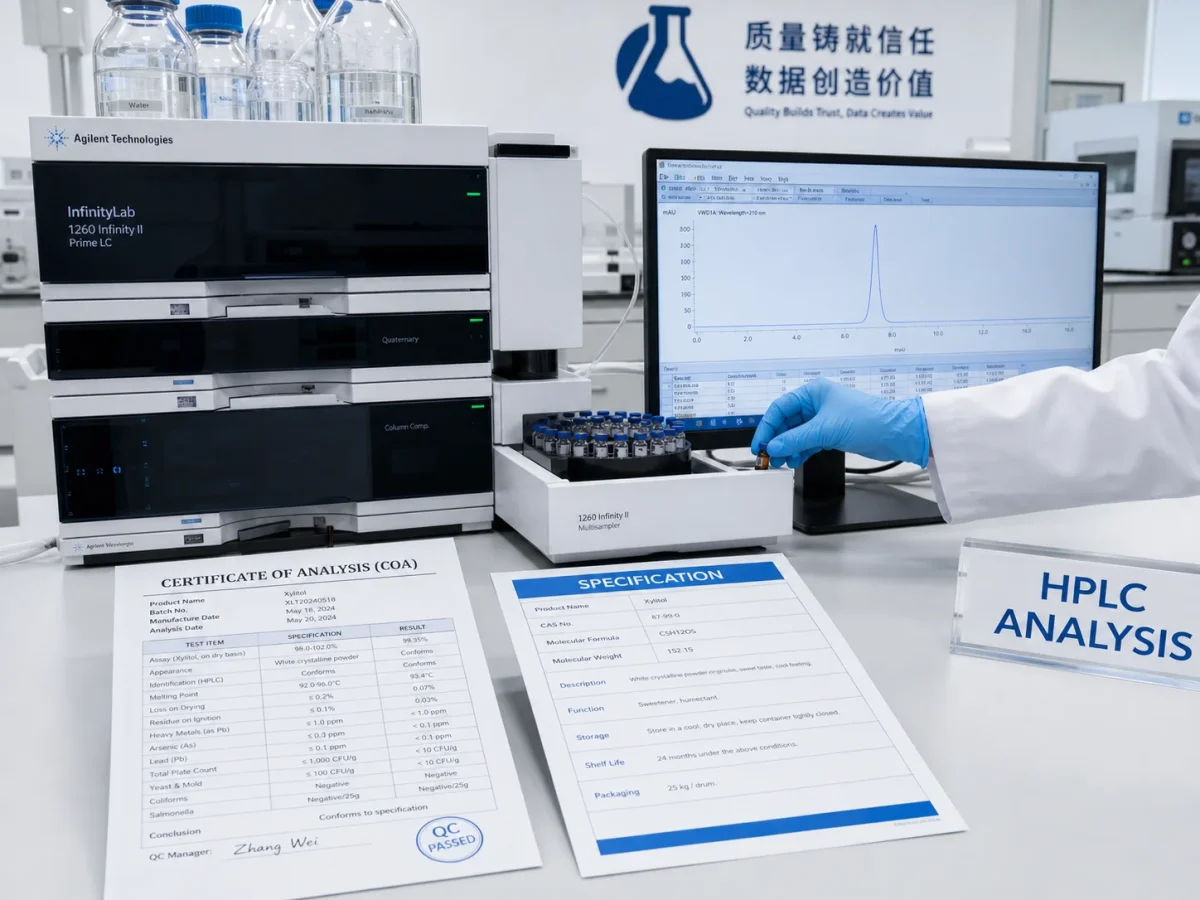
The HPLC setup above is the standard assay platform referenced in the COA table — verify that the assay method on the COA matches the method your QC team can replicate.
Practical rule: read the COA against the specification sheet, not in isolation. Check that the batch number on the COA, the sample label and the quotation record match before sample testing, and again before bulk release.
For a wider method review, use the plant extract HPLC and COA review guide. Buyers comparing tea powders and tea-derived extracts can also review the Instant Tea Powder Supplier category before selecting a material type.
COA vs SDS vs Specification Sheet
| File | Main role | Is it batch-specific? | Replaces the others? |
|---|---|---|---|
| Specification sheet | Defines target limits, assay range and agreed material parameters | No — sets the standard | No — the baseline the COA must match |
| COA (Certificate of Analysis) | Reports batch-level test results and quality values | Yes — one COA per batch | No — read it against the spec sheet |
| SDS (formerly MSDS) | Supports safe handling, storage, transport and import review | No — current revision per material | No — it is not a quality file |
| Flow chart / process description | Documents manufacturing route for QA files | No | No — supports supplier audit |
| Packing information | Carton/drum format, net weight, pallet and label fields | Varies by shipment | No — needed for freight and warehouse approval |
MSDS vs SDS: many buyers still write “MSDS”, but the current international standard (UN GHS) names it SDS — Safety Data Sheet, structured in 16 sections. For sourcing purposes, confirm the current safety data document with its revision date and material identity rather than arguing about the acronym.
HS Code and Export Classification Review
“L-Theanine” in trade can describe different materials. The following headings are common starting points for broker review, not a final customs determination:
| Material presented for review | Common HS heading candidate | Identity evidence to compare | Buyer action |
|---|---|---|---|
| High-purity L-Theanine monomer | 2922.49, other amino acids and derivatives | Product name, assay, source, manufacturing route, COA and SDS | Ask the importer or customs broker to confirm the destination-specific code |
| L-Theanine green tea extract | 1302.19, other vegetable extracts | Botanical identity, extract composition, assay range, COA and process description | Confirm whether the shipped material meets the selected botanical-extract heading |
Why this matters: assay alone does not finalize classification. Compare the product identity, source, manufacturing route, composition, COA, SDS and commercial description, then ask the importer or customs broker to confirm the code for the destination market and current shipment.
Destination-Market Documentation Boundaries
| Review area | What the supplier can provide | What the buyer must confirm |
|---|---|---|
| Material identity | Product name, source, assay range, specification and representative COA | Whether the selected material fits the intended application and internal standard |
| Quality documentation | Available SDS, process information, test records and packing details | Required tests, document versions and acceptance limits |
| Import and customs | Commercial description and available shipment-support files | Current classification, declarations and destination-specific requirements |
| Label and finished product | Ingredient-level documentation for buyer review | Finished-product wording, claims and local compliance decisions |
Do not rely on a general market table or an old regulatory summary for purchase approval. Instead, keep the current supplier documents together with the buyer’s destination-market review and the approved sample record.
The 16-Section SDS Structure
The internationally used GHS format organizes an SDS into 16 sections. When you receive an L-Theanine SDS, verify that the material identity and revision date match the supplied grade. The UNECE GHS publication provides the official framework reference.
| Section | What it covers | Buyer check for L-Theanine files |
|---|---|---|
| 1. Identification | Product name, supplier and emergency contact | Material name, CAS 3081-61-6 where applicable, supplier identity and intended grade match the RFQ |
| 2. Hazard identification | Hazard classification, label elements and other hazards | Review the current supplier assessment; do not infer a final classification from the article alone |
| 3. Composition / information on ingredients | Substance or mixture composition | Confirm the listed ingredient identity and concentration match the supplied material |
| 4. First-aid measures | Relevant first-aid instructions | Keep the supplier’s current wording with the warehouse and QA file |
| 5. Fire-fighting measures | Suitable extinguishing media and fire-related precautions | Check site procedures and storage controls against the current SDS |
| 6. Accidental release measures | Containment, cleanup and environmental precautions | Confirm spill-response instructions are available to receiving and warehouse teams |
| 7. Handling and storage | Handling precautions and storage conditions | Match the SDS conditions with packaging, warehouse and transport plans |
| 8. Exposure controls / personal protection | Exposure limits and recommended protective measures | Review with the buyer’s EHS or workplace-safety process where required |
| 9. Physical and chemical properties | Appearance and relevant physical or chemical data | Compare key values with the specification sheet and sample observations |
| 10. Stability and reactivity | Reactivity, stability and incompatible conditions | Use the current revision for storage and shipment planning |
| 11. Toxicological information | Available toxicological data and routes of exposure | Use supplier documentation for internal review; avoid turning this section into a consumer claim |
| 12. Ecological information | Environmental impact information where available | Check destination or customer-specific documentation requirements |
| 13. Disposal considerations | Disposal guidance for material and packaging | Confirm local waste-handling rules with the importer or facility |
| 14. Transport information | Transport classification and handling notes | Ask the carrier or importer to confirm the shipment-specific review |
| 15. Regulatory information | Applicable regulatory information | Verify destination-market requirements with the qualified buyer or advisor |
| 16. Other information | Revision date, references and change history | Confirm the revision is current for the quoted grade and shipment |
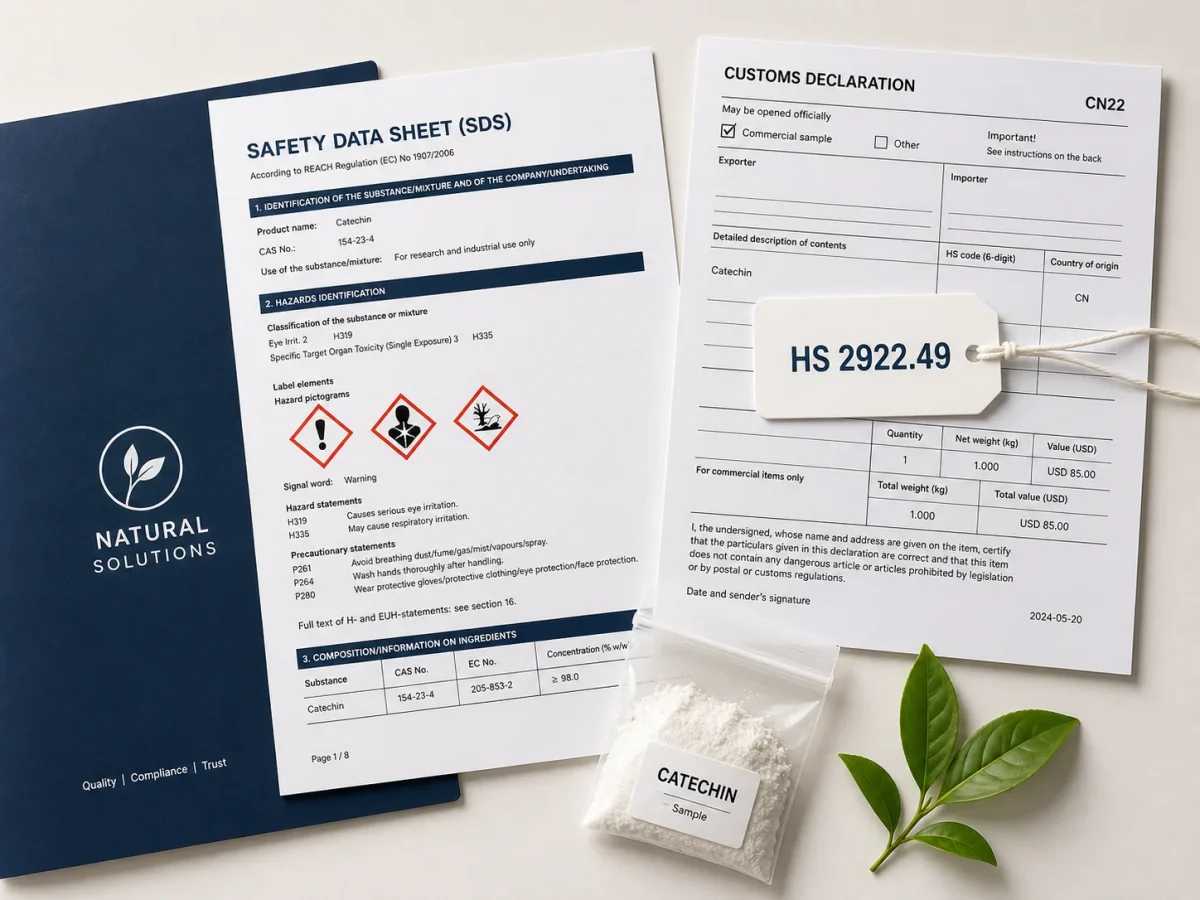
The SDS and customs documents above belong to the same file package — the SDS covers handling and transport, while the customs declaration records the HS classification that your importer must confirm.
Request the SDS before internal quality, warehouse or import review, and confirm the revision date is current for the shipped batch.
L-Theanine Document Package Checklist
| Document | What buyers should check | When it matters |
|---|---|---|
| Specification sheet | Ingredient name, assay range, appearance, physical parameters, quality limits, packaging notes | Before comparing supplier quotations |
| Representative COA | Batch number, assay method, result format, microbiology, heavy metals, moisture; must match spec limits | Before sample approval, and again before bulk release |
| SDS (current) | Material identity (CAS 3081-61-6), revision date, GHS hazard statements | Before internal quality, warehouse or import review |
| Flow chart | Manufacturing route and process steps for buyer QA files | When the buyer’s QA file requires source and process notes |
| Packing information | Inner bag, drum or carton format, net weight, pallet notes, label fields | Before shipment planning and warehouse approval |
| Export support files | Project-dependent commercial documents, packing notes, destination paperwork | Before issuing the purchase order |
Use this package together with an ingredient supplier audit checklist. To confirm available files, sample quantity, MOQ, packaging and lead time, send the project details through the HERBSEA plant extract supplier contact page.
How to Review the COA Before Sample Testing
A COA should not be reviewed as a single isolated file. Compare it with the specification sheet, the quotation item name and the sample label:
- Confirm whether the assay method and result format match the purchasing brief.
- Check that the batch number is traceable across the COA, sample label and quotation record.
- Review appearance, odor and physical notes before sending the sample into formulation trials.
- Keep the representative COA and the later commercial COA in the same project file.
- Ask the supplier which document fields are fixed and which are project-dependent.
RFQ Checklist for L-Theanine Documentation
A stronger RFQ lets the supplier confirm document availability before the buyer invests time in sample testing. Send the project context early, especially when you need a current SDS, specific COA fields, export paperwork or a quality questionnaire.
- Target ingredient: L-Theanine green tea extract or high-purity monomer
- Assay target, analytical method and specification range
- Application format: capsule, tablet, powder blend, beverage concept or functional food project
- Required documents: specification, representative COA, current SDS, flow chart, packing information and supplier questionnaire
- Sample quantity, internal test plan and expected approval timeline
- Destination market, packaging preference, MOQ expectation and estimated annual demand
- Destination-specific documents that the buyer or importer requires for internal review
L-Theanine COA and MSDS FAQ
A useful L-Theanine COA should identify the batch and report the assay method and result, appearance, identification, loss on drying, residue on ignition, heavy metals, individual metals, microbial limits, pathogens and residual solvents where applicable. Send the target material, current specification, SDS, destination market and RFQ requirements so HERBSEA can confirm the available document set.
SDS is the current term used in the GHS framework, while many purchasing teams still use MSDS. Check the material identity, revision date and 16-section structure instead of relying only on the filename.
The CAS number commonly used for L-Theanine is 3081-61-6. Cross-check it across the specification sheet, COA, SDS and shipment documents for the supplied material.
High-purity L-Theanine and tea-derived L-Theanine extract may enter different customs headings. The importer or customs broker should confirm the final code after reviewing material identity, source, composition, manufacturing route and destination requirements.
Yes. Review a representative COA, specification and document list before sample testing. Then compare the sample batch and later commercial batch against the approved requirements.
Use the HERBSEA L-Theanine Green Tea Extract 20%-40% HPLC product page for the grade, sample and quotation path. Use this guide to plan the supporting document package.
Summary: Approve the Document Set Before Bulk Release
An L-Theanine COA and MSDS request should begin with the exact material identity and assay target. Green tea extract and high-purity monomer can require different specifications and customs review. Therefore, request the specification, representative COA, current SDS, process information and packing details before sample testing, then compare the commercial batch documents with the approved project file before bulk release.
Request the matching L-Theanine document package and samples from HERBSEA.
Scope note: this page supports B2B document planning. Final customs classification, destination-market requirements, finished-product decisions and shipment declarations must be confirmed by the buyer, importer, qualified advisor or relevant authority for the specific material and shipment.
Already have a sample? Use the L-Theanine sample approval and batch-matching checklist to compare its label, COA and quotation.