
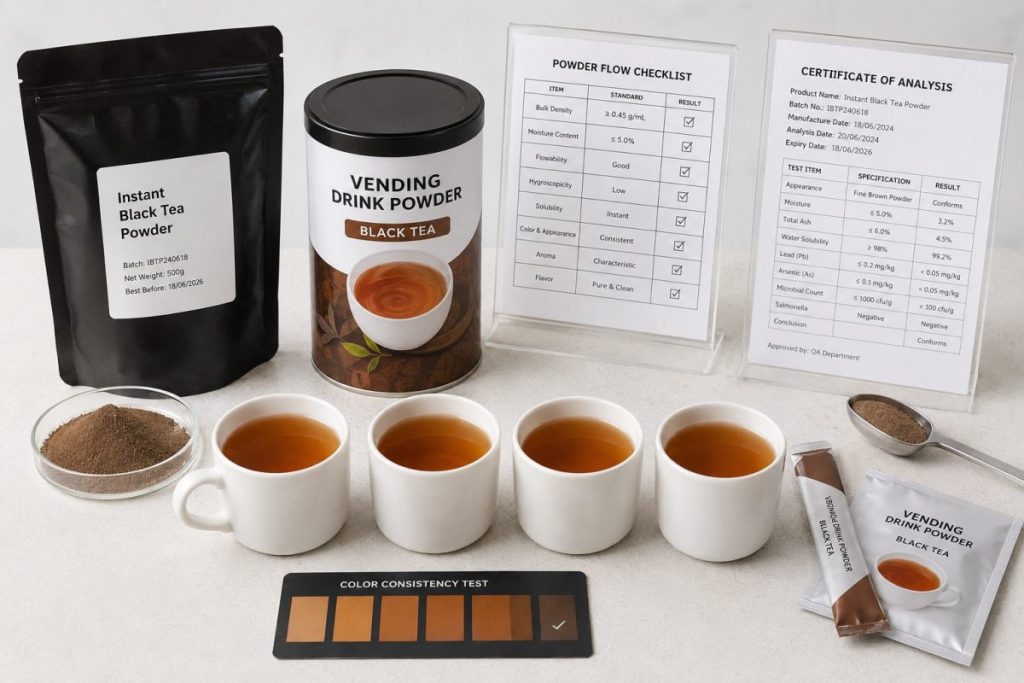
Black tea powder HS code questions should start with product identity, not only with a keyword. For B2B buyers, the customs classification path may differ depending on whether the material is fermented black tea, instant black tea powder, black tea extract powder, a tea-based preparation or a flavored dry blend.
Because import classification depends on product composition, processing method, packaging, destination market and customs interpretation, buyers should confirm the final HS code with their importer, broker or customs advisor. HERBSEA can support the discussion with product specification, COA, sample information, packaging details and export-ready documentation.
HERBSEA supplies instant black tea powder for B2B beverage, dry mix and food formulation projects. Buyers can review specification, COA, solubility, particle size, packaging, MOQ and documentation requirements before quotation.
Quick Buyer Answer
For black tea products, buyers often review HS heading 0902, which covers tea, whether or not flavored. Under the US Harmonized Tariff Schedule, 0902.30 covers black tea in immediate packings of a content not exceeding 3 kg, while 0902.40 covers other black tea.
For tea extracts, essences, concentrates or preparations based on tea, buyers may need to review HS heading 2101.20 instead. The USITC HTS includes 2101.20 for extracts, essences and concentrates of tea or maté, and preparations with a basis of these products.
Do not choose a code only because the product name contains “black tea powder.” The buyer should confirm whether the material is tea powder, instant tea powder, extract powder, flavor powder, premix or another preparation.
Why Black Tea Powder Classification Can Be Confusing
Black tea powder can describe several different materials in supplier and buyer communication. One buyer may use the phrase for ground black tea leaves. Another may use it for instant black tea powder made through extraction and drying. A third buyer may use it for a flavored milk tea powder or dessert premix.
This creates classification questions because customs authorities do not classify only by marketing name. They look at the actual material and the applicable tariff rules.
Buyers should clarify:
- Is the material made from black tea leaves, tea extract or a blended preparation?
- Is it instant and water soluble?
- Does it contain carriers, sugar, creamer, flavor or other ingredients?
- Is it packed for bulk manufacturing or retail sale?
- What is the net weight per immediate packing?
- What is the destination market?
- Does the buyer need food import documentation in addition to customs documents?
For ingredient identity questions, HERBSEA’s black tea flavor powder vs real black tea powder article can help buyers separate tea powder, extract powder, flavor powder and premix terminology before RFQ.
HS 0902: Black Tea, Whether or Not Flavored
Heading 0902 is commonly reviewed for tea products. In the US HTS, 0902.30 covers black tea in immediate packings of a content not exceeding 3 kg, while 0902.40 covers other black tea.
This distinction can matter when the buyer compares retail-style packaging with bulk manufacturing packs. It can also matter when a product is tea, whether or not flavored, rather than an extract or preparation under another heading.
Buyers may review HS 0902 when the project involves:
- Black tea leaf material
- Black tea in tea bags or retail packs
- Black tea in bulk packs
- Some flavored tea products
- Tea material where the identity remains tea rather than extract or premix
However, the buyer should not assume 0902 applies to every black tea powder. If the product is an instant extract powder or tea-based preparation, another heading may require review.
HS 2101.20: Tea Extracts, Concentrates and Preparations
Heading 2101.20 is often reviewed when the material is a tea extract, tea essence, tea concentrate or preparation with a basis of tea extract or tea. The USITC HTS page for 2101.20 describes extracts, essences and concentrates of tea or maté and preparations with a basis of these products.
This can be relevant for instant black tea powder if the product is produced through extraction, concentration and drying. It can also be relevant for some tea-based beverage powders or flavored tea preparations.
Buyers may review HS 2101.20 when the project involves:
- Instant black tea powder made from tea extract
- Black tea extract powder
- Tea essence or concentrate
- Powdered tea beverage base
- Tea-based preparation for beverage manufacturing
- Flavored dry mix based on tea extract or tea concentrate
CBP ruling examples can help import teams understand how authorities discuss similar products. For example, a CBP ruling on Black Tea Essence classified that product under 2101.20.2000, while another ruling on an iced tea mix discussed a tea-based preparation under 2101.20.5400. These rulings are product-specific examples, not automatic answers for every black tea powder.
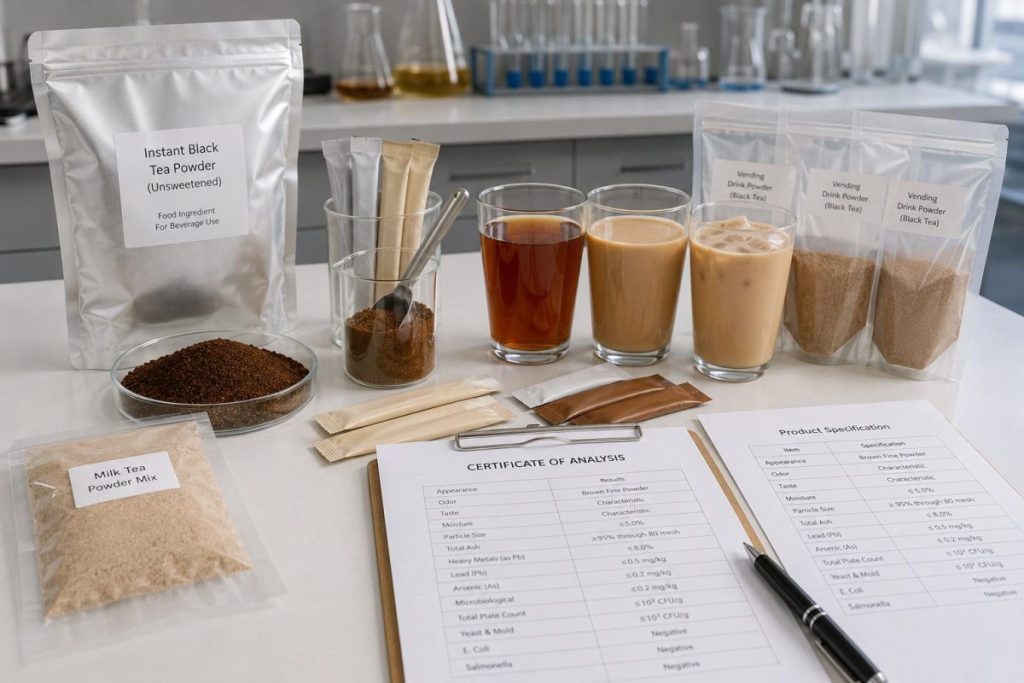
Product Identity Checklist Before HS Code Review
Before asking a supplier for an HS code, buyers should prepare a product identity checklist.
| Question | Why it matters |
|---|---|
| Is the material tea, extract, concentrate, flavor powder or premix? | Classification depends on material identity |
| Is it instant and water soluble? | Instant tea powder may require a different review than leaf tea |
| Does it contain carriers or other ingredients? | Blends and preparations can move the discussion away from plain tea |
| Is the product flavored? | Flavoring can affect label and classification review |
| What is the net weight per immediate packing? | 0902.30 and 0902.40 differ by packing context in the US HTS |
| Is it for bulk manufacturing or retail sale? | Packaging and use case can affect import documentation |
| What destination market applies? | HS subheadings and national tariff lines differ by country |
| What documents does the importer need? | Customs, food import and buyer QA documents may differ |
This table helps the supplier answer more accurately. It also helps the importer or broker avoid relying on an incomplete product name.
Documentation Buyers Commonly Request
For black tea powder export and import planning, buyers commonly request a document package before bulk shipment.
Typical documents may include:
- Commercial invoice
- Packing list
- Product specification sheet
- Batch COA
- Product label or shipping mark details, if applicable
- Manufacturing or processing description, if needed for classification review
- Ingredient statement, if the material is a blend or premix
- SDS or transport-related document if requested by the buyer or carrier
- Certificate of origin, if required by the buyer or destination market
- Phytosanitary or additional market document only if applicable
- Importer-side documents required by destination authorities
HERBSEA can support product and batch documentation discussion, but the importer should confirm which documents the destination market requires before shipment.
US Import Notes: FDA Facility Registration and Prior Notice
Black tea powder used in food or beverage manufacturing may trigger food import requirements in addition to customs classification. For the United States, FDA explains that food facilities register with FDA and that FDA receives advance notice of imported food shipments through Prior Notice.
Buyers can review FDA information on Registration of Food Facilities and Prior Notice of Imported Foods. FDA also provides a broader page on importing food products into the United States.
These links are useful for US-market planning, but the buyer’s importer, broker or regulatory advisor should confirm the current filing route, responsible party and shipment timing.
Why Supplier HS Codes Should Be Treated as References
Some suppliers include an HS code on quotations or shipping documents. This can help start the discussion, but it should not replace importer-side review.
Buyers should use supplier-provided HS codes as references because:
- National tariff lines may differ after the first six HS digits
- Product descriptions may not capture processing details
- Import authorities may request additional information
- Blends, flavor systems and premixes may need different review
- Duty rates and additional measures can change
- The importer is often responsible for final entry information
For this reason, HERBSEA recommends that buyers share the product specification and composition details with their broker before confirming the shipping document package.
HS Code Review by Product Type
| Product description in RFQ | HS direction to review | Buyer note |
|---|---|---|
| Black tea leaf material or tea in bulk pack | 0902.40 may be reviewed | Confirm packing size and product identity |
| Black tea in immediate packs not exceeding 3 kg | 0902.30 may be reviewed | Confirm retail or small-pack context |
| Instant black tea powder made from tea extract | 2101.20 may need review | Confirm extraction and drying process |
| Black tea extract powder | 2101.20 may need review | Confirm assay, carrier and extract identity |
| Milk tea premix powder | Preparation classification may need review | Confirm sugar, creamer, flavor and tea base |
| Black tea flavor powder | Flavor or preparation review may apply | Confirm carrier and declaration support |
This table is a sourcing guide only. The final HS code should be confirmed by the importer, customs broker or destination-market advisor.
If the product is more about extract identity than tea powder identity, buyers can also review HERBSEA’s black tea powder vs black tea extract guide.
Sample and Document Review Workflow
A practical black tea powder export workflow should connect sample approval with document preparation.
- Define the product identity: tea powder, instant tea powder, extract powder, flavor powder or premix.
- Confirm the finished application: beverage, dry mix, bakery, dessert, foodservice or manufacturing use.
- Request specification sheet and COA before sample approval.
- Ask whether the supplier can provide packaging details and composition information.
- Share product documents with the importer or customs broker for HS code review.
- Confirm destination-market food import requirements.
- Align invoice description, packing list and product documents before shipment.
- Review any additional importer-side requirements before bulk order release.
This workflow reduces back-and-forth during shipment preparation and helps both sides avoid mismatched product descriptions.
Supplier Questions to Ask
| Review point | Better supplier response | Weak supplier response | Buyer action |
|---|---|---|---|
| Product identity | Explains whether the material is tea powder, extract, flavor powder or premix | Uses a generic product name only | Ask for composition and processing details |
| Suggested HS code | Provides a reference code with product description context | Gives a code without explanation | Send documents to broker for confirmation |
| COA support | Can provide batch COA for approved lots | Provides only a brochure | Request COA before bulk approval |
| Packaging detail | Lists net weight, inner pack and outer pack | Gives only carton quantity | Confirm immediate packing and bulk pack details |
| Export documents | Explains common documents available for shipment | Promises every certificate without scope | Confirm exact document needs before order |
| Destination market support | Asks where the goods will be imported | Assumes one code fits all countries | Share market and importer requirements |
RFQ Details to Send
To help HERBSEA prepare a clearer black tea powder quotation and document discussion, buyers can send:
- Product type required
- Finished application
- Whether the product should be instant, extract-based, flavored or blended
- Ingredient or carrier restrictions, if any
- Packaging format and net weight per pack
- Estimated order quantity
- Destination country or region
- Required COA and specification details
- Any importer-provided HS code or broker question
- Required shipment documents
- Sample request details
For broader procurement review, buyers can also use HERBSEA’s bulk instant tea powder supplier guide and black tea powder caffeine buyer guide as supporting resources.
FAQ
What is the HS code for black tea powder?
There is no single automatic HS code for every black tea powder. Buyers commonly review 0902 for black tea products and 2101.20 for tea extracts, concentrates and tea-based preparations. The final code depends on product identity, processing, composition, packing and destination market.
Is instant black tea powder classified under 0902 or 2101.20?
It depends on the product. If the material is an instant powder made through extraction and drying, import teams may need to review 2101.20. If the material is tea in a form that remains classified as tea, 0902 may be reviewed. The importer or broker should confirm.
Can HERBSEA provide an HS code on shipping documents?
HERBSEA can discuss a reference HS code and provide product documents for buyer review. The importer or customs broker should confirm the final code for the destination market before shipment.
What documents should buyers request before black tea powder shipment?
Buyers commonly request a commercial invoice, packing list, specification sheet, batch COA, packaging details, composition information if applicable and destination-market documents required by the importer.
Does black tea powder need FDA Prior Notice for the US market?
Food import planning for the US may involve FDA facility registration and Prior Notice requirements. Buyers should review FDA guidance and confirm the filing route with their importer, broker or regulatory advisor.
Request Black Tea Powder Specifications and Export Documents
HERBSEA supplies bulk instant black tea powder for beverage, dry mix, bakery, chocolate, dessert and food formulation projects. B2B buyers can review specification, COA, product identity, sample performance, packaging, MOQ, lead time and export document requirements before quotation.
To prepare a black tea powder sourcing request with HS code and documentation questions, send your finished product brief through the HERBSEA contact page.
There is no single automatic HS code for every black tea powder. Buyers commonly review 0902 for black tea products and 2101.20 for tea extracts, concentrates and tea-based preparations, then confirm the final code with the importer or broker.
It depends on product identity, processing, composition, packing and destination market. Buyers should provide the supplier documents to their importer or customs broker for final classification review.
Common documents include commercial invoice, packing list, specification sheet, batch COA, packaging details, composition information if applicable and destination-market documents required by the importer.