
1. Why Compatibility Testing Decides RTD and Dry-Mix Success
Instant green tea powder is not interchangeable with matcha or brewed tea concentrate. It is a water-extracted, spray-dried concentrate designed to dissolve completely, but the way it behaves changes with the formulation around it. Buyers who skip a structured compatibility test routinely discover problems only at pilot scale: sediment rings in transparent PET bottles, color drift after pasteurization, astringency that emerges once acid and sweetener interact, or a solubility failure in cold-mix vending machines.
The category economics explain why this matters. Global instant green tea powder extract demand reached about USD 978 million in 2025 and is projected to grow to roughly USD 1.57 billion by 2032 (about 7.0% CAGR), with ready-to-drink beverages the largest application at roughly 45% of demand and Asia Pacific the leading region (pmarketresearch, 2026). A separate estimate sizes the same category at USD 3.7 billion in 2024 growing to USD 6.8 billion by 2033 (DataHorizzon Research, 2025). On the supply side, China Customs data for 2024 show green tea as the dominant export category — 323,900 metric tons worth about USD 1.07 billion, roughly 87% of China’s tea export volume, with top destinations including Morocco, Ghana, Mauritania, Senegal and Uzbekistan.
For a beverage buyer, the practical conclusion is: the supply base is deep and price-competitive, which means the differentiator is not finding a powder — it is specifying and verifying the right behavior for your specific matrix before you commit to a bulk order.
2. The Five Compatibility Dimensions to Specify
Before any sample or quotation, pin down these five dimensions. Each one changes the powder behavior target you send to the supplier.
| Compatibility dimension | What to specify | Why it matters |
|---|---|---|
| Beverage matrix | Water hardness, acid type and pH, sweetener system, dairy or plant-based base | Matrix drives color, clarity, sediment and flavor stability outcomes |
| Process route | Cold mix, hot dissolve, UHT/retort, vending or food-service preparation | Route sets the solubility and thermal-stability target for the powder |
| Solubility and sediment | Target dissolution time, clarity (NTU), sediment-free shelf life | Defines whether the powder fits transparent-packaging or sediment-prone systems |
| Sensory target | Green tea note, color direction, bitterness and astringency level, mouthfeel | Sensory review gates finished beverage approval |
| Document set | Specification sheet, representative COA, pesticide and heavy metal data, export files | Documents support QA and procurement sign-off |
The most common sourcing mistake is specifying only “instant green tea powder” and leaving these five fields open. Suppliers then quote a default grade that may be optimized for supplements rather than beverages — often with a higher polyphenol load and a more bitter profile than a beverage formula needs.
3. Solubility and Sediment: What “Fully Soluble” Actually Means
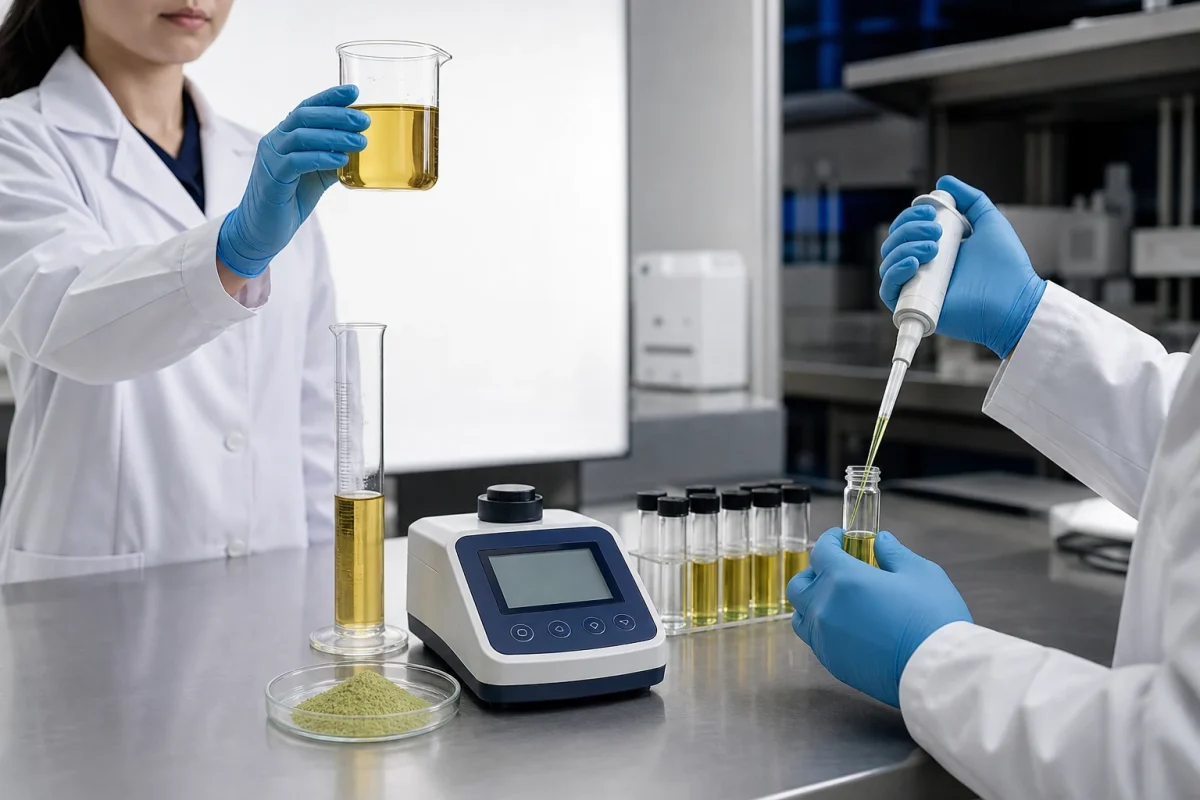
Industry marketing says “100% soluble,” but that is not a specification — it is a claim. The specification is the test you run and the number you accept. For instant green tea powder, the practical parameters are:
- Dissolution — complete dispersion in room-temperature water without heating; typical sieve requirement 98% passing 80 mesh (about 180 micron), which correlates with fast wetting and minimal lumps.
- Clarity — turbidity below 5 NTU at a 1% concentration is achievable with well-filtered, spray-dried extract; this is the number that keeps transparent RTD bottles clean (reference: supplier technical sheets).
- Sediment stability — in acidic RTD systems (pH 3.0–4.0), a properly stabilized extract holds clarity over a 6–12 month shelf life; un-stabilized polyphenol complexes precipitate and form visible sediment.
- Moisture — 5% or below is the standard ceiling for shelf-stable powder (2-year sealed shelf life), and low moisture also prevents caking in hot-climate warehousing.
- Microbial and heavy metal limits — typical targets include total plate count below 1,000 cfu/g, yeast and mold below 100 cfu/g, coliforms absent, lead below 2 ppm, arsenic below 1 ppm, cadmium below 1 ppm.
Ask the supplier for the exact test methods behind each number (AOAC, GB, or in-house SOP), not just the pass values. Two suppliers can both claim “fully soluble” with very different turbidity results in your matrix.
4. Matching Powder Behavior to Your Process Route
The same powder grade can pass in one process and fail in another. Match the behavior target to your actual line before sampling.
| Process route | Typical use | Powder behavior to verify |
|---|---|---|
| Cold mix / vending | Instant iced tea, vending machines, food-service batching | Full cold-water dispersion, no caking, no sediment after standing |
| Hot dissolve / bottling | Hot-fill RTD, tea concentrate, brewing bases | Clear hot dissolution, color stability through pasteurization |
| UHT / retort | Shelf-stable RTD bottles and cans | Thermal stability, no haze or precipitation after high-heat processing |
| Dry-mix sachet | Instant tea sachets, sugar-blend sticks | Flowability, anti-caking in the sachet, consistent dose per sachet |
Typical usage levels in commercial formulas run 0.10%–0.15% (w/v) for iced tea-style drinks and 0.20%–0.30% (w/v) for full-flavor tea, fruit-tea or milk-tea bases — but regard these only as starting points; the target depends on your polyphenol spec, sweetener system and desired taste intensity.
5. Certification and Documentation: What to Request with the Sample
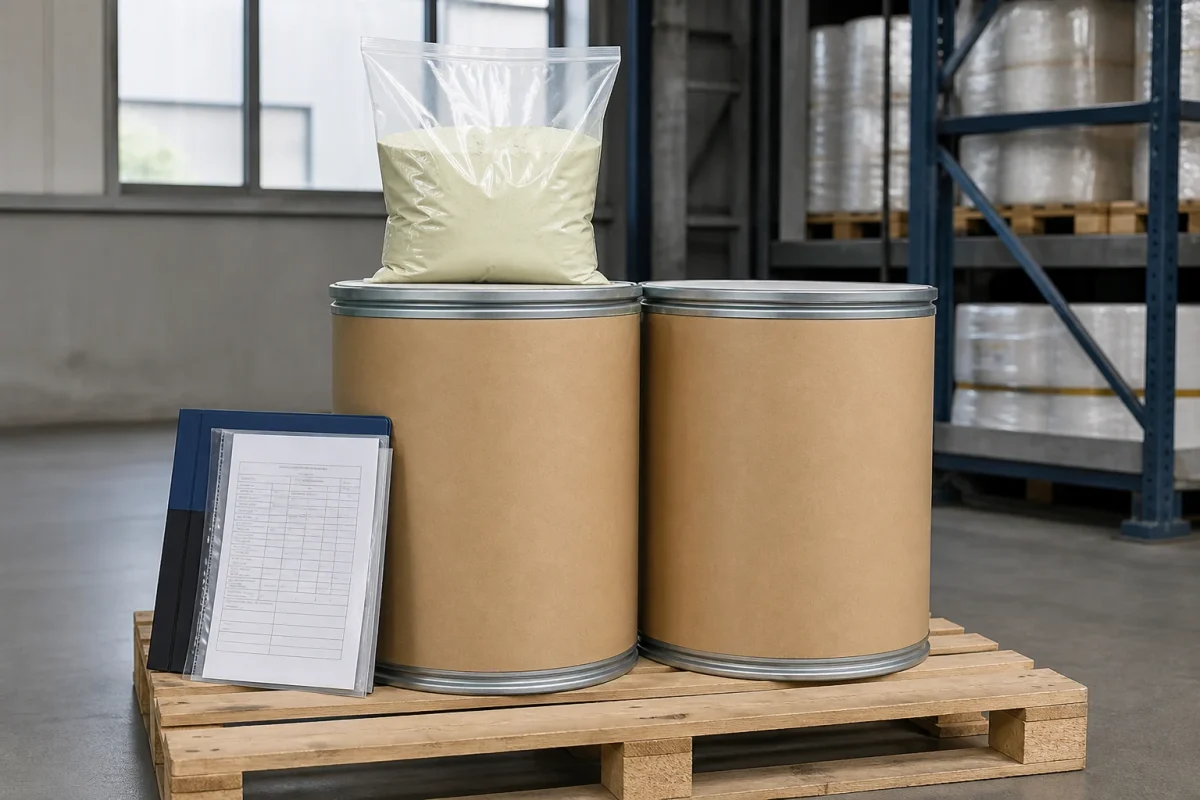
Beverage-grade instant green tea powder should arrive with a document set that lets your QA sign off without a second round of requests. The minimum set:
- Specification sheet — appearance, color, mesh size, solubility, moisture, bulk density, polyphenol and caffeine content, heavy metals, microbiology.
- Representative COA — batch number, tested values, test methods and dates; confirm it matches the specification sheet.
- Pesticide residue data — critical for EU-bound products. EU Regulation (EC) 396/2005 applies a default Maximum Residue Limit of 0.01 mg/kg to any pesticide without a specific tea MRL — effectively a zero-tolerance floor for roughly 500 regulated substances. Rejection triggers for Chinese-origin green tea into the EU have included anthraquinone, acetamiprid, clothianidin, thiamethoxam and tricyclazole, which is why a broad multi-residue screen (GC-MS/MS and LC-MS/MS per SANTE/11945/2015) matters more than a short 12-compound panel.
- Export documentation — packing list, phytosanitary or export certificate where required, and destination-market-specific documents.
Suppliers who cannot produce a representative COA at the sample stage are a red flag, regardless of price. See the Ingredient Export Documentation Checklist for the full document review flow.
6. Sample Request vs Bulk RFQ: Know Which One You Are Sending
| Dimension | Sample request | Bulk RFQ |
|---|---|---|
| Main purpose | Verify solubility, color, sediment, sensory profile and document fit | Confirm commercial supply, packing, lead time and export terms |
| Buyer input | Application, sample quantity, test matrix, COA needs | Quantity, MOQ expectation, packing size, destination market |
| Decision gate | Formula fit and sensory approval | Supplier capability, price and delivery terms |
| Follow-up | Requires later commercial confirmation | Should follow sample approval when formula fit is strict |
Send the sample request first with a defined test matrix, then the bulk RFQ once the sample clears your formula. Jumping straight to RFQ without a compatibility sample is the most common cause of rework — and of a formula change that invalidates an approved price.
7. Where the Instant Green Tea Powder Market Is Headed
| Indicator | Value | Source |
|---|---|---|
| Global instant green tea powder extract market, 2025 | USD ~978 million | pmarketresearch (2026) |
| Projected market, 2032 | USD ~1.57 billion (7.0% CAGR) | pmarketresearch (2026) |
| RTD beverages share of demand | ~45% | pmarketresearch (2026) |
| China green tea export volume, 2024 | 323,900 t (87% of tea export volume) | China Customs via CAPIA (2025) |
| China green tea export value, 2024 | USD ~1.07 billion | China Customs via CAPIA (2025) |
| Top 2024 export destinations | Morocco, Ghana, Mauritania, Senegal, Uzbekistan | China Customs via CAPIA (2025) |
| EU default pesticide MRL for tea | 0.01 mg/kg (no specific MRL listed) | EU Regulation (EC) 396/2005 |
The trend direction for beverage buyers: RTD and convenience formats are the growth engine, and the supply side remains volume-driven with competitive pricing — so the sourcing edge comes from precise specification and verification, not from hunting for a lower price per kilogram.
8. FAQ
Water quality, sweetener type, acid level, dairy or plant-based base, the process route (cold mix, hot dissolve, UHT or vending) and mixing conditions all change visible behavior — color, clarity, sediment and flavor stability.
Solubility and dissolution time in the actual matrix, clarity (NTU), sediment over shelf life, color and sensory profile, and whether the sample matches the supplied COA and specification sheet — including pesticide residue and heavy metal data for the destination market.
Typical starting points are 0.10%–0.15% (w/v) for iced-tea style drinks and 0.20%–0.30% (w/v) for full-flavor tea, fruit-tea or milk-tea bases. Final levels depend on the polyphenol spec, sweetener system and taste target.
A specification sheet, a representative COA with test methods, pesticide residue data (especially for EU-bound product, where the default MRL is 0.01 mg/kg under Regulation (EC) 396/2005), and export documents.
Instant green tea powder is a fully dissolved water extract that disperses in cold or room-temperature water without sediment, making it suitable for clear RTD products. Matcha is a ground whole-leaf suspension that settles and requires agitation — a different application class.
Use the Instant Green Tea Powder product page with the beverage matrix, process route, sample quantity, COA needs, MOQ and destination market, or send the full RFQ through the HERBSEA contact page.
Use the Instant Green Tea Powder product page to request the beverage-grade sample, or send the full RFQ through the HERBSEA contact page.
9. Summary
Instant green tea powder compatibility is a specification problem, not a guess. Define the five dimensions (matrix, process route, solubility and sediment, sensory, documents), run a structured sample test in your actual formula, and only then send a bulk RFQ. Send the supplier your target powder behavior, COA fields, sample quantity, MOQ, packing and destination market up front — the sample cycle shortens to one structured exchange, and the approved sample matches the commercial grade.
10. Related Resources
- Instant Green Tea Powder Supplier — main beverage powder page for samples and RFQ.
- Instant Black Tea Powder Supplier — adjacent black tea beverage powder path.
- Bulk Matcha Powder Supplier — adjacent green tea powder path.
- Instant Tea Powder Supplier hub — category-level comparison.
- Bulk Ingredient Sample Request Template — sample quantity, specification, COA and MOQ fields.
- Food Ingredient RFQ Template — supplier comparison, packing and quotation fields.
- Ingredient Export Documentation Checklist — COA, packing and destination-market document review.
- Ingredient Supplier Audit Checklist — supplier scope, sample control and document readiness.
Data sources: pmarketresearch (2026) instant green tea powder extract market report; DataHorizzon Research (2025); China Customs export statistics compiled by CAPIA/China Tea Marketing Association (2024 data, published 2025); EU Regulation (EC) No 396/2005 MRL framework; supplier technical specification sheets for typical solubility, mesh and microbial parameters. Market figures are third-party estimates provided for sourcing context and should be re-verified against current reports before investment decisions.