
Quick Answer
MOQ tiers at a glance
Urolithin A (CAS 1143-70-0) bulk MOQ is not one number. Across published supplier listings in 2026 the practical tiers are:
| Order tier | Typical quantity | Typical packaging | What it is for |
|---|---|---|---|
| Evaluation sample | 10 g – 100 g | Aluminium foil bag, 1 bag | Identity check, solubility and blend trials |
| Formulation / pilot lot | 500 g – 5 kg | Foil bag inside carton, 1 kg per bag | Bench batches, capsule and sachet trials |
| First commercial lot | 10 kg – 25 kg | 25 kg fibre drum with double PE or foil liner | Launch run, distributor stocking |
| Programme / container lot | 100 kg – 500+ kg (up to 10–15 MT per 20 ft) | 25 kg drums, palletised | Multi-SKU or multi-market supply |
In practice, standard 98% HPLC material is normally available from 1 kg with no custom production. Fermentation-derived grades typically start at 1–5 kg because a clean-label production route has a higher minimum batch. Larger minimum orders do not automatically lower the effective cost — packing format, pallet density and freight band usually decide the real landed number.
Therefore, HERBSEA supplies bulk botanical and specialty ingredients for supplement, functional food and beverage formulation projects. This guide gives procurement, formulation and QA teams the MOQ, packing, pallet, container, HS-code and lead-time figures to compare Urolithin A offers on the same basis.
Why MOQ and Packaging Decide the Real Cost of a Urolithin A Order
Three cost lines to model before approval
At first, a Urolithin A quotation is usually compared as a price per kilogram. That number is only half the commercial picture. Minimum order quantity, packing format and shipment band set three cost lines that never appear in the unit price:
- Quantity covered by the minimum. If the MOQ is 25 kg but the launch forecast is 8 kg, the unused 17 kg becomes inventory with a retest clock running against it. Urolithin A carries a typical 24-month shelf life under recommended storage, so surplus material has a finite window.
- Packing and pallet economics. A 1 kg foil bag and a 25 kg fibre drum hold the same product but load very differently. Packing choice changes courier versus air versus sea eligibility, which can move freight cost per kilogram by an order of magnitude.
- Freight band. Courier, air and sea freight are priced in weight bands with hard break points. A 22 kg shipment and a 26 kg shipment can sit in different bands entirely. Splitting or consolidating an order by a few kilograms often changes the total more than a 5% price negotiation.
For this reason, regard MOQ as a planning parameter rather than a hurdle. Buyers who define the intended quantity, pack format and destination before requesting a quote receive offers that can actually be compared.
Urolithin A MOQ Benchmarks by Project Stage
Quote each project stage separately
Before comparing price, ask every candidate supplier to quote the same four stages separately. Suppliers that will not break the MOQ into stages are usually quoting a stock position rather than a production plan.
| Project stage | Quantity to request | What the quote must state | Tolerance to check |
|---|---|---|---|
| Documentation review | 10 g – 50 g | Sample lot number, sample COA, sample lead time | Whether the sample comes from the same batch type as the commercial lot |
| Formula screening | 100 g – 500 g | Assay method, particle-size statement, packing | Whether a second sample from another lot is available |
| Pilot / trial batch | 1 kg – 5 kg | Pilot MOQ, packing format, lot availability, production window | Whether the pilot lot is drawn from stock or produced to order |
| First commercial run | 10 kg – 25 kg | Commercial MOQ, lead time, Incoterms, document scope | Whether the commercial lot must be re-tested by the buyer before release |
| Repeat / programme | 100 kg + | Repeat-order process, change-notice period, lot-to-lot consistency statement | Notice period if the supplier changes a raw-material source or production route |
However, published supplier listings in 2026 show how wide the range is: some Chinese platforms quote a 100 g MOQ on 99% material, others quote 500 g on 98% food-grade powder, and European warehouses quote from 10 g for cosmetic-grade material. A small listed MOQ is a marketing position, not a supply commitment — confirm that the supplier can also reach the commercial quantity before you build a launch plan on the low number.
What Moves a Urolithin A MOQ Up or Down
Variables that change the minimum
In addition, four variables, not one, set the minimum a supplier can accept.
| Variable | Low-MOQ position | High-MOQ position | Effect on the quote |
|---|---|---|---|
| Purity / assay target | 98% by HPLC | 99%+ with tight impurity control | Higher assay narrows the qualified batch pool and adds purification steps |
| Production route | Chemical synthesis, in-stock batches | Fermentation-derived, produced to order | Fermentation grades commonly quote 1–5 kg minimums and a material premium |
| Document package | Standard COA | COA plus orthogonal identity and impurity data, full dossier | Extra testing adds cost per lot and can add a release day |
| Destination and Incoterms | Buyer-arranged courier, EXW | Supplier-managed door delivery, DDP | Supplier-managed delivery pushes the minimum up because freight is consolidated |
As a useful cross-check, compare the quoted MOQ against the supplier’s stated output. Suppliers publishing 120 t/year nameplate capacity and multi-hundred-kilogram monthly output are normally quoting from stock at the 1–25 kg level. Suppliers that only publish milligram-scale catalog quantities are usually reselling, and their MOQ will move once you ask for a drum.
Packaging Formats for Urolithin A Powder
Four packaging levels to specify
First, request a packing description, not a single net-weight figure. The description should let your warehouse calculate volume, stacking height and storage footprint before the order ships.
| Pack level | Typical format | Net weight | Where it fits |
|---|---|---|---|
| Primary | Sealed foil or food-grade PE bag, heat-sealed | 100 g, 500 g, 1 kg | Samples, bench work, small pilot lots |
| Inner carton | Foil bag inside a rigid carton | 1 kg × 5–25 bags | Courier and air shipments, easy dispensing |
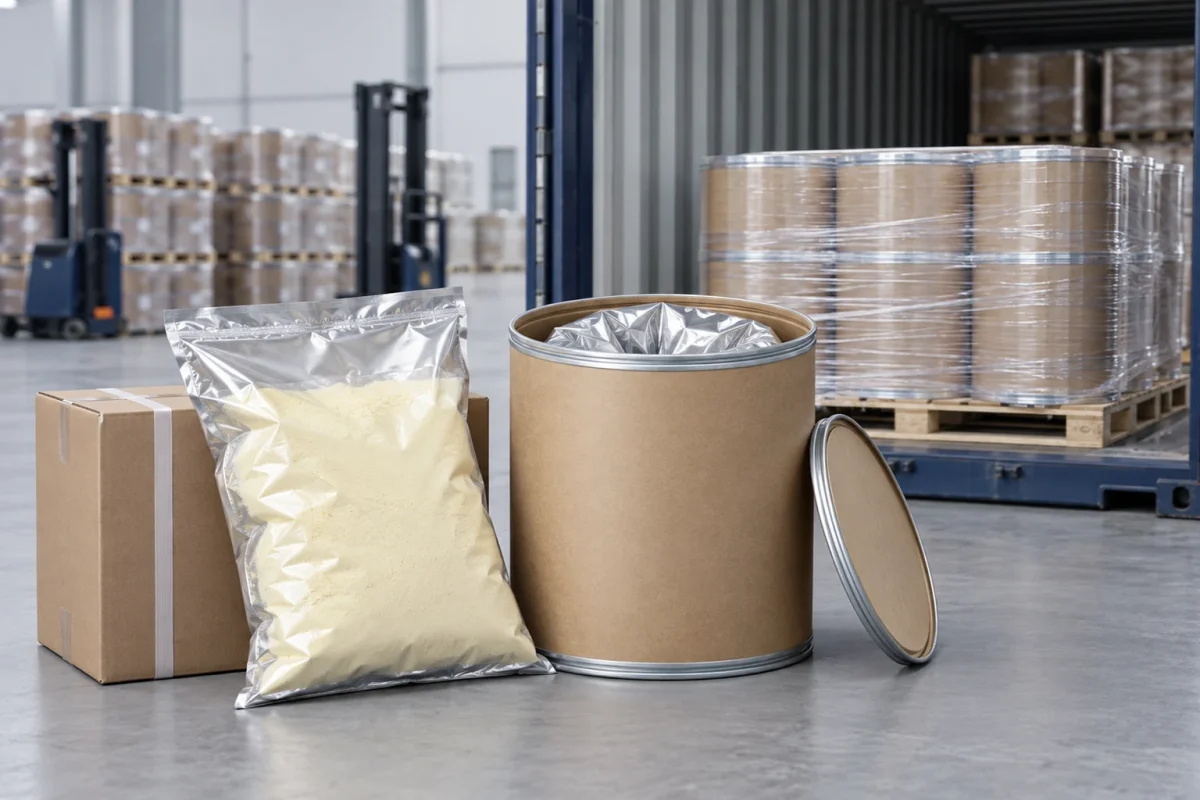
| Export drum | Fibre drum, double PE or aluminium-foil liner | 20 kg or 25 kg | Commercial lots, ocean freight, distributor stock |
| Pallet | Stretch-wrapped drums on a 1,200 × 1,000 mm or 1,100 × 1,100 mm pallet | 4 drums per layer, 3–4 layers | Container loading, warehouse put-away |
For example, a 25 kg fibre drum is commonly specified at roughly 36 cm outside diameter and 45 cm outside height. That single figure matters more than it looks: drum diameter and height decide how many units fit per pallet layer, which decides pallet count, which decides container utilisation and the final freight-per-kilogram number.
Every pack level should carry the same data fields:
Label and liner details to record
- Product name, CAS number and supplier batch or lot number
- Net weight per container and container count per outer case
- Manufacturing date, retest or shelf-life field, and storage statement
- Outer carton, pallet and shipping-mark details for the destination market
- Label language and the document references the importer or distributor needs
- Handling notes for moisture, light, temperature and warehouse release
If the supplier changes the container, liner, label or lot format between orders, QA should review the change before the next shipment. A liner substitution from foil to mono-PE is a packaging change, not a cosmetic one, and it can affect both storage claims and destination-market acceptance. Therefore, record the approved pack format in the purchase specification.
Pallet, Container and Shipping Configuration
Container planning limits
In practice, Urolithin A is a low-bulk-density powder, so container loads are volume-limited rather than weight-limited. Published export references for 25 kg drum programmes give the following planning ranges.
| Shipment mode | Practical weight band | Drums per shipment | Transit time | Best fit |
|---|---|---|---|---|
| Express courier | Up to ~20 kg | 0–1 (bags) | 3–9 days door to door | Samples, first 1 kg evaluation lots |
| Air freight | 20 kg – 200 kg | 1–8 | 3–8 days airport to airport | Time-critical pilot or launch material |
| LCL sea | 25 kg – 2,000 kg | 1–80 | 20–35 days | Trial commercial lots, cost-controlled |
| 20 ft FCL | ~10–15 MT | 400–600 (about 10–15 pallets) | 14–35 days | Programme supply, distributor fill |
| 40 ft FCL | ~20–30 MT | 800–1,200 (about 20–30 pallets) | 14–35 days | Multi-market or annual contracts |
Two planning cautions apply to the container columns. First, the drum count is a stow estimate, not a guarantee — real payload depends on bulk density, drum height, pallet stacking height and cube utilisation, and it should be engineered with the forwarder before the order is confirmed. Second, do not assume a 40 ft container carries exactly twice a 20 ft; published guidance puts it at roughly 1.6–2× for the same palletised system.
In addition, for hygroscopic powders on humid or tropical ocean routes, specify desiccant sachets inside each drum and stretch-wrapping with corner protection on every pallet. Dry sea freight is the default mode for this class of material; refrigerated containers are not normally required for a dry powder held well below 5% moisture, but they may be specified for trial lots where the buyer’s storage protocol calls for it.
Lead Time: Confirm What Starts the Clock
Milestones to confirm in writing
However, a quoted lead time is only meaningful with its trigger stated. Sample preparation, production, QA release, export-document preparation and transit sit on separate schedules and are often quoted as one number.
| Milestone | Typical duration | What the buyer should confirm |
|---|---|---|
| Sample dispatch | 1–3 working days after confirmation | Whether the sample is drawn from stock or produced |
| Stock-lot order | 3–7 working days | Which lot number is being allocated and its manufacturing date |
| New production lot | 15–25 working days | Batch size the schedule is based on, and whether the slot is reserved |
| Third-party testing | 5–10 working days if requested | Which laboratory, which method scope, whether it is pre- or post-shipment |
| Export documents | 2–5 working days after QA release | Commercial invoice, packing list, COA, certificate of origin, and any destination-specific file |
| Ocean transit | 14–35 days by route | Named load port, Incoterms, and who arranges inland delivery |
Therefore, make the quotation state the basis: a validity period, the Incoterms rule and named place, the lot or production window, and the point at which the lead time starts. Then put one owner on destination-market document review before shipment — normally the importer or distributor, since the receiving entity carries the compliance obligation.
HS Codes and Import Documentation for Urolithin A
Classification before the first shipment
Before the first shipment, classification deserves a separate review because the same powder can be declared under more than one heading depending on grade and intended use.
| Heading seen in supplier listings | Description | Typical declared use |
|---|---|---|
| 2914.40 | Carboxylic acids with phenol function | The most frequently cited heading for urolithin A (CAS 1143-70-0) in Chinese export listings |
| 2932.99 | Other heterocyclic compounds, lactones | Alternative classification used by some suppliers |
| 3001.90 / 3004 | Glandular and other organ products / preparations put up for retail sale | Used only where material is declared in a pharmaceutical context |
For this reason, confirm the heading with the supplier’s export documents and with a customs broker in the destination market before the first shipment. Ask the supplier to state the HS code on the proforma invoice and to keep it consistent across the commercial invoice, packing list and certificate of origin. Where the destination applies a different national subheading, the broker should be able to point to a previous ruling.
In addition, request the following documents with every commercial shipment:
- Commercial invoice and packing list matching the packing description exactly
- Certificate of analysis for the shipped lot, not a generic specimen COA
- Certificate of origin
- Statement of the declared HS code and the classification rationale
- Any destination-specific document the importer requires, listed in the purchase order
Regulatory Status by Market
Market review before committing to MOQ
Before committing to MOQ, confirm the current market position because regulatory status changes the quantity a buyer is willing to hold. Review the status before the MOQ is fixed rather than after.
| Market | Status | Practical effect on ordering |
|---|---|---|
| United States | FDA GRN 791, filed by Amazentis SA, received a “no questions” response in December 2018 for specified food categories | One documented route for food and supplement applications; review the notice and response letter |
| European Union | Regulated as a novel food; a positive EFSA scientific opinion was issued in 2021 and the Commission authorisation regulation remains pending | Brand owners often plan EU launches around the authorisation date and may hold smaller lots |
| United Kingdom | First review conducted by ACNFP in September 2025 | Status separate from the EU process; confirm before committing UK stock |
| China | Cosmetic new-ingredient filing approved on 26 August 2025; no novel food authorisation for food use | Cosmetic-grade demand is already moving; food-grade use carries a different route |
| Other markets | Varies; several jurisdictions have no equivalent authorisation in place | Ask the supplier which market the quoted documentation package supports |
Note the wording: an FDA “no questions” response is not an FDA approval, and the response letter states that it is not an affirmation of a legal status. Buyers should read the notice and response letter directly rather than relying on a supplier’s summary. Suppliers can also state which market a given lot and document package is prepared for — that is normally a more useful question than asking whether a product “is approved”.
Specification and COA Checks Before MOQ Approval
COA fields to compare with the sample
Once the buyer knows what material is being quoted, an MOQ discussion becomes useful. Confirm that the sample and the commercial lot share the same identity, assay basis and document scope.
| Check | What to compare | Record in the sourcing file |
|---|---|---|
| Identity | Product name, CAS number, reference information, sample label | Specification version and sample lot |
| Assay | Target range, method, available batch result | COA result and method notes |
| Physical profile | Appearance, particle size, bulk density, moisture, handling requirements | Buyer acceptance criteria |
| Quality tests | Agreed contaminant, microbiological and residual-solvent items | Test limits and document source |
| Traceability | Connection between sample, quotation and commercial lot | Lot reference and approval status |
In particular, the physical-profile row deserves attention for Urolithin A. Suppliers commonly specify light-yellow fine powder, a particle criterion such as 95% passing 80 mesh, and a bulk density at or below 0.8 g/mL. Those three fields set how the material behaves in a capsule or blend trial, and they also feed the container-loading calculation in the previous section. Use the Urolithin A COA review checklist to organise this stage, and resolve specification questions before deciding a pack size for material that has not yet passed your technical review.
How to Compare Supplier MOQ and Packaging Offers
Use one RFQ scorecard for every supplier
First, send one RFQ template to every candidate. Each supplier should quote the same target specification, quantity, packing assumption and destination, so that the offers can be ranked.
| Category | Pass question | Evidence to retain |
|---|---|---|
| MOQ fit | Does the minimum quantity match the project stage? | Sample, pilot and commercial quantities stated separately in the quote |
| Pack fit | Can the buyer receive, store and dispense the proposed container format? | Pack specification, drum dimensions, label sample, shipping marks |
| Specification fit | Does the quoted material match the approved technical basis? | Specification sheet and batch COA |
| Volume fit | Does the packing and pallet plan load without paying for air? | Pallet count, gross weight, drum-count estimate |
| Schedule fit | Can production and shipment meet the project window? | Lead-time statement with its trigger and release milestones |
| Document fit | Does the package cover the destination market? | Document list, HS code statement, COA scope |
| Repeat-order fit | Can the supplier hold the same specification and pack format later? | Repeat-order terms and change-control notice period |
However, watch two traps when ranking the results. First, a low MOQ can be paired with a higher per-kilogram price and a shorter quotation validity, which shifts risk to the buyer. Second, a low unit price at a high MOQ can be worse than a mid-price offer at a right-sized MOQ once storage, retest and freight-band costs are added. Rank on landed cost for the quantity you will actually consume, not on the headline number.
Market Context: Why Urolithin A Supply Terms Are Tightening
What supply maturity changes for buyers
In practice, MOQ is a function of supply maturity, and Urolithin A is a young ingredient category. Market research published in 2025 and 2026 puts the growth rate well above the general botanical extract market.
| Indicator | Value | Source and year |
|---|---|---|
| Urolithin A supplement market size | US$115.0 M (2025), forecast US$377.72 M by 2032, ~18.5% CAGR | PW Consulting, Urolithin A Supplement Market, 2025 |
| Food-grade Urolithin A market | US$245.5 M (2025), forecast US$759.12 M by 2032, ~17.5% CAGR | PW Consulting, Food Grade Urolithin A Market, 2025 |
| Value share of ≥98% purity grades | 74.67% of the food-grade segment in 2025 | PW Consulting, 2025 |
| Application mix | Dietary supplements 72.75%, functional foods 18.14%, functional beverages 9.12% (2025) | PW Consulting, 2025 |
| Regional split, food grade | North America US$106.65 M, Europe US$72.95 M, Asia Pacific US$48.74 M, Latin America US$11.02 M, Middle East and Africa US$6.14 M (2025) | PW Consulting, 2025 |
| Production concentration | An estimated ~60% of global output originates in Asia Pacific | Archive Market Research, Urolithin A, 2026 |
As a result, four consequences follow for a buyer writing an MOQ plan in 2026:
Four implications for a sourcing plan
- High-assay capacity is the constraint, not powder. Roughly three quarters of food-grade value sits in grades at 98% purity or above. That is where batch queues form, so ask about the batch pool rather than about general availability.
- The supplement channel dominates demand. With around 73% of food-grade volume going into dietary supplements, supplements programmes set the supply calendar that other applications queue behind.
- Production routes are shifting. Suppliers are moving from extraction toward chemical synthesis and fermentation-based routes, which changes cost structure, minimum batch size and the document package each route can support.
- Regional demand shapes lead time. North America and Europe together represent the majority of food-grade value, so lots destined for those markets compete for capacity and for document preparation slots.
For the commercial side of the same question, including purity-driven price tiers and the four cost drivers behind a quotation, see the Urolithin A powder price factors guide. In addition, keep the market assumptions beside the RFQ so the sourcing team can update them when regulations or supply routes change.
Urolithin A MOQ RFQ Checklist
RFQ fields to include
Finally, copy this into the RFQ body so every supplier answers the same questions.
- Target quantity for sample, pilot and first commercial lot, stated separately.
- Intended application and finished-product form (capsule, tablet, sachet blend or powder system).
- Required assay range and test method, plus the specific COA parameters you will review.
- Requested pack format: primary container, inner liner, outer carton, drum size.
- Destination market, delivery address type and requested Incoterms rule.
- Requested shipment mode and weight band, with a pallet and drum-count estimate.
- Declared HS code and the export documents the supplier will issue.
- Lead time for each stage, with the trigger and quotation validity period.
- Repeat-order terms, and the notice period if a raw-material source or production route changes.
Two documents to request alongside the quote: the Urolithin A supplier specification and COA guide to structure the technical package, and the ingredient supplier audit checklist to compare document quality and communication alongside MOQ and delivery terms. Buyers assembling a first-time supplier review may also want the general plant extract MOQ specification checklist as a template.
FAQ for Urolithin A MOQ Buyers
Common quantity, packaging and shipping questions
First, listings range from 10 g evaluation samples to 25 kg commercial drums. Standard 98% HPLC material may start at 1 kg, while fermentation-derived grades often start at 1–5 kg. Confirm each project stage separately.
In practice, planning references suggest about 10–15 metric tonnes in a 20 ft container and 20–30 tonnes in a 40 ft container. Final loading depends on drum dimensions, pallet height and the forwarder’s calculation.
For commercial planning, specify the primary foil or PE bag, inner carton, lined 25 kg fibre drum and stretch-wrapped pallet. Each level should show product name, CAS number, lot, net weight and storage information.
However, supplier listings cite 2914.40 most often, with 2932.99 as an alternative. Confirm the heading with the export documents and a destination-market customs broker before the first shipment.
Therefore, samples may dispatch in 1–3 working days, stock lots in 3–7 days and new production in 15–25 days. Add testing and transit time, and confirm what starts the supplier’s clock.
Although MOQ can be discussed early, final approval should follow the sample and specification review. Confirm assay, particle criterion, bulk density and document scope before fixing the commercial pack size.
In addition, HERBSEA can review the target specification, COA scope, sample quantity, packaging, pallet plan, MOQ and quotation requirements with qualified B2B buyers.
Request a Urolithin A Powder Quote
Prepare one RFQ covering the intended application, target specification, sample quantity, MOQ range, packing preference, destination market and required documents. A complete RFQ produces a quotation that can be compared line by line instead of a single price per kilogram.
HERBSEA supports qualified B2B buyers with Urolithin A sourcing, specification, sample, packaging and RFQ discussions. Contact HERBSEA for Urolithin A specification, sample, packaging and RFQ support.
Sources
- PW Consulting, Urolithin A Supplement Market — market size and regional split, 2025.
- PW Consulting, Food Grade Urolithin A Market — purity and application value shares, 2025.
- Archive Market Research, Urolithin A market report — production concentration estimate, 2026.
- US FDA, GRN 791 notice (notifier Amazentis SA) and the associated FDA response letter, December 2018.
- European Commission novel food application summaries and EFSA scientific opinion, 2021.
- UK ACNFP first review, September 2025.
- China cosmetic new-ingredient filing record, 26 August 2025.
- Supplier packaging specifications for 25 kg fibre drums and pallet configurations, 2026.
- Export loading references for palletised 25 kg drum programmes in the botanical extract category, 2026.
- Supplier price and MOQ listings, NST Chemicals and Chinese B2B platforms, 2026.
Figures are planning ranges compiled from public market research and published supplier listings. They are intended to help buyers frame an RFQ and are not quotations. Confirm current values with each supplier before committing to a purchase plan.