
Quick answer: A Urolithin A bulk quote depends on the requested HPLC assay, production route, COA and contaminant testing, order quantity, packaging, destination and delivery terms. Two suppliers may quote very different prices because they are pricing different grades or document packages. To obtain a comparable offer, specify the assay basis, required tests, MOQ, package size, destination country and target delivery date in the first RFQ.
What determines a Urolithin A bulk quote?
Urolithin A pricing is specification-driven. A supplier cannot provide a meaningful comparison from the words “Urolithin A powder” alone because the request may describe a small R&D sample, a kilogram pilot lot or recurring bulk supply. It may also leave the assay basis, production route, document package, shipping term and destination undefined.
For procurement, the first objective is not to find the lowest number. It is to make two offers comparable. Record the technical and commercial assumptions beside every quote so QA, formulation and purchasing teams evaluate the same grade.
| Quote component | Buyer must define | Why the quote changes |
|---|---|---|
| Assay | Target purity, HPLC basis and related-substance requirements | Higher assay or tighter impurity limits can reduce qualified lots and add testing |
| Test package | HPLC, residual solvents, heavy metals, moisture, microbiology and other required tests | Additional laboratory work affects cost and lead time |
| Production route | Synthetic, fermentation-derived or supplier-recommended route | Process, purification and documentation requirements differ |
| Order quantity | Sample, pilot, first commercial order and annual demand | Unit economics and packing tiers change with volume |
| Packaging | Foil bag, carton, drum, liner, label and pack size | Materials, labor, protection and freight are different |
| Destination | Country, port, Incoterm and required export documents | Freight, customs support and document scope vary |
| Delivery | Target date, shipping method and urgency | Special handling or compressed lead time may change the offer |
1. Define the grade before asking for price
Start the RFQ with the identity and specification fields that determine what the supplier is actually quoting. Use the CAS number as an identity cross-check, not as a substitute for a complete grade description.
Include:
- Product name: Urolithin A powder.
- CAS 1143-70-0, when applicable to the requested material.
- Target assay and HPLC reporting basis.
- Related-substances or impurity requirements, if defined by the project.
- Intended application and product format.
- Sample quantity, pilot quantity and estimated annual demand.
- Required COA, specification, SDS and destination-market documents.
- Package size, liner, label and storage requirements.
If the buyer does not define these fields, suppliers may quote different assumptions while using similar product names. The resulting price spread does not necessarily identify a better or worse supplier; it may simply reflect different scopes.
2. Compare HPLC assay and test scope—not just the headline percentage
An assay value is meaningful only with its method, unit, basis and lot identity. When comparing a 98% and 99% offer, ask whether both results use the same HPLC method, calculation basis and impurity rules.
| QA field | Questions for the supplier | Procurement record |
|---|---|---|
| Assay | Is the result HPLC area normalization or another basis? | Method, result, unit and basis |
| Related substances | Are limits provided for known and unknown impurities? | Limit, result and method |
| Residual solvents | Which analytes, units, limits and GC method apply? | Panel and batch-specific values |
| Heavy metals | Which elements and method are included? | Element list, units and limits |
| Moisture/LOD | Is the value as-is and what method is used? | Result and reporting basis |
| Microbiology | Which panel is required for the destination and application? | Organisms, units and limits |
| COA type | Representative or batch-specific? | Document status and lot match |

Two quotes are not comparable when one includes a batch-specific residual-solvent report and the other includes only a generic COA. Put the test scope in the RFQ before requesting the price.
3. Production route changes the quote and document questions
Suppliers may offer synthetic material, fermentation-derived material or another declared route. The route should be recorded because it can affect raw materials, process documentation, purification, residual-solvent review and the wording allowed in the buyer’s product file.
| Route question | What to confirm | Why it matters to the quote |
|---|---|---|
| Declared route | Synthetic, fermentation-derived or other documented route | Different process controls and records apply |
| Process identity | Commercial grade and production site | A route claim should connect to the supplied grade |
| Purification | Impurity-control approach and assay target | Tighter limits may require additional processing or selection |
| Solvent control | Solvent list and test method where relevant | Testing and release requirements affect cost and timing |
| Batch consistency | Same route and specification across lots | A sample should represent the commercial grade |
| Change control | Notice for source, route, site or grade changes | Future quotes may not describe the same material |
Do not assume one route is universally superior. Select the route that fits the application, documentation requirement, destination and commercial plan, then verify the actual grade with a sample and batch-linked documents.
4. Why two Urolithin A quotes may not be comparable
Before negotiating, place both offers in one comparison sheet. The following differences commonly create a misleading price gap:
- One quote is for a 1 kg pilot lot and the other is for a 500 kg annual program.
- One includes HPLC, residual-solvent GC testing and heavy metals; the other includes only a standard COA.
- One states a 98% HPLC grade and the other states 99% without defining the calculation basis.
- One is for a representative sample and the other is tied to a commercial batch.
- One uses foil bags and the other uses drums or a custom label.
- One is EXW and the other includes export packing or delivery to the destination port.
- One includes a standard lead time and the other assumes urgent production or special handling.
Use a “same scope?” column in the purchasing file. If the answer is no, request a revised quotation instead of averaging the numbers.
5. MOQ, sample size and packaging affect unit economics
Request separate pricing for the development sample, pilot order and intended commercial volume. A small quantity may carry sample preparation and packing costs that do not apply to a larger repeat order. Conversely, a large order may require production scheduling, a different package or additional export documentation.
| Inquiry stage | Specify | Quote questions |
|---|---|---|
| R&D sample | Sample mass, destination, test purpose and documents | Is the sample from a named lot? What is included in the sample charge? |
| Pilot order | Quantity, package, lead time and test scope | Will the pilot lot use the same grade as the commercial lot? |
| First commercial order | Order quantity, batch plan, package and shipping term | Which documents are supplied before release? |
| Repeat supply | Annual demand, forecast and change-control expectation | Can the supplier reserve capacity or maintain the approved grade? |
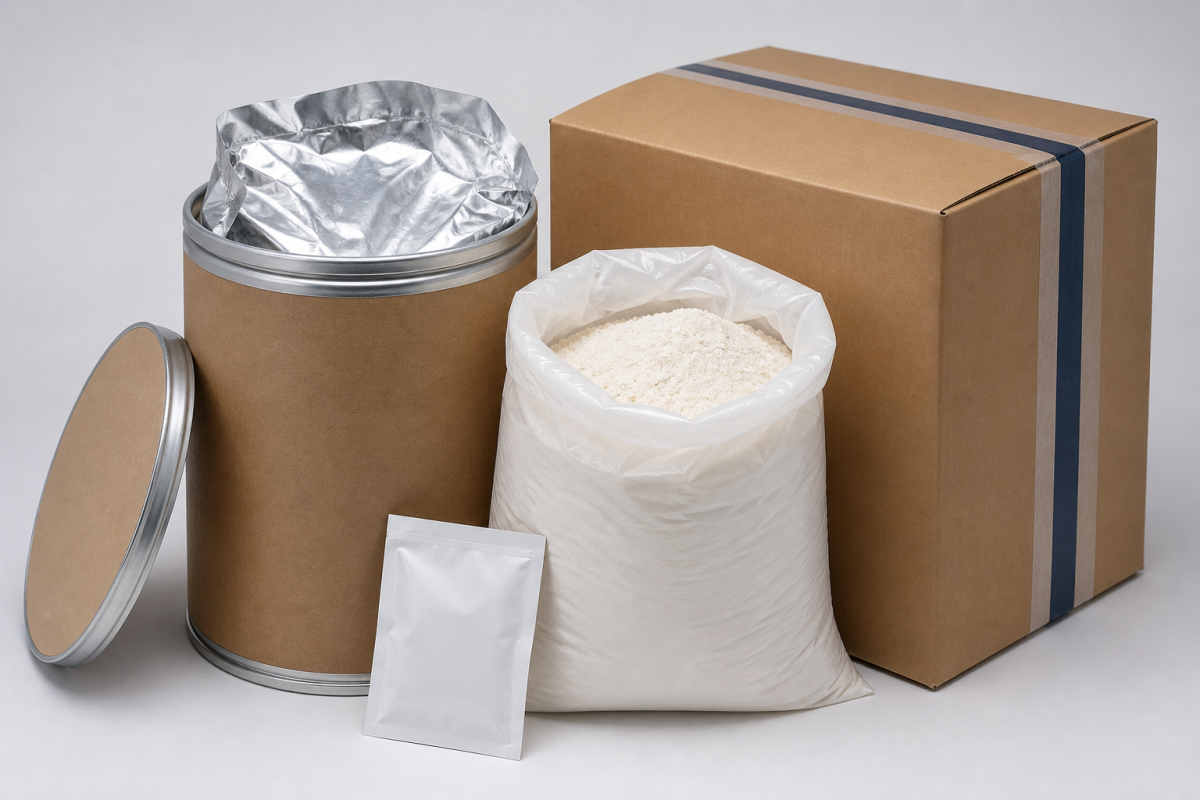
Packaging should be treated as part of the specification. Confirm bag material, liner, drum or carton, net weight, labeling, storage conditions and whether the package is suitable for the destination and handling route.
6. Destination and delivery terms change the total quote
A material price is not the same as a landed cost. Include the destination country, port or city, Incoterm, shipment method, customs-document requirement and target date in the RFQ.
Ask the supplier to identify:
- Whether the quote is EXW, FOB, CIF, DAP or another agreed term.
- Export packing and shipping documents included in the offer.
- SDS, invoice, packing list, certificate of origin or other destination files required by the buyer.
- Standard production and dispatch lead time.
- Whether the material requires special temperature, light or moisture handling.
- How a delay, split shipment or document correction is managed.
This information helps the buyer compare total sourcing cost without treating a lower factory price as a lower delivered cost.
7. Use a current COA and specification review before approval
The quote should be evaluated with the current specification and sample. Request a COA that identifies the batch, test date, methods, results, units and acceptance limits. A representative COA can support initial screening, but it should not be treated as a release document for a different commercial lot.
For a new supplier or a changed grade, review:
- Product identity, CAS reference where applicable and batch number.
- HPLC method, assay result and calculation basis.
- Related substances and impurity profile.
- Residual solvents and heavy-metal panel required by the project.
- Moisture, microbiology and physical description.
- Sample-to-batch relationship and retained sample.
- Specification revision and change-control statement.
Link the approval to a named grade and lot. If the supplier changes route, site, package, assay method or specification, repeat the checks that could affect the approved application.
8. Build an RFQ that produces comparable offers
Use this sequence in the first request:
- Identity: Urolithin A, CAS 1143-70-0, grade and intended application.
- Assay: target HPLC percentage, basis, related-substance limits and required method.
- Documents: COA, specification, SDS, residual-solvent report, heavy metals, microbiology and destination files as applicable.
- Quantity: sample size, pilot quantity, first order and estimated annual demand.
- Package: foil bag, carton, drum, liner, label and storage requirement.
- Logistics: destination, Incoterm, delivery date and shipment method.
- Change control: notification requirements for source, route, site, grade or method changes.
The clearer the RFQ, the less likely it is that suppliers will price different assumptions. It also gives QA and purchasing a shared approval record.
Supplier comparison checklist
| Parameter | Minimum evidence before comparing quotes |
|---|---|
| Identity | Product code, CAS reference where applicable and sample/lot match |
| Assay | HPLC result, method, unit, basis and specification |
| Impurities | Related-substance limits and result fields |
| Residual solvents | Required analyte panel, method and batch values |
| Heavy metals | Element list, method, units and limits |
| Production route | Declared route, grade and site information |
| Batch consistency | Sample link, batch-specific COA and change-control statement |
| Packaging | Material, net weight, liner, label and storage instruction |
| Commercial terms | MOQ, lead time, Incoterm, destination and quote validity |
Request a current Urolithin A COA and quote
Send the target assay, required COA fields, order quantity, packaging, destination country and delivery date. HERBSEA can then match the inquiry to a specific grade instead of returning a generic price range.
Request Current Urolithin A COA & Quote
The main variables are assay and HPLC basis, impurity and contaminant testing, production route, quantity, packaging, destination, delivery term and document scope. Define these fields before comparing offers.
Compare method, calculation basis, related-substance limits, batch identity and required test package first. A higher headline percentage is not a like-for-like advantage when the methods or document scopes differ.
Request the current specification, batch-specific COA when required, HPLC method or result basis, residual-solvent and heavy-metal information, microbiology where applicable, SDS, packaging details and destination documents.
Sample, pilot and commercial quantities can use different production schedules and packaging. Ask for separate tiers and state annual demand so the supplier can quote the intended supply plan rather than a one-off sample price.
A representative COA shows a typical grade or document format. A batch-specific COA reports results for the identified commercial lot. Record which document type you received and request the required lot-linked version before release.
Include identity, assay and basis, production route if relevant, application, quantity, annual demand, document scope, package, destination, Incoterm, delivery date and change-control expectations.