
Quick Answer: A urolithin A sample approval workflow is the structured process R&D, procurement, and QA teams use to turn a supplier sample into a written approval before bulk purchasing. It covers four gates: (1) define what the sample must prove, (2) match the sample to a batch-specific COA, (3) run physical and analytical review (appearance, particle size, blending, assay), and (4) lock scale-up terms before the PO. For a typical supplement project, the full program runs about 6 to 10 weeks from supplier request to written approval, and a complete sample plan for a new SKU usually costs USD 1,500 to 4,500, roughly 1 to 3 percent of a first commercial container, making it the cheapest insurance in the sourcing cycle.
1. Define What the Sample Must Prove Before You Request It
Sample approval is the bridge between supplier selection and bulk purchasing. For urolithin A powder, a sample should be reviewed together with the specification, COA, intended format, and buyer-side quality requirements. A clean sample workflow helps R&D, procurement, and QA teams make the same decision from the same evidence.
Before requesting a sample, decide what the sample is meant to prove:
- Document-review samples — small quantities (typically 20 to 50 g) used to verify that the physical material matches the COA, specification sheet, and SDS. Purpose: traceability and paperwork audit, not formulation.
- Application-test samples — material for capsule, tablet, or powder blend trials, usually 100 to 500 g so the lab can run real mixing and fill tests.
- Scale-up validation samples — 500 g to 1 kg used to confirm the approved specification holds at production-like scale and to retain a reference sample for later dispute checks.
The sample quantity and document package should match that purpose. A document-review sample with a full dossier costs the supplier little; an application-test sample needs enough material to survive excipient blending and finished-format trials.
Buyers can start from the HERBSEA Urolithin A raw material supplier page to request a sample, COA, and quotation details for supplement and functional food projects.
| Sample type | Typical quantity | What it proves | Documents to request |
|---|---|---|---|
| Document review | 20 to 50 g | Material matches COA, spec, SDS | Batch-specific COA, spec sheet, SDS |
| Application test | 100 to 500 g | Blending, flow, capsule/tablet fill | COA plus HPLC chromatogram, particle size data |
| Scale-up validation | 500 g to 1 kg | Specification holds at production scale | COA, stability summary, retain-sample policy |
2. Match the Sample to a Batch-Specific COA
The sample should be traceable to a supplier document. Buyers should confirm product name, batch number, assay result, test method, appearance, and storage information. If the sample and COA are not clearly connected, scale-up review becomes harder.
Three traceability rules that help you avoid most downstream disputes:
- The COA must carry the batch number printed on the sample label. A generic, batch-less COA cannot be matched to the physical material in your lab.
- Ask for the HPLC chromatogram, not just the purity line. A number without the chromatogram cannot be verified internally.
- Check whether the assay is reported as-is or on a dry basis. The two numbers can differ by a meaningful margin when moisture is above 0.5 percent.
| Parameter | Typical specification | Common method |
|---|---|---|
| Assay (urolithin A) | NLT 98.0 percent | HPLC |
| Appearance | Off-white to yellow powder | Visual |
| Water | NMT 1.0 percent | USP |
| Residue on ignition | NMT 1.0 percent | USP |
| Heavy metals | NMT 20 ppm | USP |
| Arsenic | NMT 2 ppm | ICP-MS |
| Lead | NMT 2 ppm | ICP-MS |
| Total plate count | NMT 1,000 cfu/g | USP |
| Yeast and mold | NMT 100 cfu/g | USP |
| E. coli / Salmonella | Negative | USP |
One concept buyers frequently miss: HPLC area purity and mass-balance purity are not the same number. HPLC area percentage does not account for water, residual solvents, or inorganic salts. Review assay, moisture, and elemental impurities together to form a complete picture of material quality.
3. Analytical Methods Behind a Reliable COA
Understanding which tests back a COA helps QA teams decide how much independent verification is needed. The urolithin A industry relies on a small set of instrumental methods, each answering a different question.
| Method | What it confirms | When it matters |
|---|---|---|
| HPLC / UHPLC | Quantifies urolithin A monomer content with high precision | Core release test; assay on every batch COA |
| LC-MS | Confirms molecular weight and identity | Identity verification on first batches |
| NMR | Structural confirmation | Supplier qualification, reference standards |
| UV-Vis | Rapid screening only; overestimates actives | Preliminary checks, not for bulk release |
| Headspace GC | Residual solvents | Chemical-synthesis route batches |
A 2025 peer-reviewed study in Molecules established a UHPLC method for urolithin A in health products with excellent linearity (r-squared = 0.9998), a detection limit of 0.051 microgram per milliliter, and spike recovery of 98 to 102 percent, evidence that standardized quantification is now routine. Commercial batches for B2B transactions should carry an HPLC/UHPLC chromatogram and a batch-specific COA as the core delivery documents.
The manufacturing route also matters for the file package: urolithin A is produced either by chemical synthesis (the more mature, scalable route) or by microbial fermentation and bioconversion of ellagic acid. Synthesis batches need residual-solvent data; fermentation batches need biomass, endotoxin, and microbial limits. Ask which route your candidate supplier runs and make sure the COA covers the corresponding impurity profile.
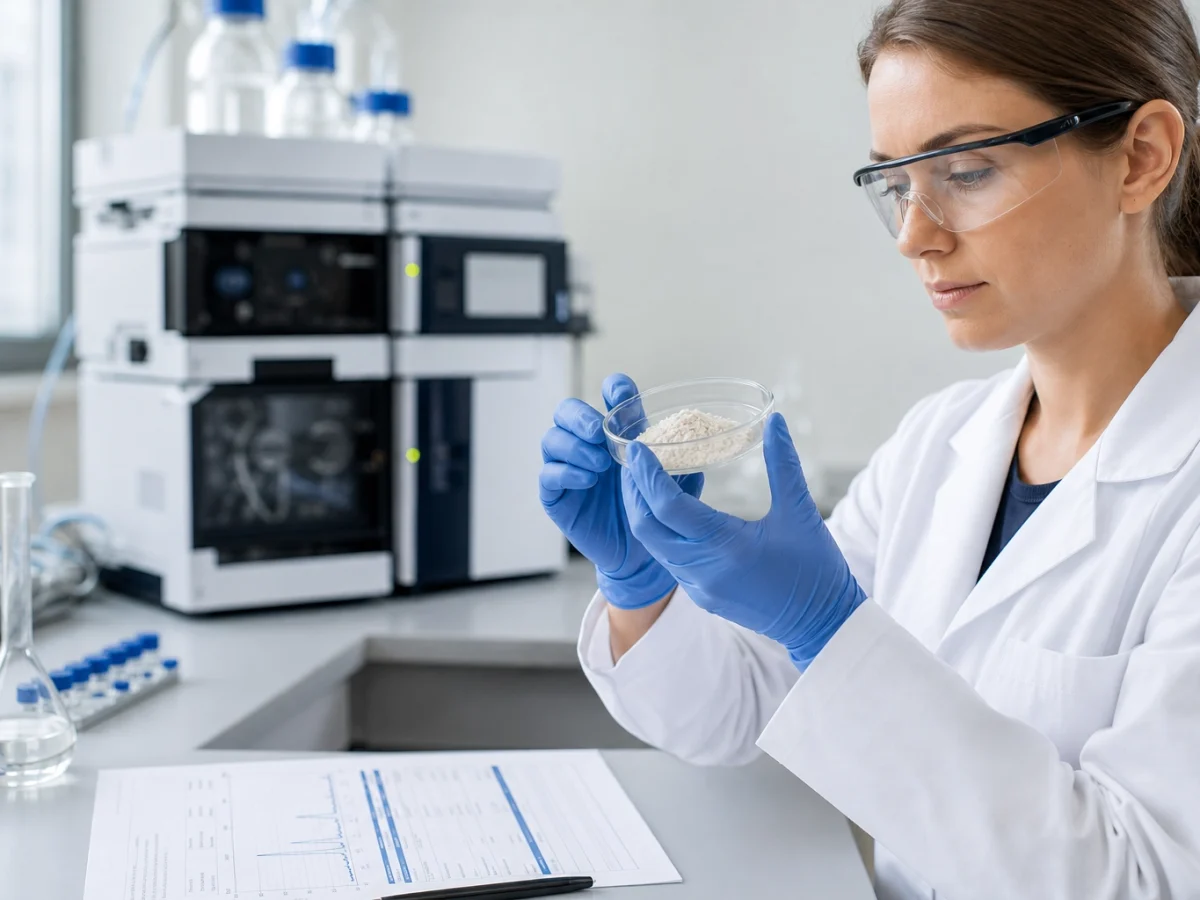
4. Physical Review: Appearance, Odor, Flow, and Blending
Basic receiving observations are still useful. Record powder color, odor, texture, visible agglomeration, packaging condition, and label information. These notes create a reference when the commercial lot arrives later. For urolithin A, the FDA GRN 791 review describes the material as a beige-to-yellow powder; commercial COAs typically specify off-white to yellow.
Particle size and flow behavior can affect capsules, tablets, and powder blends. During sample review, formulation teams should:
- Compare the powder with target excipients and evaluate blend uniformity.
- Check flow behavior — poor flow adds handling instructions to the commercial RFQ.
- Note that urolithin A has limited water solubility, which drives formulation decisions. If your format needs it, request solubility or particle-size data and discuss micronization, liposomal, or microencapsulation options with the supplier. Claims of improved bioavailability should always be backed by comparative data.
- Record whether any special handling requirement (inert atmosphere, light protection, low-humidity storage) should be added to the bulk spec.
5. The Sample Approval Checklist (Step by Step)
Run the sample through the same five gates every time, so decisions stay comparable across suppliers.
| Step | Buyer action | Key output |
|---|---|---|
| 1. Document review | Check COA, specification sheet, SDS; verify batch number matches label | Approved file package |
| 2. Receiving check | Record appearance, packaging condition, label details | Receiving notes |
| 3. Application test | Evaluate flow, blending, finished-format compatibility | Test results |
| 4. QA decision | Compare internal results with target specification | Written approval or rejection |
| 5. RFQ update | Send final quantity, packing, and document requirements | Locked RFQ for bulk PO |
Keep a portion of the approved sample as a retain sample. If the first commercial container later fails, run the same analytical panel on the retain sample and the failing lot side by side; that comparison is exactly what the reference sample is for.
6. Timeline and Cost Benchmarks for a Sample Program
For a standard botanical ingredient, expect roughly 6 to 10 weeks from supplier request to written approval:
| Stage | Typical duration |
|---|---|
| Supplier preparation and shipment | About 2 weeks |
| Customs clearance and receiving | About 1 week |
| Laboratory and sensory evaluation | 2 to 4 weeks |
| Application trials | 1 to 2 weeks |
| Approval and spec lock | About 1 week |
On cost: a complete sample plan for a new SKU typically runs USD 1,500 to 4,500 all-in. Against a first commercial container in the USD 80,000 to 200,000 range, that is a 1 to 3 percent insurance policy. For any important SKU, run the same RFQ and the same evaluation matrix against 3 to 5 candidate suppliers in parallel, and let the data, not the story, drive the decision.
7. Regulatory Status: What the File Package Should Reflect
Regulatory status varies by market and is tied to the specific material and manufacturing process. This affects what documentation you should demand before approval.
| Market | Status relevant to B2B buyers |
|---|---|
| United States | U.S. GRAS notice GRN 791 (FDA no-objection letter, December 2018) covers a specific notifier material at up to 500 to 1,000 mg per serving in defined food categories |
| European Union | Evaluated as a novel food ingredient; confirm current authorization status for the specific material before sale |
| Japan | Cosmetic ingredient listing; not a FOSHU or FFC food |
| South Korea | Not approved as a health functional food; cosmetic ingredient only |
| Australia / New Zealand | Non-traditional / novel food; permitted as an active in listed medicines (TGA route) |
The critical B2B point: U.S. GRAS status is manufacturing-process specific. A no-objection letter for one supplier material does not cover another supplier powder. Demand the candidate own file package, not a competitor letter, and verify purity, heavy metals, and residual solvents with third-party testing where the category requires it. For supplier quality context, pair this workflow with the Urolithin A specification and COA guide.
8. Bulk Order Scale-Up: Questions to Lock Before the PO
After the sample passes internal review, confirm whether the bulk lot can match the approved specification and whether the same document scope will be available. Discuss before issuing the PO:
- Specification lock — will the commercial lot be released against the same assay, impurity, and physical limits as the approved sample?
- Document scope — batch-specific COA, HPLC chromatogram, SDS, spec sheet, and any certifications (Halal, Kosher, ISO 9001, non-GMO) that were part of approval.
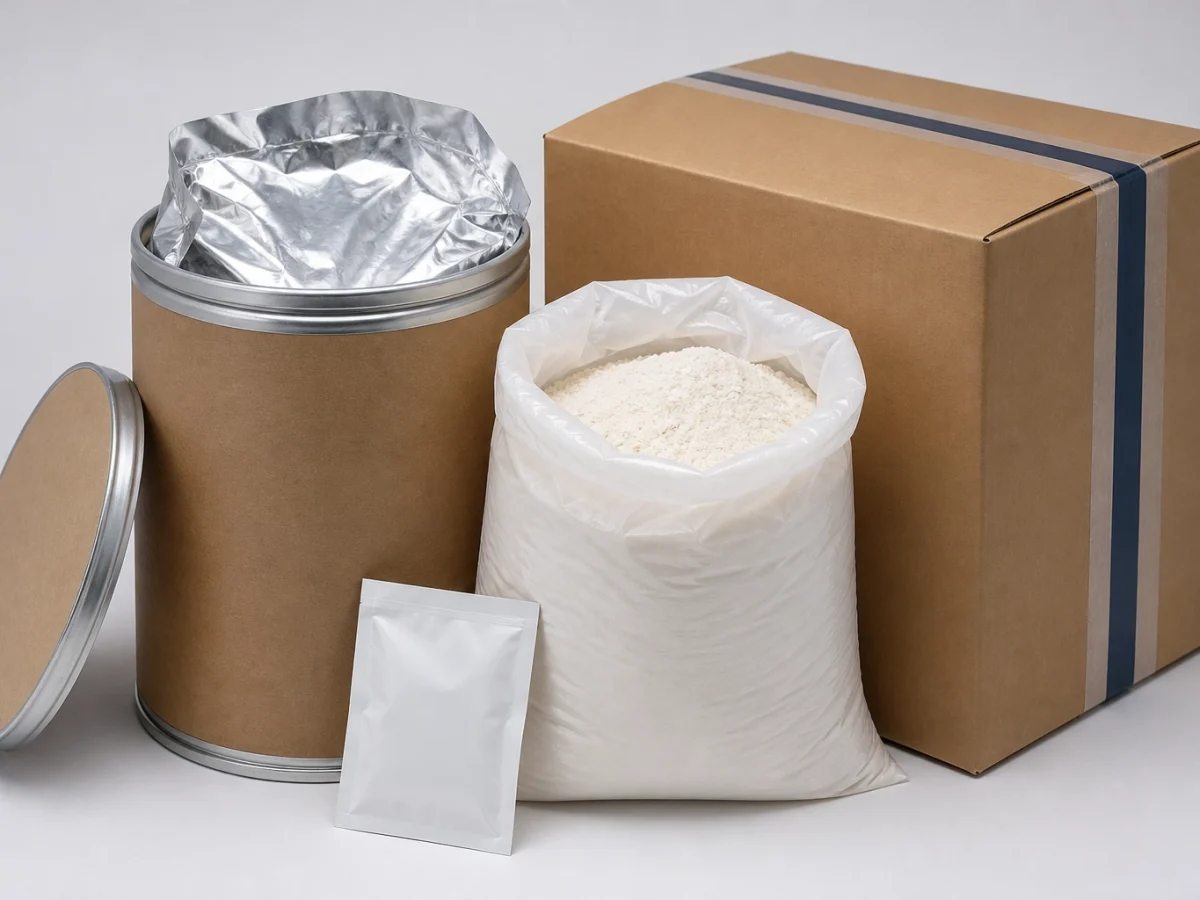
- Packaging and storage — typical bulk packaging is sealed drums with food-grade polyethylene inner liners; confirm storage conditions (cool, dry, away from strong light and heat).
- Lead time and shelf life — stability data typically supports 24 to 36 months of shelf life; confirm the shelf-life basis for the commercial lot.
- Export documents and receiving requirements — commercial invoice, packing list, and any destination-market paperwork.
Also agree on the retain-sample policy for bulk lots: how much is kept, by whom, and for how long.
Request 20 to 50 g for a document-review sample, 100 to 500 g for application and formulation tests, and 500 g to 1 kg if you need scale-up validation and a retain sample. Quantity should match what the sample is meant to prove.
A batch-specific COA with batch number, assay, test method, appearance, and storage conditions, the specification sheet, and the SDS. For first qualification, also request the HPLC chromatogram and any origin or certification documents relevant to your destination market.
Roughly 6 to 10 weeks from supplier request to written approval: about 2 weeks for supplier preparation and shipment, 1 week for receiving, 2 to 4 weeks for laboratory evaluation, 1 to 2 weeks for application trials, and about 1 week for approval and spec lock.
HPLC area percentage measures the relative peak area and does not account for water, residual solvents, or inorganic salts. The assay, often reported on a dry basis, reflects actual content. Read both together with moisture and elemental impurity data for a complete quality picture.
Because approval is granted to a specific batch, not to a supplier in the abstract. A batch-matched COA lets QA trace the sample to its production record and makes scale-up review and later dispute checks against a retain sample possible.
No. U.S. GRAS status is manufacturing-process specific and tied to a specific notifier’s material. Each supplier must provide its own regulatory file package. Verify current status for the specific material and market you are sourcing into.
Summary
A defensible urolithin A sample approval process is: define what the sample must prove, match it to a batch-specific COA, verify identity, assay, and impurity profile with the right analytical methods, record physical and blending behavior, run the five-step approval checklist, benchmark timeline and cost against industry norms, confirm the regulatory file package applies to your supplier own material, and lock scale-up terms before the PO. Keep a retain sample, and let the same evidence drive R&D, procurement, and QA.
Related reading: the Urolithin A and CoQ10 formulation checklist, urolithin A price factors, and raw material specification questions cover the adjacent decisions in the same sourcing cycle.
Data Sources
FDA U.S. GRAS Notice GRN 791 response letter (Amazentis SA, December 2018) — urolithin A identity, manufacturing processes, specifications, stability, and per-serving use levels. Industry market reports (2025): urolithin A market roughly USD 39.4 million with about 6.1 percent CAGR (2025 to 2033); urolithin A supplement market roughly USD 115 million in 2025 with about 18.5 percent CAGR to 2032; food-grade urolithin A roughly USD 19.7 million in 2025. B2B sample-program benchmarks: USD 1,500 to 4,500 full sample plan; 6 to 10 week timeline; 1 to 3 percent of first-container value; parallel 3 to 5 supplier evaluation. Regulatory snapshots compiled from public ingredient-regulatory summaries (2025 to 2026); confirm current status with the relevant authority before commercial use. For compound identity and literature, buyers may reference PubChem Urolithin A.
HERBSEA provides raw materials for B2B manufacturing and formulation use. This article is for ingredient sourcing and specification review only. It is not medical advice and makes no diagnosis, treatment, or consumer-use recommendations.