
Quick Answer
A Urolithin A raw material specification review should verify five areas before shortlisting: identity (CAS 1143-70-0, C13H8O4), assay (HPLC purity, typically ≥98%), physical profile (appearance, particle size, moisture), contaminants (heavy metals, microbiology, residual solvents) and documentation (COA, MSDS, facility certifications such as FSSC 22000 or ISO 22000). The global Urolithin A market is estimated at about US$42.4 million in 2026 with a 6.1% CAGR through 2036 (Future Market Insights, Aug 2026), and the high-purity >98% grade is expected to account for roughly 63% of demand. Buyers should confirm whether each spec value is a target specification or a tested batch result, and ask for the COA of the actual batch being quoted.
1. A Five-Point Specification Review Before Supplier Shortlisting
Before sending an RFQ, procurement and QA teams should lock the project requirement first: application, target purity, finished format (capsule, tablet, powder blend), destination market and document checklist. A complete requirement converts into a short, unambiguous specification request.
Use this five-point review as the shortlist filter:
- Identity – Does the document refer to Urolithin A with CAS 1143-70-0, and does the COA match the quoted material?
- Assay – Is the purity method stated (HPLC), and is the value a batch result rather than a generic target?
- Physical profile – Are appearance, particle size and moisture expectations listed?
- Contaminants – Are heavy metals, microbiology and residual solvents included with limits and methods?
- Documentation – Are batch-specific COA, MSDS and facility certifications available on request?
A supplier that cannot answer all five with documents is usually filtered out before sample testing, which saves weeks of back-and-forth. For the full shortlisting process, see the guide to [auditing a Urolithin A raw material supplier before bulk purchase](https://www.iherbsea.com/urolithin-a-raw-material-supplier-audit/).
2. Identity First: CAS 1143-70-0 and Product Naming
Identity review prevents confusion between Urolithin A and upstream botanical extracts such as pomegranate extract, ellagitannins or ellagic acid. Two technical facts matter here:
- CAS 1143-70-0, molecular formula C13H8O4 (molecular weight about 228.2 g/mol).
- Urolithin A is a postbiotic metabolite, not a fruit extract. It is formed when gut bacteria convert ellagitannins and ellagic acid from pomegranate, walnuts, raspberries or strawberries into urolithins (via strains such as Gordonibacter spp.). Only an estimated 30-40% of people naturally produce meaningful amounts of Urolithin A (metabotype A), which is the main reason brands use directly supplied Urolithin A instead of relying on dietary precursors.
When the specification and COA consistently reference CAS 1143-70-0 with 1H-NMR or LC-MS identification data, the risk of receiving a look-alike compound or an undifferentiated botanical extract is removed before commercial purchase. Buyers may reference the PubChem entry for neutral identity verification.
3. HPLC Assay and Purity: Target Spec vs. Batch Result
Purity and assay method are the central specification points. The market standard for commercial grades is HPLC assay ≥98%, and the >98% purity segment is estimated to hold about 63% of 2026 demand (Future Market Insights). Some manufacturers quote ≥99%.
Ask these three questions in the RFQ:
- Is the assay method HPLC, and what are the chromatography conditions?
- Is the quoted value a target specification or the result of the current batch?
- What impurities are screened (e.g., unreacted ellagic acid, structural analogs such as urolithin B, synthesis intermediates)?
A supplier that states “≥98% HPLC” without a batch COA may be quoting a generic target; the COA of the actual batch being quoted is the document that procurement should require before sample approval.
4. Contaminant Limits: Heavy Metals, Microbiology and Residual Solvents
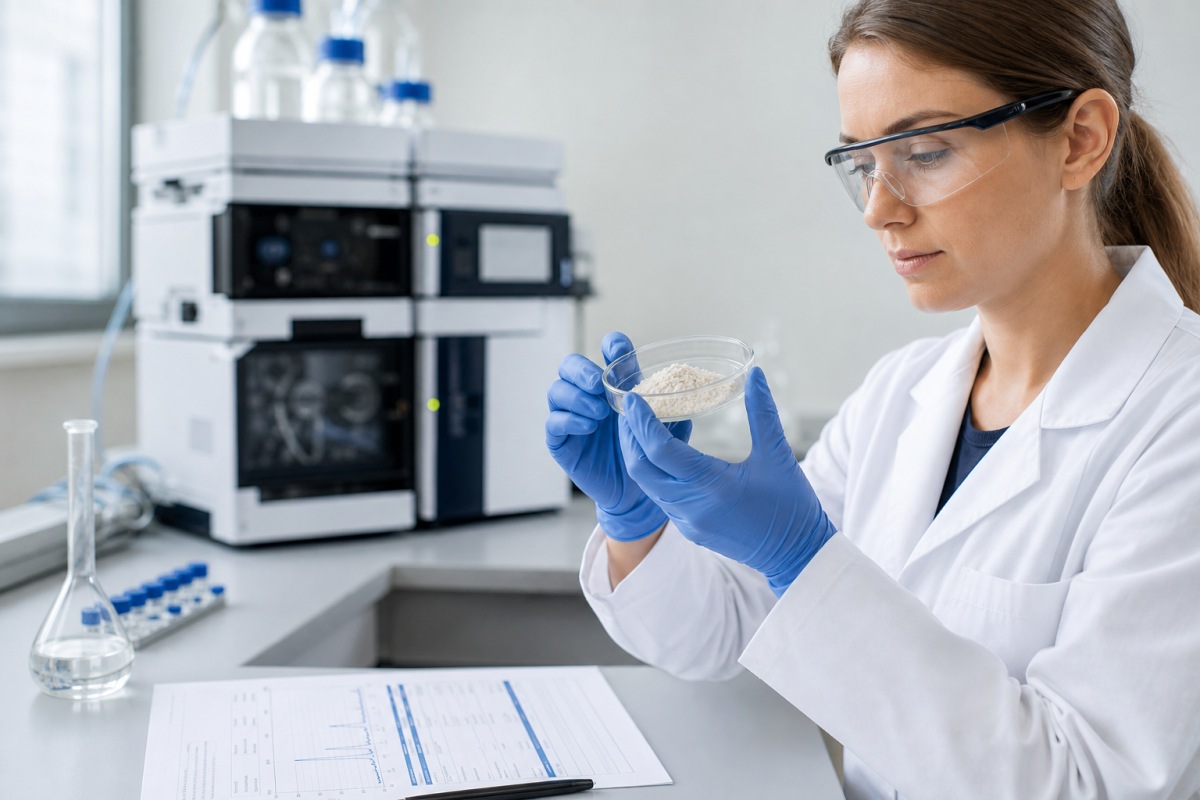
Contaminant limits should be set according to the buyer’s quality system and destination market. The table below shows common benchmark limits seen on commercial COAs (values vary by manufacturer and by market; confirm the exact limits in the batch COA).
| Contaminant parameter | Common benchmark limit | Typical method |
|---|---|---|
| Total heavy metals | ≤10 ppm | ICP-MS / colorimetric |
| Lead (Pb) | ≤0.5-2 ppm | ICP-MS / AAS |
| Arsenic (As) | ≤1-2 ppm | ICP-MS / AAS |
| Cadmium (Cd) | ≤0.5-1 ppm | ICP-MS / AAS |
| Mercury (Hg) | ≤0.1 ppm | ICP-MS / AAS |
| Total plate count | ≤1,000 CFU/g | USP / ChP |
| Yeast & mould | ≤100 CFU/g | USP / ChP |
| E. coli / Salmonella | Negative | USP / ChP |
| Residual solvents | Per ICH/Ph. Eur. limits, if applicable | GC |
If a test item is not listed on the standard COA, ask whether it can be confirmed through supplier records or third-party testing before commercial purchase. For destination markets with stricter rules (for example the EU with its contaminant framework), buyers may need additional items such as pesticide residue or PAH testing beyond the standard COA scope.
5. Physical Profile and Processing Fit
Physical characteristics matter during receiving, weighing, blending and finished-product manufacturing. Key items to confirm on the specification:
- Appearance – typically a beige to yellow fine powder.
- Loss on drying / water – commonly ≤0.5-1.0% (Karl Fischer) or ≤5.0% LOD; low moisture protects stability during 24-month shelf life.
- Particle size – e.g., 95% pass 80 mesh; relevant for capsule filling, tableting and powder blending.
- Bulk density – useful for formulation volume calculations.
- Storage and retest – store in a well-closed container away from light, moisture and heat; typical shelf life 24 months in original packaging.
These details are especially useful when the material will be evaluated for capsules, tablets or powder blends, where flowability and density directly affect production runs.
6. Documentation and Certification Checks
Certifications are part of the specification package because they indicate which quality system produced the batch. Not all certifications are equal, and each one answers a different procurement question.
| Certification | What it covers | Why procurement should care |
|---|---|---|
| FSSC 22000 / ISO 22000 | Food-safety management system, HACCP-based | Strong baseline for food and supplement raw materials |
| ISO 9001 | Quality-management system | Indicates repeatable production and QC processes |
| HACCP | Hazard analysis and critical control points | Documents contamination-control points in the process |
| cGMP | Good manufacturing practices | Expected for nutraceutical raw materials |
| Kosher / Halal | Religious dietary compliance | Required for specific regional and channel demands |
Request a batch-specific COA (the certificate for the exact batch quoted), an MSDS, and the facility’s current certification list. For identity-critical compounds, also request 1H-NMR or LC-MS identification data on the COA rather than relying on retention time alone.
7. Sample Types and RFQ Quality
A clear specification request helps suppliers quote the correct material and reduces back-and-forth. When the RFQ includes target purity, sample quantity, finished format, destination country and a document checklist, the supplier can respond with more useful pricing and lead-time details.
Sample programs differ by stage, and the specification attached to each type should match its purpose:
| Sample type | Typical scope | Best use |
|---|---|---|
| Stock sample | Small quantity from an existing batch, low cost, fast | First-pass identity, assay and appearance screening |
| Custom sample | Produced to your target assay or particle size | Verifying that your exact spec is manufacturable |
| Pre-production sample | From the actual production run before bulk | Final QA sign-off before a commercial order |
Whatever the sample type, ask for the COA of the sample batch and confirm that the bulk quotation refers to the same specification. For the end-to-end path from request to batch approval, review the [Urolithin A sample approval workflow](https://www.iherbsea.com/urolithin-a-sample-approval-workflow/).
8. Market and Regulatory Context for Procurement Teams
Understanding the category helps buyers calibrate pricing and compliance expectations.
| Metric | Value | Source |
|---|---|---|
| Global Urolithin A market, 2026 | ≈ US$42.4 million | Future Market Insights, Aug 2026 |
| Forecast, 2036 (CAGR 6.1%) | ≈ US$76.7 million | Future Market Insights, Aug 2026 |
| >98% purity grade share of 2026 demand | ≈ 63% | Future Market Insights, Aug 2026 |
| Leading application segment | Mitochondrial health (≈46% of demand) | Future Market Insights, Aug 2026 |
| U.S. regulatory reference | No-questions letter under the Generally Recognized as Safe framework (FDA GRN 791, 2018) | FDA GRN 791 notice |
| EU status | Novel food application on file with the European Commission; authorization not yet granted | European Commission application summary |
Regulatory status should be verified separately for each destination market, and finished-product claims are reviewed within each sales geography. This is ingredient sourcing context for B2B formulation planning, not consumer-claim support.
Confirm the five-point list: identity (CAS 1143-70-0), assay method, physical profile, contaminant review and documentation scope. Check that the COA belongs to the exact batch being quoted, not a generic target document.
No. Pomegranate and other ellagitannin-rich materials provide upstream compounds, while Urolithin A is a specific compound with its own identity reference. For procurement, buyers should confirm whether the project needs a botanical extract, a purified Urolithin A raw material, or another ingredient direction.
HPLC purity is an important specification point, but it should not be reviewed alone. Buyers should also check identity, impurity profile where available, residual solvents, heavy metals, microbiology, particle size, COA format, packaging and the intended finished-product format.
Ask whether these items can be confirmed from supplier records or third-party testing before commercial purchase. If the destination market or buyer-side QA system requires stricter contaminant review, include those items in the RFQ before sample approval.
Start with the batch COA, specification sheet, SDS, manufacturing or process information where available, and relevant quality-system documents. If the project requires ISO, FSSC, cGMP, Kosher or Halal documentation, confirm the exact certificate scope with the supplier before purchase approval.
Request the sample batch COA, confirm the assay and identity data where available, and ask whether the bulk quotation will follow the same specification. The sample stage should confirm identity, assay, physical profile, contaminant review, packaging and document alignment before commercial purchase.
Summary
A Urolithin A raw material specification is the buying standard that connects assay, appearance, contaminant review, storage, packaging and documentation. Procurement and QA teams should review identity, CAS number, HPLC assay, physical profile, COA scope, contaminant items, packaging and sample-to-bulk alignment before shortlisting a supplier.
To move from specification review to sourcing, review the HERBSEA Urolithin A powder supplier page and request the current specification, COA and sample support. For quotation or document questions, contact HERBSEA through the plant extract supplier contact page.