
Quick answer: A qualified RTD tea powder supplier should provide a clear product specification, representative COA, sample material, solubility and sensory information, batch traceability, packaging details, MOQ, lead time and export documents. For beverage teams, compare the powder in the same water system and process conditions that will be used in the finished RTD project before approving a bulk order.
RTD tea projects need more than a tea ingredient with a low quoted price. Procurement, R&D and QA teams need to know whether the powder will disperse in the target water system, keep a consistent tea profile, meet the agreed specification and arrive with documents that support internal approval.
In practice, this checklist is for beverage brands, contract manufacturers, importers and ingredient distributors comparing an RTD tea powder supplier for ready-to-drink tea, iced tea, dry beverage blends and related formulation projects.
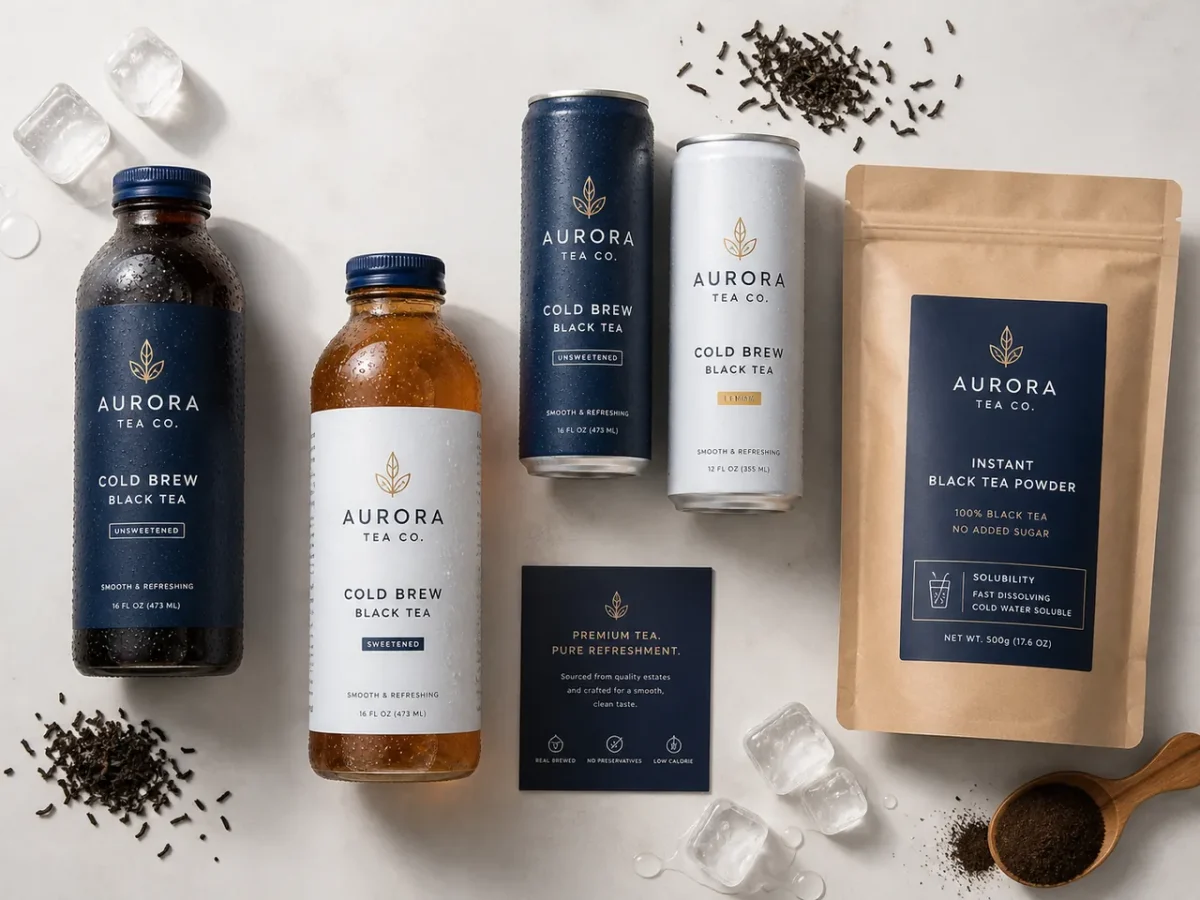
1. Start with the finished beverage requirement
Before contacting suppliers, define the application. The right powder depends on the beverage process, not only the tea name.
| Buyer input | What to define before RFQ | Why it matters |
|---|---|---|
| Beverage format | RTD tea, iced tea, tea concentrate, dry mix, vending drink or milk tea base | The same tea powder may perform differently across formats |
| Process | Cold fill, hot fill, aseptic, spray drying or dry blending | Heat, residence time and shear can affect color, aroma and dispersion |
| Tea direction | Black tea, green tea, oolong, white tea or blended tea profile | Determines the source material and sensory target |
| Solubility target | Cold soluble, hot soluble, instant dispersible or suspension-compatible | Helps the supplier recommend a practical grade |
| Sensory target | Tea body, aroma, color depth, bitterness, astringency and aftertaste | Gives the sample review a repeatable scorecard |
| Commercial plan | Sample quantity, trial volume, MOQ, annual demand and delivery window | Supports realistic quotation and production planning |
Therefore, a clear brief prevents an RFQ from becoming a generic request for “tea powder.” It also gives the supplier enough information to recommend a grade and document package.
2. RTD tea powder supplier qualification checklist
Before comparing prices, use the following checkpoints to evaluate two or more suppliers against the same technical brief.
Product identity and specification
Ask the supplier to identify the tea source, powder type, extraction or drying direction, carrier status if applicable, appearance, particle size, moisture, solubility guidance and storage conditions. The specification should use the same product name and grade across the quotation, sample label, COA and packing documents.
Solubility and dispersibility
However, “instant” should be tested in the intended process rather than accepted as a label. Request the supplier’s recommended test conditions and record:
- Water temperature and hardness
- Mixing speed and mixing time
- Order of addition
- Sediment, ring formation or floating particles
- Filterability and stability during holding
- Behavior after the target heat process
- Appearance after dilution and packaging simulation
For example, a powder can disperse quickly in a laboratory beaker and still need adjustment in a commercial beverage system. As a result, compare samples using the same water, temperature, equipment and hold time.
Sensory consistency
In addition, use a simple sensory scorecard instead of relying on a single tasting comment.
| Sensory checkpoint | Buyer record | Supplier follow-up |
|---|---|---|
| Tea aroma | Intensity and direction | Source, extraction and storage information |
| Color | Shade and depth after dilution | Target color range and batch reference |
| Tea body | Light, medium or full | Tea type, extract ratio and application notes |
| Bitterness/astringency | Acceptable range | Processing, blend or grade recommendation |
| Aftertaste | Clean, persistent or off-note | Retention sample and batch comparison |
| Repeatability | Difference between sample lots | Batch records and retained sample policy |
Document fields to verify before approval
Once the sample performs acceptably, check that the commercial documents describe the same grade. Confirm the product name, lot or batch number, specification revision, test date, storage statement and issuing company before the approval record is signed.
Documents and batch traceability
At the quotation or sample stage, request the documents your QA team needs for internal review:
- Product specification sheet
- Representative COA and test methods
- SDS or MSDS, where required by the destination market
- Microbiology and contaminants information appropriate to the material
- Allergen and carrier declaration, where applicable
- Country-of-origin and batch traceability information
- Packaging specification and label information
- Export documents available for the shipment route
The COA should identify the lot or batch and match the sample label. If a supplier sends a generic COA with no batch reference, ask what document will be issued for the commercial lot. This step is especially important when several grades share similar product names.
What to request with the first sample
Finally, ask for the sample code, lot reference, net weight, dispatch date, storage statement, current specification and recommended test conditions in the same email. This small document packet lets R&D, procurement and QA review the physical powder against the same supplier record.
3. Compare cold-soluble, hot-soluble and dry-mix requirements
The phrase “RTD tea powder” can cover different technical needs. For this reason, map the article and RFQ to the process before selecting a grade.
| Requirement | Cold-soluble powder | Hot-soluble powder | Dry-mix or vending powder |
|---|---|---|---|
| Main review point | Dispersion at low temperature | Stability through heat and hold time | Blend uniformity and reconstitution |
| Useful sample test | Cold water dispersion and sediment check | Heat-process simulation and color check | Mixing sequence and sachet/vending test |
| Buyer documents | Solubility guidance, COA, storage and batch records | Heat/process notes, COA and sensory reference | Particle size, flow, carrier and packaging details |
| Common commercial question | Does it disperse without visible residue? | Does the tea profile hold after processing? | Does the powder remain uniform in the dry blend? |
By contrast, do not approve a grade based only on a product name. Approve it against the agreed application and test conditions.
4. Sample testing workflow before bulk order
A practical sample process keeps the supplier decision traceable. In addition, it gives procurement, R&D and QA a shared record when they review the same lot.
- First, send the application brief. Include beverage format, process, target sensory profile, expected volume, destination market and document requirements.
- Then request a matched sample. Ask for the product name, grade, lot reference, recommended test conditions and current specification.
- Run a bench test. Use the target water and process conditions. Record dispersion, color, aroma, tea body, sediment and hold-time behavior.
- Review documents. Match the COA, specification, sample label and supplier quotation.
- Run a repeat test if needed. Compare a second lot or retention sample when consistency is important.
- Finally, issue an internal approval note. Record the approved grade, test conditions, open questions and commercial assumptions.
- Request the bulk quotation. Confirm MOQ, lead time, packaging, payment terms, shipment documents and batch release process.
As a result, procurement and formulation teams have a shared basis for supplier comparison.
5. MOQ, lead time and packaging questions
Commercial terms should be part of qualification, not an afterthought. Before a technical approval becomes a purchase order, confirm that the commercial conditions fit the launch schedule.
| RFQ field | Question to ask | Record in the comparison sheet |
|---|---|---|
| MOQ | What is the MOQ for the selected grade and packaging format? | MOQ by grade and pack size |
| Sample | What sample quantity is available and is it from a commercial lot? | Sample size, lot and cost policy |
| Lead time | What is the standard lead time after artwork, payment or order confirmation? | Production and dispatch lead time |
| Packaging | What inner and outer packaging is available? | Bag, drum, carton, liner and pallet details |
| Label | Which product, batch and storage fields appear on the label? | Label review status |
| Batch release | When is the final COA issued? | Pre-shipment or post-production document |
| Repeat supply | Can the supplier reserve a grade or retain a reference sample? | Continuity plan |
| Shipping | Which export and commercial documents are available? | Invoice, packing list and other required files |
However, avoid publishing a fixed MOQ or lead time as a universal promise. These terms depend on grade, order size, packaging and production schedule and should be confirmed in the quotation.
6. Supplier scorecard for an RTD tea powder project
A scorecard makes technical and commercial trade-offs visible. For example, a lower price should not outweigh a failed solubility test or missing batch records.
| Evaluation area | Suggested question | Weight example |
|---|---|---|
| Application fit | Does the powder perform in the target RTD process? | 25% |
| Sensory fit | Does the tea profile match the approved benchmark? | 20% |
| Quality documents | Are specification, COA, SDS/MSDS and traceability records available? | 20% |
| Batch consistency | Can the supplier explain lot control and retention samples? | 15% |
| Commercial fit | Are MOQ, lead time and packaging workable? | 10% |
| Communication | Does the supplier answer RFQ and technical questions clearly? | 10% |
The percentages are a working example. Buyers can adjust them to match their project risk and approval process; therefore, the scorecard should support discussion rather than replace technical judgment.
7. What to include in an RTD tea powder RFQ
A useful RFQ should include the following items so that each supplier answers the same questions:
- Tea type and desired sensory direction
- RTD, iced tea, dry mix or other finished format
- Process details such as cold fill, hot fill or aseptic processing
- Solubility and dispersibility requirement
- Target color, aroma, tea body and acceptable bitterness range
- Sample quantity and evaluation date
- Estimated trial, first order and annual volume
- Target packaging and label requirements
- Required COA, specification, SDS/MSDS and export documentation
- Destination market and shipping terms
- MOQ and lead-time questions
In practice, the more precise the brief, the easier it is to compare one supplier response with another.
8. Related HERBSEA pages for buyer review
- Bulk Instant Tea Powder Supplier Guide for supplier, COA, MOQ, sample and RFQ checkpoints.
- Cold Soluble Tea Powder for RTD and instant drink application review.
- Instant Tea Powder Supplier Category for black tea, green tea, oolong and other powder options.
- Instant Black Tea Powder for RTD Beverages for black tea-specific solubility and formulation questions.
- Tea Extract Powder Supplier Guide for tea extract specification and supplier documentation.
- Contact HERBSEA Plant Extract Supplier to send a target specification and RFQ.
9. FAQ for RTD Tea Powder Buyers
Request a product specification, representative COA, sample information, recommended test conditions, packaging options, MOQ, lead time and available export documents. Confirm which files will be issued for the commercial batch.
Use the intended water, temperature, mixing equipment, process and hold time. Record dispersion, sediment, color, aroma, tea body and aftertaste, then compare the result with the approved benchmark.
Not automatically. The correct grade depends on the process, water system, target sensory profile and stability requirements. A sample should be reviewed under the actual application conditions.
The specification should identify the material and grade, appearance, particle or mesh direction, moisture or other agreed limits, solubility guidance, storage conditions, packaging and batch documentation requirements.
MOQ and lead time should be compared with the project forecast, trial schedule, packaging plan and inventory policy. Confirm the terms for the selected grade and order size rather than relying on a general supplier statement.
HERBSEA can review the target tea type, beverage format, process conditions and document requirements for a B2B sample request. Include the estimated volume, destination market and required specification in the inquiry.
Summary
Qualifying an RTD tea powder supplier means connecting application performance with documentation and commercial execution. Therefore, compare solubility, sensory consistency, batch traceability, COA and specification quality, samples, MOQ, lead time and packaging before approving the grade. A structured RFQ and repeatable sample test help procurement, R&D and QA teams make the same supplier decision from the same evidence.
HERBSEA supplies bulk tea powders and botanical ingredients for B2B beverage and formulation projects. Send your application brief, target specification, sample requirements and estimated volume for a supplier review.
This article is for B2B ingredient sourcing, formulation and specification review. Final product, labeling and import decisions should be completed by the responsible buyer and qualified compliance team.