
Instant tea powder types are not interchangeable for B2B beverage and food manufacturing. Spray-dried, freeze-dried and agglomerated instant tea powders can all support commercial products, but they differ in solubility, sensory profile, cost-in-use, bulk density, flow, appearance and production fit. A buyer choosing the wrong powder format may see slower reconstitution, unexpected sediment, weak tea aroma or handling issues during scale-up.
This guide compares the main instant tea powder formats for RTD tea, milk tea, vending drink powder, instant beverage sachets, foodservice blends and food applications. It supports the broader Instant Tea Powder category page and links to exact product and application pages when the buyer needs a deeper sourcing path.
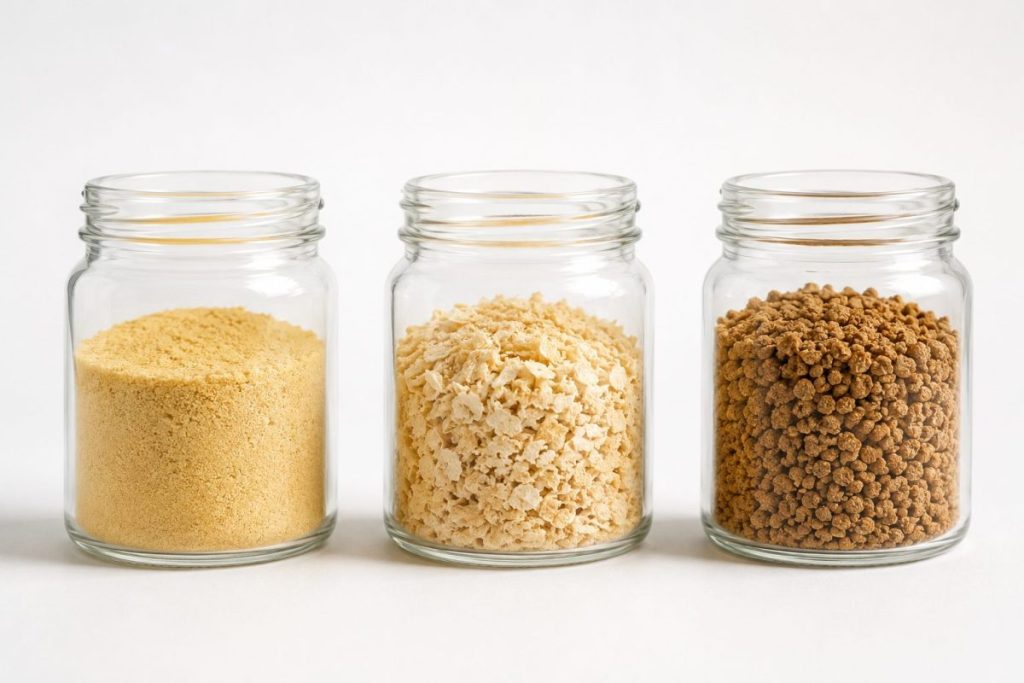
Instant Tea Powder Type Selection Starts With Application
The most useful comparison begins with the finished product. A bottled RTD tea needs different behavior than a milk tea powder, a vending drink blend or a bakery application. The buyer should define whether the material must dissolve in cold water, disperse quickly in hot water, hold clarity, carry strong tea flavor, blend with powders or support a premium sensory position.
For commercial sourcing, the format decision should connect technical performance with cost and supply readiness. A premium freeze-dried powder may preserve aroma well, but it may not be necessary for every dry mix. A spray-dried powder may be efficient for high-volume beverage manufacturing. Agglomerated powder may be useful when fast wetting and dry blend behavior matter. The right choice is the one that fits the buyer’s formula and production line.
| Application | Typical powder requirement | Useful internal page |
|---|---|---|
| RTD iced tea | Cold-water performance, clarity, color and low sediment | Instant black tea powder for RTD beverages |
| Milk tea or tea latte | Strong tea body, dairy compatibility and stable color | Instant Black Tea Powder |
| Instant drink powder | Fast wetting, dry blend flow and consistent reconstitution | Bulk instant tea powder supplier checklist |
| Cold-fill beverage | Cold soluble grade and application testing in the final formula | Cold soluble tea powder guide |
| Food and bakery | Flavor strength, color after processing and label fit | Black tea powder sourcing guide |
Spray-Dried Instant Tea Powder
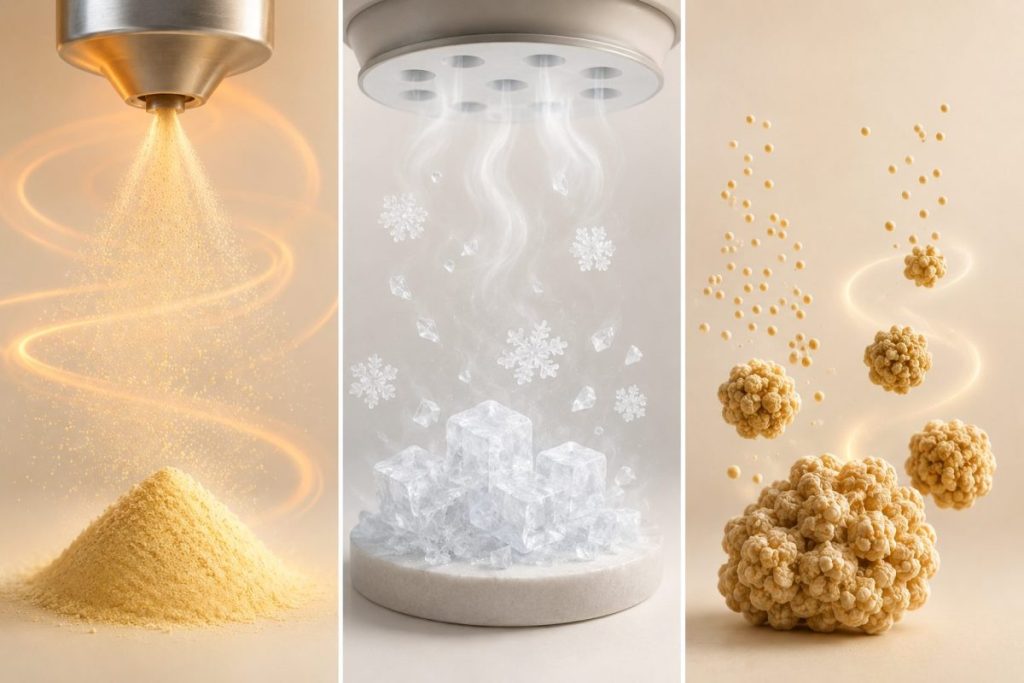
Spray-dried instant tea powder is widely used because it can support scalable production, practical cost-in-use and consistent supply. In a typical process, prepared tea extract is converted into powder through a hot air drying system. The final powder can be adjusted by extract concentration, carrier system, drying conditions and post-processing steps.
For buyers, spray-dried tea powder is often the first format to evaluate when the project needs stable supply and commercial efficiency. It can work for RTD tea, milk tea, instant beverage powder, foodservice blends and food manufacturing. The trade-off is that aroma and delicate top notes may not always match a premium freeze-dried option. The buyer should test the material in the real formula instead of relying only on the drying method name.
- Best fit: scalable beverage and food manufacturing projects.
- Key checks: solubility, color, sediment, flavor strength, carrier and particle size.
- Buyer question: does the powder meet the finished product target at the planned usage level?
Freeze-Dried Instant Tea Powder
Freeze-dried instant tea powder is often reviewed when a buyer wants a premium sensory profile or a more delicate aroma direction. The process removes water at low temperature after freezing, which can help preserve some volatile sensory notes. This format may be considered for premium instant tea, specialty beverage products, high-end powder mixes or brand concepts where aroma is a major selling point.
The commercial trade-off is cost and supply planning. Freeze-dried tea powder can be more expensive and may not be necessary for every project. A buyer should compare the sensory difference in the final formula and decide whether that difference supports the target price point. If a milk tea powder uses strong dairy, sugar and flavor systems, the premium aroma advantage may be less visible than expected.
- Best fit: premium instant tea, specialty beverage and aroma-sensitive products.
- Key checks: aroma, color, flavor clarity, cost-in-use and packaging needs.
- Buyer question: does the sensory improvement justify the commercial cost?
Agglomerated Instant Tea Powder
Agglomerated instant tea powder is produced by forming smaller particles into larger porous granules. This can improve wetting speed, reduce dust, support dry blend handling and create a more user-friendly powder for sachets, vending systems and foodservice blends. Agglomeration does not automatically make a powder better; it makes the powder behave differently.
For dry mixes, agglomerated powder can help with flow and reconstitution. For RTD manufacturing, the buyer still needs to review clarity, sediment and process compatibility. For milk tea powder, the buyer should test whether the agglomerated tea powder blends evenly with dairy powder, sugar, stabilizers and flavors. Handling advantages should be confirmed in the buyer’s production environment.
- Best fit: instant drink powder, vending blends, sachets and foodservice applications.
- Key checks: wetting speed, dust level, flow, dry blend uniformity and reconstitution.
- Buyer question: does the improved handling solve a real production or consumer-use issue?
Technical Comparison Matrix
| Criteria | Spray-dried | Freeze-dried | Agglomerated |
|---|---|---|---|
| Cost-in-use | Usually efficient for scale | Usually higher | Depends on base powder and granulation |
| Aroma retention | Good for many commercial products | Often stronger for premium concepts | Depends on base powder |
| Wetting speed | Can vary by particle and carrier | Can vary by structure | Often improved for dry mixes |
| Cold-water behavior | Must be tested by grade | Must be tested by grade | Must be tested by grade |
| Dry blend handling | Good when particle size is matched | May need handling review | Often useful for flow and dust reduction |
| Best starting point | High-volume beverage and food projects | Premium sensory projects | Sachets, vending and powder drink blends |
This matrix should guide the first sample request, not replace testing. A supplier can provide a starting recommendation, but the buyer should still compare samples in the final product. The final formula may include sweetener, milk powder, acid, flavor, stabilizer, minerals or other botanical ingredients that change the real performance of the tea powder.
How to Test Instant Tea Powder Types
Buyers should use a consistent sample testing method across powder types. The goal is to compare the same points in the same way: wetting, dispersion, color, sediment, aroma, taste, mouthfeel, dry blend behavior and standing observation. A simple test sheet helps the product development, quality and purchasing teams discuss the same results.
- Test hot water and cold water when both are relevant to the product.
- Test the powder in the final formula when milk, acid, sweetener or flavor systems are used.
- Record the mixing method, temperature, observation time and sample level.
- Compare dry powder appearance and prepared beverage appearance separately.
- Keep approved sample, COA and internal notes together for commercial review.
For RTD beverage projects, the buyer should also review the RTD black tea powder guide. For cold-fill and iced tea products, the cold soluble tea powder guide gives a more focused path. For supplier comparison and quotation preparation, use the bulk instant tea powder supplier checklist.
COA, Specification and Supplier Questions
Instant tea powder type is only one part of supplier evaluation. The buyer should also request documents and commercial details that connect the sample with a real order. A powder that works well in a beaker still needs batch-level documentation, packing information, lead time and repeat supply planning.
| Question | Why it matters |
|---|---|
| Is the sample spray-dried, freeze-dried, agglomerated or a custom format? | Clarifies the comparison and supports internal notes. |
| What carrier or excipient is used? | Affects label review, taste, cost and formula compatibility. |
| Can the supplier provide specification and COA? | Supports quality and purchasing approval. |
| What is the standard packing size? | Affects warehouse handling and production planning. |
| What MOQ and lead time apply to the selected grade? | Shows whether the material fits the launch schedule. |
Common Selection Mistakes
One common mistake is choosing the most premium-sounding format before the formula has been tested. Freeze-dried powder may sound attractive, but the final product may not show enough sensory difference to support the higher cost. Another mistake is choosing only by unit price. A lower unit price can become expensive if the powder needs a higher addition level, creates sediment, slows production or requires extra formula adjustment.
Buyers also sometimes compare samples without controlling the test method. If one sample is mixed in hot water, another in cold water and another in a sweetened formula, the result is not a fair comparison. The same sample level, liquid temperature, mixing method, holding time and observation notes should be used across all options. This makes the selection more reliable and gives the supplier clearer feedback.
A third mistake is separating technical review from commercial review. A powder type may perform well in the lab but still be difficult to use if the MOQ, lead time, packing size or document set does not fit the buyer’s project. Format selection should therefore include both application testing and supply planning.
Commercial Quote Comparison for Instant Tea Powder Types
When comparing quotes, buyers should avoid looking only at price per kilogram. Cost-in-use depends on flavor strength, color contribution, addition level, wastage, packing format and production efficiency. A powder with a higher unit price may be more efficient if it delivers the target sensory profile at a lower level or reduces handling issues. A powder with a lower price may still be the right choice for high-volume products when it meets the target specification and application result.
| Quote factor | What to compare |
|---|---|
| Unit price | Compare only after the same powder type, specification and packing format are clear. |
| Cost-in-use | Review the level needed to reach the target tea flavor and color. |
| MOQ | Check whether the minimum order fits launch volume and warehouse planning. |
| Lead time | Confirm sample timing, production timing and shipment route before approval. |
| Document package | Compare specification, COA, packing details and supporting statements. |
| Repeat supply | Ask whether the approved sample can connect to a stable commercial grade. |
Page Boundary and Internal Linking Path
This article should rank for comparison and education intent around instant tea powder types. The instant tea powder category page should remain the hub for product selection. The instant black tea powder product page should remain the conversion page for exact black tea powder inquiries. This division helps Google understand the site structure and reduces internal keyword overlap.
Buyers who need exact product options can move from this comparison guide to the category page. Buyers who already know they need black tea can move to the black tea product page or the black tea powder sourcing guide. Buyers comparing supplier readiness can use the bulk supplier checklist before contacting HERBSEA.
Related Tea Product Pages
Use these pages to move from powder type comparison into exact product and quotation review.
- Instant Tea Powder Supplier for the full tea powder selection hub.
- Instant Black Tea Powder for black tea beverage and dry mix projects.
- Instant Green Tea Powder for green tea beverage, powder mix and food application review.
- Green Tea Leaf Extract L-Theanine 20%-40% HPLC for standardized green tea extract specification review.
- Bulk Instant Tea Powder Supplier Guide for document, sample and quotation checklist review.
There is no single best format for every RTD project. Buyers should compare cold-water behavior, clarity, sediment, color and flavor in the final formula. Spray-dried or cold soluble grades are common starting points, but sample testing should decide the final choice.
Freeze-dried instant tea powder may be reviewed when the project needs a premium aroma direction or specialty sensory profile. Buyers should compare the sensory benefit against cost-in-use and supply planning.
Agglomerated instant tea powder can support faster wetting, lower dust and better dry blend handling. It is often reviewed for instant drink powder, vending blends, sachets and foodservice applications.
Buyers should request specification, COA, carrier information, packing details, sample reference, MOQ and lead time. These details connect the sample result with commercial supply planning.
Yes. Buyers can share the application, sensory target, solubility requirement, document needs, sample quantity and expected volume. HERBSEA can help recommend a suitable instant tea powder starting point for testing.
Request Instant Tea Powder Samples
To compare instant tea powder types for a B2B project, share your target product, preferred sensory direction, solubility requirement, sample quantity, documentation needs, packing preference and buying timeline. HERBSEA can help match the inquiry with relevant instant tea powder grades and bulk supply information.
Contact HERBSEA to request specifications, samples and quotation details for instant tea powder projects.
Black Tea Powder Internal Sourcing Links
For a complete black tea powder sourcing review, use the following HERBSEA pages before requesting samples or bulk quotation:
- black tea powder supplier product page for specification, COA, MOQ, samples and bulk packaging.
- What Is Black Tea Powder? for definition, applications and specification checks.
- black tea powder for milk tea formulation guidance.
- Black Tea Powder for RTD Tea Manufacturing and iced tea projects.
- Black Tea Powder vs Black Tea Extract for choosing between beverage-base powder and extract-led specifications.
- bulk black tea powder supplier selection checklist.