
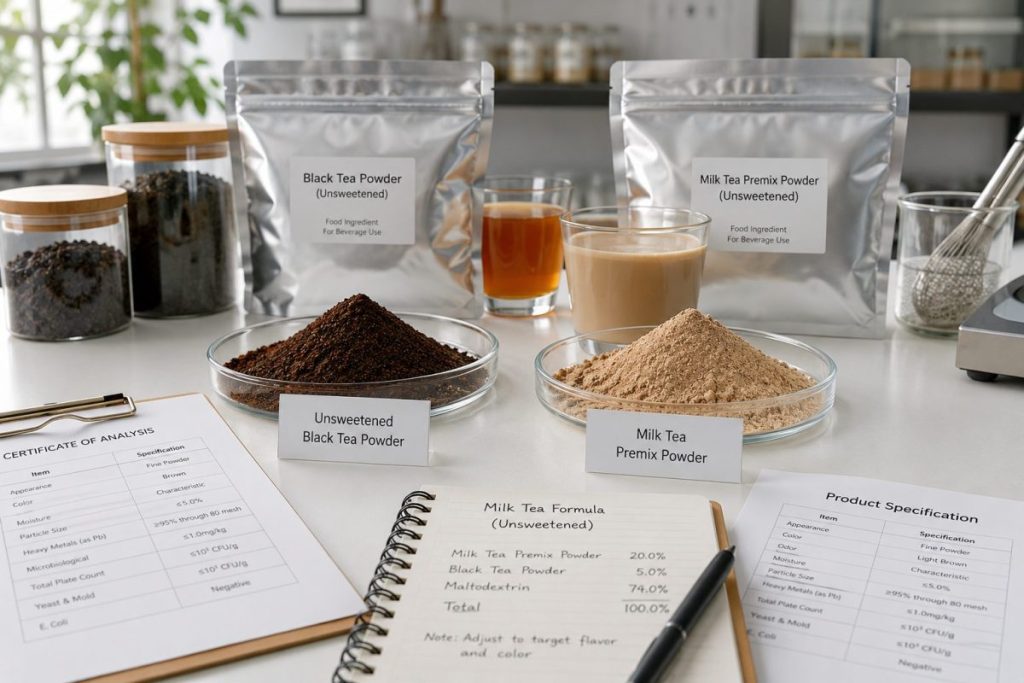
For beverage brands, the choice between unsweetened black tea powder and milk tea premix powder affects more than flavor. It changes how much control the R&D team has over sweetness, dairy system, tea strength, ingredient declaration, cost structure and supplier documentation.
Unsweetened black tea powder is usually selected when a brand wants to build its own milk tea, iced tea, RTD tea or dry mix formula from a tea base. Milk tea premix powder is usually selected when a buyer wants a more ready-to-blend system that may already include creamer, sugar, flavoring or other dry ingredients.
HERBSEA supplies instant black tea powder for B2B beverage and food formulation projects. Buyers can compare tea powder specifications, solubility, COA, sample performance, packaging and RFQ requirements before confirming a bulk order.
Quick Buyer Answer
Choose unsweetened black tea powder when your project needs control over tea intensity, sweetness, milk system, flavor direction and finished product positioning.
Choose milk tea premix powder when your project needs a faster concept sample or a standardized dry blend with less formula development on the buyer side.
For many commercial projects, the better first step is not to ask which one is cheaper. The better question is whether the finished product needs a flexible tea ingredient or a fixed premix system.
What Unsweetened Black Tea Powder Means
Unsweetened black tea powder is a tea ingredient without added sugar or dairy-style premix components. In B2B sourcing, buyers may use the term to describe instant black tea powder, soluble black tea powder or a black tea base powder used in beverage manufacturing.
The main purchasing advantage is formula control. A beverage developer can adjust sweetness, creamer, plant-based milk, aroma, color, acidity and solids level separately. This is useful for brands developing:
- Milk tea and bubble tea base formulas
- Low-sugar or custom-sweetened tea beverages
- RTD black tea and iced tea products
- Powdered beverage sachets
- Vending drink powders
- Bakery, dessert or chocolate applications that need tea character without a complete premix
If the project is mainly milk tea, HERBSEA’s guide to instant black tea powder for milk tea explains how buyers can evaluate tea strength, color, dispersion and dairy-system compatibility in sample testing.
What Milk Tea Premix Powder Means
Milk tea premix powder usually refers to a dry blend designed to simplify milk tea preparation or manufacturing. Depending on the supplier and formula, a premix may include tea powder, creamer, sugar, flavor powder, stabilizer, thickener or other dry ingredients.
This format can be convenient when the buyer wants a fast sample, a consistent house formula or a simple production process. However, it may reduce flexibility. Once the premix is fixed, changing sweetness, milk body, tea strength or flavor balance often requires a new blend.
Buyers should also review the ingredient declaration, allergen information, country-specific labeling requirements and document package carefully. A premix is not only a tea ingredient. It is a multi-ingredient system.
For US-market projects, buyer-side regulatory teams often compare early ingredient-list questions with the FDA’s Food Labeling Guide. If a premix contains milk-derived creamer, caseinate, whey, soy lecithin or similar components, the FDA’s food allergen information is also relevant for internal label review.
Decision Table for Beverage Buyers
| Buyer question | Unsweetened black tea powder | Milk tea premix powder |
|---|---|---|
| Formula control | Higher control over tea, sweetness, dairy system and flavor | Lower control if the premix formula is fixed |
| R&D workload | Requires more formulation work | Faster for concept development |
| Ingredient list | Usually simpler as a tea base ingredient | More complex because it may include creamer, sugar and flavors |
| Sweetness adjustment | Buyer controls sweetener type and level | Often built into the premix |
| Dairy or plant-based system | Buyer can choose milk powder, creamer or plant-based components | Supplier formula may already define the milk system |
| Tea strength | Easier to adjust by changing tea powder level or grade | Depends on the premix design |
| MOQ comparison | Based on single tea ingredient | Based on custom or standard dry blend |
| Documentation review | Focuses on tea powder specification and COA | Requires review of all premix components and finished blend documents |
| Best fit | Custom beverage brands and manufacturers | Quick-launch concepts, foodservice mixes or standard milk tea powders |
When Unsweetened Black Tea Powder Is the Better Starting Point
Unsweetened black tea powder is often the better starting point when the buyer needs a tea base that can move across several finished products. The same tea powder may be evaluated for milk tea, iced tea, RTD beverages or dry mix formats, depending on solubility and sensory requirements.
It is also useful when a brand wants to compare different sweetener systems or dairy options. For example, one project may need a strong black tea note in a milk tea formula, while another may need cleaner dispersion for a cold beverage. Starting with the tea powder gives the R&D team more room to test.
This flexibility is especially useful when the buyer wants the final product label, sweetness direction and dairy system to be developed by its own formulation team rather than fixed by a premix supplier.
For broader supplier comparison, buyers can also review HERBSEA’s bulk instant tea powder supplier guide, which focuses on COA review, samples, packaging, MOQ and RFQ details for bulk instant tea powder projects.
When Milk Tea Premix Powder May Be the Better Fit
Milk tea premix powder may be suitable when the buyer needs a quick sample for internal review, a standard foodservice formula or a dry mix that requires fewer production steps. This can reduce early-stage development work when the project has a simple flavor target and does not require much customization.
However, premix buyers should ask whether the supplier can modify tea strength, sweetness, creamer type, color, flavor and packaging. If the answer is limited, the premix may work for a standard product but may not support a differentiated brand formula.
For buyers comparing tea bases specifically for milk tea, HERBSEA’s instant tea powder for milk tea guide gives a wider view of instant tea powder types and sourcing paths.
Solubility and Process Fit
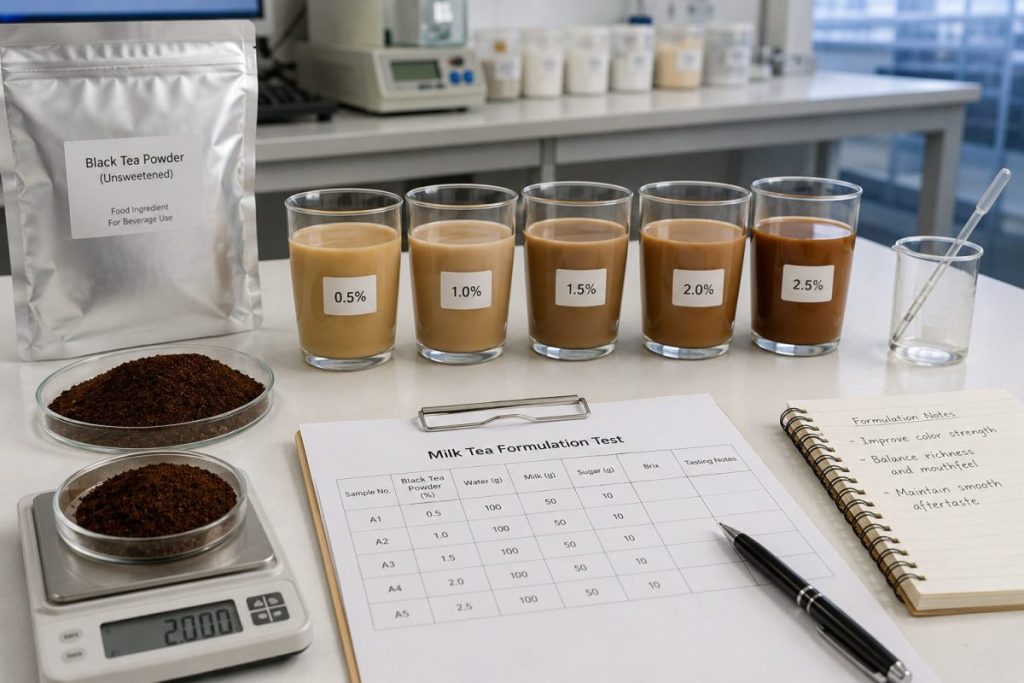
Solubility requirements should be tested in the real beverage system, not only in plain water. Unsweetened black tea powder may perform differently in hot water, cold water, milk systems, high-solids formulas or acidic beverage bases.
For milk tea projects, buyers should test:
- Dispersion speed in the intended process temperature
- Tea color after mixing with dairy or creamer components
- Sediment after standing
- Taste balance after sweetener and milk-system adjustment
- Powder flow and handling in dry blending
- Batch-to-batch sensory consistency
If the project requires cold preparation or RTD processing, buyers can review HERBSEA’s cold soluble tea powder guide before requesting samples.
Specification Points to Compare
For unsweetened black tea powder, the specification review usually focuses on tea ingredient quality and manufacturing fit. Buyers may request:
- Product name and botanical or tea base description
- Appearance, color and odor
- Solubility or dispersion notes
- Particle size or mesh range
- Moisture limit
- Caffeine or tea solids information, if specified
- Microbiological limits
- Heavy metals limits
- Residue or contaminant requirements based on destination market
- Packaging format and storage conditions
For milk tea premix powder, buyers should ask for the specification of the finished premix and, where available, component-level information for tea powder, creamer, sweetener and flavor system. The review is more complex because the premix is a formulation, not only a single raw material.
Documentation Differences
Unsweetened black tea powder and milk tea premix powder may require different document packages. A tea ingredient usually needs a COA, specification sheet and export-related documents agreed during quotation. A premix may require additional information connected to the full ingredient system.
For international projects, the Codex General Standard for the Labelling of Prepackaged Foods can be a useful reference during buyer-side label planning. The final market review should still be handled by the brand owner, importer or local regulatory consultant.
Before RFQ, buyers should clarify:
- Whether the material is a single tea powder or a blended premix
- Whether sugar, creamer or flavor components are included
- Whether component information can be shared
- Whether the supplier provides a COA for each batch
- Whether packaging and label requirements are for bulk manufacturing or foodservice use
- Whether the destination market has additional documentation requirements
If the project compares tea powder with extract powder rather than premix, use HERBSEA’s black tea powder vs black tea extract guide to keep the sourcing path clear.
Sample Testing Workflow
A practical sample test should compare both materials inside the same target formula. Testing unsweetened black tea powder in plain water and comparing it with a complete premix beverage can lead to the wrong conclusion because the formula systems are different.
For teams building a repeatable sensory method, ISO 3103 on tea preparation for sensory tests can provide a useful reference point for tea liquor evaluation. Powdered milk tea and RTD systems should still be tested in the actual finished formula because creamer, sweetener, process temperature and solids level can change the result.
Use this workflow:
- Define the finished product: milk tea, dry mix sachet, vending powder, RTD tea or bakery application.
- Set the target process: hot blending, cold blending, dry mixing or liquid processing.
- Test unsweetened black tea powder with the buyer’s own sweetener and milk system.
- Test milk tea premix powder according to the intended production method.
- Compare color, tea strength, mouthfeel, sweetness control, sediment and aftertaste.
- Review the COA, specification and ingredient information before scale-up.
- Request a second sample if the first material is close but needs a different tea strength, solubility profile or sensory direction.
This approach helps separate tea quality from premix design. It also helps the supplier recommend a more suitable grade before the buyer places a bulk order.
Supplier Questions to Ask
When comparing unsweetened black tea powder and milk tea premix powder suppliers, buyers can ask:
- Is this a single tea ingredient or a finished premix?
- Is the black tea powder sweetened or unsweetened?
- What applications is this grade commonly evaluated for?
- Is the material suitable for hot process, cold process or dry blending?
- What specification and COA can be reviewed before order confirmation?
- Can the tea strength, color or solubility profile be adjusted?
- What packaging options are available for bulk supply?
- What MOQ, sample quantity and lead time apply?
- What information should be included in the RFQ?
These questions help avoid comparing a flexible ingredient with a fixed premix as if they were the same product.
How to Write a Better RFQ
To help HERBSEA recommend the right black tea powder, buyers can send a short project brief with:
- Target finished product
- Required format: unsweetened tea powder, milk tea base or premix comparison
- Hot or cold process
- Desired tea strength and color
- Sweetener and dairy or creamer system, if already selected
- Required packaging format
- Estimated order quantity and market destination
- COA, specification and documentation requirements
- Sample request details
For projects that need a tea base rather than a complete premix, start from HERBSEA’s instant black tea powder product page and request a sample based on the finished application.
FAQ
Is unsweetened black tea powder the same as milk tea premix powder?
No. Unsweetened black tea powder is usually a tea base ingredient without added sugar or dairy-style premix components. Milk tea premix powder is usually a blended system that may include tea powder, creamer, sugar, flavor and other dry ingredients.
Which is better for custom milk tea formulation?
Unsweetened black tea powder is usually better when the buyer wants to control tea strength, sweetness, milk body and flavor direction. Milk tea premix powder may be better for a faster standard formula.
Can unsweetened black tea powder be used in milk tea?
Yes, it can be evaluated as a tea base for milk tea formulas. Buyers should test it with the intended milk system, sweetener, process temperature and finished product requirements.
What should buyers request before ordering in bulk?
Buyers should request the specification, COA, sample, packaging details, MOQ, lead time and RFQ requirements. For premix powder, buyers should also review the full ingredient system and related documentation.
Should buyers choose black tea powder or black tea extract?
It depends on the finished product and specification target. Black tea powder is often evaluated for tea taste, color and beverage performance, while extract powder may be selected for marker-led specification needs. Buyers can compare both options in HERBSEA’s black tea powder and extract sourcing guide.
Request Black Tea Powder Specifications and Samples
HERBSEA supplies bulk instant black tea powder for beverage, milk tea, RTD, dry mix and food formulation projects. B2B buyers can review specification, COA, sample performance, packaging, MOQ and lead time before quotation.
To compare unsweetened black tea powder with a milk tea premix requirement, send your finished product brief through the HERBSEA contact page.
Choose unsweetened black tea powder when the formula team wants to control creamer, sweetener, flavor, cost and nutrition panel separately instead of buying a ready premix system.
Prepare both options in the intended formula and compare tea strength, color, dairy compatibility, sweetness control, sediment, cost-in-use and document availability.
Review COA, specification sheet, ingredient composition, allergen statement, packaging details, shelf-life information and market-specific export documents.
Share the target drink format, serving size, sweetness system, creamer type, order quantity, destination market and whether the project needs a single ingredient or a custom blend.