
HERBSEA supplies bulk Instant Black Tea Powder for beverage, milk tea, food-service, functional food, HERBSEA supplies bulk Instant Black Tea Powder for beverage, milk tea, food-service, functional food, and dry blend projects. For purchasing, R&D, and quality teams, the real question is not only whether the powder tastes like black tea. The more important question is whether it performs well in the target matrix, matches the specification sheet, and can be supplied with repeatable quality.
Instant black tea powder can be used in RTD drinks, milk tea, tea lattes, premixes, and beverage bases. In sourcing, buyers should review solubility, dispersibility, color impact, taste profile, caffeine target, particle size, moisture, microbiology, packaging, MOQ, lead time, and COA consistency.
For a broader category view, see Instant Tea Powder Supplier and Bulk Instant Tea Powder Supplier.
If the project leans toward beverage development, the Functional Beverage Ingredients Sourcing Guide is a useful adjacent reference.
What buyers should define first
Before requesting a quote, define the application. A powder for milk tea may need a different flavor strength and color than a powder for RTD iced tea or a dry beverage premix.
Ask these basic questions:
- Is the target product RTD, milk tea, premix, or food-service?
- Should the powder be hot-soluble, cold-soluble, or dispersible?
- What color and tea strength are needed?
- Is caffeine content a fixed requirement?
- Will the formula include dairy, non-dairy creamer, protein, acid, or flavor systems?
- What is the target MOQ and lead time?
- Is documentation support needed for export or quality review?
If the supplier cannot answer these clearly, the material may not be the right fit.
Key specification review points
The first review should clarify what type of instant black tea powder is being requested. A grade for milk tea may behave differently from a grade for RTD iced tea or a supplement-style beverage blend.
| Review item | What buyers should confirm |
|---|---|
| Ingredient | Instant Black Tea Powder |
| Source | Tea extract or customer-approved tea material |
| Specification focus | Solubility, dispersibility, color, flavor profile, moisture, mesh size, caffeine target, and microbiology |
| Assay method | HPLC, UV, titration, or customer-agreed method |
| Documents | COA, specification sheet, production flow chart, allergen statement, and quality questionnaire |
| Commercial details | MOQ, lead time, packaging, sample availability, and export support |
For black tea identity and basic requirements, the ISO page for Black tea, Definition and basic requirements is a useful background reference.
Where instant black tea powder fits
Instant black tea powder is not only a flavor ingredient. It can also affect color, caffeine level, aroma, and the overall beverage profile.
Common applications include:
- RTD iced tea
- Milk tea and tea latte
- Beverage premixes
- Food-service drink bases
- Functional beverage systems
- Dry blend beverage concepts
For RTD projects, Instant Black Tea Powder for RTD Beverages gives a more specific application path. For milk tea projects, Instant Black Tea Powder for Milk Tea and Instant Tea for Milk Tea are better matches.
Solubility and process fit
Buyers should define the expected performance before comparing samples. “Instant” does not mean the same thing in every beverage system.
Review these points during sample testing:
- Cold-water behavior
- Hot-water behavior
- Mixing time and mixing speed
- Sediment after standing
- Foam and wetting behavior
- Color release and shade stability
- Taste strength, bitterness, and aftertaste
- Compatibility with sweeteners, acids, creamers, proteins, and flavors
For cold beverage projects, Cold Soluble Tea Powder can help buyers compare process expectations.
Quality and supply checklist
Before bulk order planning, buyers should confirm:
- Botanical or tea source material and plant part where applicable.
- Tea extract type and carrier status if used.
- Caffeine target or tea solids target when needed.
- Test method, including HPLC, UV, titration, or a customer-agreed method.
- Color, flavor profile, moisture, mesh size, bulk density, and flow properties.
- Heavy metals, microbiology, residual solvents, pesticide residue, and shelf-life information where applicable.
- Packaging format, MOQ, lead time, and export support.
- Current COA, sample reference, and specification sheet before commercial order planning.
For broader document review, the Botanical Extract Quality Testing Guide is a useful companion page.
COA and sample review
A supplier should provide more than a product name. Ask for a document package before moving too far into pricing.
Useful documents include:
- COA
- Specification sheet
- SDS or MSDS
- Allergen statement
- Country of origin
- Batch or production information
- Storage and packaging guidance
When you request a sample, confirm whether it is representative of the commercial batch. A sample that looks good but does not match the bulk material can create problems later.
Suggested sample request wording:
“We are evaluating instant black tea powder for a beverage project. Please send the specification sheet, COA, sample quantity, MOQ, lead time, and storage guidance.”
For supplier contact, Contact Plant Extract Supplier is the simplest route.
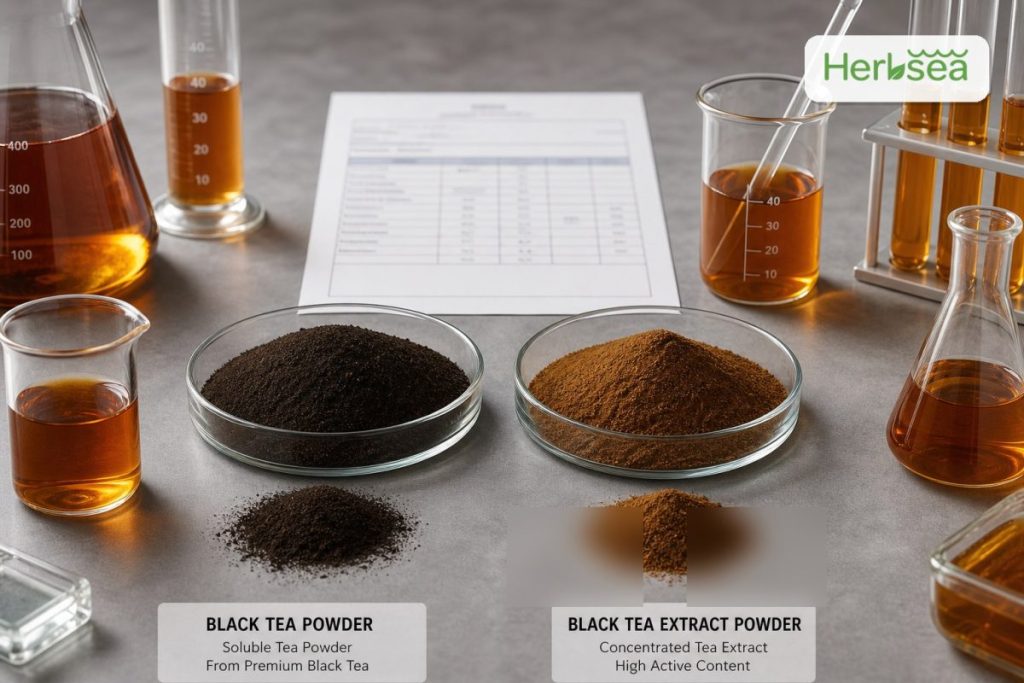
Black tea powder vs black tea extract
This is a common buyer question, and the answer depends on the application.
- Black tea powder is usually better when the project needs a more direct tea positioning and easier formula communication.
- Black tea extract may be better when the formula needs stronger marker control, tighter standardization, or a different process path.
For a more direct comparison, Black Tea Powder vs Black Tea Extract gives the sourcing team a cleaner decision path. If the team needs a broader introduction first, the Black Tea Powder Sourcing Guide works well as the entry page.
Supplier questions to ask
Before sourcing, ask:
- What is the exact ingredient name and specification?
- Can you provide a batch-specific COA?
- What is the assay or caffeine content?
- Which test method is used?
- Is a sample available before MOQ?
- What application format is supported?
- What is the MOQ and lead time?
- How should the ingredient be stored?
- Can the supplier support formulation review?
How to write a better RFQ
To receive a useful quotation, share the target specification, application, annual volume estimate, destination market, packaging preference, and sample quantity.
Include:
- Finished application: RTD iced tea, milk tea, beverage premix, food-service blend, or functional beverage
- Solubility target: hot-soluble, cold-soluble, dispersible, or shake-before-use
- Target color, tea strength, taste direction, and caffeine requirement
- Required documents: COA, specification, flow chart, allergen statement, and questionnaire
- Sample quantity, review timeline, and packaging preference
- MOQ expectation, lead time, and destination market
This information helps HERBSEA confirm specification fit, documents, MOQ, lead time, and quotation details.
FAQ
What is instant black tea powder used for?
Instant black tea powder can be used in RTD iced tea, milk tea, beverage premixes, food-service blends, and functional beverage formulas.
What should buyers check before buying instant black tea powder?
Review solubility, color, flavor, caffeine target, COA quality, batch number, sample availability, MOQ, packaging, and lead time.
Should buyers test instant black tea powder in water only?
Water testing is useful as a first screen, but final approval should be done in the actual formula matrix.
How should buyers compare suppliers?
Compare application fit, sensory profile, solubility, color impact, document quality, communication speed, MOQ, and lead time.
Is black tea powder the same as black tea extract?
Not always. They may serve different processing, standardization, and formula goals.
Yes. For active B2B projects, share the finished application, sample quantity, target specification, destination market and document needs so HERBSEA can match the sample to the intended formula.
Start with the COA and specification sheet, then confirm microbiology, heavy metals, packaging details, flow chart and export documents when the project requires them.
A useful RFQ includes tea type, solubility target, finished application, expected annual volume, packaging preference, destination country, sample request and required quality documents.
Use the Instant Tea Powder Supplier category and the bulk instant tea powder sourcing guide to compare black tea, green tea, oolong, white tea and milk tea application paths.
Conclusion
Instant black tea powder can be a strong fit for RTD drinks, milk tea, and beverage premixes, but only if the material matches the intended matrix.
The best sourcing decision is the one that balances solubility, taste, color, documentation, and supply consistency. When those pieces line up, the ingredient is much easier to move from sample to production.