
Quick Answer: To approve a pea protein powder sample, match the COA lot number to the sample label, confirm the protein percentage and test method against your target grade, check moisture, ash and particle size against your formula’s process requirements, verify heavy metals and microbiology meet your destination market limits, and ask the supplier for method references when any value is outside your expected range.
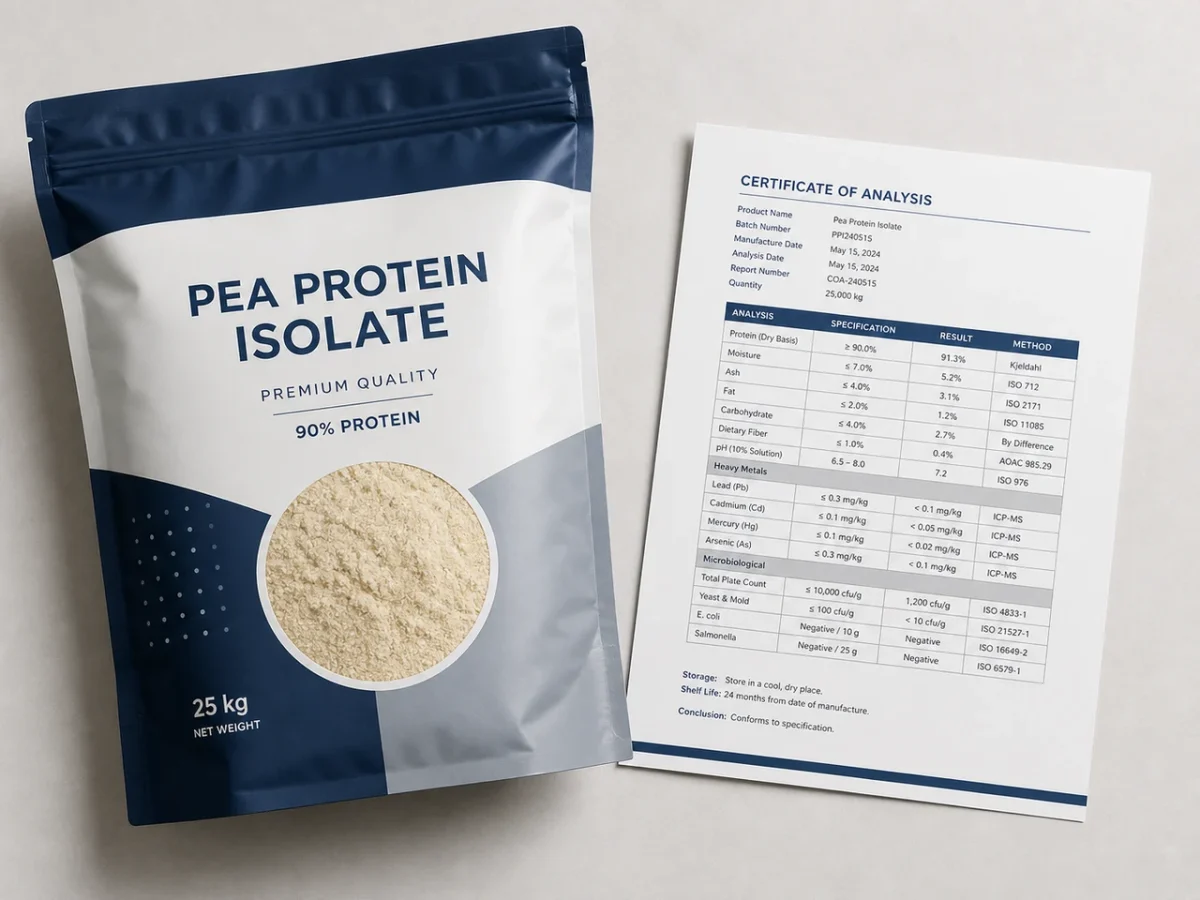
1. What Is a Pea Protein Powder COA?
A Certificate of Analysis (COA) is a batch-level document issued by the manufacturer after production. It reports the tested results of that specific lot against the agreed specification. It is the evidence that a received sample or shipment matches what the buyer and supplier agreed before order.
A COA is not the same as a specification sheet:
| Specification Sheet | COA | |
|---|---|---|
| Scope | Target ranges the product should meet | Actual measured values for one batch |
| Issued when | At product development or quotation stage | After each production lot is tested |
| Key content | Protein, moisture, ash, particle size, heavy metal and microbiology limits | Same parameters with real results, plus lot number, production date, expiry and test methods |
| Buyer use | Define what to buy and compare grades | Verify that the batch you received matches what was agreed |
When reviewing a pea protein COA, match every reported value against the specification column for that grade. Differences in test method (for example AOAC 990.03 vs an internal method) can change the reported number, so confirm the method before comparing two COAs from different suppliers.
2. COA Field-by-Field Guide for Pea Protein
Most pea protein COAs follow a standard structure. These are the fields that matter for sample approval:
| Field | What it reports | Why buyers review it | Common method |
|---|---|---|---|
| Protein content (N x 6.25) | Total protein on dry basis | Confirms the grade (isolate vs concentrate) | AOAC 990.03 / 984.13, Kjeldahl |
| Moisture | Water content of the powder | Affects stability, caking and shelf life | AOAC 925.10 / 984.25 |
| Ash | Mineral residue after combustion | Indicator of refinement level | AOAC 942.05 |
| Fat | Residual lipid content | Foaming, emulsion and mouthfeel in formulas | AOAC 920.39 / 922.06 |
| Crude fiber | Insoluble fiber fraction | Texture and label claims | AOAC 962.09 |
| Particle size | Mesh / micron range | Dispersion, solubility and process fit | Sieve analysis / laser diffraction |
| Heavy metals (Pb, As, Cd, Hg) | Contaminant levels | Regulatory compliance for the target market | ICP-MS / AAS |
| Microbiology | TVC, coliforms, E. coli, Salmonella, yeast & mold | Safety release for food-grade use | ISO / USP (61), (62) |
| Sensory | Color, odor, taste | Formula acceptance and batch consistency | Organoleptic evaluation |
| Lot info | Lot no., mfg date, expiry | Traceability and sample-to-batch matching | – |
3. Typical Pea Protein Isolate Specification Reference
The table below is a cross-supplier reference compiled from published supplier COAs. It shows the range buyers commonly see for pea protein isolate (80% grade). Use it as a screening reference only – confirm final values with the supplier’s actual COA for your target grade.
| Parameter | Common range seen in supplier COAs |
|---|---|
| Protein (dry basis, N x 6.25) | 80-90% |
| Moisture | <= 8% |
| Ash | <= 6.5% |
| Fat | <= 8% |
| Crude fiber | <= 5% |
| Particle size | >= 90% through 100 mesh |
| Lead (Pb) | <= 0.2 – 2.0 ppm |
| Arsenic (As) | <= 0.05 – 1.0 ppm |
| Cadmium (Cd) | <= 0.05 – 0.5 ppm |
| Mercury (Hg) | <= 0.05 – 0.2 ppm |
| Total plate count | <= 10,000 – 30,000 CFU/g |
| Coliforms | <= 30 – 100 CFU/g |
| E. coli | Negative |
| Salmonella | Negative / 25 g |
| Yeast & mold | <= 50 – 250 CFU/g |
4. How to Review a Sample COA in 5 Steps
- Match the lot number – the lot on the COA must equal the lot on the sample container and packing list. A mismatch is a follow-up, not an approval.
- Check protein and method – confirm the protein percentage meets your target grade and note the test method (for example AOAC 990.03) so you can compare like for like.
- Check process-relevant fields – compare moisture, particle size and sensory notes with your formula’s dispersion, solubility and texture requirements.
- Verify regulatory fields – confirm heavy metals and microbiology results meet your destination market limits (for example EU Regulation (EC) 1881/2006 contaminant limits).
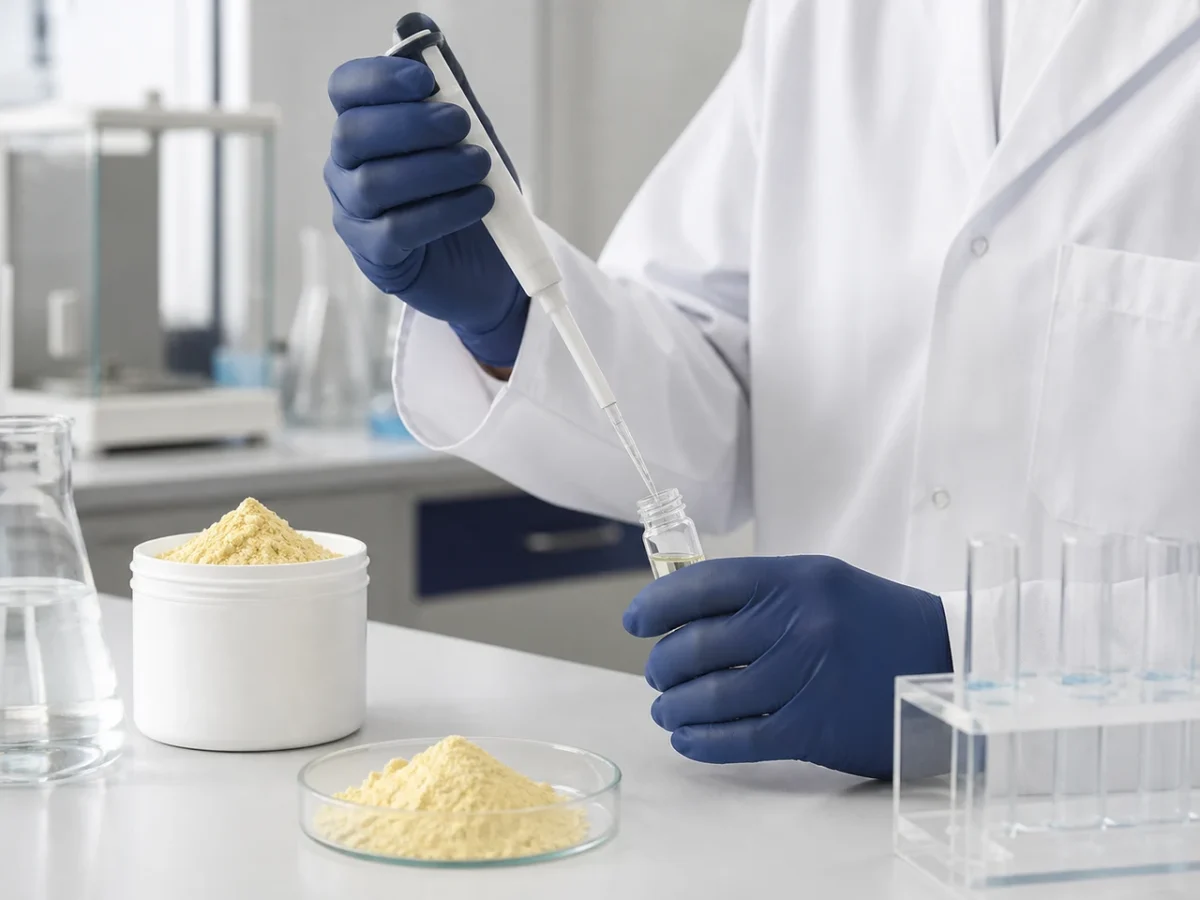
- Ask for method references – if any reported value is outside your expected range, request the method reference and, where needed, a third-party lab report from an ISO 17025 accredited laboratory.
5. COA Red Flags That Should Trigger a Follow-up
- No lot number, or a lot number that does not match the received material.
- Results listed without any test-method reference.
- “Typical analysis” or a marketing sheet presented instead of a lot-specific COA.
- Missing microbiology or heavy metals sections for a food-grade application.
- Suspiciously round results on every parameter (real measurements carry decimals).
- A COA dated before the claimed production date.
None of these automatically disqualify a material – they are points where a buyer should pause and request the missing document before sign-off.
6. Document Review vs Commercial RFQ
| Dimension | Document review | Commercial RFQ |
|---|---|---|
| Main purpose | Confirm identity, specification, COA fields and sample fit | Confirm MOQ, price discussion path, packing, lead time and shipment needs |
| Buyer input | Application, target grade, method preference and document list | Trial quantity, annual estimate, destination country and packing requirement |
| Limit | Does not replace commercial confirmation | Should be based on a clear specification and document checklist |
7. Market Context: Why COA Review Matters Now
Pea protein isolate demand keeps growing. Industry research places the global pea protein isolate market at roughly USD 1.3-1.5 billion in 2024-2025, with forecasts of continued growth at about 8-9% CAGR through the early 2030s (Archive Market Research 2026; Datastring Consulting 2026). As buyers evaluate more suppliers for beverage, powder blend and meat-alternative formulations, standardizing COA review becomes a practical way to compare batches that may differ in protein content, particle size and documentation completeness.
8. RFQ Checklist for Pea Protein
- Target protein percentage and method preference.
- Particle size and sensory requirements.
- Application and process condition.
- Representative COA and specification sheet.
- Microbiological and heavy metal limits for your destination market.
- Sample quantity, packing and destination country.
9. Related Product Pages
- Pea Protein – main product page for sourcing.
- Soy Protein Powder – related plant protein option.
- Mung Bean Protein – related plant protein option.
10. Related Sourcing Pages
- Plant Protein Supplier hub for category-level comparison.
- Ingredient Sourcing Resource Center for RFQ, sample, audit and export document workflows.
- Bulk Ingredient Sample Request Template for sample quantity, COA and specification notes.
- Food Ingredient RFQ Template for quotation details.
- Contact HERBSEA with specification, sample, COA and RFQ requirements.
11. FAQ
Buyers commonly review protein target, moisture, ash, particle size, sensory notes, microbiology, heavy metals and sample lot information.
Yes. Buyers should test dispersion, taste, color and process fit in the intended application before bulk order.
Include target protein percentage, application, sample quantity, document list, trial quantity, packing need and destination country.
Concentrate typically reports lower protein (about 60-75%) with higher fiber, while isolate reports higher protein (about 80% or above on dry basis). Check the protein and fiber fields on the COA to confirm which grade the batch matches.
Differences usually come from the test method used (for example AOAC 990.03 vs 968.06), the nitrogen conversion factor, or the grade of the batch. Confirm the method before comparing values from different suppliers.
Request supplementary analysis before accepting the delivery. Specify in your purchase contract which COA parameters are mandatory for your application.
Summary
For a faster supplier review, send the ingredient name, target grade, application, sample plan, COA or specification requirements, order estimate, packing need and destination country in one RFQ.
Data sources: Archive Market Research (pea protein isolate market, 2026); Datastring Consulting (pea protein isolate market outlook, 2026); published supplier COA examples (protein 80-90% dry basis, AOAC Kjeldahl methods); AOAC Official Methods 990.03, 984.13, 942.05, 920.39, 967.26; EU Regulation (EC) 1881/2006 (contaminant limits); ISO 17025 (laboratory accreditation). Specification ranges are screening references compiled from published supplier documents – confirm final values with the supplier’s actual COA for your target grade.