
Quick Answer: A complete plant protein powder RFQ should state nine things in one message: the protein source (pea, soy, mung bean, chickpea, broad bean or a blend), the target protein percentage with its assay method (e.g., 80% protein by Dumas, dry basis), the application format (RTD beverage, dry blend, bar, bakery or seasoning) and process condition, the sensory and physical targets (taste, color, particle size, dispersion), the COA and specification scope you expect (protein, moisture, ash, heavy metals, microbiology, allergen statement), the certification tier you need (FSSC 22000, ISO 22000, HACCP, Halal, Kosher, organic), sample quantity and your application test plan, commercial terms (trial and formal MOQ, packing, lead time, Incoterm, destination country), and the export document list. Sending all nine fields together lets a supplier return a usable first quotation in one round instead of three.
1. Why a Structured RFQ Matters for Plant Protein Powder in 2026
Plant protein is one of the fastest-moving ingredient categories in food and beverage sourcing. Industry research values the global plant-derived protein powder market at roughly USD 7.23 billion in 2024, growing to about USD 7.72 billion in 2025 and projected toward USD 15 billion by 2035, a CAGR of about 6.8% (industry research compiled by WiseGuy Reports, 2025). Broader-scope estimates that include retail and supplement channels put the plant protein powder market near USD 22.29 billion in 2024, with a 7.9% CAGR to 2033 (Archive Market Research, 2025).
The growth has widened the quality spread between suppliers. Global plant-based protein export value reached about USD 52.1 billion in 2024, and Europe is the largest import region at roughly 46% of the market (India Ministry of Food Processing Industries sector profile, 2024). China is the world’s largest pea protein exporter by shipment count, followed by Germany and the Netherlands (Volza export data, 2024), and China’s Zhaoyuan cluster alone exported about CNY 1.17 billion of pea protein in 2024 (China Export & Credit Insurance data, 2025). For a B2B buyer the practical conclusion is simple: a written RFQ with explicit source, specification, method and document fields is the cheapest quality filter you can apply before any sample or audit cost is incurred.
| Market / supply indicator | Value | Source / year |
|---|---|---|
| Global plant-derived protein powder market | USD 7.23B (2024) → USD 15B (2035E), CAGR ~6.8% | WiseGuy Reports, 2025 |
| Plant protein powder market (retail + supplement channels) | USD 22.29B (2024), 7.9% CAGR to 2033 | Archive Market Research, 2025 |
| Global plant-based protein export value | USD 52.1B (2024); Europe ~46% of demand | India MoFPI sector profile, 2024 |
| Top pea protein exporters by shipments | China 9,202; Germany 5,988; Netherlands 1,804 | Volza export data, 2024 |
| China Zhaoyuan pea protein exports | ~CNY 1.17B (2024), world’s largest pea protein base | China Export & Credit Insurance, 2025 |
2. Protein Source First: The Field That Sets Everything Else
The first RFQ field is the source. Pea, soy, mung bean, chickpea and broad bean proteins are not interchangeable: they differ in protein content, allergen profile, flavor, dispersion and price point, and each behaves differently in a formula.
| Source | Typical grades | Allergen / label note | RFQ note |
|---|---|---|---|
| Pea protein | Concentrate 55-65%, isolate 80-85% protein | Naturally free of soy, gluten and dairy; check pea allergen status for destination market | Neutral flavor, strong emulsion and water-binding; the default for clean-label and hypoallergenic claims |
| Soy protein | Isolate ~90% (dry basis), concentrate ~70%, textured (TSP) | Major allergen in EU and US labeling; confirm non-GMO status for many markets | Best gelling and emulsifying performance; 42% of global soy protein ingredients are isolates (360 Research Reports, 2025) |
| Mung bean protein | Concentrate and isolate ranges vary by producer | Generally low-allergen; confirm processing aids | Growing category for clear protein beverages; confirm clarity and solubility targets |
| Chickpea protein | Isolate 80-90% protein typical | Naturally free of soy, gluten, dairy | Mild flavor and light color; good for bakery and dry blends; confirm fiber content affects texture |
| Broad bean (fava) protein | Concentrate and isolate ranges vary by producer | Check fava bean allergen status and anti-nutritional factor handling | Strong in meat alternatives; confirm dehulling and processing documentation |
State the source and the target protein percentage together, and add the assay method. Protein is most commonly reported on a dry basis by the Dumas or Kjeldahl nitrogen method; the COA should name the method and the conversion factor so different quotations are comparable.
3. Specification Fields: The Six Lines Every RFQ Must Carry
A comparable RFQ pins down six specification lines. Leaving any of them open produces quotations that cannot be compared side by side.
| Specification field | What to confirm | RFQ note |
|---|---|---|
| Protein percentage | Target value, method (Dumas / Kjeldahl), basis (dry or as-is) | e.g., “80% min by Dumas, dry basis”; the single most quoted field |
| Particle size | Mesh or micron range, method (e.g., 100 mesh pass rate) | Affects dispersion, mouthfeel and blend uniformity |
| Sensory | Taste, odor and color targets against a retained reference | Specify off-flavor limits (e.g., beany, bitter) for your application |
| Moisture | Loss on drying target (typically <= 8%) | Drives shelf life, caking and microbial risk |
| Microbiology | TPC, yeast & mold, coliforms, E. coli, Salmonella | Salmonella negative in 25 g is the standard food-grade requirement |
| Heavy metals | Pb, As, Cd, Hg limits per destination regulation | Confirm the method (ICP-MS / AAS) and the standard applied |
Add your application format and process condition to the same RFQ message. Beverage, dry blend, bar, bakery and seasoning projects put different demands on the powder, and the supplier can only recommend a grade when the application is known.
4. Application Fit: Beverage, Dry Blend, Bar or Bakery
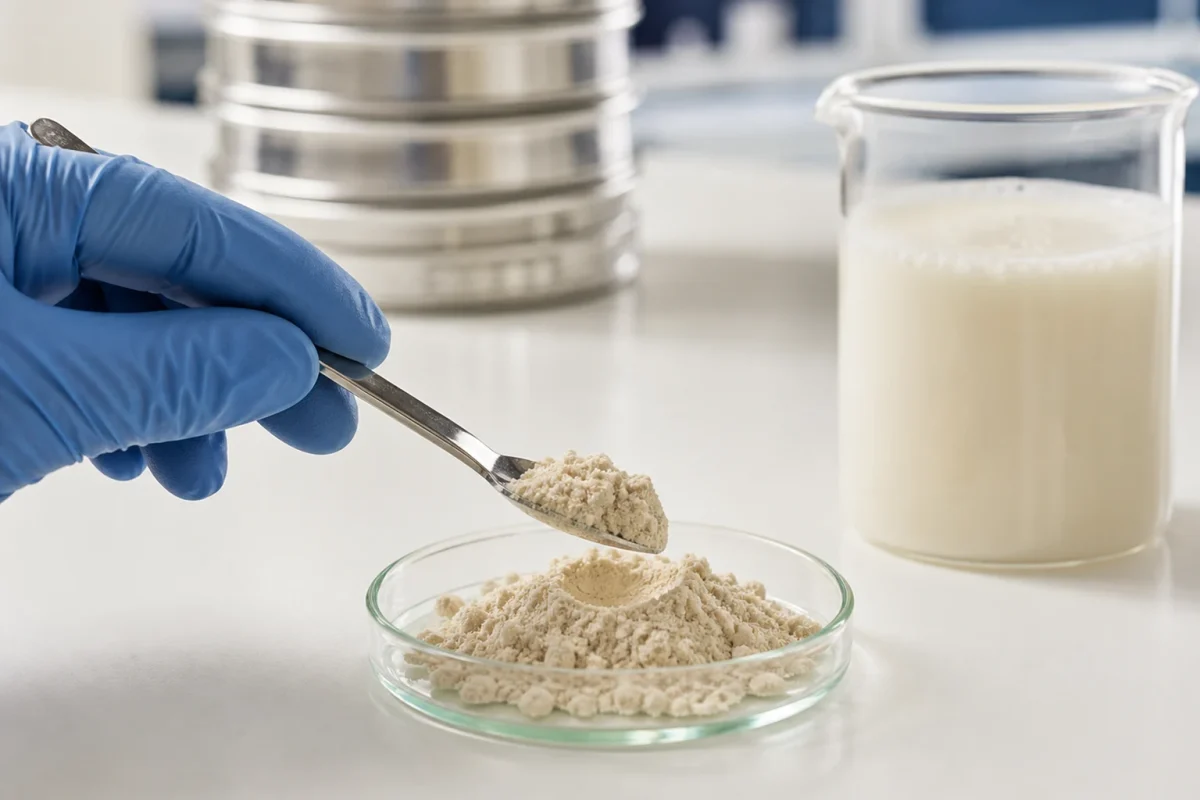
Application determines which physical properties matter most, so a structured RFQ links the specification to the format.
| Application | Priority properties | Typical RFQ request |
|---|---|---|
| RTD beverage / clear protein drink | Solubility, clarity, low sediment, heat and pH stability | “Target: clear soluble protein beverage, pH 3.2-4.0, UHT process” |
| Powder drink / dry blend | Flowability, particle size, dispersibility, anti-caking behavior | “Target: stick-pack powder drink, instant dispersion in cold water” |
| Protein bar | Water-binding, texture contribution, flavor masking | “Target: baked/cold-set bar, 20% protein inclusion, neutral flavor” |
| Bakery / snacks | Dough behavior, color contribution, water absorption | “Target: fortified bread/snack, confirm browning and texture impact” |
| Meat alternative | Water-holding, gelling, fibrous structure | “Target: plant-based patty/sausage, confirm hydration ratio” |
Bench and pilot methods should record water temperature, addition order, mixing energy, hydration time, formula pH and final sediment or texture — without controlled conditions, results from different samples are not comparable. Sample evaluation belongs to your bench, not to the supplier’s COA.
5. Certifications and Documents: The Tier a Supplier Can Prove
A plant protein quotation is only as strong as the documents behind it. The RFQ should state the certification tier you need, so all bidders quote against the same evidence level.
| Certification / document tier | What it covers | RFQ note |
|---|---|---|
| Food-safety schemes | FSSC 22000, ISO 22000, HACCP, BRC | FSSC 22000 and BRC are the most common audit schemes requested for EU/US food import |
| Quality management | ISO 9001 | Facility-level quality system evidence |
| Religious / dietary | Halal, Kosher certificates | Confirm the certificate issuer and renewal date; required for many destination markets |
| Origin claims | Organic (USDA / EU), Non-GMO Project | Confirm certification body and annual audit status; pea and soy grades are commonly non-GMO |
| Lot documents | COA, specification sheet, MSDS, flow chart | Ask whether the COA is in-house or ISO 17025 third-party; record which one you are buying |
Required COA fields for bulk plant protein: appearance, color and odor; protein assay with method; moisture; total ash; heavy metals (Pb, As, Cd, Hg); microbiology; and an allergen statement (e.g., “free from soy, gluten and dairy” for pea protein, or a soy allergen declaration for soy grades). Ask whether pesticide residues are screened, especially for organic-certified material destined for strict markets.
6. Sample Approval: Budget, Timeline and the Lot-Linking Rule
Samples are where an RFQ becomes a physical decision. The failure mode to avoid is a floating approval — a sample bench-tested with no lot number, no COA and no written record, followed by a bulk shipment from a different batch.
- Request a sample quantity that fits your test plan. 50-100 g is the common R&D and QA range for protein powders; initial identity checks from origin manufacturers are often free at 10-50 g.
- Link the sample lot to the COA. Keep the sample COA, spec sheet and retained sample in one file. If the bulk shipment lot differs from the approved sample lot, require a fresh COA review before release.
- Run your application tests, not just the supplier’s assay. Solubility in your beverage matrix, dispersion in a stick pack, sediment in an RTD and texture in a bar are decisions only your bench can answer.
- Budget by sample type. Stock sample programs typically run USD 0-50 with courier freight the main variable; custom or specification-matched samples usually USD 50-500; pre-production or pilot lots USD 100-1,000+ (industry procurement guides, 2025). Custom formulation development can run USD 200-2,000+ (Accio supplier guides, 2025). Industry experience puts sample-to-order conversion in the 20-30% range, so plan the number of suppliers you qualify accordingly.
| Sample stage | Typical cost | Typical timeline |
|---|---|---|
| Stock sample (10-50 g) | USD 0-50 (often free) | Dispatch within days to 2 weeks |
| Custom / spec-matched sample | USD 50-500 | 1-4 weeks after specification finalization |
| Pre-production / pilot lot | USD 100-1,000+ | 3-8 weeks including production and shipping |
| Sample-to-order conversion | 20-30% of qualified samples | Industry benchmark, not a guarantee |
7. Commercial Terms: MOQ, Packing, Lead Time and Export Documents
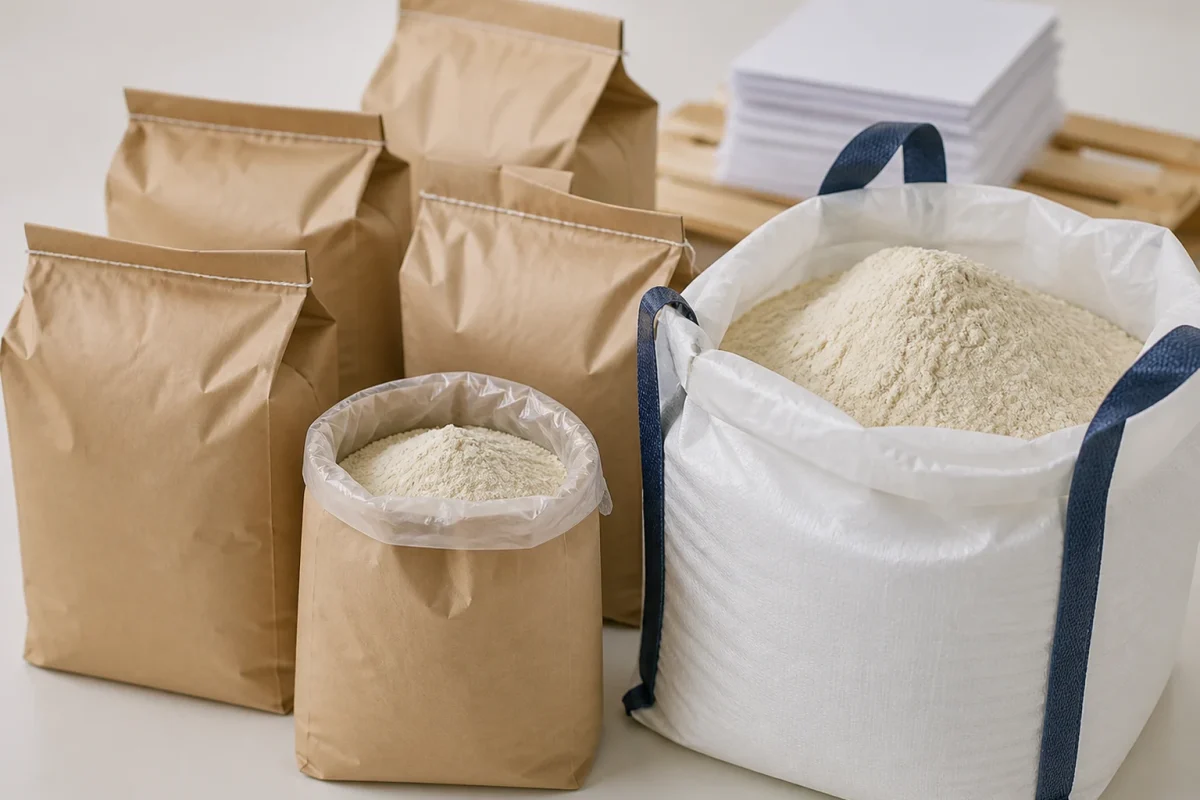
Commercial fields belong in the same RFQ, not a follow-up email, because they decide which suppliers can actually bid.
| Commercial field | Typical market benchmark | RFQ note |
|---|---|---|
| Sample quantity | 10-50 g free identity samples; 1-5 kg evaluation samples | Confirm whether freight is included |
| MOQ — trial order | 1-5 kg per SKU for R&D; 100 kg development lots common | Confirm the trial MOQ is per SKU, not per blend |
| MOQ — formal order | 500-1,000 kg per SKU; ~1 MT for ocean-freight pricing | Custom grades and private label usually raise the MOQ |
| Packing | 20-25 kg kraft paper bags with PE liner; 500-1,000 kg super sacks | Confirm inner liner, sealing and pallet configuration |
| Lead time — stocked lots | 2-3 weeks for standard grades | Confirm what “stocked” means for your source and grade |
| Lead time — production lots | 4-6 weeks for pallet-scale or made-to-spec volumes | Custom specifications can run longer; get the date in writing |
| Shipping split | Courier for samples; air freight around 50-100 kg; sea freight at 500 kg+ | Match the mode to your trial timeline |
| Export documents | COA, spec sheet, MSDS, certificate of origin, phytosanitary where required | Add allergen, non-GMO and non-BSE/TSE statements if your market needs them |
| Shelf life | 24-36 months typical for plant protein powders | Confirm re-test date and storage conditions on the COA |
Also state the Incoterm you quote against (EXW, FOB, DAP, DDP) and the destination country. Destination determines residue limits, the document list and sometimes the eligible origin — for example, soy allergen labeling and GMO declarations differ between the EU, US and Asian markets.
8. Document Review vs Commercial RFQ: Two Stages, One File
| Dimension | Document review | Commercial RFQ |
|---|---|---|
| Main purpose | Confirm identity, specification, COA fields and sample fit | Confirm MOQ, price basis, packing, lead time and shipment needs |
| Buyer input | Application, target grade, method preference, document list | Trial quantity, annual estimate, destination country, packing requirement |
| Output | Shortlist of suppliers whose documents and sample pass | A comparable quotation set on identical specification and terms |
| Limit | Does not replace commercial confirmation | Should be based on the approved specification and document checklist |
Keep the two stages in one RFQ file so the final quotation references an approved specification version, a sample lot number and a COA scope. That is what makes a price comparable across suppliers — and defensible internally when the shipment arrives.
9. The Plant Protein Powder RFQ Checklist
Send these fields in one RFQ message:
- Protein source, target percentage and assay method (e.g., “pea isolate, 80% min by Dumas, dry basis”).
- Application format and process condition (beverage, dry blend, bar, bakery, meat alternative; pH, heat process, mixing method).
- Specification scope: particle size, taste, color, moisture, microbiology and heavy-metal limits.
- Certification tier: FSSC 22000 / ISO 22000 / HACCP / BRC, Halal, Kosher, organic or non-GMO as required.
- COA and document list: protein assay method, moisture, ash, heavy metals, microbiology, allergen statement, issuing lab.
- Sample quantity, sample lot recording rule and your application test plan.
- Trial and formal MOQ, packing format, lead time expectation, Incoterm and destination country.
- Annual volume estimate so the supplier can quote the right commercial tier.
- Export document list: COA, spec sheet, MSDS, certificate of origin, phytosanitary where applicable.
10. Related Sourcing Pages
- Plant Protein Supplier hub — category-level comparison of pea, soy, mung bean, chickpea and broad bean protein.
- Pea Protein — isolate and concentrate grade review for bulk sourcing.
- Soy Protein Powder — specification and sample comparison for soy grades.
- Mung Bean Protein — for plant protein formulation projects.
- Chick Pea Protein Powder — for dry blend and food applications.
- Broad Bean Protein Powder — for supplier comparison.
- Bulk Ingredient Sample Request Template — sample quantity, COA and specification notes.
- Food Ingredient RFQ Template — quotation details.
- Ingredient Sourcing Resource Center — RFQ, sample, audit and export document workflows.
- Contact HERBSEA — send your specification, sample, COA and RFQ requirements to the supplier team.
Data sources: Market and trade figures cited from WiseGuy Reports (2025), Archive Market Research (2025), India Ministry of Food Processing Industries sector profile (2024), Volza export data (2024), China Export & Credit Insurance (2025), 360 Research Reports (2025) and industry procurement guides (2025). Figures are directional benchmarks for RFQ planning, not guarantees; confirm current numbers with your supplier and destination-market regulations before purchase approval.
11. FAQ
Send the protein source, target protein percentage with assay method, application format, specification scope, certification tier, sample quantity and test plan, trial and formal MOQ, packing need, lead time expectation, Incoterm, destination country and the document list — in one RFQ message.
Beverages, dry mixes, bars, bakery and meat alternatives require different dispersion, sensory and particle-size behavior. The same protein percentage can perform well in a bar and fail in a clear RTD, so the application must be in the RFQ before grade recommendation.
No. Buyers should confirm source, grade, sensory target and process conditions before bulk quotation. A specification matched to the application, with a controlled bench test, is the only comparable basis across suppliers.
FSSC 22000, ISO 22000, HACCP or BRC as the food-safety scheme, ISO 9001 for quality management, and Halal, Kosher, organic or Non-GMO certificates as your destination market requires. Ask whether the COA is issued in-house or by an ISO 17025 third-party lab.
Identity samples of 10-50 g are often free or under USD 50; evaluation samples of 1-5 kg are common; custom or specification-matched samples typically cost USD 50-500; pre-production or pilot lots run USD 100-1,000+. Sample timelines range from days to 4 weeks for stock grades and up to 8 weeks for custom lots.
Trial MOQs of 1-5 kg and development lots from 100 kg are common; commercial MOQs typically run 500-1,000 kg per SKU, with about 1 MT for ocean-freight pricing. Standard grades ship in 2-3 weeks from stock or 4-6 weeks from production; custom specifications take longer.
12. Summary
A plant protein powder RFQ that specifies the source, protein percentage with assay method, application format, specification scope, certification tier, COA and document list, sample plan, MOQ, packing, lead time, Incoterm and destination country will return comparable quotations and expose specification gaps before any sample cost. Send the nine checklist fields in one message, keep the sample lot tied to its COA, and your first quotation round becomes your supplier filter.
Download or request the plant protein powder RFQ checklist from HERBSEA.