
China Urolithin A Powder Suppliers: A Practical B2B Buyer Guide
When a buyer searches for China Urolithin A powder suppliers, the real task is usually not finding another product page. It is finding a supplier that can connect material identity, assay method, production route, batch documents, sample testing, packaging and export requirements in one reviewable file.
Quick answer: A reliable China Urolithin A powder supplier should provide a clear material identity, stated CAS reference, defined assay method, lot-specific COA, specification sheet, SDS, sample traceability, packaging details and a quotation that separates product terms from logistics terms. Buyers should compare suppliers on the same brief and verify whether the responding company is a manufacturer, a trading company or a coordinated supply partner.
Urolithin A projects often move quickly from a small sample to a larger formulation discussion. That speed makes supplier qualification important. A low quotation does not compensate for an unclear source, a non-matching COA or a sample that cannot be connected to a commercial lot.
1. What Buyers Are Actually Comparing in China
The phrase “China supplier” covers several different business models. A buyer may be speaking with a direct manufacturer, a specialized ingredient exporter, a trading company, or a supplier that coordinates production and documentation through approved partners. None of these models is automatically suitable or unsuitable. The key question is whether the supplier clearly explains responsibility for manufacturing, testing, release, export paperwork and after-sales communication.
| Supplier model | What it may offer | What the buyer should verify |
|---|---|---|
| Direct manufacturer | Direct control of production planning, batch release and packaging | Manufacturing site, testing scope, change control, export experience and document issuer |
| Specialized ingredient exporter | Familiarity with international quotations, freight and customer documentation | Relationship with the actual plant, lot ownership, sample source and technical response time |
| Trading company | Access to more than one production source and flexible commercial coordination | Exact source for the quoted lot, responsibility for COA accuracy and replacement process |
| Coordinated supply partner | One contact for factory, laboratory, packaging and shipment arrangements | Written division of responsibility and the party that controls final release |
For a first screen, ask every candidate to identify the legal selling entity, the manufacturing location, the testing location and the party named on the COA. If those four points remain vague, the buyer cannot build a reliable supplier record.
2. Confirm Urolithin A Identity Before Reviewing Price
Urolithin A is commonly referenced by CAS 1143-70-0. That reference helps organize the inquiry, but it does not replace an identity test. The buyer should ask how the supplier confirms identity, what analytical method supports the result and whether the document applies to the same material offered in the quotation.
The quotation should state the material name, physical form, target assay, manufacturing route if relevant, packaging format and intended commercial scope. A product name alone is not enough because similar naming can appear across different purity targets, grades or development materials.
At minimum, align these fields before comparing offers:
- Material name and CAS reference.
- Powder form and any particle-size or flow preference.
- Assay target and calculation basis.
- Manufacturing route stated by the supplier.
- Lot number, sample code and production or retest information.
- Storage conditions and proposed shelf-life statement.
- Packaging material, net weight and label fields.
- Destination market and required export documents.
If one quotation says “Urolithin A 98%,” another says “Urolithin A powder,” and a third uses a product code without a technical name, send a normalized specification before asking for final pricing. Otherwise, the comparison may look precise while the suppliers are quoting different materials.
3. Assay and Production Route: Questions for China Urolithin A Powder Suppliers
Many buyers begin with “98% HPLC.” Consider that phrase a starting point, not a complete quality statement. Ask whether the number is a minimum release limit, a typical value, a recent batch result or a target for development material. Also ask which laboratory ran the test and whether the method is identified on the COA.
The production route can affect documentation, impurity review, solvent questions and the way the supplier explains the material. A buyer does not need to choose a route from a marketing description. The buyer does need the supplier to state the route consistently and explain which controls apply to the offered lot.
| Technical point | Questions to send the supplier | Why it matters |
|---|---|---|
| Identity | Which test confirms Urolithin A identity? Is the method named on the COA? | Prevents a name match from being mistaken for a material match |
| Assay | Is the result a minimum, typical value or batch result? What is the calculation basis? | Makes supplier-to-supplier comparison meaningful |
| Reference standard | Which reference standard does the laboratory use, and how is it controlled? | Supports review of the reported HPLC result |
| Route statement | Does the supplier describe the material as fermentation-derived, chemically synthesized or another route? | Aligns impurity, residual-solvent and documentation questions |
| Impurity profile | Which related substances or process impurities are monitored? | Helps QA define the release review |
| Residual solvents | Which solvents are relevant to the declared route and what limits apply? | Connects the process statement to a practical test request |
| Water and physical data | Are moisture, particle size, bulk density or solubility included in the specification? | Shows whether the powder fits the planned handling and formulation process |
Avoid treating “synthetic,” “fermentation,” “natural” or “pharmaceutical grade” as a complete technical answer. The supplier should connect the description to test items and a document scope. If a term has a special regulatory meaning in the destination market, the buyer’s own regulatory team should confirm the interpretation.
4. How to Review a China Urolithin A COA
A useful COA should allow a second reviewer to identify the lot, understand the test result and connect the certificate to the sample and commercial offer. The following checklist works well for an initial supplier screen.
Product and lot identity
Check the product name, CAS reference, lot number, manufacture date or retest date, net weight and document issue date. The same lot or sample identifier should appear on the sample label and in the supplier’s dispatch record.
Test method and result
Look for the method name or method reference, numerical result, unit, specification limit and test date. A certificate that only says “pass” may be insufficient for a buyer comparing several sources. Ask the supplier to distinguish release specifications from typical technical data.
Related substances and contaminants
The exact test panel depends on the route and buyer requirement. Ask the supplier to identify which related substances, residual solvents, heavy metals, microbiological items and other contaminants are tested on every lot, tested periodically or available by request. A periodic test may be useful, but it should not be described as a lot result when it is not.
Laboratory responsibility
Confirm whether the testing laboratory belongs to the manufacturer, operates as an independent service provider or supports several suppliers. If an external laboratory is used, ask for the report scope and the relationship between the report and the released lot. ISO/IEC 17025 can be used as a laboratory-competence reference, but it does not mean that the ingredient itself carries that certification.
Document consistency
Compare the COA with the specification sheet, SDS, sample label, packing list and quotation. Differences in product name, assay basis, shelf-life wording or responsible company should be resolved before the buyer approves the sample.
5. Sample Testing Workflow Before a Bulk Order
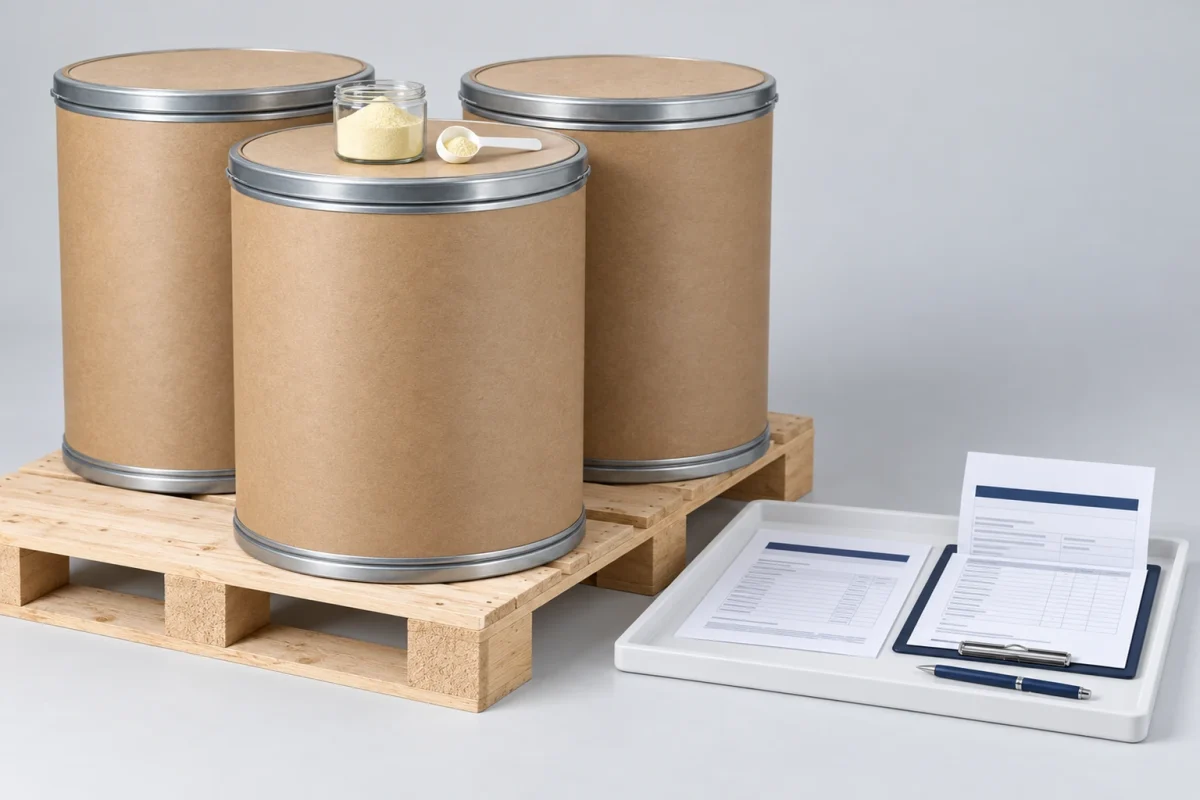
A sample is most useful when the buyer defines what the sample must prove. Sending a pouch without a lot reference creates a weak link between R&D evaluation and commercial purchasing.
| Stage | Buyer action | Supplier information to request | Decision output |
|---|---|---|---|
| Requirement brief | Define application, target assay, format, destination and order estimate | Confirm the supplier can quote the same requirement | Normalized RFQ |
| Document screen | Review identity, COA fields, SDS and specification | Send current documents for the proposed material | Document questions list |
| Sample dispatch | Record sample code, lot, weight and dispatch date | Confirm whether the sample is commercial, retained or development material | Traceable sample record |
| Bench evaluation | Test identity, handling and application fit under the buyer’s protocol | Provide additional technical data when requested | Internal test report |
| Commercial review | Compare the sample result with the proposed lot and terms | Confirm MOQ, lead time, packaging and change-notification process | Proceed, hold or request a new sample |
The buyer should keep the sample photo, label, courier record, COA and internal test notes in one folder. If the supplier later changes the lot, manufacturing site, test method or packaging, the team can decide whether a new review is necessary.
6. Packaging, MOQ and Export Readiness
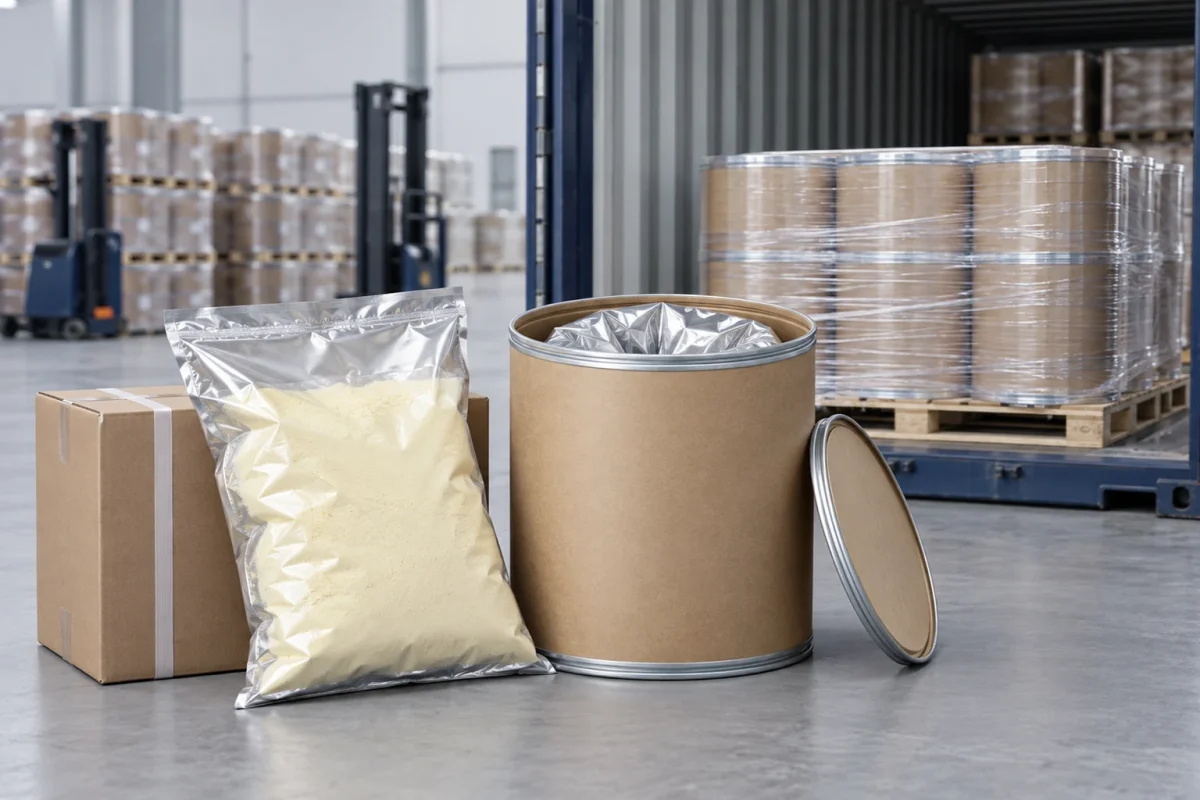
Packaging decisions affect warehouse handling, sampling, labeling and shipping documentation. Ask the supplier to quote the standard pack and the available alternatives separately. Typical discussions may include foil bags, fiber drums, cartons, pallet configuration, inner liners, desiccant use where applicable and label content.
Do not assume that a generic “25 kg bag” statement is a finished packaging specification. Confirm the material in contact with the powder, net weight tolerance, lot label, production or retest information, outer carton or drum, pallet requirement and storage statement.
| Commercial field | Questions for the supplier |
|---|---|
| MOQ | What is the minimum order for the quoted specification and pack size? |
| Sample | Is the sample from a current commercial lot? What quantity and courier terms apply? |
| Lead time | Does the lead time begin after payment, artwork approval or specification confirmation? |
| Packaging | What are the inner liner, outer container, net weight and pallet options? |
| Label | Which product, lot, weight, date and storage fields appear on the label? |
| Export documents | Can the supplier provide commercial invoice, packing list, shipment documents and the technical files requested by the destination market? |
| Change control | How will the supplier notify changes to source, process, site, method or packaging? |
For a first quotation, request the product price, packaging cost, sample cost, freight basis and document charges as separate lines. This makes the final comparison easier and prevents a low material price from hiding a different shipping or documentation scope.
7. Factory Audit Questions Without Overcomplicating the First Screen
A full on-site audit may not be practical at the beginning of a project. Buyers can still ask focused questions that reveal whether a supplier understands its own process.
Manufacturing and release
Ask who owns the batch release decision, where production occurs, how the supplier handles out-of-specification results and whether retained samples are kept. The purpose is not to collect generic policy language. It is to understand who can answer a lot-specific question after shipment.
Laboratory and records
Ask how the supplier controls reference standards, method versions, raw data, report approval and document revisions. A responsive supplier should be able to explain which items appear on the COA and which records remain available for a qualified buyer’s review.
Change notification
Ask what events trigger notification: a manufacturing-site change, route change, specification revision, packaging change, testing-laboratory change or new label format. Put the agreed notification approach in the commercial or quality record rather than leaving it in informal chat.
Supplier continuity
Ask whether the quoted source is a regular commercial item or a project-specific batch. Confirm typical production capacity only when the supplier can state the basis for the estimate. Avoid using unsupported capacity numbers in internal approval documents.
8. Comparing China Urolithin A Powder Suppliers on One Scorecard
A scorecard prevents procurement from selecting a supplier on price alone. Use a simple 0–2 scale for each category: 0 means missing or unclear, 1 means partly documented, and 2 means complete and consistent.
| Category | 0 points | 1 point | 2 points |
|---|---|---|---|
| Material identity | Product name only | Name and CAS reference | Identity method and consistent documents |
| Assay evidence | “Pass” only | Numerical result without full basis | Method, basis, limit, result and lot |
| Route transparency | No route statement | General route description | Route linked to impurity and solvent review |
| Sample traceability | Unmarked sample | Sample code only | Sample code, lot, label and dispatch record |
| Packaging | Generic pack statement | Basic pack and weight | Full pack, label and pallet specification |
| Export support | No document list | Basic commercial documents | Technical and shipping document plan |
| Response quality | Repeatedly incomplete | Answers after several rounds | Clear, consistent and dated responses |
| Commercial fit | MOQ or lead time unclear | Terms partly stated | MOQ, lead time, payment and freight basis clear |
The score is a decision aid, not a certification. A supplier with a high score still requires the buyer’s internal quality and regulatory review. A low score tells the team where the evidence is missing and whether another clarification round is worthwhile.
9. RFQ Template for China Urolithin A Powder Suppliers
Use the following brief when contacting several suppliers. Sending the same information to each candidate keeps the comparison fair.
Material: Urolithin A powder, CAS 1143-70-0
Target assay: State the required minimum or range and the analytical basis.
Required documents: Lot-specific or representative COA, specification sheet, SDS, route statement, impurity or residual-solvent information where applicable, packaging specification and origin or manufacturing statement.
Sample request: State quantity, sample purpose, desired lot connection and destination.
Commercial request: Ask for MOQ, sample cost, bulk price tiers, standard pack, custom pack options, lead time, payment terms and freight basis.
Quality questions: Ask which tests are lot-based, which are periodic, how the supplier handles an out-of-specification result and how it communicates changes.
Destination: Name the receiving country and product category so the supplier can identify relevant document requirements without guessing.
Ask suppliers to return the information in a structured table. A clear response is easier to compare than a folder containing multiple unlabeled PDFs and a short message saying “all documents available.”
10. Common Problems in China Supplier Qualification
- The supplier sends a generic COA: Ask for a current lot-specific certificate or clearly label the file as representative.
- The product name changes between files: Pause the comparison and request a written reconciliation.
- The assay basis is missing: Ask whether the result is as-is, dry basis or another stated calculation.
- The sample has no lot reference: Request a traceable replacement before using the result for commercial approval.
- The route statement and test panel do not match: Ask which process controls and impurity tests apply.
- The supplier cannot separate price from freight: Request a line-item quotation.
- The MOQ changes after the quotation: Ask for the standard MOQ and the reason for any project-specific exception.
- The SDS is old or uses another company identity: Request a current destination-market version.
- The supplier promises capacity without evidence: Record the claim as unverified and ask for a realistic supply plan.
These issues do not automatically disqualify a China supplier. They do show that the buyer needs clarification before treating the quotation as comparable.
11. How HERBSEA Can Support a China Urolithin A Sourcing Brief
HERBSEA supplies bulk Urolithin A for B2B formulation and manufacturing projects. Buyers can start with the bulk Urolithin A powder supplier page and provide the target assay, application format, sample requirement, destination market and expected order range. For deeper quality review, see the Urolithin A specification and COA guide and the Urolithin A raw-material specification checklist.
The most useful first inquiry is specific. Include the documents you need, the test basis you expect, the packaging format you can receive and the questions your QA team must close. This gives the supplier a practical brief and gives your team a traceable basis for comparison.
12. Frequently Asked Questions
Start with material identity, assay method, lot or sample traceability, manufacturing route, COA, specification sheet, SDS, packaging, MOQ, lead time and destination-market document needs.
A trading company can be suitable when it clearly identifies the production source, document issuer, lot responsibility and after-sales process. The buyer should compare evidence rather than relying on the company label alone.
The COA should show the agreed assay limit, numerical result, analytical method or reference, calculation basis, test date and lot number. Buyers should set the final acceptance limit with their own qualified quality team.
That is the preferred arrangement for a qualification sample. If the supplier sends a development or representative sample, the supplier should identify it clearly and explain how the commercial lot will be controlled before purchase.
Request a COA, specification sheet, SDS, packaging information, sample record, route or origin statement where relevant, MOQ, lead time and the commercial documents needed for the destination market.
Send the same technical brief to both suppliers, normalize the assay basis and packaging requirement, compare the same document fields, and separate product price from freight and document charges. Use a written scorecard before commercial approval.
Final Checklist
- The supplier identifies the legal selling entity and manufacturing location.
- The quoted material name, CAS reference and physical form are consistent.
- The assay method, calculation basis, limit and result are visible.
- The COA, sample label and quotation use matching identifiers.
- The supplier explains the production route and relevant test panel.
- Packaging, MOQ, lead time and export-document scope are written down.
- The buyer has a sample-testing plan and a named approval owner.
- Open questions are recorded and closed before the purchase order.
- The destination market and final-product category have been reviewed by the buyer’s own team.
Sources and Verification Notes
For technical and quality-system context, buyers can review the ISO/IEC 17025 overview, the U.S. OSHA Hazard Communication Standard and the European Chemicals Agency SDS guidance. These references explain laboratory competence and document structure; they do not approve a specific Urolithin A lot or replace the buyer’s destination-market review.
Summary
The best China Urolithin A powder supplier is not simply the supplier with the lowest quoted price. It is the supplier that can connect identity, route, assay, lot documents, sample, packaging, export records and commercial terms in a consistent file. Normalize the RFQ, compare the same evidence, and keep the sample linked to the proposed commercial lot. That process gives procurement and QA teams a clearer basis for approving a bulk ingredient source.
HERBSEA provides raw materials for B2B formulation and manufacturing projects. This article is for ingredient sourcing and specification review only. It does not provide consumer-use recommendations or market approval decisions.