
Quick answer: Qualify an RTD tea powder supplier under the exact water, pH, heat and hold conditions planned for the finished beverage.
RTD tea powder supplier qualification should compare cold-water dispersion, turbidity, sediment, pH response, color, tea aroma, heat-process behavior, batch COA, traceability, packaging, MOQ and lead time under the same test conditions. Approve a matched sample and its document set before releasing a bulk order.
How to qualify an RTD tea powder supplier for the finished beverage
Ready-to-drink tea projects place several requirements on one raw material: the powder must disperse in the intended water system, produce a repeatable tea profile, remain compatible with the process, and arrive with documents that allow procurement and quality teams to make the same approval decision. A powder that performs well in a small beaker may behave differently after dilution, heating, holding, filling or packaging.
The qualification target is therefore not simply “instant tea powder.” It is a defined combination of tea type, solids level, process, water, sensory profile, packaging and documentation. Write those variables into the RFQ before comparing suppliers. This reduces the risk of comparing different grades under different assumptions.
For a typical RTD tea project, define the following before requesting samples:
| Buyer input | What to define | Why it changes supplier qualification |
|---|---|---|
| Finished format | Black tea, green tea, oolong, white tea, botanical blend or flavored tea | Source material and sensory benchmark are not interchangeable |
| Process route | Cold fill, hot fill, aseptic, tunnel pasteurization or post-blend filling | Heat, residence time and shear can change color, aroma and dispersion |
| Water system | Purified, softened, mineralized or process water; temperature and hardness | Ionic content and temperature can affect clarity, sediment and flavor |
| Target solids | Beverage solids or powder concentration used in the bench test | A result at one concentration cannot automatically represent another |
| Sensory direction | Tea aroma, color, body, bitterness, astringency and aftertaste | Gives the supplier a measurable sample brief instead of a generic request |
| Commercial plan | Sample quantity, trial volume, first order, annual forecast and destination | Supports a realistic MOQ, packing and lead-time discussion |
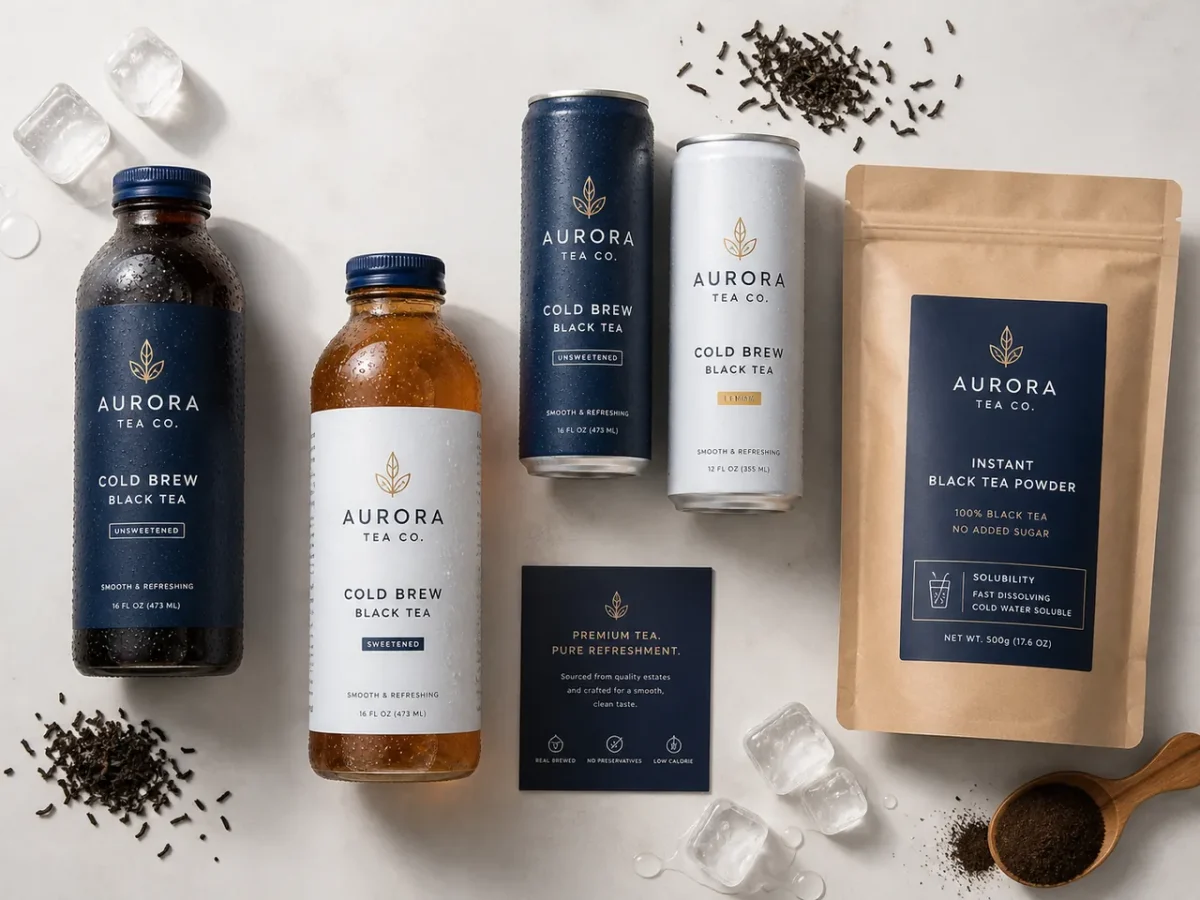
The best RTD tea powder supplier response should repeat these inputs in its quotation or technical reply. If a supplier answers only with a product name and a price, the response is not yet comparable with a documented qualification package.
1. Build a supplier qualification scorecard before testing
Use one scorecard for every candidate. The exact weights depend on the beverage, but the categories should remain stable so that a low price cannot hide a poor application fit.
| Qualification area | Evidence to request | Example weight |
|---|---|---|
| Application fit | Matched sample, recommended concentration and process notes | 25% |
| Dispersion performance | Solubility method, turbidity/settling observations and hold-time notes | 20% |
| Sensory fit | Color, aroma, tea body, bitterness and aftertaste against a reference | 15% |
| Quality documentation | Specification, batch or representative COA, test method and traceability | 20% |
| Commercial execution | MOQ, sample policy, packaging, lead time and shipment documents | 10% |
| Technical communication | Clear answers, revision control and response to RFQ fields | 10% |
The weights are a working model, not a universal standard. For a clear RTD beverage, dispersion and heat-process performance may deserve more weight. For a dry-mix product, particle size, flow and blend uniformity may receive more weight. Record the reason for any change to the scorecard.
2. Review identity and specification before the bench test
The first technical check is document consistency. The material name, grade, tea source and format should match across the quotation, sample label, specification sheet, COA and packing information. A mismatch does not automatically disqualify a supplier, but it must be resolved before a sample is approved.
Ask for the following specification fields where they apply to the selected grade:
- Tea source and product identity.
- Powder or extract format and any carrier declaration.
- Appearance, color description and odor.
- Particle-size or mesh direction when it affects handling or dispersion.
- Moisture or loss-on-drying limit where included in the specification.
- Solubility or dispersibility guidance and the test conditions behind it.
- Microbiology limits and contaminant parameters appropriate to the material and destination.
- Storage, shelf-life or retest information supplied for the specific grade.
- Packaging format, net weight, inner liner and label fields.
- Batch coding and traceability route.
Do not convert a supplier’s typical range into a binding specification without written confirmation. “Usually clear” is not the same as a defined turbidity target. “Instant” is not a complete test method. The buyer’s specification should state the acceptance criteria and the method used to evaluate them.
3. RTD tea powder supplier solubility and dispersibility tests
Solubility is often the first reason an RTD tea powder sample is rejected. It is also the area most likely to be described with vague language. A useful test records the conditions, not only the final opinion.
Minimum test variables
Record the same variables for every supplier:
- Water source, temperature and, where relevant, hardness or mineral profile.
- Powder concentration and total batch volume.
- Order of addition and wetting time.
- Mixing equipment, speed and mixing duration.
- Rest or hold time before the first observation.
- Visible floating particles, ring formation, sediment or haze.
- Filterability or screen residue if the production process uses filtration.
- Appearance after the planned heat or filling simulation.
- Observation after the target hold period and after cooling.
| Observation | What the buyer records | What the supplier should clarify |
|---|---|---|
| Initial wetting | Time to become uniformly dispersed | Recommended order of addition and mixing energy |
| Visual dispersion | Clarity, haze, floating particles or clumps | Grade design, particle-size direction and carrier status |
| Sediment | Amount and location after a defined hold time | Expected behavior for the selected process and concentration |
| Turbidity | Instrument reading or controlled visual scale | Method, instrument, temperature and acceptance range |
| Process response | Appearance before and after heat or filling simulation | Process limits and any application notes |
| Repeatability | Difference between duplicate tests or lots | Batch consistency and retention-sample practice |
A simple visual result can be useful during early screening, but an instrument value is more transferable when the method is controlled. Record the instrument model or visual scale, sample temperature, dilution and time point so another person can repeat the observation.
Cold-soluble, hot-soluble and suspension-compatible requirements
Use the process language that matches the project:
| Requirement | Primary test | Typical buyer question |
|---|---|---|
| Cold-soluble | Dispersion at the lowest planned temperature | Does the powder disperse without visible residue under the actual cold-fill conditions? |
| Hot-soluble | Dispersion plus heat and hold simulation | Does the tea profile and appearance remain acceptable after the planned heat step? |
| Suspension-compatible | Controlled suspension, settling and re-dispersion review | Is the intended haze or suspension repeatable at the target concentration? |
| Dry-mix reconstitution | Dry blending, wetting and reconstitution | Does the powder disperse uniformly after storage and reconstitution? |
Do not approve a material solely because it passes a warm-water test when the product will be filled cold. Conversely, do not reject a grade for slight haze when the finished beverage specification intentionally allows a controlled suspension. The acceptance rule belongs to the finished-product brief.
4. Turbidity, sediment and pH checks
Turbidity and sediment are not interchangeable. Turbidity describes the amount of light-scattering material in the liquid under a defined method; sediment describes material that settles or collects over time. A beverage team should track both when clarity and shelf appearance matter.
A practical bench matrix
Use a small matrix instead of a single observation. The exact points should be selected by the formulation team and recorded in the sample report.
| Test factor | Suggested comparison | Record |
|---|---|---|
| Temperature | Lowest process temperature, room temperature and post-heat temperature | Temperature at mixing and at each observation |
| pH | Target beverage pH and two nearby development points | pH method, calibration status and result |
| Time | Immediately after mixing, after a defined hold, and after cooling | Turbidity, sediment and color at each time point |
| Concentration | Target solids plus one development concentration | Powder mass, liquid mass and calculation basis |
| Process | Bench mix versus heat/fill simulation | Equipment, shear, residence time and cooling step |
If pH changes the result, record the matrix component that caused the change. Do not present a single pH result as a universal performance claim. The result belongs to the tested grade, concentration, water system and process conditions.
5. Heat-process and sensory qualification
An RTD tea powder supplier sample should connect physical observations with sensory review. Heat can change color, aroma, tea body, bitterness and astringency even when the powder remains visually dispersed. The sample report should separate instrumental or visual observations from sensory comments.
Heat-process record
Document the planned process simulation before testing:
- Starting temperature and target process temperature.
- Heating rate or practical heating procedure.
- Hold time and cooling procedure.
- Container or vessel used for the simulation.
- Sample concentration and pH.
- Appearance before heat, immediately after heat and after cooling.
- Retained sample code and test date.
Sensory scorecard
| Sensory point | Buyer record | Why it matters in supplier selection |
|---|---|---|
| Tea aroma | Intensity, direction and off-notes | Links the grade to the product brief and reference sample |
| Color | Shade, depth and change after processing | Supports a repeatable visual target |
| Tea body | Light, medium or full relative to the benchmark | Helps the supplier recommend a suitable grade or blend |
| Bitterness and astringency | Acceptable range and process effect | Avoids approving a sample that changes after processing |
| Aftertaste | Clean, persistent or unwanted note | Captures differences not visible in the COA |
| Lot comparison | Difference between samples or batches | Connects sensory approval with continuity planning |
Sensory review is not a replacement for the COA. It is an application-fit check performed alongside specification and batch documentation. Use a consistent tasting form, coded samples and the same preparation method for all suppliers.
6. RTD tea powder supplier COA and traceability review
The COA should be reviewed as a batch document, not treated as a decorative attachment. Before approval, compare the COA with the specification and sample label.
For black-tea projects, buyers can use ISO 3720:2011 as a reference for black tea definitions and basic requirements. However, it does not replace a finished-beverage specification, a supplier’s batch COA or an application test under the planned RTD process.
| Document check | What to verify | If unclear |
|---|---|---|
| Product identity | Name, grade, lot and sample label match | Ask for a corrected or cross-referenced document |
| Assay or marker | Method, result, unit and specification range | Ask whether the result is batch-specific and which method applies |
| Physical parameters | Appearance, color, moisture, particle size or other agreed fields | Confirm the acceptance limit and test method |
| Microbiology | Test items, units and limits appropriate to the material | Ask which destination-market requirements are covered |
| Contaminants | Heavy metals, pesticide or solvent information where applicable | Confirm method, reporting limit and document scope |
| Traceability | Source, batch coding and retention-sample link | Ask how the approved sample is linked to the commercial lot |
| Revision control | Issue date, document version and responsible issuer | Record the version used in the approval file |
A representative COA can support early screening, but the buyer should confirm what document will accompany the commercial batch. Do not assume that a representative document is a batch release document.
7. Sample approval workflow before bulk quotation
Use the following sequence to keep procurement, R&D and QA aligned:
- Send the application brief. State tea type, beverage format, process route, target water, concentration, sensory direction, destination and estimated volume.
- Request a matched sample. Ask for the grade, lot reference, recommended preparation, current specification and available COA.
- Log the sample on arrival. Record product name, supplier code, lot, package condition, receipt date and storage condition.
- Run the controlled bench test. Use the same water, concentration, temperature, mixing and observation time for all candidates.
- Run the process simulation. Include pH and the planned heat, hold and cooling sequence where relevant.
- Complete the sensory form. Use coded samples and a defined reference; record aroma, color, body, bitterness, astringency and aftertaste.
- Review the document set. Match sample, specification, COA, SDS/MSDS where required, packaging and quotation information.
- Repeat or challenge the test. If the project is sensitive to clarity, color or lot consistency, test a second sample or retained lot.
- Issue an approval note. Identify the approved grade, test conditions, open items, document version and commercial assumptions.
- Request the bulk quotation. Confirm MOQ, packaging, lead time, batch release documents and shipment requirements for the selected grade.
The RTD tea powder supplier approval note should be stored with the sample code and COA. This creates a reference for repeat orders and makes it easier to investigate a later difference.
8. MOQ, packaging and lead-time qualification
Commercial fit is part of supplier qualification because a technically suitable sample is not useful if the order terms cannot support the project.
| RFQ field | Questions for the supplier | What to record internally |
|---|---|---|
| Sample | Is the sample from a commercial lot? What quantity and preparation notes are available? | Sample code, lot, cost and dispatch time |
| MOQ | What is the MOQ for this grade and packing format? | MOQ by grade and pack size |
| Packaging | What inner liner, bag, drum, carton or pallet options are available? | Material, net weight, label and storage fields |
| Lead time | What is the lead time after specification and order confirmation? | Production, release and dispatch timing |
| Batch release | When is the final COA issued? | Pre-shipment or post-production document status |
| Reorder | Can the approved sample and specification version be referenced for repeat supply? | Continuity and change-notification process |
| Export file | Which commercial and destination documents can be supplied? | Required document checklist and owner |
Avoid publishing a universal MOQ or lead-time promise. These terms depend on grade, packaging, order size, production schedule and destination. Confirm them in the quotation for the selected project.
9. What to include in an RTD tea powder supplier RFQ
Send one complete brief rather than several disconnected questions. Include:
- Tea type and desired sensory direction.
- RTD, iced tea, tea concentrate, dry mix or vending application.
- Cold-fill, hot-fill, aseptic or other process information.
- Target water, powder concentration and solubility requirement.
- pH, color, turbidity, sediment and hold-time expectations where defined.
- Sample quantity, evaluation date and whether a matched reference is available.
- Trial volume, first order volume and expected annual volume.
- Destination country and required documentation.
- Packaging preference and label information.
- COA, specification, SDS/MSDS, microbiology or contaminant documents required for internal review.
- MOQ, lead-time and batch-release questions.
The RFQ should distinguish confirmed requirements from development targets. If the formula is not finalized, state what remains open instead of turning a development assumption into a fixed supplier specification.
10. Related HERBSEA resources
- Instant Tea Powder Supplier Category for available tea powder categories and commercial product paths.
- Bulk Instant Tea Powder Supplier Guide for supplier, COA, sample, MOQ and RFQ checkpoints.
- Cold Soluble Tea Powder for cold-dispersion and RTD application questions.
- Instant Black Tea Powder for RTD Beverages for black-tea-specific formulation review.
- Tea Extract Powder Supplier Guide for tea extract specification and documentation questions.
- Contact HERBSEA Plant Extract Supplier to submit a target specification, sample request and RFQ.
FAQ: RTD tea powder supplier qualification
Request a product specification, sample information, representative or batch COA as applicable, preparation guidance, packaging options, MOQ, lead time and available shipment documents. Confirm which documents will accompany the commercial lot.
Use the target water, concentration, mixing method, temperature, pH and hold time. Record dispersion, turbidity, sediment, color, aroma, tea body and aftertaste before and after the planned process simulation.
Not automatically. The suitable grade depends on the water system, process route, finished-product appearance, sensory target and defined acceptance criteria. Approve the grade against the actual application conditions.
Turbidity is a light-scattering observation under a defined method; sediment is material that settles or collects during a defined hold period. Track both when clarity and shelf appearance are important.
No. A representative COA can support initial screening, but the buyer should confirm the batch-specific document and its lot link before commercial release. The sample label, specification version and COA should be traceable as one approval record.
Include tea type, beverage format, process route, target water, concentration, sensory direction, sample quantity, destination, estimated order volume and required documents. A complete brief helps the supplier send a more relevant grade and quotation.
Summary: RTD tea powder supplier qualification
RTD tea powder supplier qualification works best as a controlled comparison of application performance, documents and commercial execution. Start with the finished beverage brief, test each candidate under the same water, concentration, pH, mixing, heat and hold conditions, and record turbidity, sediment, color and sensory results separately from the COA. Then connect the approved sample to the specification version, batch records, packaging, MOQ and lead-time discussion.
Next step: Send HERBSEA your RTD tea powder application brief with the target process, specification requirements, sample quantity, destination and estimated volume.
This article is for B2B ingredient sourcing, formulation and specification review. Finished-product, labeling and import decisions should be completed by the responsible buyer and qualified compliance team.