
Quick Answer — What should a mushroom extract RFQ include?
Seven fields in one message: (1) species and part used (fruiting body, mycelium on grain, or liquid-fermented mycelium); (2) extract format — powder, extract ratio, or marker-standardized grade; (3) target marker with its assay method (beta-glucan by enzymatic assay, not total polysaccharide); (4) COA scope — assay, heavy metals, microbiology, pesticide screen, carrier declaration; (5) sample quantity and your application test plan; (6) commercial terms — MOQ, packing, lead time, Incoterm, destination country; and (7) the export document list. Sending all seven fields together lets a supplier return a usable first quotation in one round instead of three. Use the Mushroom Extract Supplier hub as the working category page, then apply the checklist below before shortlisting any supplier.
1. Why a Structured RFQ Matters for Mushroom Extracts in 2026
Mushroom extracts are one of the fastest-moving functional ingredient categories. Industry research puts the global functional mushroom ingredient market at roughly USD 8.89 billion in 2024, with projections toward USD 16.92 billion by 2035 at a CAGR of about 6.7% (industry research compiled by HSRB, 2025). North America and Southeast Asia are the fastest-growing regions.
Growth has widened the quality spread between suppliers. Independent sampling reported in 2025 found that only 38.2% of surveyed retail products carried complete credentials and clear origin information, and fewer than 12% could provide third-party assay data for their declared actives (China market supervision sampling, 2025, cited by HSRB). DNA testing of 42 reishi spore powder lots rejected 10 — a 23.3% failure rate. For a B2B buyer, the practical conclusion is simple: a written RFQ with explicit specification, method and document fields is the cheapest quality filter you can apply, before any sample or audit cost is incurred.
| Market / quality indicator | Value | Source / year |
|---|---|---|
| Global functional mushroom ingredient market | USD 8.89B (2024) → USD 16.92B (2035E), CAGR ~6.7% | HSRB industry research, 2025 |
| Products with complete credentials and clear origin | 38.2% of surveyed retail products | China market supervision sampling, 2025 |
| Lots providing third-party assay data for declared actives | <12% | Same sampling, 2025 |
| Reishi spore powder lots failing identity testing | 10 of 42 sampled (23.3%) | CACMS gene-identity study, 2025 |
| Starch content found in mycelium-on-grain material | 30-60% by dry weight | McCleary & Draga, J. AOAC Int., 2017 |
2. Species and Part Used: The First RFQ Field
The largest source of mislabeled mushroom material is not the species name — it is the part of the fungus that was actually extracted. The same species can be sold as fruiting body powder, as mycelium grown on grain (the whole colonized mass ground together), or as liquid-fermented mycelium. Each has a different composition profile and a different specification language.
| Part used | What it is | RFQ note |
|---|---|---|
| Fruiting body extract | Extracted from the mushroom itself (hot water, ethanol, or dual) | The reference format for most beta-glucan specifications; confirm “fruiting body” in writing |
| Fruiting body powder | Dried and milled fruiting body, no concentration | Check for intact identity, microbiology and sensory fields rather than a high assay number |
| Mycelium on grain | Mycelium plus the residual grain substrate, ground together | Reported assays are often inflated by grain starch; specify an alpha-glucan limit if you accept this format |
| Liquid-fermented mycelium | Mycelium harvested from submerged fermentation | Common for cordyceps CS-4; confirm the strain and fermentation documentation |
If your formulation or label plan says fruiting body, the RFQ should require the supplier to confirm the part used and to back it with starch and ergosterol results (see Section 3). A mismatch between the declared part and the analytical data is a valid reason to stop the RFQ before quotation.
3. Marker Fields and Assay Methods: The Field Most Buyers Get Wrong
A “polysaccharide 40%” line and a “beta-glucan 20%” line are not comparable, and a quotation that mixes them is not comparable either. The two method families measure different things:
- Gravimetric or non-specific polysaccharide assays (including phenol-sulfuric type methods) precipitate all polysaccharides together — alpha-glucans (starch, glycogen), beta-glucans, and non-glucan polysaccharides. A grain-heavy material can report “60% polysaccharides” while contributing little fungal beta-glucan.
- Enzymatic beta-glucan assays (the Megazyme K-YBGL procedure derived from McCleary’s method, aligned with AOAC 995.16) report total glucan, alpha-glucan, and beta-glucan by difference. The alpha-glucan line exposes grain starch immediately.
| COA line | What it confirms | Typical benchmark |
|---|---|---|
| Beta-glucan (enzymatic method) | Fungal (1,3)(1,6)-beta-D-glucan content | 20%+ workable for many formulations; 50%+ premium grades |
| Alpha-glucan | Starch or glycogen — dilution from grain substrate | <5% for fruiting body material |
| Total polysaccharide (gravimetric) | Bulk carbohydrate, method-dependent | Only comparable against the same method and species |
| Starch (enzymatic, AOAC 996.11) | Direct grain-substrate exposure | >5% is a hold signal for fruiting body claims |
| Ergosterol (HPLC-UV) | Fungal membrane marker — identity cross-check | Low ergosterol indicates substrate dilution |
| Species-specific marker | Triterpenes (reishi), betulinic acid (chaga), adenosine (cordyceps CS-4) | Confirm per species and per your label plan |
Common market specifications you can use as RFQ reference points include reishi extract standardized for polysaccharides and triterpenes, lion’s mane for beta-glucans, turkey tail for polysaccharide peptides, cordyceps CS-4 for adenosine and polysaccharides, chaga for betulinic acid, and tremella for polysaccharides above 40%. Whatever the target, write the method into the RFQ: “beta-glucan by enzymatic assay, reporting alpha-glucan separately.”
4. COA Scope: Fields to Require on Every Lot
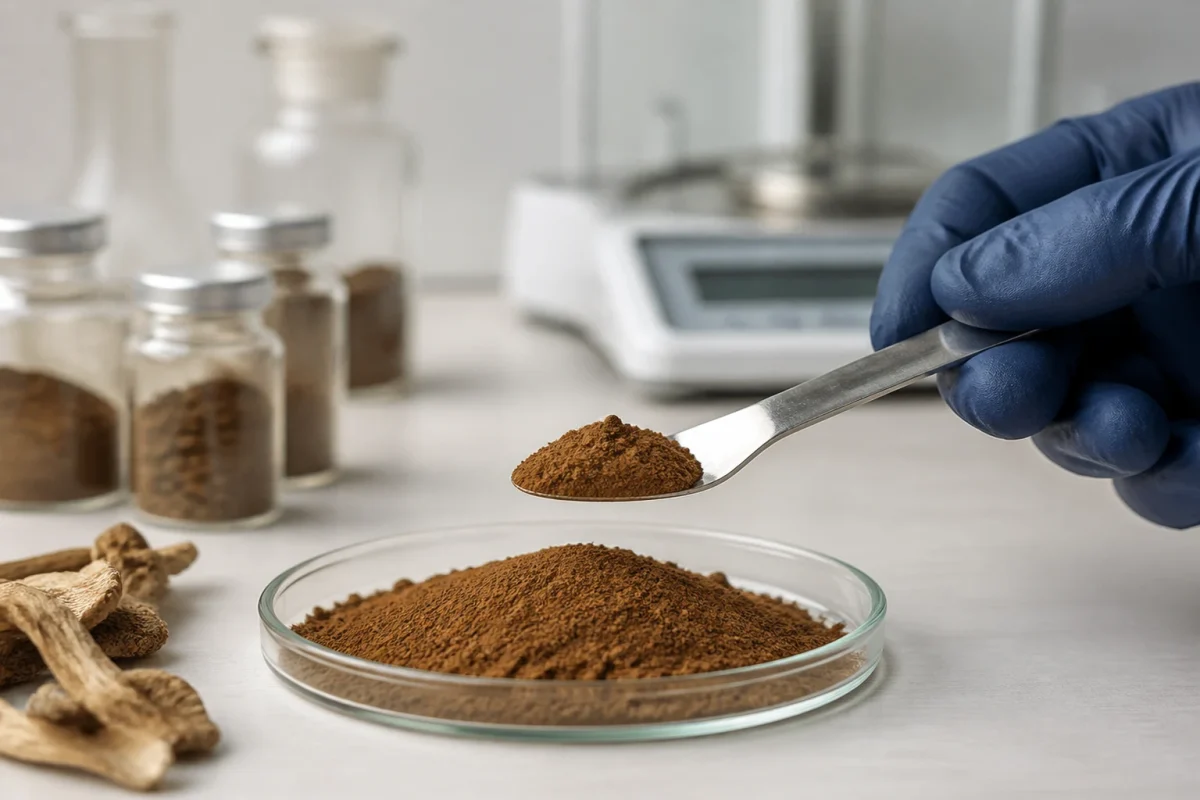
A quotation is only as good as the documents behind it. The RFQ should list the COA fields you expect, so all bidders quote against the same document scope. Minimum fields for a bulk mushroom extract COA:
| COA field | What it confirms | Common methods / limits |
|---|---|---|
| Appearance, color, odor | Lot conformity to the approved sample | Visual / sensory, vs retained reference |
| Assay (marker) | Active content of this lot | Method named on the COA (see Section 3) |
| Moisture (loss on drying) | Stability and shelf life | ≤ 5-8% typical for extract powders |
| Total ash | Mineral residue and process control | ≤ 5-10% typical |
| Heavy metals (Pb, As, Cd, Hg) | Contaminant compliance for destination market | ICP-MS / AAS; limits set by destination regulation |
| Microbiology (TPC, yeast & mold, coliforms, E. coli, Salmonella) | Food safety | ISO / GB plate methods; Salmonella negative in 25 g |
| Pesticide residues | Destination-market MRL compliance | Multi-residue GC-MS/MS + LC-MS/MS screen |
| Carrier / filler declaration | Whether maltodextrin or other carriers are present | Should be declared; affects label and blend math |
Ask whether the COA is issued by an ISO 17025-accredited third-party laboratory or by the supplier’s in-house lab. Both are workable, but the RFQ decision (and your audit file) should record which one you are buying. For destination markets with strict residue enforcement, a multi-residue pesticide screen covering hundreds of compounds is the safe default rather than a short panel.
5. Sample Approval: Link the Sample Lot to the COA
Samples are where an RFQ becomes a physical decision. The failure mode to avoid is a floating approval — a sample tasted or bench-tested with no lot number, no COA and no written record, followed by a bulk shipment from a different batch.
- Request a sample quantity that fits your test plan. 50-100 g is the common R&D and QA range for extract powders; smaller free samples (10-25 g) are standard for initial identity checks from origin manufacturers.
- Record the sample lot number against the COA you received. The sample COA, the spec sheet and the retained sample belong in one file. If the lot number on the bulk shipment differs from the approved sample lot, the shipment needs a new COA review before release.
- Run your application tests, not just the supplier’s assay. Solubility in your beverage matrix, dispersion in a stick pack, sediment in an RTD, color and bitterness contribution, and heat or pH stability during your process are decisions only your bench can answer.
- Budget sample stage by type. Stock sample programs typically run USD 0-50 with courier freight the main variable; custom or specification-matched samples usually USD 50-500; pre-production or pilot lots USD 100-1,000+. Industry experience puts sample-to-order conversion in the 20-30% range, so plan the number of suppliers you qualify accordingly.
6. Commercial Terms: MOQ, Packing, Lead Time and Export Documents
Commercial fields belong in the same RFQ, not a follow-up email, because they change which suppliers can actually bid.
| Commercial field | Typical market benchmark | RFQ note |
|---|---|---|
| MOQ — trial order | 1-5 kg per SKU is common for trial or R&D volumes | Confirm the trial MOQ is per SKU, not per blend |
| MOQ — formal order | 25 kg per SKU is the standard commercial drum | Custom specifications and blends usually raise the MOQ |
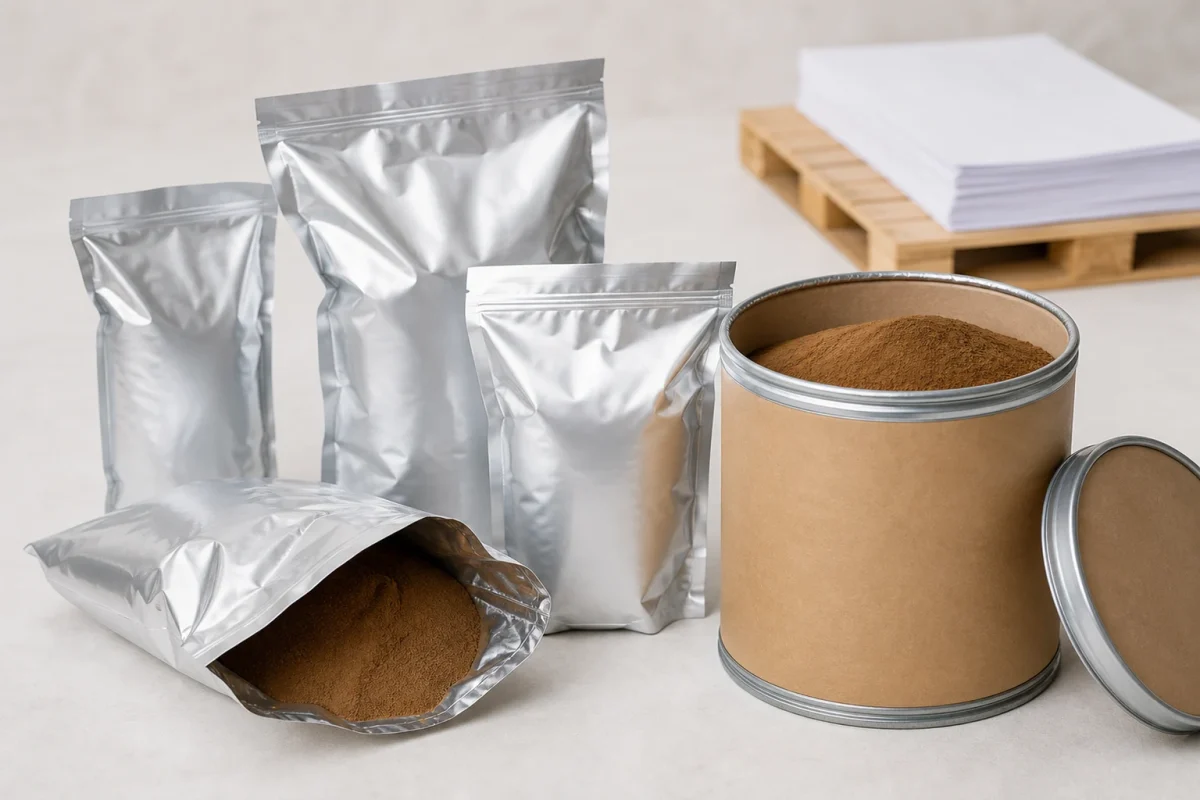
| Packing | 1 kg aluminum foil bag; 25 kg fiber drum with double PE liner | Nitrogen-flushed or vacuum packing for hygroscopic powders |
| Lead time — stocked lots | 2-3 weeks including dispatch for small orders | Confirm what “stocked” means for your species and grade |
| Lead time — production lots | 4-6 weeks for pallet-scale or made-to-spec volumes | Custom marker grades can run longer; get the date in writing |
| Shipping split | Courier for sample and small lots; air freight around 50 kg; sea freight at 100 kg+ | Match the shipping mode to your trial timeline |
| Export documents | COA, specification sheet, MSDS, certificate of origin, phytosanitary where required | Add allergen, GMO-free and non-BSE/TSE statements if your market needs them |
| Shelf life | 24-36 months typical for extract powders | Confirm re-test date and storage conditions on the COA |
Also state the Incoterm you quote against (EXW, FOB, DAP, DDP), the destination country, and the destination port or warehouse. Destination determines the residue limits, the document list and sometimes the eligible origin — for example, UK/EU novel-food rules restrict how mycelium-based ingredients can be placed on the market for many species.
7. Document Review vs Commercial RFQ: Two Stages, One File
| Dimension | Document review | Commercial RFQ |
|---|---|---|
| Main purpose | Confirm identity, part used, specification, COA fields and sample fit | Confirm MOQ, price basis, packing, lead time and shipment needs |
| Buyer input | Application, target grade, method preference, document list | Trial quantity, annual estimate, destination country, packing requirement |
| Output | Shortlist of suppliers whose documents and sample pass | A comparable quotation set on identical specification and terms |
| Limit | Does not replace commercial confirmation | Should be based on the approved specification and document checklist |
Keep the two stages in one RFQ file so the final quotation references an approved specification version, a sample lot number and a COA scope. That is what makes a price comparable across suppliers — and defensible internally when the shipment arrives.
8. The Mushroom Extract RFQ Checklist
Send these fields in one RFQ message:
- Target species, Latin name, and part used (fruiting body, mycelium on grain, or liquid-fermented mycelium).
- Extract format: powder, extract ratio (e.g., 1:1 or concentrated), or marker-standardized grade — with the intended application.
- Target marker and assay method: beta-glucan by enzymatic assay with alpha-glucan reported separately, or the species-specific marker you require.
- COA scope: appearance, assay, moisture, ash, heavy metals, microbiology, pesticide screen, carrier declaration, and issuing lab (in-house or ISO 17025 third party).
- Sample quantity, sample lot recording rule, and your application test plan.
- MOQ for trial and formal orders, packing size, lead time expectation, Incoterm and destination country.
- Export document list: COA, spec sheet, MSDS, certificate of origin, phytosanitary where applicable, plus any statements your market requires.
9. Related Sourcing Pages
- Mushroom Extract Supplier hub — category-level comparison of species, grades and documents.
- Reishi Mushroom Extract — polysaccharide and triterpene grade review for bulk sourcing.
- Lion’s Mane Mushroom Extract — beta-glucan grade and document comparison.
- Turkey Tail Mushroom Extract — beta-glucan and sample review.
- Chaga Mushroom Extract — betulinic acid specification review.
- Cordyceps Powder — powder format and document checks.
- Bulk Ingredient Sample Request Template — sample quantity, COA and specification notes.
- Food Ingredient RFQ Template — quotation structure for food ingredients.
- Ingredient Sourcing Resource Center — RFQ, sample, audit and export document workflows.
10. FAQ
Species and part used, extract format, target marker with assay method, COA scope, sample quantity and test plan, MOQ, packing, lead time, Incoterm, destination country, and the export document list — sent together so the supplier can quote in one round.
No. Extracts are compared on marker assay and method (beta-glucan enzymatic, species-specific actives), while powders are compared on identity, particle size, microbiology and sensory fields. Putting both in one comparison table produces false equivalence.
Non-specific polysaccharide methods co-measure starch and other carbohydrates, so a grain-heavy material can report a high total while contributing little fungal beta-glucan. Enzymatic methods report alpha-glucan separately, which exposes substrate dilution directly.
Trial orders of 1-5 kg per SKU and formal orders of 25 kg per drum are the common market structure; custom marker grades and blends usually carry higher minimums. Confirm both tiers in the RFQ before shortlisting.
B2B buyers can request the available COA, specification sheet, packing details and export document support before quotation. Start with the mushroom extract hub to shortlist species and grades, then send the RFQ fields to the HERBSEA team.
Fruiting body ingredients are extracted from the mushroom itself and are the reference format for most beta-glucan specifications. Mycelium-on-grain products include the residual grain substrate — published testing found 30-60% starch by dry weight in such materials — so alpha-glucan and starch lines should be checked before comparing them against fruiting body quotes.
11. Summary
A mushroom extract RFQ that specifies species and part used, extract format, marker with assay method, COA scope, sample plan, MOQ, packing, lead time, destination and export documents will return comparable quotations and expose specification gaps before any sample cost. Send the seven checklist fields in one message, keep the sample lot tied to its COA, and your first quotation round becomes your supplier filter.
Data sources: HSRB industry research on the functional mushroom ingredient market (2025); China market supervision sampling and CACMS identity studies (2025); McCleary & Draga, Journal of AOAC International (2016-2017); published supplier COA and MOQ benchmarks from US, EU and China-origin suppliers (2024-2026). Commercial benchmarks are indicative — confirm exact limits against your destination-market regulation and each supplier’s current specification.