
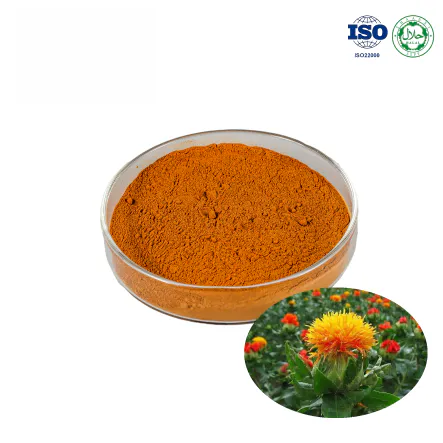
Is Safflomin A in saffron extract? No. Safflomin A (hydroxysafflor yellow A, CAS 78281-02-4) is the marker of safflower (Carthamus tinctorius) extract, not saffron (Crocus sativus). Genuine saffron extract is standardized on crocin, safranal and picrocrocin. Below we review typical HPLC COA items for saffron extract, show how to tell safflower yellow from saffron on a spec sheet, and list the documents to request before an RFQ.
Saffron Extract vs. Safflower Yellow (Safflomin A) on a Spec Sheet
| Item | Saffron extract (Crocus sativus) | Safflower yellow / “saffron substitute” (Carthamus tinctorius) |
|---|---|---|
| Marker compounds | Crocin, safranal, picrocrocin | Safflomin A / hydroxysafflor yellow A |
| CAS | Crocin 42553-65-1; Safranal 116-26-7 | HSYA 78281-02-4 |
| HPLC detection | 440 nm (crocin) / 330 nm (safranal) | 403 nm |
| Typical spec | Crocin 3–5% + Safranal 0.3–0.8% (HPLC) | HSYA ≥40% or ≥98% (reference standard) |
| COA red flag | “Safflomin A” listed as saffron marker | — |
If a supplier quotes “safflomin A ≥98%” on a saffron extract COA, the document describes safflower yellow, not Crocus sativus extract.
For the document screening steps, see how to review an HPLC COA.
Typical COA Values: Crocin, Safranal & Physical Tests
| Item | Method | Industry typical range* |
|---|---|---|
| Crocin | HPLC | 3–5% (spec NLT 5.0% seen) Source: inhealthnature.com; nutrifoods.eu |
| Safranal | HPLC or UV | 0.3–3.5% (batch results 3.05–3.2% seen at 3% spec) Source: inhealthnature.com; wellgreenherb.com; sanxinherbs.com; nutrifoods.eu |
| Picrocrocin | UV (ISO 3632) | colour strength ≥200, flavour ≥70 Source: nutrifoods.eu |
| Loss on drying | 105°C | ≤5.0% (batch 2.23% seen) Source: wellgreenherb.com |
| Ash | 600°C | ≤5.0% (batch 3.05% seen) Source: sanxinherbs.com |
| Pb / As / Cd / Hg | ICP-MS | ≤1 / ≤1 / ≤1 / ≤0.1 ppm (EU style) Source: nutrifoods.eu |
| TPC / Y&M | USP/EP | ≤10,000 / ≤1,000 cfu/g Source: wellgreenherb.com |
HERBSEA lot data (three-batch COA values) is available on request.
*Industry ranges compiled from public supplier spec sheets (wellgreenherb.com, sanxinherbs.com, inhealthnature.com, nutrifoods.eu), accessed 2026-11-13. Values are for reference comparison only, not HERBSEA claims.
Use the three-lot COA comparison method to compare results on the same reporting basis.
Saffron Extract Specification Checklist
Use this checklist to define purchasing requirements. It is a review guide; the agreed specification and batch COA should establish the actual values for the material being quoted.
| Review item | What to confirm |
|---|---|
| Identity | Product name: Saffron Extract; botanical source: Crocus sativus. Confirm plant part and identity documentation. Confirm the marker basis: crocin/safranal (HPLC) vs safflomin A (403 nm, safflower). |
| Marker profile | Confirm whether crocins, picrocrocin, safranal or other markers are relevant to the proposed grade. Request target ranges and acceptance limits. |
| Analytical basis | Request the assay method, units and reporting basis. Check that the specification and COA use comparable definitions. |
| Composition and handling | Confirm extract ratio where relevant, carrier or excipient content, moisture, particle size, color and odor. |
| Quality limits | Agree residual solvent, heavy metal and microbiological requirements with your QA team and destination market needs. |
| Commercial details | Confirm sample quantity, MOQ, packing size, storage information, lead time and shipment terms in the quotation. |
Application Fit and Sample Testing
Share whether you are developing capsules, tablets, a powder blend or another finished-product format. Carrier composition, color, odor and dispersion can affect processing and formula acceptance. Do not assume that extracts with similar marker claims will perform the same way.
- Define the application and acceptance criteria before requesting a sample.
- Record the sample code, lot number and specification version; connect them with the supplied COA.
- Evaluate color, odor, blending and dispersion under your actual process conditions. For liquid projects, check settling and color stability in the intended matrix.
- Record the results and confirm how the approved sample relates to the proposed commercial batch.
Documents for Procurement and QA Review
Request a specification sheet and a representative or batch-specific COA, identifying which is supplied. Review the botanical source, plant part, marker definitions, test methods and ingredient composition together. A representative COA should not be treated as the release record for a later shipment.
Ask which supporting records are available for the proposed grade: test reports, process information, origin or traceability details, allergen statement, storage guidance and packing information. Confirm the scope and current validity of any certification your project requires. Use the plant extract COA review checklist to organize document screening.
Compare Supplier Replies on the Same Basis
Use one purchasing brief for every quotation. Mark each field as confirmed, pending or outside your requirements so that a lower unit price does not hide a difference in grade or documentation.
| Decision | Evidence to compare |
|---|---|
| Technical match | Identity, plant part, marker definition, method, composition and agreed limits. |
| Sample match | Traceable sample lot, evaluation results and relationship to the commercial batch. |
| Supply match | Document readiness, MOQ, packaging, delivery terms and handling of specification changes. |
Prepare Your Saffron Extract RFQ
Include the intended application, specification and method, required documents, sample quantity, estimated order volume, packing preference and destination market. If a field is undecided, describe your process and constraints so the proposed grade can be reviewed against them.
You can also compare the plant extract ingredient category while preparing a broader sourcing brief.
FAQ: Saffron Markers and Safflomin A
No. Safflomin A (hydroxysafflor yellow A, CAS 78281-02-4) is a safflower (Carthamus tinctorius) marker, not a saffron (Crocus sativus) marker. Compare it with crocin (CAS 42553-65-1) and safranal (CAS 116-26-7) when reviewing a saffron extract COA.
The reference detection wavelengths in the comparison above are 440 nm for crocin and 330 nm for safranal, versus 403 nm for safflomin A / hydroxysafflor yellow A in safflower. Request the actual validated assay method and reporting basis for the proposed grade; HPLC and UV results are not directly interchangeable.
Review three fields: first, confirm the marker names (crocin, safranal and picrocrocin rather than safflomin A); second, check the CAS identifiers against the named markers; third, compare the detection wavelengths and assay method with the specification. Request botanical identity documentation and the batch-specific COA before accepting the material.