
Quick Answer: Dihydroquercetin (DHQ, taxifolin) and quercetin are different flavonoids with different specifications, sources and formulation behavior. DHQ is the hydrogenated form of quercetin (no C2=C3 double bond), has roughly 10x higher aqueous solubility (about 0.87-1.0 mg/mL vs about 0.06 mg/mL for quercetin), and is mainly produced from larch (Larix) sources, while quercetin is typically extracted from Sophora japonica flower buds, onions or tartary buckwheat. Buyers should specify the assay range (for example >= 95% HPLC), test method, source material and application format separately for each ingredient before requesting a quotation.
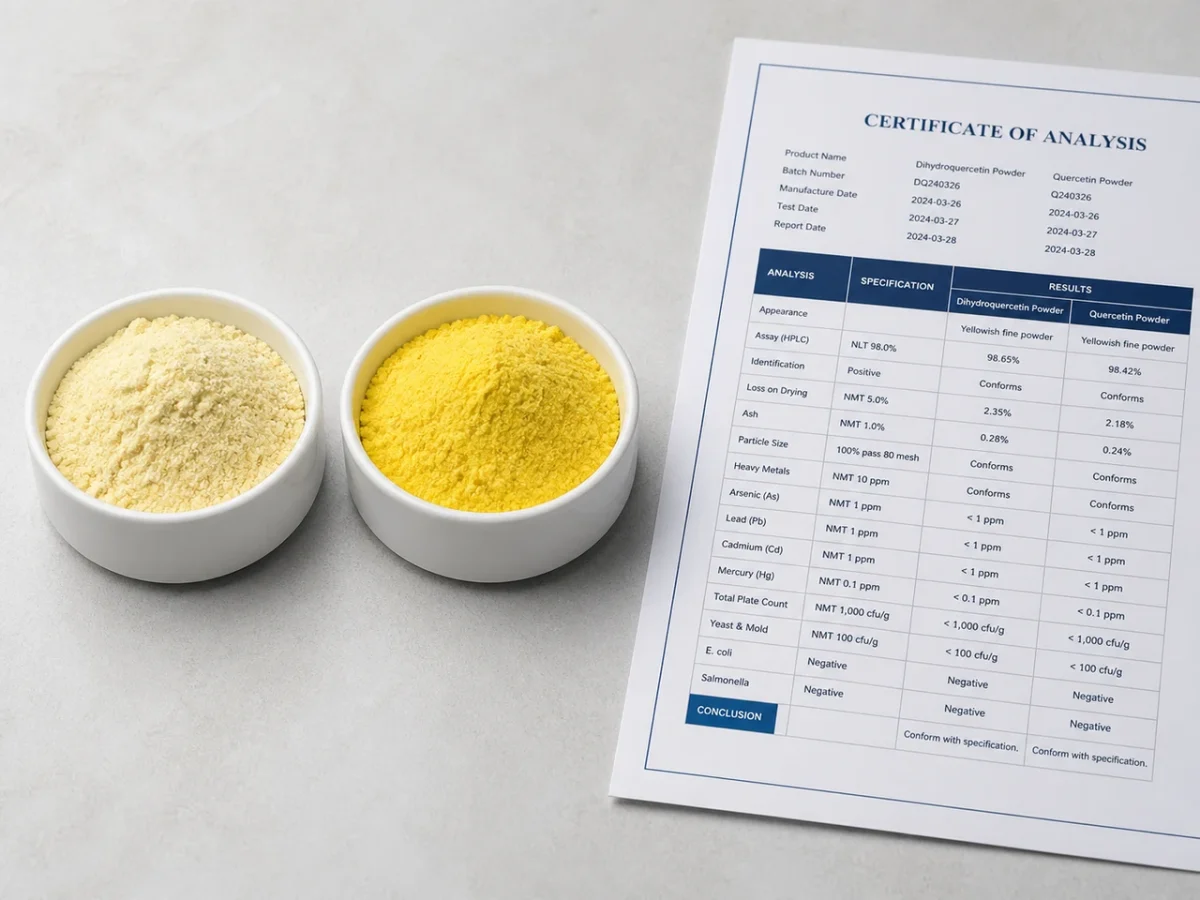
1. What Is the Difference Between Dihydroquercetin and Quercetin?
Dihydroquercetin (also called taxifolin) and quercetin are both flavonoids, but they are different chemical compounds with different CAS numbers, molecular weights and physical behavior. The core structural difference: quercetin has a C2=C3 double bond in its C-ring (flavonol class), while dihydroquercetin has a saturated C2-C3 single bond (flavanonol class). This single bond difference changes water solubility, stability and formulation fit.
| Parameter | Dihydroquercetin (Taxifolin) | Quercetin |
|---|---|---|
| CAS number | 480-18-2 / 24198-97-8 / 17654-26-1 | 117-39-5 |
| Molecular formula | C15H12O7 | C15H10O7 |
| Molecular weight | 304.25 g/mol | 302.24 g/mol |
| Flavonoid class | Flavanone (dihydroflavonol) | Flavonol |
| Aqueous solubility (reference) | About 0.87-1.0 mg/mL | About 0.06 mg/mL |
| Typical commercial sources | Larch (Larix sibirica / gmelinii) wood and bark | Sophora japonica flower buds, onions, tartary buckwheat |
Why this matters for buyers: the same “flavonoid” label hides two different raw materials with different purity targets, different COA fields and different downstream behavior in beverages, capsules and powder blends.
2. Botanical Sources and Commercial Production
Source selection is a practical first filter when shortlisting suppliers.
| Sourcing question | Dihydroquercetin | Quercetin |
|---|---|---|
| Primary botanical source | Larch tree (Larix sibirica, Larix gmelinii) heartwood and bark; also Douglas fir bark | Sophora japonica flower buds (main commercial source), onion skins, tartary buckwheat |
| Commercial availability | Smaller production base, fewer dedicated producers | Wide production base, many suppliers worldwide |
| Typical assay grades | >= 90%, >= 95%, >= 98% by HPLC | 95%, 98% by HPLC; quercetin dihydrate also available |
| Purity method commonly cited | HPLC | HPLC or UV |
| Market position | Specialty / premium niche | Commodity-grade mainstream |
Buyers sourcing DHQ should ask for the botanical source declaration (larch species) because it affects supply security and documentation. For quercetin, confirm whether the material is anhydrous or dihydrate, since that changes assay calculation and moisture limits on the COA.
3. Specification Comparison for Supplier Review
| Review field | Dihydroquercetin | Quercetin |
|---|---|---|
| Assay target | Confirm HPLC assay (for example >= 95%) and agreed method | Confirm HPLC or UV assay and whether dihydrate basis |
| Physical review | Fine powder appearance, odor, flow, bulk density, blend behavior | Yellow powder appearance, odor, color impact, dispersion behavior |
| Solubility-related | Higher water solubility supports liquid and beverage formats | Lower water solubility; color impact in clear liquids should be tested |
| Document package | COA, specification sheet, source declaration, flow chart, allergen statement, quality questionnaire | COA, specification sheet, source statement, allergen statement, quality questionnaire |
4. COA and Sample Review Checklist
A useful comparison starts with one supplier lot and one document set. Match the sample label, COA, specification and quotation to the same material before internal evaluation.
- Confirm ingredient name, source material, plant part where applicable and supplier lot number.
- Compare assay value, test method (HPLC vs UV), moisture, particle size, color and carrier declaration.
- Review microbiology, heavy metals, residual solvents, storage condition and retest policy.
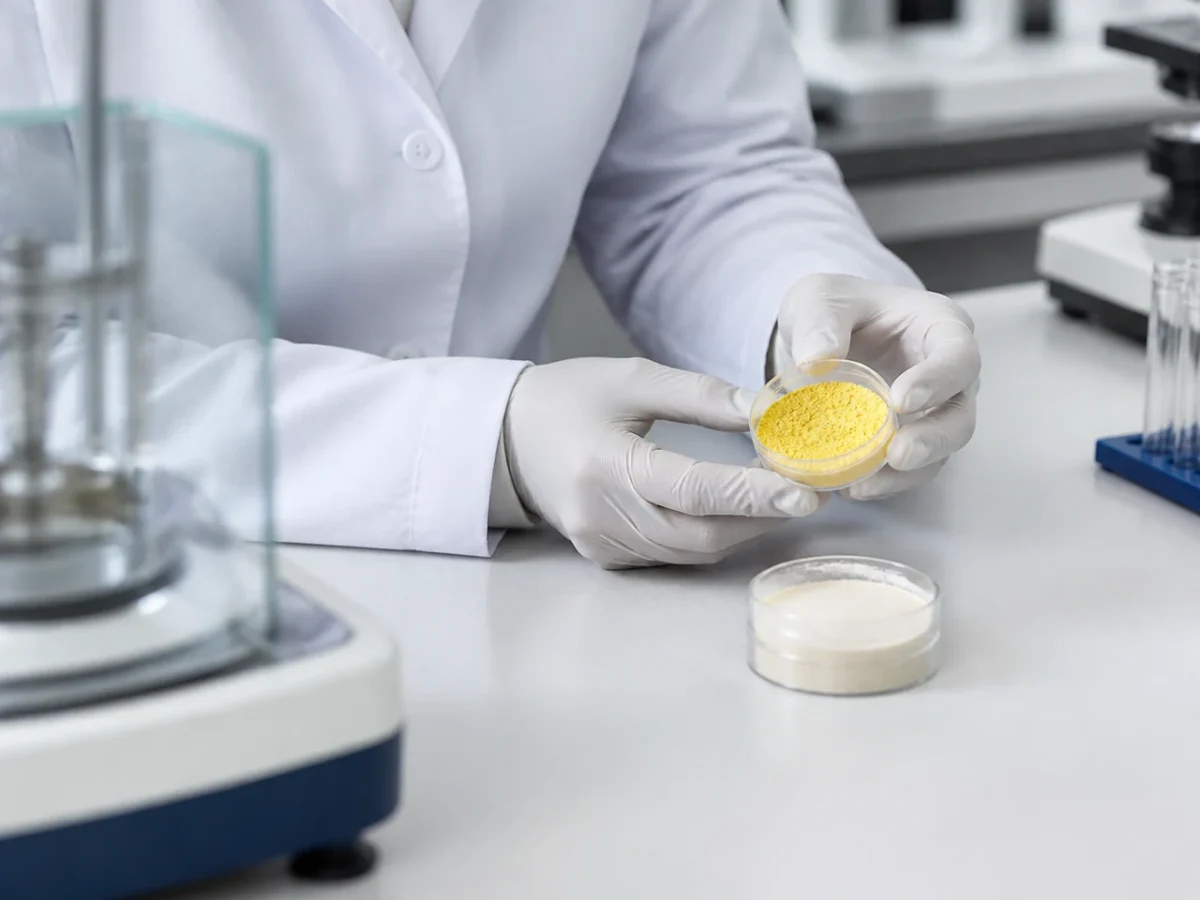
- Record appearance, odor, taste profile, flow, bulk density, mesh size and blend behavior during sample testing.
- For DHQ: confirm the larch source and whether the assay is calculated on dry basis.
- For quercetin: confirm anhydrous vs dihydrate form and the moisture limit on the COA.
- Ask for packaging format, MOQ, lead time, quotation validity and export document availability before order planning.
Sample Approval in 5 Steps
- Match lot identity – confirm the lot number on the COA equals the lot on the sample container and packing list.
- Check assay and method – verify the assay value meets your target range and note whether HPLC or UV was used.
- Check form-specific fields – for DHQ confirm source (larch species) and dry-basis assay; for quercetin confirm anhydrous vs dihydrate and the moisture limit.
- Test in your application – run dispersion, color, taste and blend behavior in the actual formula format before bulk order.
- File the evidence – keep sample code, COA, specification and quotation together in the purchasing file for reorder consistency.
5. Application and Formulation Fit
| Application format | What to test in samples | Useful RFQ detail |
|---|---|---|
| Capsules or tablets | Flow, bulk density, color, particle size and compatibility with excipients | Assay target, capsule or tablet format, annual volume and document list |
| Powder blends or sachets | Blend uniformity, dust level, color impact, caking tendency | Blend matrix, flavor base, packing size, sample quantity |
| Beverages or instant concepts | Dispersion, sediment, taste profile, color impact, pH stability | Liquid system, pH range, flavor base, target active content |
| Custom formula projects | Compatibility with other ingredients, documentation depth | Full formula direction, restricted excipients, launch timeline |
Practical note: DHQ’s higher water solubility makes it a more frequent candidate for clear beverage and aqueous formats, while quercetin’s intense yellow color and lower solubility usually require carrier or dispersion testing in liquids. Both can work in capsules and tablets, where particle size and flow matter more than solubility.
6. Market Context for Buyers
The global quercetin market was estimated at about USD 1.1 billion in 2025, with forecasts of roughly 7.5% CAGR through 2034 (Growth Market Reports, 2026). Quercetin is the mainstream, higher-volume ingredient, while dihydroquercetin occupies a smaller, premium niche with a shorter list of dedicated producers. This asymmetry matters for sourcing strategy: quercetin benefits from a deep supplier pool and price competition, while DHQ buyers should qualify a smaller number of producers more carefully, especially on source declaration, assay consistency and documentation depth.
7. RFQ Checklist for Both Ingredients
- Target ingredient name and CAS number (avoid mixing DHQ and quercetin in one RFQ).
- Assay target and test method (HPLC or UV), with dry-basis or dihydrate basis stated.
- Botanical source declaration and plant part.
- Application format (capsule, tablet, beverage, powder blend) and process condition.
- Particle size, moisture and color requirements.
- COA fields required: assay, moisture, ash, heavy metals, microbiology, residual solvents, lot number, retest date.
- Sample quantity, packing preference and destination country.
- Annual volume estimate and lead time expectation.
8. Related Product Pages
- Quercetin Powder product page for grade, COA and bulk purchasing details.
- Taxifolin Bulk Powder Supplier Guide for related source, sample and document review.
- Dihydroquercetin vs Quercetin supplier comparison for a second buyer guide focused on specification review and sourcing questions.
9. Related Sourcing Pages
- Plant Extract COA Review Checklist for document checks before sample approval.
- Plant Extract Ingredients for broader botanical ingredient sourcing.
- Contact HERBSEA to request specification, COA, samples and quotation details.
10. FAQ for B2B Buyers
No. Dihydroquercetin (taxifolin) is the hydrogenated form of quercetin: the C2=C3 double bond in the C-ring is saturated. They have different CAS numbers, molecular weights and physical properties, so they must be specified and quoted separately.
Compare assay range, test method, source material, particle size, physical sample behavior, COA depth, MOQ, lead time, packing options and document availability.
Request the current COA, specification sheet, lot number, sample label, allergen statement, flow chart, quality questionnaire and export documents required by your destination market.
Share the target ingredient, assay range, application format, sample quantity, expected order volume, packing preference, destination market, document list and buying timeline.
The saturated C2-C3 bond changes the molecular shape and hydrogen-bonding behavior, giving DHQ roughly 10x higher aqueous solubility (about 0.87-1.0 mg/mL vs about 0.06 mg/mL). This is why DHQ is more often considered for clear beverage and aqueous formulations.
HERBSEA can review the target specification, confirm available grades, prepare COA and sample options, and provide quotation details for suitable B2B ingredient projects.
Summary
For a faster supplier review, send the ingredient name with CAS number, target grade and assay method, botanical source requirement, application format, sample plan, COA requirements, order estimate, packing need and destination country in one RFQ.
Data sources: Growth Market Reports (quercetin market, 2026: ~USD 1.14 billion in 2025, ~7.5% CAGR to 2034); BenchChem / Herbuno technical references (taxifolin CAS 480-18-2, C15H12O7, MW 304.25; aqueous solubility 0.87-1.0 mg/mL vs quercetin 0.06 mg/mL); published supplier COA examples (DHQ >= 90/95/98% HPLC; quercetin 95/98% HPLC). Solubility and purity figures are reference ranges from published technical literature – confirm actual values with the supplier’s COA for your target grade.