
Quick Answer: Most cinnamon powder COAs fail buyers not because the assay is wrong, but because they skip the fields that actually determine compliance: the botanical species, the coumarin content, and the heavy-metal results. A European Commission JRC study published in September 2025 found that more than 66% of cinnamon samples marketed in the EU failed international quality standards, breached EU food-safety rules, were suspected of fraud, or exceeded legal coumarin limits. The species line on your COA — Ceylon (Cinnamomum verum) or cassia (C. cassia / C. burmannii / C. loureiroi) — decides your coumarin exposure, your export-market access, and your finished-product legal risk. Before you approve any cinnamon powder COA, verify: (1) species is named, not just “cinnamon”; (2) coumarin is quantified; (3) lead is tested against EU Regulation 2023/915 (2.0 mg/kg) or your destination limit; (4) mesh, moisture and microbiology match your process. HERBSEA can support this review with the Cinnamon Powder product page, COA, and sample support for qualified projects.
Why “Cinnamon” on a COA Is a Compliance Time Bomb
Here is the uncomfortable truth about the cinnamon trade: the word “cinnamon” on a label, a spec sheet, or a certificate of analysis almost never tells you which plant you are buying. Four distinct species are sold under that one word. Two of them — Ceylon and cassia — differ by a factor of roughly a thousand in a compound that regulators actively limit. If your COA says “cinnamon powder” and stops there, you have not been given a specification. You have been given a gamble.
The European Commission’s Joint Research Centre (JRC) published a study on 24 September 2025 covering cinnamon marketed across the EU. The headline number should be on every buying team’s wall: more than 66% of the tested samples failed to meet international quality standards, were non-compliant with EU food-safety legislation, were suspected of fraud, or potentially exceeded legal coumarin limits. The study covered quality, species substitution, adulteration with other plant parts, and contaminant levels. Two-thirds of the market failing. That is not a footnote; it is the operating reality of this supply chain.
The problem is not new, and it is not confined to the EU. Retail surveys in the Czech Republic tested 60 ground-cinnamon samples across twelve brands and found coumarin levels ranging from 2,650 to 7,017 mg/kg — consistent with cassia, not Ceylon — while a direct plantation sample from Sri Lanka was coumarin-free. The pattern repeats everywhere retail “cinnamon” is sold without a species commitment. For a B2B buyer, this is the strongest possible argument for demanding the species line in writing on every COA, batch after batch.
So the opinion this guide is built on is simple and deliberately uncomfortable: if your supplier’s COA does not name the species and quantify coumarin, regard the document as decorative. The assay number may be perfect. The shipment may still fail customs, fail your customer’s audit, or fail in a finished product that carries your brand. Species is not a flavour preference. It is the compliance fork in the road, and it is decided at the COA stage — or not at all.
Ceylon vs Cassia: The Species Decision That Determines Compliance
“Cinnamon” in commercial trade covers at least four species. For a purchasing team only two matter: Ceylon (Cinnamomum verum, also called true cinnamon, mostly from Sri Lanka) and cassia (mainly C. cassia from China and Vietnam, C. burmannii from Indonesia, and C. loureiroi from Vietnam). Both are dried tree bark. Both taste and smell like cinnamon. They diverge sharply on coumarin, price, and regulation.
| Parameter | Ceylon (C. verum) | Cassia (C. cassia / burmannii / loureiroi) | Why it matters in a COA |
|---|---|---|---|
| Coumarin content | Typically ≤0.004% (up to ~185 mg/kg measured) | Typically 0.3–0.9%, measured averages 1,880–3,260 mg/kg, extremes up to ~10,000 mg/kg | The single biggest regulatory differentiator |
| Flavour profile | Delicate, sweet, floral, mild | Strong, pungent, spicy, slightly bitter | Sensory spec for baked goods vs blends |
| Bark structure | Thin, papery, multi-layer, light tan | Thick, woody, single-layer, darker | Visual identity check on intake |
| Typical price | Premium (export price ~4.7x cassia at trade level) | Commodity pricing | Cost and fraud motive |
| EU PGI eligibility | Ceylon cinnamon PGI registered (2022) | Not eligible | Provenance and label claims |
| Main supply origin | Sri Lanka (~90% of true cinnamon) | China, Vietnam, Indonesia | Where your supply chain points |
The regulatory stakes are not theoretical. The Austrian food-safety agency AGES measured cassia at 1,880 to 3,260 mg/kg of coumarin against a maximum near 185 mg/kg in Ceylon. The Czech retail survey found cassia at up to 7,017 mg/kg. Ceylon typically sits below 0.004%. That is not a small difference; it is a thousand-fold difference in a controlled compound. EU Regulation (EC) 1334/2008 caps coumarin in finished foods at 2 mg/kg for most categories, 5 mg/kg in desserts, 15 mg/kg in fine bakery wares, and 50 mg/kg in traditional seasonal baked goods labelled as containing cinnamon. Feed those numbers against a cassia powder at 3,000 mg/kg: even a 0.1% inclusion rate in a 2 mg/kg-capped product category takes you over the limit. Ceylon is the only defensible species for most EU finished-food applications. This is not a marketing choice; it is arithmetic.
There is also a fraud dimension that belongs in the sourcing brief. Ceylon sells at roughly twice the price of cassia at retail level, and about 4.7 times at export level when you compare Sri Lankan and Chinese trade prices. That premium is exactly the motive for species substitution in ground cinnamon — partial or complete replacement of Ceylon with cassia, or bulking with other plant parts. When a COA claims Ceylon but ships cassia, the buyer absorbs the compliance risk and the price risk at the same time. The species line, confirmed by analysis, is the control.
Coumarin: Run the Math Before You Approve the COA
Coumarin is a naturally occurring compound in cassia cinnamon with a liver-toxicity profile at sustained high intake. The European Food Safety Authority (EFSA) established a tolerable daily intake (TDI) of 0.1 mg per kilogram of body weight per day. For a 60 kg adult, that is 6 mg per day. Run the arithmetic:
- Average cassia runs near 3,000 mg/kg of coumarin. About 2 grams of bark reaches the 6 mg daily TDI.
- A 500 mg cassia capsule taken twice daily is 1 gram of bark — half the daily TDI before any other dietary exposure.
- Ceylon, at a maximum near 185 mg/kg, keeps exposure below 0.2 mg per gram — roughly 30 times more headroom at the same intake.
Regulators have already translated this into finished-food limits. The table below is the version a QA team should keep next to the coumarin field of every COA:
| EU food category | Max coumarin (mg/kg finished product) | Source |
|---|---|---|
| Most food categories (default) | 2 | Regulation (EC) 1334/2008 |
| Desserts | 5 | Regulation (EC) 1334/2008 |
| Fine bakery wares (pastries, biscuits, cakes) | 15 | Regulation (EC) 1334/2008 |
| Traditional / seasonal baked goods labelled as containing cinnamon | 50 | Regulation (EC) 1334/2008 |
Two practical notes for buyers. First, there is currently no EU maximum level for coumarin naturally present in cinnamon as a raw ingredient — the limits apply to finished foods. That means the compliance burden lands on your formulation, not on the spice at customs. Second, India’s FSSAI went further: since 30 November 2021, all imported cinnamon must be tested for coumarin with a limit of 0.3% by mass — effectively excluding high-coumarin cassia from the Indian import channel. Buyers serving India need the coumarin number on the COA, not a species claim.
The strongest signal of how seriously regulators view this: in June 2026, the Guangxi–ASEAN Food Inspection Centre in China (with 13 co-drafting bodies including Chinese universities, a Vietnamese cinnamon company, and a Thai ASEAN association) finalized cross-border group standards that include a method for determining coumarin in cinnamon products by LC-MS/MS — explicitly framed as closing a testing gap created by EU and Indian import limits that had become technical trade barriers. The world is moving toward coumarin as a routine release parameter. Buyers who request it now are ahead of the compliance curve; buyers who wait will be re-qualifying suppliers in a rush.
How Species Fraud Gets Caught: Authentication Methods
If species is the compliance fork in the road, the question every buyer eventually asks is: how do I actually verify the species claim on the COA? The honest answer is that a paper claim is a starting point, not proof — and the analytical toolkit for authentication is more accessible than most purchasing teams assume.
- Coumarin as a chemical fingerprint. The cheapest and most direct screen. Ceylon runs at or below roughly 185 mg/kg; cassia averages 1,880–3,260 mg/kg and can reach the low thousands. One LC-MS/MS or HPLC coumarin result separates the two species with high confidence. This is the same test India already requires at import (0.3% limit) and the same method the new Guangxi–ASEAN standard codifies.
- Chromatographic fingerprinting. Volatile-oil profiles by GC-MS show species-characteristic patterns (cinnamaldehyde, coumarin, eugenol and other minor constituents differ between Ceylon and the cassia species). A fingerprint comparison against authenticated reference material catches partial substitution that a single marker might miss.
- DNA barcoding. PCR-based analysis of marker genes identifies the botanical species directly from the powder. DNA methods are the definitive answer when a dispute escalates, because they do not rely on chemistry that can be engineered. They cost more per test and are best used on the approved sample and on disputes, not on every batch.
- Near-infrared spectroscopy (NIR). A fast, non-destructive screen that can be run at the factory gate once a spectral library is built from authenticated batches. NIR is a screening tool, not a court of appeal, but it turns species checking into a routine intake step rather than a laboratory project.
- Microscopy and simple physical checks. Ceylon bark is thin, papery and multi-layered with light colour; cassia bark is thick, woody and darker. A retained-reference comparison under magnification catches gross substitution in minutes, at zero laboratory cost.
The professional protocol: verify the species claim on the approved sample with an analytical method (coumarin by LC-MS/MS as the baseline, DNA if the stake is high), then screen incoming batches with the fast method (NIR or coumarin spot check), and escalate to full analysis only on non-conformance. That three-tier approach buys authentication at a cost proportional to the risk. Accepting a species claim on paper alone — for a product whose two species differ a thousand-fold in a regulated compound — is the one mistake this guide exists to avoid.
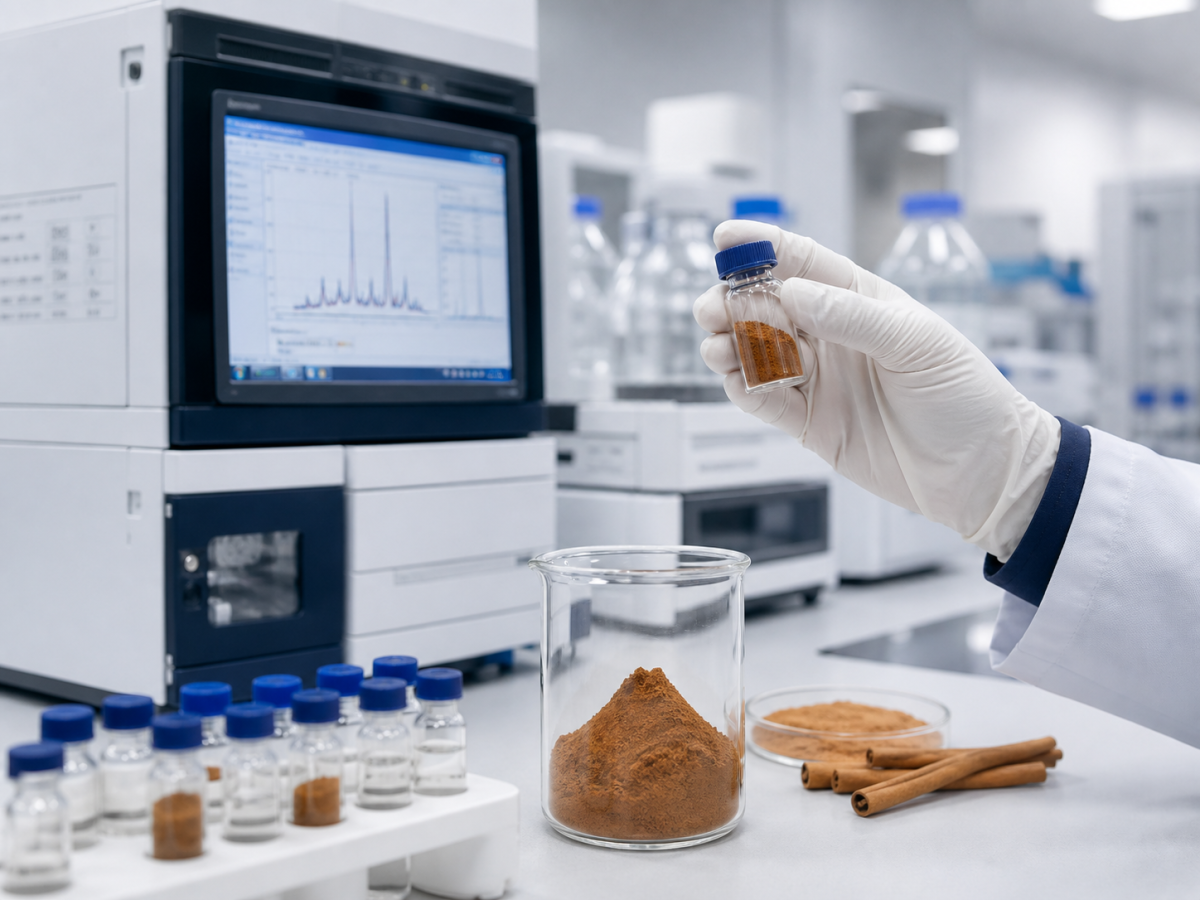
A Realistic COA Walkthrough: What the Numbers Should Look Like
To make the checklist concrete, here is what a defensible cinnamon powder COA looks like when the numbers are filled in. Regard the ranges as typical market practice, not as a HERBSEA offer or a regulatory ceiling — your spec should set your own targets.
| COA field | Typical value range (cassia food grade) | What it tells you |
|---|---|---|
| Species | Cinnamomum cassia (Chinese cassia) | Compliance fork: coumarin exposure |
| Plant part | Inner bark | Purity of the raw material |
| Volatile oil (cinnamaldehyde) | 1.0–3.0 mL/100g (ISO 6571) | Flavour intensity and function |
| Particle size | 60–100 mesh (D50 per spec) | Process and blend behaviour |
| Moisture (loss on drying) | ≤10–12% | Stability, microbial risk, caking |
| Total ash | ≤6–8% (typ.) | Cleanliness, adulteration screen |
| Coumarin | 1,000–4,000 mg/kg (cassia, must be stated) | Formulation and export compliance |
| Lead | ≤2.0 mg/kg (EU 2023/915) | Brand-risk field, per-batch ICP-MS |
| Total heavy metals (As, Cd, Hg) | Per destination limits | Export compliance |
| TAMC / TYMC | ≤10^3–10^4 CFU/g (typ. food grade) | Spoilage and hygiene |
| Salmonella | Negative / 25 g | Finished-product safety |
| E. coli | Negative / g | Hygiene indicator |
| Batch no. / mfg / exp | e.g., 260814A / 2026-08 / 2028-08 | Traceability and shelf-life |
Read the COA as a story, not a list. The species line sets the compliance chapter. The coumarin number sets the formulation chapter. The lead number sets the brand chapter. The moisture, ash and microbiology numbers set the process chapter. If any chapter is missing, the document is a fragment of a COA — and the batch is a fragment of a controlled supply.
Lead, Heavy Metals and the Recall That Rewrote Supplier Qualification
Species and coumarin are the headline compliance issues, but the 2023–2024 lead recalls in the United States proved that heavy metals are the issue that ends brands. Cinnamon ground in Ecuador and adulterated with lead chromate contaminated applesauce sold across the US. The recall expanded to nearly 3 million pouches. The US CDC logged 566 lead-exposure cases, 55% of them in children under two. The implicated cinnamon tested as high as 5,110 mg/kg of lead.
That recall changed the first question a supplement or food buyer asks a cinnamon supplier. Before 2023, lead was a box on a certificate. After it, lead is a per-batch ICP-MS assay that the buyer screens against a hard number. In 2024 the FDA also recommended recalls of ground cinnamon from several distributors at 2 to 3.4 mg/kg of lead. The regulatory floor for bark spices in the EU is now explicit: Regulation (EU) 2023/915 sets a maximum level of 2.0 mg/kg of lead in “bark spices”, which includes cinnamon. Some buyers apply stricter screens — for example, holding a finished daily-dose product below the California Proposition 65 exposure level of 0.5 micrograms of lead per daily serving, which for a 500 mg capsule dose effectively means sub-mg/kg cinnamon.
Heavy-metal expectations for a cinnamon powder COA:
| Contaminant | Typical release limits | Method / source |
|---|---|---|
| Lead | ≤2.0 mg/kg (bark spices, EU 2023/915); stricter brand screens per serving | ICP-MS |
| Other heavy metals (As, Cd, Hg) | Per destination-market limits (e.g., GB 2762-2022 in China; USP/FCC in the US) | ICP-MS |
| Sulphur dioxide / sulphites (E 220–228) | ≤150 mg/kg for Cinnamomum ceylanicum (EU 1333/2008) | Distillation / ion chromatography |
| Pesticide residues | EU MRLs under Reg. 396/2005; India-origin cinnamon subject to 20% official-control frequency at EU entry (Reg. 2019/1793) | GC-MS/MS multi-residue |
The practical rule: never accept “heavy metals: conforms” without numbers and a method. The COA should state lead in mg/kg with an ICP-MS method reference and the batch-specific result. In the post-recall environment, “within limits” without a value is not a data point; it is a hope.
Market Reality: China’s Cassia Dominance and the 4.7x Price Gap
Understanding where cinnamon actually comes from changes how you read a COA and how you negotiate. The supply map is heavily concentrated. China and Vietnam together produce about 89% of the world’s cinnamon. By volume, China, Vietnam and Indonesia are the dominant producers — collectively responsible for roughly 86% of world output. Consumption in 2024 rose to about 294,000 tons, led by Indonesia, China and India, which together account for about 40% of global volume.
The price structure is where the sourcing logic lives. Trade data reported for 2024 show Sri Lankan exports averaging about USD 10,969 per ton against Chinese exports averaging about USD 2,316 per ton — a 4.7x gap that reflects the Ceylon premium and the cassia commodity reality. That gap is also the standing motive for substitution and fraud, which is exactly why species authentication belongs in your incoming inspection, not just your supplier’s marketing sheet.
Chinese production data put the cassia supply base into perspective. Industry research for 2024 reports Chinese cassia (cinnamon bark) exports of about 43,000 tons worth roughly USD 187 million, up 5.9% in volume year on year, with more than 45% of export volume going to Southeast Asia. On the domestic side, Guangxi is the core production province — reported output around 87,000 tons, about 61% of national production — followed by Guangdong and Yunnan. At the district level, customs data from Yunfu (Guangdong, the home of the “China Cinnamon Hometown” Luoding) reported 2024 exports of cinnamon and other plant seasonings of 15,192 tons worth about CNY 256.5 million, up 12.8% in volume and 9.5% in value, shipping to more than 30 countries across Europe, the Americas and Southeast Asia. Fangchenggang district (Guangxi) reported annual cassia bark production of about 15,850 tons with output value of CNY 348 million.
For a buyer, the market picture supports one clear sourcing stance: cassia volume and pricing are driven by China’s supply chain, and Ceylon is a distinct, premium, small-volume category. If your formulation can use cassia, you are buying into a deep, price-competitive market — and you must control coumarin at the finished-product level. If your destination market or claim position requires Ceylon, you are buying a premium that must be verified by species analysis, because the fraud incentive is highest exactly there.
The 12 Fields a Compliant Cinnamon COA Must Carry
A usable cinnamon COA is more than an assay certificate. Use this checklist as your incoming-inspection standard. If any field is missing, the COA is incomplete for a commercial purchase decision.
- Species (botanical name). Must state Cinnamomum verum (Ceylon) or the specific cassia species — never just “cinnamon”. This is the non-negotiable line.
- Plant part and format. Bark (inner bark), leaf, or blended; powder, cut, or stick. Powder from inner bark is the standard for food use.
- Assay / marker compound. Typically volatile oil content (cinnamaldehyde) per ISO 6571:2008, with the result in mL/100g or % v/w. Know your target.
- Particle size (mesh). D50 or mesh range, e.g., 60, 80, 100 mesh. Confirm against your blending and encapsulation process.
- Moisture. Loss on drying, typically ≤10-12% for spice powders (GB/T 12729.7-2008 or equivalent). Drives shelf life and microbial risk.
- Total ash / acid-insoluble ash. A fingerprint of cleanliness and adulteration with dirt or non-bark material.
- Coumarin content. Quantified in mg/kg, with method (LC-MS/MS or HPLC). Request it even for cassia — you need the number for your formulation math.
- Heavy metals. Lead at minimum, with value and method (ICP-MS); arsenic, cadmium, mercury per destination rules.
- Microbiology. TAMC, TYMC, E. coli, Salmonella, and yeast/mould per your market’s food-safety limits.
- Residual fumigants / irradiation. Declaration of ethylene oxide, phosphine, or irradiation treatment if used — increasingly a market-access issue.
- Allergen and GMO declarations. Spice powders can carry cross-contact risks; confirm the statements you need for labelling.
- Batch traceability. Batch number, manufacturing and expiry dates, specification version, and the release signature linking the COA to the physical goods.
The order matters. Species first, because it determines everything downstream. Coumarin next, because it is the compliance field. Lead third, because it is the brand-risk field. Everything else supports the process fit. If your supplier cannot produce this set without hesitation, the safest move is to request the COA before sampling — and to sample before committing to bulk.
Documents Beyond the COA: ISO Standards and the Certificate Stack
The COA is the core, but compliant sourcing stacks several documents on top of it. International quality standards exist for both species and should be referenced in your specification: ISO 6539:2014 covers Ceylon cinnamon from Madagascar, Seychelles and Sri Lanka; ISO 6538:1997 covers Chinese, Indonesian and Vietnamese cassia. When a supplier’s spec sheet references the applicable ISO standard, it signals that the production and testing framework is codified rather than improvised.
| Document | What it confirms | When to request |
|---|---|---|
| COA (per batch) | Species, assay, coumarin, heavy metals, microbiology | Every batch |
| Specification sheet | Full parameter table, methods, limits | With quotation |
| ISO standard reference (6539 / 6538 / 6571) | Production and testing framework alignment | With specification |
| Organic certificate | Certified-organic growing area and processing (premium: organic cassia area in China grew ~8.6% in 2024; organic cinnamon commands a 25-35% premium) | When organic claim is needed |
| Non-GMO / allergen statements | Labelling and market access | On request |
| Certificate of origin | Customs, tariff preference, provenance | On request |
| Fumigation / irradiation certificate | Pest-treatment record for import clearance | On request |
| Facility certification (ISO 22000 / HACCP / FSSC 22000) | Food-safety management system scope and validity | Verify scope covers the line |
One buying opinion worth stating plainly: a certificate stack is only as good as the batch linkage. Organic certificates and facility certifications describe the system; only the batch-level COA with a matching batch number describes the goods in your container. Require that the COA batch number appears on the packing list and the invoice. That three-way match is the cheapest fraud control in the entire sourcing process.
Mesh, Moisture and Sensory: The Fields Formulators Actually Fight Over
Regulatory fields get the headlines, but most real-world formulation problems with cinnamon powder come from the physical and sensory fields. These are the ones that decide whether the ingredient works in your process on Monday, not whether it passes a desk review on Friday.
- Mesh size is a process decision, not a preference. A 60-mesh powder behaves differently from a 100-mesh powder in blending, encapsulation, dissolution, and colour contribution. Fine powders pack differently, dose differently, and can agglomerate with moisture. State the mesh in the RFQ; do not accept “powder” without a number.
- Moisture drives three risks at once. High moisture accelerates microbial growth, speeds caking and flow problems, and shortens shelf life. A COA showing loss-on-drying at the top of the acceptable range should push you to re-verify the batch at intake, especially for humidity-sensitive markets.
- Volatile oil content is the flavour-and-function marker. Cinnamaldehyde drives the aroma and the functional character of the spice. If your product is a cinnamon-forward beverage or bakery application, set a volatile-oil minimum in the spec and confirm the method is ISO 6571 steam distillation, not a faster surrogate.
- Sensory confirmation belongs in the sample step. Colour (light tan Ceylon vs darker cassia), aroma intensity, and astringency should be checked against a reference sample from the approved batch — not against memory. Keep the approved sample, the COA, and the batch number in one record so later batches can be compared objectively.
- Carrier and blend behaviour. If cinnamon is going into a dry blend, confirm flowability and particle-size distribution with the actual carrier matrix. What works in a single-ingredient test can fail in a multi-component blend.
The professional habit to build: every approved batch gets a retained sample, and every incoming batch is compared to it, not to the spec sheet alone. Specs define the window; the retained sample defines the fingerprint.
Application Fit: Which Grade for Which Product
Species and mesh choices should follow the finished product, not the other way round. The table below is the application map a sourcing team can use to translate a product brief into a cinnamon specification.
| Application | Typical spec direction | Why |
|---|---|---|
| Baked goods, pastries, biscuits (EU) | Ceylon preferred; cassia only if finished coumarin fits the 15 mg/kg category limit | Coumarin cap binds in fine bakery |
| Seasonal / traditional bakery (EU, e.g., speculaas) | Cassia acceptable; 50 mg/kg seasonal allowance | Higher coumarin headroom |
| US-market baked goods and blends | Cassia dominant; standard flavour intensity | No coumarin cap on the spice itself; watch lead |
| Beverages, granola, breakfast cereals | Medium mesh; volatile-oil target for flavour delivery | Suspension and flavour release |
| Dry seasoning blends | 60–80 mesh for flow and uniformity | Blending behaviour in the carrier matrix |
| Supplements / capsules (daily intake) | Ceylon strongly preferred; per-batch lead screen below Prop 65 serving exposure | Daily-dose exposure math |
| Food service / mass-market spice | Cassia commodity grade; cost-optimized | Volume economics |
One pattern runs through the table: the more concentrated the cinnamon is in the finished product, and the more frequently it is consumed, the stricter the species and heavy-metal requirement becomes. A pinch in a cinnamon roll is a different regulatory question from a capsule taken twice a day. Sourcing teams that keep the application frame in the RFQ get specifications that are right the first time; teams that buy “cinnamon powder” generically are negotiating with themselves.
From RFQ to Batch Release: A Sourcing Playbook
Cinnamon powder is a low-cost, high-volume commodity — which is exactly why sloppy process discipline shows up here faster than in premium ingredients. This is the playbook that keeps a cinnamon program defensible end to end:
- Write the one-page spec first. Species, mesh, volatile-oil minimum, coumarin and lead documentation requirements, destination market. The spec is the contract; the COA is the evidence.
- Request the COA before the sample. A supplier that cannot produce a batch-linked COA with the 12 fields is not ready for your business. The COA request is also a supplier test: response speed and completeness correlate with control-room quality.
- Verify the species claim on the approved sample. Coumarin by LC-MS/MS as the baseline; DNA only if the stake or suspicion is high. Record the analytical result with the sample.
- Sensory sign-off against a reference. Colour, aroma, astringency against the retained standard — not against memory.
- Commercial terms around the approved sample. Batch size, packing (multi-layer paper bags with PE liner, or drums), label language, shipping terms (FOB/CIF/DDP), and the document set for the destination country.
- Incoming inspection per batch. Fast species screen (NIR or coumarin spot check), lead by ICP-MS on the release certificate, moisture and mesh confirmation, retained sample per batch.
- Keep a per-batch record. COA, spec version, packing photo, sensory notes, analytical confirmation, final quote. This file is your reorder checklist and your audit trail — and it is the document set your customer’s auditor will ask for first.
The difference between a commodity buyer and a professional buyer is not the price paid; it is the record kept. In a category where two-thirds of the EU market sample failed compliance or quality checks, the professional buyer is the one who can prove, batch by batch, what the species was, what the coumarin was, and what the lead was. Everything else is a certificate in a drawer.
Sample Strategy and RFQ Structure
Cinnamon is inexpensive enough that suppliers may assume a quick sample is fine — but the sample is where species verification and sensory sign-off should actually happen. Use the sample step to close the compliance questions, not just the flavour questions.
Typical sample tiers and how to use them:
| Sample type | Typical turnaround | Use in a cinnamon program |
|---|---|---|
| Stock sample | Days | Screen species claim, coumarin value, mesh, sensory |
| Custom sample (specified species, mesh, volatile oil) | 1-3 weeks | Match the project specification exactly |
| Pre-production sample (trial batch) | 3-6 weeks | Process validation, blend behaviour, stability |
A supplier-ready RFQ for cinnamon powder should carry: target species (Ceylon or specific cassia), powder format and mesh, volatile-oil minimum, coumarin and heavy-metal documentation requirements, destination country (because it decides the legal limits that apply), sample quantity and test plan, packing format, MOQ, and timeline. When the destination is the EU, state it — it changes the coumarin and lead requirements the supplier must document. When the destination is India, the 0.3% coumarin import limit should be in the RFQ text so the supplier quotes a compliant grade.
FAQ: Cinnamon Powder COA and Sourcing
Because Ceylon and cassia differ by roughly a thousand-fold in coumarin – the compound EU Regulation 1334/2008 limits in finished foods. A COA that names only cinnamon leaves the buyer to absorb species, compliance and pricing risk on the same shipment. Name the species or do not approve the batch.
No. Cassia is the volume and value workhorse of the spice trade, and for US-market or cassia-compliant applications it delivers stronger flavour per dollar. Ceylon is the defensible choice where coumarin limits bind – most EU finished-food categories – and where a premium provenance claim is required. The decision is regulatory and economic, not aesthetic.
For cassia, a quantified value in mg/kg with the method reference – because your formulation math needs the actual number. For Ceylon, confirm it is below roughly 185 mg/kg (typically 0.004% or less). If the COA omits coumarin entirely, regard it as incomplete for any EU or India-bound product.
Require a per-batch ICP-MS result in mg/kg, screened against EU Regulation 2023/915’s 2.0 mg/kg limit for bark spices or a stricter brand screen per finished-serving basis. After the 2023-2024 US lead recalls, a heavy-metals line that says only ‘conforms’ without a value is not acceptable.
The specification sheet defines the window – parameters, methods, limits – that every batch must fit. The COA reports the actual results of one specific batch against that window, with batch number, dates and release signature. You need both, and they must reference each other.
A compliant stack includes: COA with species, coumarin and lead values; specification sheet referencing the applicable ISO standard; certificate of origin; and any fumigation or irradiation certificate. Lead must meet Regulation 2023/915; sulphite and additive rules follow Regulation 1333/2008. Buyers serving India should add the FSSAI coumarin import requirement (0.3% or less) to the document list.
Summary
The cinnamon powder market is a two-tier supply chain wearing one label. Ceylon and cassia look alike, taste similar, and are legally very different ingredients. A compliant sourcing program starts with three hard requirements on every COA: the botanical species in writing, coumarin quantified, and lead tested by ICP-MS with a real number. Around that core, add mesh, moisture, volatile oil, microbiology, batch traceability, and the document stack that links the certificate to the goods. The JRC’s 66% non-compliance finding is the best argument a purchasing team can use internally for tightening the spec — and the cheapest insurance available is demanding the species line before the sample, and the batch-linked certificate set before the container.
HERBSEA supplies bulk Cinnamon Powder and supports specification review, COA, and sample planning for qualified B2B projects. Related sourcing guides: Spices Powder Supplier hub · Ginger Powder · Turmeric Powder · Bulk Ingredient Sample Request Template · Food Ingredient RFQ Template · Contact HERBSEA.
Data Sources and Notes
- European Commission JRC study on cinnamon marketed in the EU, published 24 September 2025: 66%+ of samples failed quality/compliance/fraud checks or exceeded coumarin limits (NPJ Science of Food summary, 2025).
- EU Regulation (EC) 1334/2008: coumarin limits in finished foods (2 / 5 / 15 / 50 mg/kg by category).
- Regulation (EU) 2023/915: maximum lead level 2.0 mg/kg in bark spices. Regulation (EC) 1333/2008: 150 mg/kg sulphites in Cinnamomum ceylanicum. Regulation (EU) 2019/1793: 20% official-control frequency for India-origin cinnamon at EU entry.
- EFSA tolerable daily intake for coumarin: 0.1 mg/kg body weight/day.
- FSSAI (India) import notification, 30 November 2021: coumarin limit 0.3% (mass fraction) for imported cinnamon.
- AGES (Austrian food-safety agency, 2025): cassia coumarin 1,880-3,260 mg/kg vs Ceylon max ~185 mg/kg. Czech retail survey (2012): 60 samples at 2,650-7,017 mg/kg cassia; Sri Lankan plantation sample coumarin-free.
- US CDC lead-exposure cases and FDA ground-cinnamon recall recommendations, 2023-2024 (implicated cinnamon up to 5,110 mg/kg lead; FDA recall range 2-3.4 mg/kg).
- Trade and market data: global cinnamon consumption ~294,000 t in 2024 (IndexBox); China + Vietnam ~89% of world production (NPJ Science of Food, 2025); China/Vietnam/Indonesia ~86% of output; Sri Lanka export price ~USD 10,969/t vs China ~USD 2,316/t (IndexBox, 2024); global cinnamon market USD 1.0B (2024) to USD 1.4B (2030), CAGR 4.7% (GII Research, 2025).
- Chinese industry data: 2024 Chinese cassia exports ~43,000 t / USD 187M (+5.9% volume); Guangxi ~61% of national production (Baiyan/Booyan consulting reports, 2025); Yunfu customs 2024 exports 15,192 t / CNY 256.5M (+12.8% volume); Fangchenggang annual cassia bark output ~15,850 t / CNY 348M; organic cassia area +8.6% in 2024 with 25-35% price premium; China cinnamon industry size CNY 1.87B in 2024 (+6.8%).
- Guangxi-ASEAN Food Inspection Centre cross-border group standard for coumarin determination in cinnamon (LC-MS/MS), finalized June 2026, framed as closing EU/India trade-barrier testing gap.
- Standards: ISO 6539:2014 (Ceylon), ISO 6538:1997 (cassia), ISO 6571:2008 (volatile oil), GB/T 12729.7-2008 (moisture), GB/T 30381-2013 (cassia definition), GB 2762-2022 (contaminant limits in China).
Compliance Note: HERBSEA provides raw materials for B2B manufacturing and formulation use. The information on this page is for ingredient sourcing, specification review, and supplier communication only. It is not medical advice and does not provide consumer-use guidance. Buyers are responsible for verifying regulatory status and permitted claims in their destination market.