
Quick Answer — What to verify before you compare Shiitake Mushroom Extract suppliers
Bulk Shiitake Mushroom Extract is a standardized powder ingredient derived from the fruiting body of Lentinula edodes, typically specified by polysaccharide content (10%–50%), beta-glucan content (20%–40%), lentinan assay (10%–30% by HPLC), extract ratio (10:1 to 50:1), mesh size and batch documents. Before comparing quotes, confirm four things with every supplier: (1) the exact specification basis and assay method, (2) fruiting body versus mycelium source, (3) the document set (COA, specification sheet, SDS, export documents) and (4) the MOQ-to-commercial-order path including packaging and lead time. A price that arrives without these four details is not yet comparable.
1. What “Bulk Shiitake Mushroom Extract” Actually Covers
Bulk Shiitake Mushroom Extract is not one fixed product. It is a family of standardized powders and liquids made from Lentinula edodes (shiitake), and the commercial name alone does not define the grade. The same product name can describe a 10% polysaccharide powder, a 30% lentinan concentrate or a raw mycelium-fermented blend, and those materials are not interchangeable in formulation.
For B2B purchasing, the working definition should be tied to three parameters that appear on the COA:
- Active-marker specification — polysaccharides, beta-glucans or lentinan, each with a defined assay range and test method.
- Extract ratio and carrier — the raw-material-to-extract ratio (e.g., 10:1, 20:1, 30:1) and whether the powder contains a carrier or is 100% fruiting-body solids.
- Physical profile — particle size (mesh), bulk density, moisture, color and odor, which determine blending, tableting and solubility behavior in the buyer’s finished format.
- Specification ownership — Ask the supplier to state the marker range, assay method, source part and carrier status in writing before any price discussion.
- Batch traceability — Confirm that each commercial lot will carry a batch-specific COA and that the approved sample can be traced to the later production lot.
- Document completeness — Verify the standard document set: COA, specification sheet, SDS, flow chart, and quality questionnaires if required by your QA team.
- Supply continuity — Ask about raw-material sourcing, stock levels, production scheduling and how the supplier handles peak-season demand.
- Communication and reorder process — Check whether the supplier keeps a consistent contact point for reorders and whether packing, labeling and lead time can stay stable across repeat orders.
Common commercial specification ranges for Shiitake Mushroom Extract powder:
| Specification parameter | Typical commercial range | Common test method |
|---|---|---|
| Polysaccharides | 10% – 50% (10%, 20%, 30%, 40%, 50% are standard) | Phenol-sulfuric acid (UV-VIS) |
| Beta-1,3/1,6-D-glucan | 20% – 40% | Megazyme enzymatic assay |
| Lentinan assay | 10% – 30% | HPLC |
| Extract ratio | 10:1 – 50:1 | Batch record / supplier method |
| Particle size | 80 – 100 mesh (95% pass 80 mesh typical) | Sieve analysis |
| Loss on drying (moisture) | ≤ 5.0% | Drying oven 105°C |
| Residue on ignition (ash) | ≤ 5.0% | Muffle furnace 750°C |
| Heavy metals (total) | < 20 ppm (Pb ≤ 2, As ≤ 2, Cd ≤ 1, Hg ≤ 0.1 ppm typical) | ICP-MS / AAS |
| Total plate count | < 1,000 – 10,000 cfu/g | Plate count |
| Yeast & mold | < 100 cfu/g | Plate count |
| Pathogens (Salmonella, E. coli) | Negative | Culture methods |
| Shelf life | 24 months | Stability data |
Sources: supplier specification sheets published for Shiitake Mushroom Extract (2024–2026), including Nutramax, Wellnature, Haoze Bio and Zhenhuacui product data; test methods follow pharmacopeia and industry practice (UV-VIS, HPLC, Megazyme AOAC-style assays).
2. Fruiting Body vs Mycelium: Read the Source Before Comparing Prices
The single most common sourcing error in mushroom extract purchasing is comparing prices across different raw-material bases. Shiitake extract can be made from the fruiting body (the mushroom itself) or from mycelium (the root-like vegetative tissue) grown on grain substrate.
The two materials are different inputs with different economics:
| Comparison point | Fruiting-body extract | Mycelium-grown material |
|---|---|---|
| Starting material | Cultivated shiitake mushrooms (whole fruiting body) | Mycelium cultured on grain (rice, oats, etc.) |
| Substrate content | No grain filler; solids are mushroom tissue | Substrate can account for a large share of the dry weight |
| Typical marker density | Higher per-gram polysaccharide/beta-glucan levels | Lower marker density per gram of powder |
| Unit price basis | Higher per kg | Lower per kg |
| Best use case | Standardized supplement, beverage and functional food ingredients | Budget blends where full specification flexibility is not required |
| Documentation expectation | Full COA + specification sheet + origin traceability | Batch COA; substrate disclosure required |
A quote that looks cheaper may simply be a different raw-material basis. Buyers should ask the supplier to state the botanical source part (fruiting body or mycelium) in writing on the specification sheet, and to confirm whether the powder is 100% mushroom solids or contains substrate/carrier. If the buying brief requires a standardized extract for a supplement formula, the fruiting-body material is usually the correct reference point for comparison.
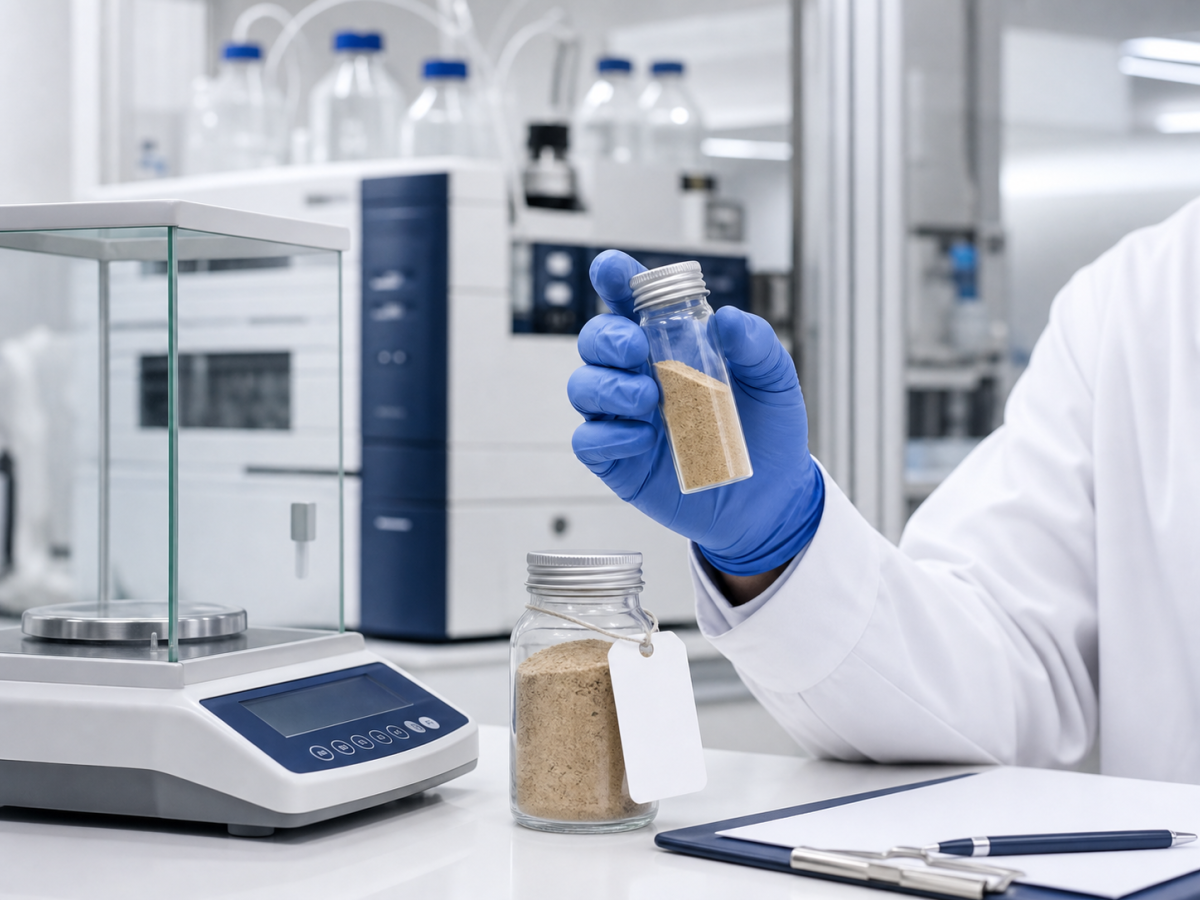
3. How to Shortlist a Bulk Shiitake Extract Raw Material Supplier
A bulk Shiitake Extract raw material supplier is different from a sample-only vendor. The shortlisting question is not “who has the lowest price on one batch” but “who can support repeat purchasing under the same specification direction.” Use these checks in order:
A practical way to run this check is to send the same purchasing brief to three to five shortlisted suppliers and compare replies in one table. If one supplier answers with a defined grade, a sample plan and a document list, and another answers with only a price line, the two replies are not equivalent — and the price-only reply is not yet a comparable quote.
4. Shiitake Extract MOQ, Sample and Order Planning
MOQ is not a standalone number. It changes with specification level, packing format, stock status and destination market, and different order stages deserve different questions. Buyers should state the stage clearly so the supplier can reply with practical options.
| Order stage | Typical scope | What to confirm with the supplier |
|---|---|---|
| Sample request | 10 g – 500 g | Sample quantity, purpose, COA availability, delivery address, whether the sample is free or fee-based |
| Pilot / trial order | 1 – 25 kg | Packing size, document checklist, lead time, price basis vs commercial tier |
| Commercial order | 25 kg+ (drum-based) | Order volume, annual demand estimate, packaging preference, reorder plan, incoterms |
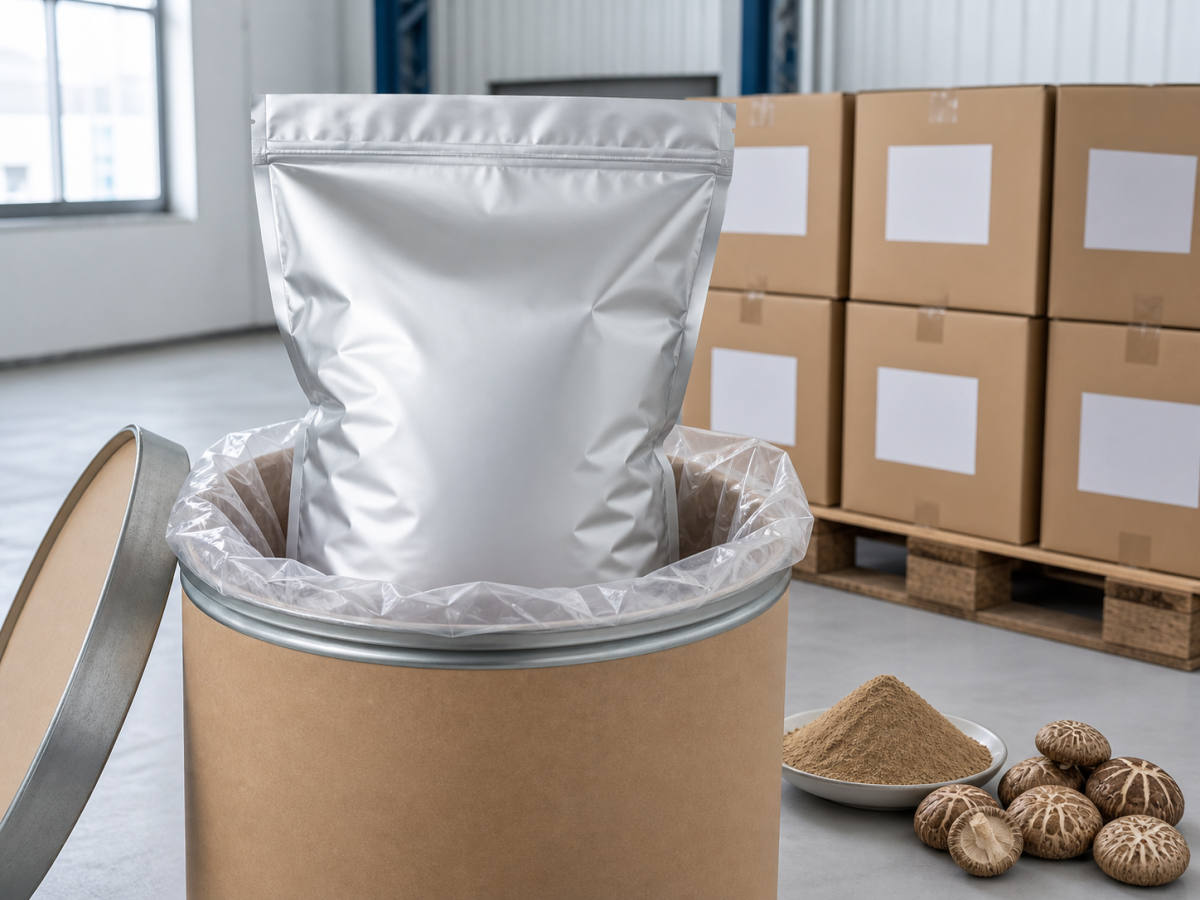
Typical bulk commercial packing is 25 kg per drum with two inner food-grade bags, while smaller pilot packs are commonly 1 kg foil bags. MOQ on the market commonly starts at 1 kg for sample/trial quantities and 25 kg (one drum) for commercial-grade pricing; larger volumes of 100 kg, 500 kg or 1 MT usually qualify for tiered pricing and reserved production slots. Buyers should treat a low MOQ as useful only if the specification basis can be maintained at the commercial volume. If a small sample is approved and the commercial batch later changes the specification basis, the project loses time in QA review — so confirm in writing that the same specification direction applies from sample to bulk.
5. Packaging Options for Bulk Shiitake Extract
Bulk mushroom extract packaging affects receiving, storage, sampling, weighing and production handling — not just shipping. The right format depends on the buyer’s warehouse conditions and manufacturing process. If the material is transferred to a contract manufacturer, confirm that facility’s preferred pack sizes, label details and pallet requirements before ordering.
| Packaging element | Common options | Buyer questions to ask |
|---|---|---|
| Inner bag | Single or double food-grade PE/aluminum foil bag | Is the inner bag sealed against moisture? Nitrogen flush available? |
| Unit pack | 1 kg foil bag; 5 kg bag; 10 kg carton; 25 kg drum | Which pack sizes keep my receiving and weighing process efficient? |
| Drum type | Fiber drum, plastic drum, aluminum foil drum | Is the drum food-contact safe and export-ready? |
| Palletization | Cartons on pallets, drum pallets, with/without shrink wrap | What are the pallet dimensions and gross weight for my logistics quote? |
| Labeling | Product labels, batch marks, shipping marks | Which label fields are required by my receiving and customs process? |
A complete packaging brief should include preferred net weight per bag or drum, inner bag requirement, carton or drum preference, pallet needs, shipping-mark requirements and any destination-market documentation tied to the pack. Sending this before quotation lets the supplier quote on the correct basis instead of a generic packing line.
6. Lead Time and Export Document Planning
Lead time depends on stock status, production schedule, testing time, packing arrangement and destination country. Stocked grades usually ship faster; custom-specification batches require production and full QC release. Sending the document list early shortens back-and-forth.
| Document | Purpose in bulk sourcing |
|---|---|
| COA (batch-specific) | Confirms marker assay, physicals, heavy metals and microbiology for that lot |
| Specification sheet | Defines the agreed grade, method and acceptance range |
| SDS | Required for transport and destination-market compliance |
| Commercial invoice | Customs and payment record |
| Packing list | Weight, carton/drum count and marks |
| Certificate of Origin (COA-adjacent trade docs) | Duty assessment in the destination country |
| Quality questionnaire / supplier audit response | Buyer QA team review before approval |
For U.S. dietary supplement projects, buyers may review the FDA’s general dietary supplements page for regulatory background and 21 CFR Part 111 for current good manufacturing practice requirements. These references support buyer-side quality-system review; final supplier selection should still rely on the actual specification, COA, sample review and documentation provided for the selected material. For background research on Lentinula edodes extract, buyers can also review PubMed search results for Lentinula edodes extract.
7. Writing a Shiitake Mushroom Extract RFQ
A Shiitake Mushroom Extract supplier RFQ should be specific enough for the supplier to match the project on the first reply. A vague “please quote Shiitake Mushroom Extract” produces a vague answer; a structured RFQ produces a quote that procurement and QA can actually compare.
RFQ template (copy and adapt):
> Please quote Shiitake Mushroom Extract powder for supplement formulation. We need: current specification and assay method, polysaccharide or beta-glucan target range, source part (fruiting body or mycelium), batch-specific COA sample, sample availability and quantity, MOQ by stage (sample / pilot / commercial), packaging options, lead time, available export documents, and destination market compliance notes. Intended format: capsules or tablets. Estimated annual volume: [X kg].
| RFQ element | Why it matters | What to include |
|---|---|---|
| Product identity | Avoids name-only quoting | Shiitake Mushroom Extract powder, Lentinula edodes |
| Specification direction | Sets the comparison basis | Polysaccharide %, beta-glucan %, lentinan assay, extract ratio, mesh |
| Source part | Prevents fruiting-body vs mycelium mismatch | Fruiting body (or mycelium, if acceptable) |
| Application format | Drives particle size and solubility needs | Capsule, tablet, powder blend, beverage |
| Volume and stage | Determines MOQ and price tier | Sample / pilot / commercial quantity + annual estimate |
| Destination market | Drives documents and compliance | Country, incoterms, port |
| Document checklist | Aligns QA expectations | COA, spec sheet, SDS, CoO, questionnaires |
8. Market and Supply Context at a Glance
Bulk buyers benefit from knowing the supply side of the market before negotiating. Key data points for Shiitake Mushroom Extract sourcing:
| Indicator | Value | Source & year |
|---|---|---|
| Global shiitake extracts market size | USD 475.25 million (2025), projected USD 858.3 million by 2032 (8.81% CAGR) | PW Consulting / pmarketresearch.com, 2026 report |
| Shiitake extract share of global fungus extract powder market | ~19.9% of 2025 revenue (approx. USD 407 million) | pmarketresearch.com fungus extract powder market report, 2026 |
| Largest application segment | Dietary supplements (~55% of fungus extract powder revenue) | pmarketresearch.com, 2026 |
| China shiitake export volume (2024) | 51,000 metric tons; approx. USD 480 million; average unit value approx. USD 9,345/ton | China Customs data via cefic.org.cn, 2024 |
| U.S. specialty mushroom sales (2024–2025 season) | USD 95.0 million, +10% year over year | USDA NASS Mushrooms Report, August 2025 |
| U.S. shiitake grower prices | USD 6.23/lb (up from USD 4.92) | USDA NASS Mushrooms Report, August 2025 |
| Typical commercial shelf life | 24 months | Supplier spec sheets, 2024–2026 |
China remains the dominant production base for shiitake raw material and extract powder, which is why most bulk buyers sourcing at commercial scale evaluate Chinese suppliers for specification fit, documentation and logistics. Regional demand for standardized mushroom extracts is concentrated in dietary supplements, functional food and beverages, and personal care — the same applications a bulk buyer’s finished product usually targets.
9. Supplier Comparison Scorecard
Procurement teams can compare supplier replies on the same basis with a simple scorecard. For each shortlisted supplier, score the following fields and weight them according to the project:
| Scorecard field | What to look for | Weight guidance |
|---|---|---|
| Product name clarity | Named grade, not a generic category | High |
| Specification match | Marker range, assay method, source part align with brief | High |
| COA completeness | Batch-specific, includes physicals + heavy metals + microbiology | High |
| Sample availability | Clear quantity, timing and sample-to-bulk alignment | Medium |
| MOQ structure | Sample / pilot / commercial tiers explained | Medium |
| Packaging options | Pack sizes and formats fit receiving process | Medium |
| Lead time | Stated for stock and custom-specification batches | Medium |
| Export document support | COA, spec sheet, SDS, CoO, questionnaires | High |
| Communication quality | Direct answers, no generic price-only replies | Medium |
If a supplier replies with only a price and no specification detail, that quote is not ready for comparison. If another supplier provides a clearer document package and practical sample guidance, the higher unit price may still be the more useful sourcing decision. Review unit price only after technical fit, document scope and supply conditions are clear.
10. FAQ
Ask for the current specification and assay method, source part (fruiting body or mycelium), sample availability, batch-specific COA, MOQ by order stage, packaging options, lead time and available export documents. Share the application format and destination market so the supplier can reply accurately.
They are different measurement bases for the same type of mushroom extract. Polysaccharide content is usually measured by the phenol-sulfuric acid (UV-VIS) method; beta-1,3/1,6-D-glucan is measured with an enzymatic (Megazyme) assay; lentinan assay is typically measured by HPLC. Buyers should confirm which marker their formula needs and which test method the COA uses, because two COAs stating different markers are not directly comparable.
The starting material changes the cost and the marker density per gram. Fruiting-body extract is 100% mushroom solids with a higher per-gram marker concentration; mycelium material grown on grain substrate can contain a large share of grain filler, which lowers the per-kg price but changes the specification basis. Compare quotes only within the same raw-material basis.
Sample quantities commonly start at 10 g to 500 g (many suppliers offer free samples with buyer-paid shipping), pilot orders at 1 kg, and commercial orders at 25 kg per drum, which is the standard bulk packing. Larger volumes (100 kg, 500 kg, 1 MT) usually qualify for tiered pricing. MOQ should be discussed together with specification and documentation, not as a standalone number.
Buyers can send the target specification, sample quantity, application format and document checklist through the HERBSEA contact page so the team can review available sample and COA support before any purchase order.
Use this article as the procurement checklist and the Shiitake Mushroom Extract supplier product page as the core inquiry page for product-specific sourcing support.
11. Summary and Next Steps
Optimizing a Shiitake Mushroom Extract purchase starts with a written specification brief, not a price request. Confirm the marker range and assay method, the source part, the document set and the MOQ-to-bulk path before comparing quotes. Send the same RFQ to shortlisted suppliers, score the replies on the checklist above, and approve samples against the commercial specification direction.
To request current quotation support, send your specification, sample quantity, application format, destination market and document checklist through the HERBSEA contact page. Buyers comparing broader mushroom ingredient options can also review the Mushroom Extract category, or start from the bulk Shiitake Mushroom Extract supplier product page for product-specific sourcing support.
Data sources: Market sizes from PW Consulting / pmarketresearch.com reports (2026); China export figures from China Customs data as compiled by cefic.org.cn (2024); U.S. production figures from USDA NASS Mushrooms Report (August 2025); specification ranges compiled from supplier spec sheets for Shiitake Mushroom Extract (2024–2026). Figures are provided for background context only and should be re-verified against current supplier data at the time of purchase.
HERBSEA provides raw materials for B2B manufacturing and formulation use. The information on this page is for ingredient sourcing and specification review only. It is not medical advice and does not provide diagnosis, treatment, cure, prevention, dosage, or consumer use recommendations.