
Every supplement formulator knows resveratrol. However, sourcing High Purity Trans-Resveratrol 99% HPLC that actually delivers on its clinical label claims is a completely different challenge — and one that ultimately separates premium dietary brands from commodity products.
1. Why “Resveratrol” Alone Is Not a Specification Worth Trusting
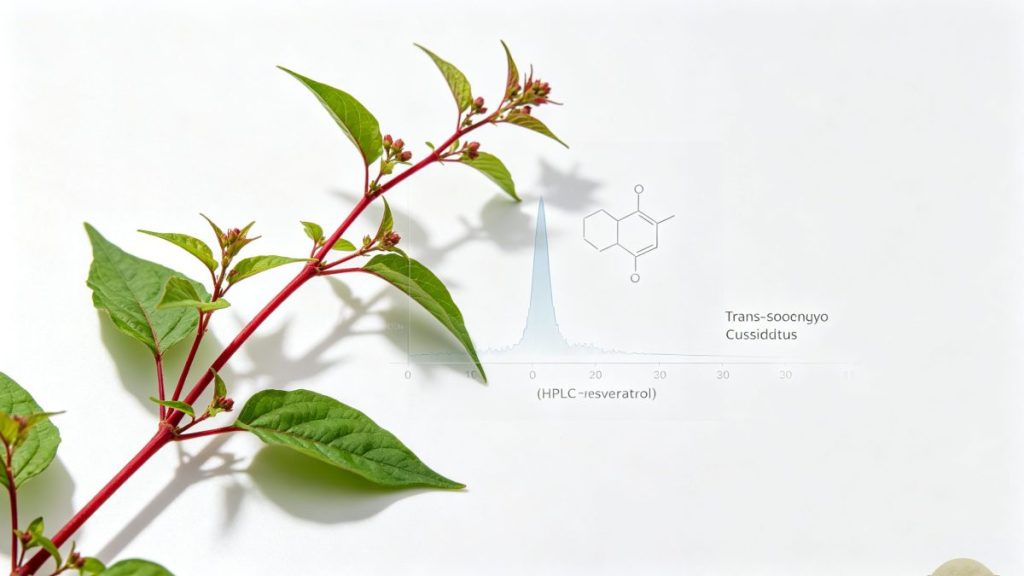
Here is the uncomfortable truth about the global ingredient market: the word “resveratrol” on a COA or a raw label tells you almost nothing useful. Specifically, what matters is not whether a powder contains some raw resveratrol — rather, it is which isomer is present, at what purity, verified by which method, and extracted from which source.
Resveratrol exists in two geometric isomeric forms: trans-resveratrol and cis-resveratrol. Consequently, they are not interchangeable. Specifically, trans-resveratrol is the naturally occurring, biologically active, and clinically studied form. In contrast, cis-resveratrol is formed when trans-resveratrol is exposed to UV light — making it a degradation product, not a desirable active. Furthermore, the overwhelming majority of peer-reviewed research on resveratrol’s health effects — from cardiovascular protection to SIRT1 activation to anti-inflammatory signaling — is conducted exclusively with High Purity Trans-Resveratrol 99% HPLC, not a generic mixture of isomers.
And yet, many commercial resveratrol ingredients are sold with specifications that fail to distinguish between trans and total resveratrol content. Alternatively, they report only a broad “resveratrol” percentage that may be heavily weighted toward the cis isomer. For instance, a powder labeled “Resveratrol 98%” could theoretically contain 30% cis-resveratrol and only 68% trans-resveratrol — and that would still pass a non-isomer-specific UV assay.
This is not a hypothetical scenario. Indeed, a 2018 analytical survey of commercial resveratrol ingredients published in the Journal of AOAC International found significant isomer ratio discrepancies across suppliers. Specifically, some samples contained as much as 25–40% cis-resveratrol despite being sold simply as “resveratrol.” Therefore, the takeaway for supplement brand owners and formulators is clear: specifying High Purity Trans-Resveratrol 99% HPLC is not a premium option among many — rather, it is the only specification that guarantees your product contains what the clinical literature is actually based on.
2. Trans-Resveratrol vs. “Resveratrol”: The Isomer Problem That Determines Efficacy
Let’s be precise about what separates High Purity Trans-Resveratrol 99% HPLC from generic resveratrol powder — because this distinction directly impacts product efficacy and consumer trust.
2.1 Structural Chemistry
Trans-resveratrol (CAS 501-36-0) has the two phenolic rings on opposite sides of the central ethylene bridge. In contrast, cis-resveratrol (CAS 61434-67-1) has the rings on the same side. This is not a cosmetic difference. Rather, the trans configuration allows the molecule to adopt a planar conformation that fits precisely into the binding pockets of target proteins — including SIRT1, cyclooxygenase enzymes, and various kinase domains. Conversely, the cis isomer cannot reproduce this binding geometry, which is why utilizing High Purity Trans-Resveratrol 99% HPLC is standard for high-end formulations.
2.2 Biological Activity Gap
Consequently, the functional consequence is highly measurable. In head-to-head biological assays comparing standard powders against High Purity Trans-Resveratrol 99% HPLC:
- SIRT1 activation: High Purity Trans-Resveratrol 99% HPLC activates SIRT1 at concentrations 10–50× lower than cis-resveratrol in cellular assays.
- Antioxidant capacity: Furthermore, High Purity Trans-Resveratrol 99% HPLC exhibits approximately 2–3× the ORAC value of cis-resveratrol.
- Cellular uptake: Meanwhile, High Purity Trans-Resveratrol 99% HPLC is preferentially transported across cell membranes by SLC family transporters, whereas cis-resveratrol uptake is drastically less efficient.
- In vivo pharmacokinetics: As a result, High Purity Trans-Resveratrol 99% HPLC achieves a significantly higher plasma AUC than cis-resveratrol at equivalent oral doses in rodent models.
2.3 Why HPLC Is Non-Negotiable
UV spectrophotometry — still used by some suppliers for routine resveratrol assay — cannot reliably distinguish between the trans and cis isomers because both absorb at approximately 306 nm. In contrast, only high-performance liquid chromatography (HPLC) with a properly calibrated reverse-phase column can separate and quantify the two isomers independently.
Therefore, when you specify High Purity Trans-Resveratrol 99% HPLC, you are specifying three things simultaneously:
- Total resveratrol ≥99.0% by HPLC area normalization.
- Trans-resveratrol ≥99.0% of total resveratrol content (meaning cis-resveratrol ≤1.0%).
- Method of verification is strictly HPLC, not UV — thus, it is the only method capable of isomer-specific quantification for High Purity Trans-Resveratrol 99% HPLC.
3. Polygonum Cuspidatum: The Superior Botanical Source for Commercial Resveratrol
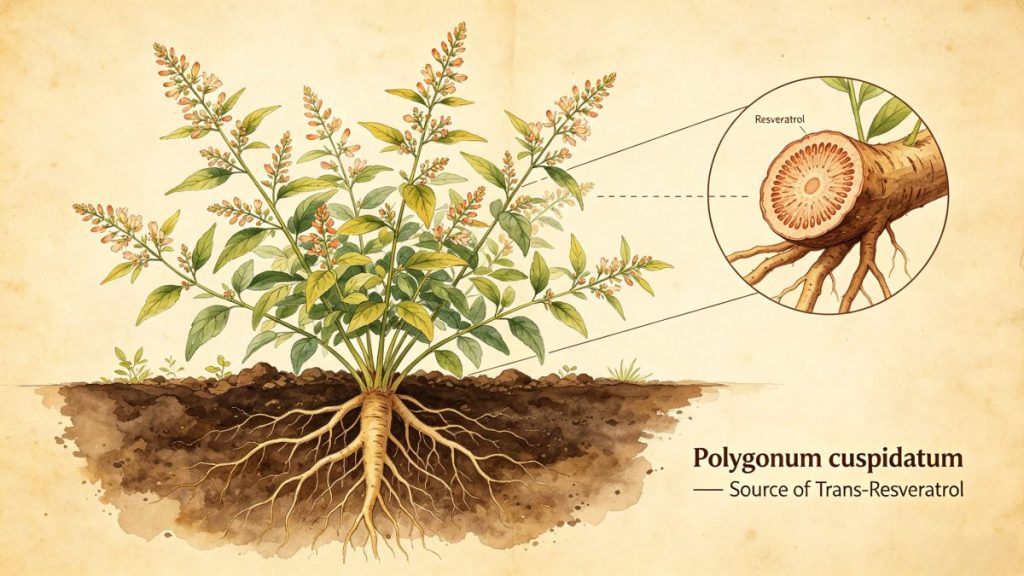
Resveratrol can be sourced from several botanical raw materials — including grape skin, peanut root, mulberry, and Polygonum cuspidatum (Japanese knotweed). However, for commercial-scale production of High Purity Trans-Resveratrol 99% HPLC, Polygonum cuspidatum is the dominant and superior choice.
3.1 Resveratrol Content by Source
| Source | Typical Resveratrol Content (dry weight) | Trans-Resveratrol Ratio | Commercial Viability for High Purity Trans-Resveratrol 99% HPLC |
| Polygonum cuspidatum root | 0.5–2.5% | >95% trans | ★★★★★ (Ideal for High Purity Trans-Resveratrol 99% HPLC) |
| Grape skin / Vitis vinifera | 0.01–0.1% | 90–95% trans | ★★ (Unviable for High Purity Trans-Resveratrol 99% HPLC) |
| Peanut root | 0.01–0.05% | Variable | ★ (Unviable for High Purity Trans-Resveratrol 99% HPLC) |
| Synthetic / Fermentation | Variable | >99% trans (purified) | ★★★ (Alternative to High Purity Trans-Resveratrol 99% HPLC) |
Because Polygonum cuspidatum contains resveratrol at concentrations 10–100× higher than grape skin, therefore, extraction is far more efficient, solvent use is lower, and the economics of purification to High Purity Trans-Resveratrol 99% HPLC are substantially more favorable. Furthermore, the plant’s root naturally produces resveratrol almost entirely in the trans configuration, thereby reducing the purification burden and minimizing the risk of cis isomer contamination.
3.2 The Extraction and Purification Pipeline
Commercial production of High Purity Trans-Resveratrol 99% HPLC from Polygonum cuspidatum typically follows this sequence:
- Harvest & drying: Roots are harvested at maturity (3–5 years) and, subsequently, dried under controlled temperatures to minimize UV exposure and enzymatic degradation.
- Solvent extraction: Food-grade ethanol or ethanol-water mixtures are preferred for regulatory compliance. Conversely, methanol-based extraction should raise immediate red flags when manufacturing High Purity Trans-Resveratrol 99% HPLC for the U.S. and EU markets.
- Concentration & crystallization: Next, the crude extract is concentrated under vacuum, and the resveratrol is crystallized by adjusting solvent polarity.
- Purification: Subsequently, recrystallization or column chromatography is deployed. To achieve the target criteria of High Purity Trans-Resveratrol 99% HPLC, multiple recrystallization steps are typically required.
- HPLC verification: Finally, every batch is assayed by HPLC with isomer resolution to confirm both total and trans-resveratrol parameters for High Purity Trans-Resveratrol 99% HPLC.
3.3 Supply Chain Considerations
Sourcing Polygonum cuspidatum extract resveratrol 50–99% HPLC means you are working with a botanical ingredient that is subject to agricultural variability. Therefore, the resveratrol content in P. cuspidatum roots varies with growing region and harvest season. Reputable suppliers mitigate this variability through contract farming relationships as well as strict incoming raw material testing before extraction. Consequently, this raw material sourcing documentation forms the baseline for producing High Purity Trans-Resveratrol 99% HPLC with batch-to-batch consistency.
4. The Science: What Trans-Resveratrol Actually Does and What the Data Show
The resveratrol literature is massive — spanning over 15,000 publications. However, for formulators sourcing High Purity Trans-Resveratrol 99% HPLC, understanding which mechanisms are robustly supported is essential for responsible product positioning.
4.1 SIRT1 Activation: The Longevity Connection
The best-characterized mechanism of High Purity Trans-Resveratrol 99% HPLC is its interaction with the sirtuin family, particularly SIRT1. The original 2003 report by Howitz and Sinclair (Nature) demonstrated that trans-resveratrol activates SIRT1 through an allosteric mechanism. Subsequently, structural biology work refined the model, showing that High Purity Trans-Resveratrol 99% HPLC binds directly to the N-terminal domain of SIRT1. Consequently, it enhances its affinity for specific substrates — notably PGC-1$\alpha$, a master regulator of mitochondrial biogenesis.
4.2 Cardiovascular Protection
Multiple meta-analyses of human clinical trials support a consistent effect of High Purity Trans-Resveratrol 99% HPLC on cardiovascular risk markers:
- Endothelial function: Specifically, a meta-analysis of 6 RCTs found that High Purity Trans-Resveratrol 99% HPLC supplementation improved flow-mediated dilation (FMD) by 1.43%.
- Systolic blood pressure: In addition, a meta-analysis reported a significant reduction in systolic BP of 3.2mmHg at doses of High Purity Trans-Resveratrol 99% HPLC 150mg/day.
- LDL oxidation: Meanwhile, in vitro and ex vivo studies consistently show that High Purity Trans-Resveratrol 99% HPLC inhibits LDL oxidation, thereby preventing a key initiating event in atherogenesis.
4.3 Inflammation and COX Inhibition
Our High Purity Trans‑Resveratrol 99% HPLC acts as a potent inhibitor of cyclooxygenase‑1 (COX‑1) and cyclooxygenase‑2 (COX‑2). Furthermore, it suppresses NF‑κB activation, thereby reducing the transcription of pro‑inflammatory cytokines including TNF‑α, IL‑1β, and IL‑6. Consequently, these mechanisms are highly relevant to chronic, low‑grade inflammation associated with aging, making High Purity Trans‑Resveratrol 99% HPLC a vital tool for preventative longevity formulations.
4.4 The Bioavailability Challenge — And Why Purity Matters Here
Trans‑resveratrol, like many polyphenols, has poor oral bioavailability due to extensive phase II conjugation in the gut and liver. However, this is a known limitation, not a reason to dismiss the ingredient.
Instead, what High Purity Trans‑Resveratrol 99% HPLC contributes to addressing this challenge is absolute dose certainty. Specifically, when you formulate with High Purity Trans‑Resveratrol 99% HPLC, a 250 mg capsule delivers exactly 247.5 mg of pure active compound. In contrast, at 95% purity, the same capsule could deliver as little as 237.5 mg of trans‑resveratrol if the remaining 5% is cis isomer. In a category where clinical effects appear to be dose‑dependent, therefore, choosing High Purity Trans‑Resveratrol 99% HPLC over lower grades is not trivial.
5. Reading a Trans-Resveratrol COA: What Every Procurement Team Must Check
A Certificate of Analysis for High Purity Trans-Resveratrol 99% HPLC should contain more than just an assay number. Specifically, here are the parameters your team must verify.
5.1 Essential COA Parameters for High Purity Trans-Resveratrol 99% HPLC
| Parameter | Specification | Why It Matters for High Purity Trans-Resveratrol 99% HPLC |
| Appearance | Off-white to pale yellow powder | Darkening indicates oxidation or UV degradation of the trans isomer |
| Identification | HPLC retention time matches reference | Confirms identity of High Purity Trans-Resveratrol 99% HPLC |
| Assay (HPLC, trans) | ≥99.0% | Core specification — the true active compound parameter |
| Cis-resveratrol (HPLC) | ≤1.0% | Confirms structural and isomer integrity of the batch |
| Heavy Metals (as Pb) | ≤10ppm | USP general limits compliant for High Purity Trans-Resveratrol 99% HPLC |
| Residual Solvents | Conforms to USP <467> / ICH Q3C | Confirms no harmful extraction solvent residues in the powder |
| Total Plate Count | ≤1,000CFU/g | Microbial safety and compliance for global shipping |
5.2 Red Flags on a Trans-Resveratrol COA
- “Resveratrol” assay without “trans” specification: This means the assay is likely total resveratrol by UV. Therefore, you should reject the lot or request strict High Purity Trans-Resveratrol 99% HPLC data.
- UV assay method in place of HPLC: As discussed, UV cannot distinguish trans from cis. Consequently, you must insist on HPLC with isomer resolution to guarantee High Purity Trans-Resveratrol 99% HPLC status.
- Missing residual solvent data: Extraction can use ethanol, methanol, or acetone. Therefore, a full residual solvent panel is required to prove compliance for High Purity Trans-Resveratrol 99% HPLC.
6. Formulation Considerations for High Purity Trans-Resveratrol
Sourcing High Purity Trans-Resveratrol 99% HPLC is half the equation. Therefore, the other half is formulating it into a finished product that preserves its structural integrity.
6.1 Physical Properties
- Solubility: High Purity Trans‑Resveratrol 99% HPLC is practically insoluble in water. Consequently, for capsule or tablet formulations, the powder is typically filled directly without aqueous processing.
- Stability: Furthermore, it is highly sensitive to UV light and alkaline pH. Because exposure to UV light converts trans to cis, therefore, formulations using High Purity Trans‑Resveratrol 99% HPLC should be packaged in opaque containers.
- Melting point: 253–255 °C — meaning High Purity Trans‑Resveratrol 99% HPLC remains thermally stable at normal manufacturing temperatures.
6.2 Bioavailability Enhancement Strategies
Given known bioavailability constraints, formulators working with High Purity Trans-Resveratrol 99% HPLC have several scientifically grounded options:
- Piperine co-administration: Piperine inhibits glucuronidation, thereby increasing the bioavailability of High Purity Trans-Resveratrol 99% HPLC by approximately 229% in human studies.
- Micronization: Reducing particle size increases dissolution rate and surface area, thus modestly improving absorption of High Purity Trans-Resveratrol 99% HPLC.
- Lipid-based delivery: Alternatively, self-emulsifying drug delivery systems (SEDDS) can improve lymphatic transport and bypass first-pass metabolism of High Purity Trans-Resveratrol 99% HPLC.
7. Regulatory Landscape: Labeling Trans-Resveratrol
Our High Purity Trans-Resveratrol 99% HPLC falls within the regulatory frameworks for botanical dietary ingredients in most major markets. However, the specific labeling requirements vary significantly by jurisdiction.
- United States (FDA / DSHEA): Under DSHEA, resveratrol from Polygonum cuspidatum is classified as a dietary ingredient. Therefore, you must list it clearly as “Trans-Resveratrol (from Japanese Knotweed Root Extract)” on the Supplement Facts panel to reflect High Purity Trans-Resveratrol 99% HPLC standards.
- European Union: In the EU, High Purity Trans-Resveratrol 99% HPLC is regulated as a food supplement ingredient under Directive 2002/46/EC. Importantly, resveratrol extracted from P. cuspidatum root — which has a documented history of consumption in the EU before May 1997 — is generally not considered a novel food.
- Japan: Meanwhile, in Japan, products utilizing High Purity Trans-Resveratrol 99% HPLC may be marketed as “Foods with Function Claims” (FFC) if supported by a systematic review submitted to the Consumer Affairs Agency.
8. Supplier Vetting Checklist for High Purity Trans-Resveratrol 99% HPLC
If you are evaluating suppliers for High Purity Trans-Resveratrol 99% HPLC, here is the minimum due diligence checklist your procurement team should complete:
- HPLC chromatogram per batch showing baseline resolution of trans and cis peaks for High Purity Trans‑Resveratrol 99% HPLC.
- Full heavy metals panel compliant with USP <232> Elemental Impurities limits.
- Residual solvent analysis per USP <467> or ICH Q3C.
- Stability data covering ≥ 12 months under ICH conditions (25 °C/60% R.H) specifically for High Purity Trans‑Resveratrol 99% HPLC.
9. Conclusion: The Business Case for High Purity Trans-Resveratrol
Choosing High Purity Trans-Resveratrol 99% HPLC over a generic “resveratrol 98%” powder is not about chasing a specification number. Rather, it is about three things that directly affect your brand:
First, clinical relevance. The studies your marketing team will reference were all conducted with trans-resveratrol, not a cis/trans mixture of uncertain composition. Therefore, your product should contain High Purity Trans-Resveratrol 99% HPLC, the exact molecule the science is about.
Second, label integrity. A product labeled “Trans‑Resveratrol 250 mg (≥ 99% HPLC)” is precise, transparent, and completely defensible. Consequently, High Purity Trans‑Resveratrol 99% HPLC is the kind of labeling that builds multi‑purchase brand trust.
Third, competitive differentiation. The resveratrol category is crowded. Therefore, competing on purity, isomer integrity, and analytical transparency is a premium strategy that works because it is grounded in something real.
For brands that take their ingredient sourcing seriously, consequently, High Purity Trans-Resveratrol 99% HPLC is not a luxury. Rather, it is the baseline.
Contact Us Today to learn more about our wholesale opportunities and professional-grade formulations.
References
- Howitz KT, Bitterman KJ, Cohen HY, et al. Small molecule activators of sirtuins extend Saccharomyces cerevisiae lifespan. Nature. 2003;425(6954):191-196. PubMed
- Hubbard BP, Gomes AP, Dai H, et al. Evidence for a common mechanism of SIRT1 regulation by allosteric activators. Science. 2013;339(6124):1216-1219. PubMed
- Johnson JJ, Nihal M, Siddiqui IA, et al. Enhancing the bioavailability of resveratrol by combining it with piperine. Molecular Nutrition & Food Research. 2011;55(8):1169-1176. PubMed
- Timmers S, Konings E, Bilet L, et al. Calorie restriction-like effects of 30 days of resveratrol supplementation on energy metabolism and metabolic profile in obese humans. Cell Metabolism. 2011;14(5):612-622. PubMed
- Liu Y, Ma W, Zhang P, He S, Huang D. Effect of resveratrol on blood pressure: A meta-analysis of randomized controlled trials. Clinical Nutrition. 2015;34(1):27-34. PubMed
- USP <232> Elemental Impurities — Limits. United States Pharmacopeia. USP.org
- ICH Q3C (R8) Guideline: Impurities — Residual Solvents. International Council for Harmonisation. ICH.org
- Berman AY, Motechin RA, Wiesenfeld MY, Holz MK. The therapeutic potential of resveratrol: a review of clinical trials. NPJ Precision Oncology. 2017;1:35. PubMed
- ISO/IEC 17025:2017 — General Requirements for the Competence of Testing and Calibration Laboratories. ISO.org
- FDA Current Good Manufacturing Practice (cGMP) for Dietary Supplements — 21 CFR Part 111. FDA.gov